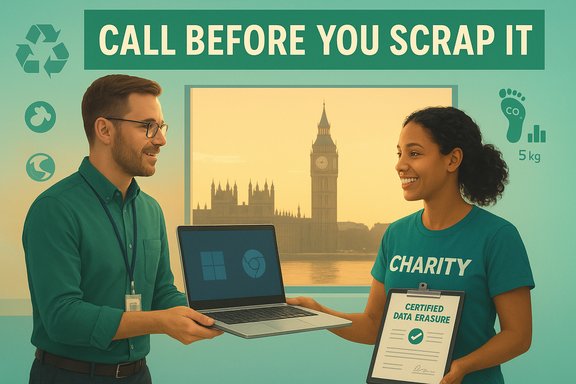
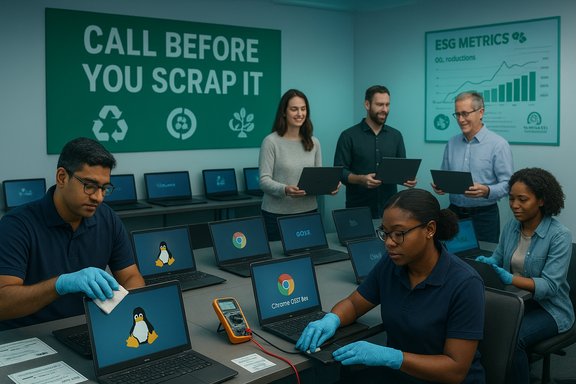
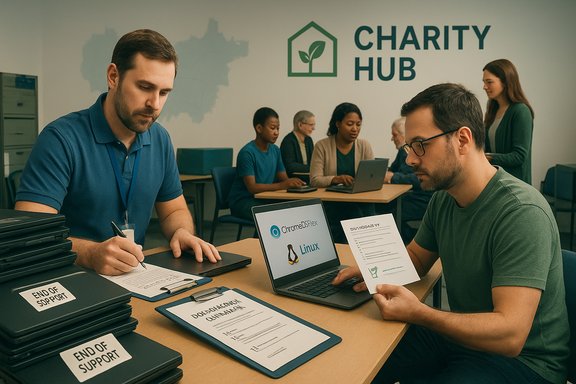
SocialBox.Biz’s new “Call Before You Scrap It” appeal is an emphatic push for companies—especially those in Westminster and central London—to stop defaulting to recycling and instead assess surplus Windows 10 machines and other corporate IT for reuse, secure refurbishment and redistribution to charities and vulnerable residents. The campaign is timed to the post‑Windows 10 support transition and the European Week for Waste Reduction, and promises measurable social value (devices for education, job search and connectivity), simple corporate reporting benefits, and tangible carbon‑savings claims—while raising practical questions about data security, compatibility and how environmental benefits are calculated.
The technical backdrop is unambiguous: Microsoft ended mainstream support for Windows 10 on October 14, 2025, closing the clock on routine security patches, feature updates and vendor technical assistance for the platform. Organisations and households now face three linked choices: upgrade eligible machines to Windows 11, buy time with limited Extended Security Updates (ESU), or retire machines—ideally by putting still‑serviceable hardware to new use. Market data in the weeks around the cutoff showed a large installed base of Windows 10 PCs. Independent analytics placed Windows 10 usage at roughly the 40–50% band of Windows installs during late‑2025, meaning millions of devices worldwide and across the UK remained on Windows 10 as the support deadline passed—an important supply pool for reuse programmes. These figures vary month‑to‑month by tracker and geographic filter, but they support the central proposition that a significant volume of corporate kit will be redundant for Windows 11 yet still perfectly usable for web‑centric tasks. SocialBox.Biz positions itself precisely at that intersection: intercept corporate refreshes, apply certified data‑erasure and basic repairs, reimage with lightweight or open‑source OS options where appropriate, and redistribute devices to vetted charities and beneficiaries in London. The organisation bundles logistics, impact reporting and marketing assets for donor companies—making reuse a low‑friction route to documented social value and scope‑3 emissions narratives.
Independent lifecycle studies show a wide range of manufacturing emissions per laptop:
Organisations preparing COP30‑era narratives or Europe‑wide EWWR activities can use a reuse programme to demonstrate local circularity commitments during awareness weeks (the EWWR runs from 22–30 November 2025 and focuses on WEEE that year), amplifying both environmental and social outcomes.
Recommended actions:
SocialBox.Biz’s “Call Before You Scrap It” is now an active invitation to Westminster‑area businesses and organisations across the UK to turn redundant Windows 10 laptops and surplus IT into measurable social impact—so long as donors pair good intentions with documented processes, robust data protections and transparent environmental accounting.
Source: Pressat Press Release SocialBox.Biz Calls on Companies to Re-use Windows 10 Laptops And Surplus IT with SocialBox.Biz in the City of Westminster and Beyond -- Even companies without access to items can still increase their social impact with SocialBoxBiz impact plans !
 Background / Overview
The technical backdrop is unambiguous: Microsoft ended mainstream support for Windows 10 on October 14, 2025, closing the clock on routine security patches, feature updates and vendor technical assistance for the platform. Organisations and households now face three linked choices: upgrade eligible machines to Windows 11, buy time with limited Extended Security Updates (ESU), or retire machines—ideally by putting still‑serviceable hardware to new use. Market data in the weeks around the cutoff showed a large installed base of Windows 10 PCs. Independent analytics placed Windows 10 usage at roughly the 40–50% band of Windows installs during late‑2025, meaning millions of devices worldwide and across the UK remained on Windows 10 as the support deadline passed—an important supply pool for reuse programmes. These figures vary month‑to‑month by tracker and geographic filter, but they support the central proposition that a significant volume of corporate kit will be redundant for Windows 11 yet still perfectly usable for web‑centric tasks. SocialBox.Biz positions itself precisely at that intersection: intercept corporate refreshes, apply certified data‑erasure and basic repairs, reimage with lightweight or open‑source OS options where appropriate, and redistribute devices to vetted charities and beneficiaries in London. The organisation bundles logistics, impact reporting and marketing assets for donor companies—making reuse a low‑friction route to documented social value and scope‑3 emissions narratives.What SocialBox.Biz is asking companies to do
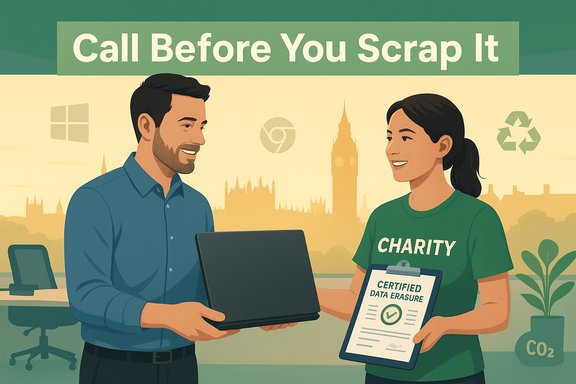
SocialBox.Biz’s core request is simple and operational: contact the organisation before consigning laptop fleets or surplus IT to recycling contractors. The practical steps they propose are:- Triage your estate to identify candidate devices (age, RAM, storage, battery health).
- Call SocialBox.Biz to arrange an assessment and, where appropriate, collection.
- Require certified data erasure and chain‑of‑custody documentation for any donated hardware.
- Match reimaged devices to partner charities (homeless projects, Age UK, education programmes) with basic onboarding and connectivity guidance.
Why reuse makes sense now: security, social and environmental logic
- Security: Post‑EOL Windows 10 installations progressively lose protection against new vulnerabilities. Continuing to operate unpatched endpoints increases risk for networked organisations and households. Repurposing eligible devices onto actively maintained OS channels (e.g., ChromeOS Flex or well‑supported Linux distributions) can restore a secure update path for web‑centric workloads.
- Social impact: There is a demonstrable need for hardware among people leaving homelessness, low‑income households and older adults. SocialBox.Biz highlights individual case stories—such as a beneficiary who could resume college studies after receiving a donated laptop—to illustrate impact at the beneficiary level. Documented beneficiary stories form the backbone of the organisation’s corporate reporting packs.
- Environmental logic: Extending device life delays embodied‑carbon costs associated with manufacturing new hardware. Reuse is a cornerstone of circular‑economy thinking: keeping functional devices in use typically reduces net lifecycle emissions compared with premature replacement and energy‑intensive recycling. SocialBox.Biz and its press materials quantify these benefits in headline metrics intended for corporate reporting.
Verifying the numbers — what stacks up and what needs caution
SocialBox.Biz public materials include headline environmental claims—for example, that donating 500 unwanted computers prevents roughly 155 tonnes of CO₂, equivalent (they say) to removing 60 cars from UK roads for a year and comparable to the annual absorption of around 6,460 mature trees. Those figures are attention‑grabbing and useful for narrative reporting, but they rest on per‑device embodied‑carbon assumptions that vary substantially between device models and LCA methodologies. The numbers require scrutiny before they’re used as formal scope‑3 offsets in corporate sustainability filings.Independent lifecycle studies show a wide range of manufacturing emissions per laptop:
- A detailed Fraunhofer IZM assessment of a contemporary modular laptop estimated cradle‑to‑gate GWP on the order of ~130–200 kg CO₂e per device in some model examples. That implies 500 devices would avoid roughly 65–100 tonnes CO₂e if each device’s embodied carbon were fully counted and avoided by reuse—significantly below the 155‑tonne headline but still material.
- Other industry and secondary sources commonly cite 200–300 kg CO₂e per laptop as pragmatic averages depending on screen size, battery capacity and manufacturing footprint; using those mid‑range figures produces avoided emissions that approach SocialBox.Biz’s communications. Because per‑device impacts vary by model, supplier and the scope of the LCA, the proper approach for corporate reporting is to declare the per‑device assumptions and methodology used and to treat numbers as estimates unless an independent LCA is provided.
Practical strengths of SocialBox.Biz’s model
- Local, measurable impact: Collecting and rehoming devices locally produces tangible beneficiary stories and measurable distribution metrics useful for CSR narratives. Westminster‑area case studies are already referenced.
- Low barrier for IT teams: SocialBox.Biz offers collection logistics, certified data‑erasure and templated impact packs (case studies, certificates) that shrink the governance burden for corporate donors. That reduces friction compared with ad hoc donation routes.
- Technical practicality: Many mid‑2010s machines cannot upgrade to Windows 11 because of TPM/CPU gating but are excellent candidates for lightweight, actively maintained OSes (ChromeOS Flex, Ubuntu, Zorin, Linux Mint). Those alternatives return a secure update channel for web‑first tasks and schooling.
- Environmental logic: Reuse delays embodied emissions and reduces e‑waste flow into energy‑intensive downstream processes, particularly important as Europe focuses the 2025 EWWR on WEEE. SocialBox.Biz’s timing to the EWWR magnifies practical visibility and participation opportunities.
Material risks and limitations—what donors must plan for
- Data‑protection obligations: The legal and reputational cost of inadequate erasure is real. Corporate donors must insist on verifiable ITAD certificates from refurbishers and should require chain‑of‑custody documentation for devices leaving their estate. SocialBox.Biz emphasises certified wiping, but donors should demand evidence and audit rights.
- Compatibility and user needs mismatch: ChromeOS Flex and Linux are excellent for web‑first use, but households that rely on Windows‑only educational or welfare apps may experience friction. A triage process matching recipient needs to device OS is essential.
- Hidden support costs: Charities and community partners will need capacity for onboarding, connectivity advice and potentially first‑line repairs. Donors should budget a modest support window or sponsor connectivity vouchers to ensure devices deliver ongoing value.
- Over‑claiming environmental benefits: As noted above, per‑device carbon‑savings depend on defensible LCA choices. Companies should avoid presenting an unverifiable tonnes‑saved figure in formal reporting without attaching the calculation methodology and sensitivity bounds. SocialBox.Biz provides impact packs—donors should request the underlying assumptions.
- Processing and downstream capacity: The UK’s specialist capacity to extract high‑value metals from complex WEEE (printed circuit boards and precious‑metal recovery) has historically been limited, and much of the country’s complex e‑scrap has been processed abroad or sent to specialist refineries in Europe. That structural reality underscores the logic of reuse before recycling, because local smelting and sophisticated recovery capacity remain constrained. The House of Commons has highlighted the UK’s limited capacity to recover certain high‑value components domestically and the reality of export and downstream treatment pathways.
A pragmatic playbook for IT teams who want to donate safely
- Inventory and classify: create a short spreadsheet of candidate devices (model, CPU generation, RAM, storage, battery health, TPM presence). This is the single most important step.
- Pilot with a small batch: test your refurbisher’s workflow on a representative set of models (boot, Wi‑Fi, camera, battery longevity) and validate installed OS images (ChromeOS Flex or chosen Linux distro).
- Require certified erasure: contractually insist on recognised erasure tools and an ITAD certificate issued for each batch. Don’t ship equipment without this.
- Align recipients to capabilities: match devices to likely tasks—web‑centric devices to learners and job‑seekers, larger screens for older users with visual needs, Windows‑capable machines retained for legacy app needs.
- Package support: include a user‑friendly first‑boot guide, a short contact for first‑line help, and where possible a connectivity voucher or signposting to social‑tariff broadband offers.
- Record and report transparently: request a documented impact pack that includes device counts, basic LCA assumptions used to estimate avoided emissions, erasure certificates and anonymised beneficiary outcomes. Use these in annual ESG disclosures—clearly noting methodologies.
Critical analysis: what makes SocialBox.Biz’s approach credible—and where it needs discipline
Strengths:- The model directly converts an IT refresh liability into a measurable community benefit and aligns neatly with corporate ESG narratives. The “Call Before You Scrap It” message is operational and easy for busy IT teams to remember.
- Local distribution paired with onboarding maximises the probability that devices become long‑term assets rather than short‑lived burdens. Case stories cited by SocialBox.Biz (e.g., beneficiaries moving into education) demonstrate plausible, verifiable outcomes at scale when paired with support.
- The environmental case for reuse is robust in principle: manufacturing dominates laptops’ lifecycle carbon in most LCAs, so extending useful life is an effective emissions‑avoidance strategy. Several independent LCAs and industry analyses corroborate that manufacturing emissions per device are non‑trivial and that reuse materially reduces per‑year carbon intensity.
- Data security must be demonstrably airtight. The reputational damage of inadequate wiping would outweigh the CSR benefit; donors must insist on industry‑standard erasure certificates and audit rights.
- Environmental accounting must be transparent. Companies should only claim scope‑3 reductions tied to device donation if the methodology is explicit, conservative and defensible—preferably with independent verification or accepted LCA inputs. Avoid using headline figures without footnoted methodology.
- Matching devices to needs and providing connectivity/support are non‑negotiable for long‑term impact. A laptop without broadband or basic skills training is a brittle intervention. Corporate partners should budget for modest onboarding or partner with local libraries and charities for training.
How SocialBox.Biz positions donations for corporate reporting and COP30 readiness
SocialBox.Biz offers tailored impact plans and marketing assets designed to feed into CSR and sustainability reporting—attested erasure certificates, beneficiary case studies, simple carbon‑savings calculations and storytelling materials for annual reports. For companies tracking scope‑3 procurement emissions, reusing depreciated assets via a documented refurbisher pipeline can be part of a narrative on avoided emissions—so long as the calculation method is transparent. SocialBox.Biz points donors to these reporting materials as a core service.Organisations preparing COP30‑era narratives or Europe‑wide EWWR activities can use a reuse programme to demonstrate local circularity commitments during awareness weeks (the EWWR runs from 22–30 November 2025 and focuses on WEEE that year), amplifying both environmental and social outcomes.
Final verdict and recommended next steps for IT decision‑makers
SocialBox.Biz’s “Call Before You Scrap It” campaign is a timely, operationally credible proposition: it intercepts a real stream of potentially reusable Windows 10 devices created by Microsoft’s end‑of‑support milestone and channels them into local social value pipelines. The idea is technically and morally sensible—provided donors implement robust safeguards for data protection, realistic triage for hardware suitability, and modest support budgets for connectivity and onboarding.Recommended actions:
- Catalogue and triage your Windows 10 estate this quarter. Identify clear reuse candidates and legacy systems that must remain Windows‑native.
- Pilot a small donation with a trusted refurbisher—request erasure certificates, a hardware test report and an impact pack. Treat the pilot as an operational proof‑point before scaling.
- Insist on transparent carbon calculation methods if you plan to count donations toward scope‑3 claims. Prefer conservative, independently verifiable LCA inputs and avoid headline tonnes without a methodology annex.
- Pair donations with connectivity or training funding to ensure sustained use and measurable social outcomes.
SocialBox.Biz’s “Call Before You Scrap It” is now an active invitation to Westminster‑area businesses and organisations across the UK to turn redundant Windows 10 laptops and surplus IT into measurable social impact—so long as donors pair good intentions with documented processes, robust data protections and transparent environmental accounting.
Source: Pressat Press Release SocialBox.Biz Calls on Companies to Re-use Windows 10 Laptops And Surplus IT with SocialBox.Biz in the City of Westminster and Beyond -- Even companies without access to items can still increase their social impact with SocialBoxBiz impact plans !