Call Before You Scrap It: Reusing Windows 10 PCs for Local Social Benefit

  • Thread Author
SocialBox.Biz’s new “Call Before You Scrap It” appeal is an emphatic push for companies—especially those in Westminster and central London—to stop defaulting to recycling and instead assess surplus Windows 10 machines and other corporate IT for reuse, secure refurbishment and redistribution to charities and vulnerable residents. The campaign is timed to the post‑Windows 10 support transition and the European Week for Waste Reduction, and promises measurable social value (devices for education, job search and connectivity), simple corporate reporting benefits, and tangible carbon‑savings claims—while raising practical questions about data security, compatibility and how environmental benefits are calculated.

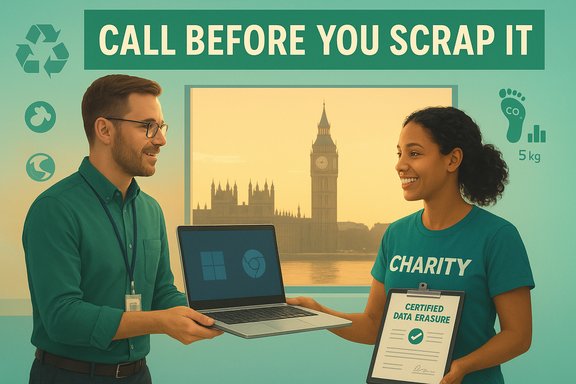
Two people discuss data erasure for charity, with a laptop and clipboard, under a “Call Before You Scrap It” banner.Background / Overview​

The technical backdrop is unambiguous: Microsoft ended mainstream support for Windows 10 on October 14, 2025, closing the clock on routine security patches, feature updates and vendor technical assistance for the platform. Organisations and households now face three linked choices: upgrade eligible machines to Windows 11, buy time with limited Extended Security Updates (ESU), or retire machines—ideally by putting still‑serviceable hardware to new use. Market data in the weeks around the cutoff showed a large installed base of Windows 10 PCs. Independent analytics placed Windows 10 usage at roughly the 40–50% band of Windows installs during late‑2025, meaning millions of devices worldwide and across the UK remained on Windows 10 as the support deadline passed—an important supply pool for reuse programmes. These figures vary month‑to‑month by tracker and geographic filter, but they support the central proposition that a significant volume of corporate kit will be redundant for Windows 11 yet still perfectly usable for web‑centric tasks. SocialBox.Biz positions itself precisely at that intersection: intercept corporate refreshes, apply certified data‑erasure and basic repairs, reimage with lightweight or open‑source OS options where appropriate, and redistribute devices to vetted charities and beneficiaries in London. The organisation bundles logistics, impact reporting and marketing assets for donor companies—making reuse a low‑friction route to documented social value and scope‑3 emissions narratives.

What SocialBox.Biz is asking companies to do​

SocialBox.Biz’s core request is simple and operational: contact the organisation before consigning laptop fleets or surplus IT to recycling contractors. The practical steps they propose are:
  • Triage your estate to identify candidate devices (age, RAM, storage, battery health).
  • Call SocialBox.Biz to arrange an assessment and, where appropriate, collection.
  • Require certified data erasure and chain‑of‑custody documentation for any donated hardware.
  • Match reimaged devices to partner charities (homeless projects, Age UK, education programmes) with basic onboarding and connectivity guidance.
The organisation stresses a local redistribution model—collect in Westminster and neighbouring boroughs, then rehome machines to local beneficiaries—arguing that local reuse reduces transport emissions and maximises social return. Westminster City Council is among the public bodies noting the initiative, which reinforces the local partnership angle.

Why reuse makes sense now: security, social and environmental logic​

  • Security: Post‑EOL Windows 10 installations progressively lose protection against new vulnerabilities. Continuing to operate unpatched endpoints increases risk for networked organisations and households. Repurposing eligible devices onto actively maintained OS channels (e.g., ChromeOS Flex or well‑supported Linux distributions) can restore a secure update path for web‑centric workloads.
  • Social impact: There is a demonstrable need for hardware among people leaving homelessness, low‑income households and older adults. SocialBox.Biz highlights individual case stories—such as a beneficiary who could resume college studies after receiving a donated laptop—to illustrate impact at the beneficiary level. Documented beneficiary stories form the backbone of the organisation’s corporate reporting packs.
  • Environmental logic: Extending device life delays embodied‑carbon costs associated with manufacturing new hardware. Reuse is a cornerstone of circular‑economy thinking: keeping functional devices in use typically reduces net lifecycle emissions compared with premature replacement and energy‑intensive recycling. SocialBox.Biz and its press materials quantify these benefits in headline metrics intended for corporate reporting.

Verifying the numbers — what stacks up and what needs caution​

SocialBox.Biz public materials include headline environmental claims—for example, that donating 500 unwanted computers prevents roughly 155 tonnes of CO₂, equivalent (they say) to removing 60 cars from UK roads for a year and comparable to the annual absorption of around 6,460 mature trees. Those figures are attention‑grabbing and useful for narrative reporting, but they rest on per‑device embodied‑carbon assumptions that vary substantially between device models and LCA methodologies. The numbers require scrutiny before they’re used as formal scope‑3 offsets in corporate sustainability filings.
Independent lifecycle studies show a wide range of manufacturing emissions per laptop:
  • A detailed Fraunhofer IZM assessment of a contemporary modular laptop estimated cradle‑to‑gate GWP on the order of ~130–200 kg CO₂e per device in some model examples. That implies 500 devices would avoid roughly 65–100 tonnes CO₂e if each device’s embodied carbon were fully counted and avoided by reuse—significantly below the 155‑tonne headline but still material.
  • Other industry and secondary sources commonly cite 200–300 kg CO₂e per laptop as pragmatic averages depending on screen size, battery capacity and manufacturing footprint; using those mid‑range figures produces avoided emissions that approach SocialBox.Biz’s communications. Because per‑device impacts vary by model, supplier and the scope of the LCA, the proper approach for corporate reporting is to declare the per‑device assumptions and methodology used and to treat numbers as estimates unless an independent LCA is provided.
In short: reuse does save carbon versus premature replacement in almost all credible LCAs, but the precise tonnes saved per donated device hinge on the baseline assumptions (which product types would have been bought instead, what recycling credits are claimed, and how remaining use/lifetime extension is modelled). Organisations should ask refurbishers for the calculation method and supporting LCA inputs before counting donations as scope‑3 reductions.

Practical strengths of SocialBox.Biz’s model​

  • Local, measurable impact: Collecting and rehoming devices locally produces tangible beneficiary stories and measurable distribution metrics useful for CSR narratives. Westminster‑area case studies are already referenced.
  • Low barrier for IT teams: SocialBox.Biz offers collection logistics, certified data‑erasure and templated impact packs (case studies, certificates) that shrink the governance burden for corporate donors. That reduces friction compared with ad hoc donation routes.
  • Technical practicality: Many mid‑2010s machines cannot upgrade to Windows 11 because of TPM/CPU gating but are excellent candidates for lightweight, actively maintained OSes (ChromeOS Flex, Ubuntu, Zorin, Linux Mint). Those alternatives return a secure update channel for web‑first tasks and schooling.
  • Environmental logic: Reuse delays embodied emissions and reduces e‑waste flow into energy‑intensive downstream processes, particularly important as Europe focuses the 2025 EWWR on WEEE. SocialBox.Biz’s timing to the EWWR magnifies practical visibility and participation opportunities.

Material risks and limitations—what donors must plan for​

  • Data‑protection obligations: The legal and reputational cost of inadequate erasure is real. Corporate donors must insist on verifiable ITAD certificates from refurbishers and should require chain‑of‑custody documentation for devices leaving their estate. SocialBox.Biz emphasises certified wiping, but donors should demand evidence and audit rights.
  • Compatibility and user needs mismatch: ChromeOS Flex and Linux are excellent for web‑first use, but households that rely on Windows‑only educational or welfare apps may experience friction. A triage process matching recipient needs to device OS is essential.
  • Hidden support costs: Charities and community partners will need capacity for onboarding, connectivity advice and potentially first‑line repairs. Donors should budget a modest support window or sponsor connectivity vouchers to ensure devices deliver ongoing value.
  • Over‑claiming environmental benefits: As noted above, per‑device carbon‑savings depend on defensible LCA choices. Companies should avoid presenting an unverifiable tonnes‑saved figure in formal reporting without attaching the calculation methodology and sensitivity bounds. SocialBox.Biz provides impact packs—donors should request the underlying assumptions.
  • Processing and downstream capacity: The UK’s specialist capacity to extract high‑value metals from complex WEEE (printed circuit boards and precious‑metal recovery) has historically been limited, and much of the country’s complex e‑scrap has been processed abroad or sent to specialist refineries in Europe. That structural reality underscores the logic of reuse before recycling, because local smelting and sophisticated recovery capacity remain constrained. The House of Commons has highlighted the UK’s limited capacity to recover certain high‑value components domestically and the reality of export and downstream treatment pathways.

A pragmatic playbook for IT teams who want to donate safely​

  • Inventory and classify: create a short spreadsheet of candidate devices (model, CPU generation, RAM, storage, battery health, TPM presence). This is the single most important step.
  • Pilot with a small batch: test your refurbisher’s workflow on a representative set of models (boot, Wi‑Fi, camera, battery longevity) and validate installed OS images (ChromeOS Flex or chosen Linux distro).
  • Require certified erasure: contractually insist on recognised erasure tools and an ITAD certificate issued for each batch. Don’t ship equipment without this.
  • Align recipients to capabilities: match devices to likely tasks—web‑centric devices to learners and job‑seekers, larger screens for older users with visual needs, Windows‑capable machines retained for legacy app needs.
  • Package support: include a user‑friendly first‑boot guide, a short contact for first‑line help, and where possible a connectivity voucher or signposting to social‑tariff broadband offers.
  • Record and report transparently: request a documented impact pack that includes device counts, basic LCA assumptions used to estimate avoided emissions, erasure certificates and anonymised beneficiary outcomes. Use these in annual ESG disclosures—clearly noting methodologies.

Critical analysis: what makes SocialBox.Biz’s approach credible—and where it needs discipline​

Strengths:
  • The model directly converts an IT refresh liability into a measurable community benefit and aligns neatly with corporate ESG narratives. The “Call Before You Scrap It” message is operational and easy for busy IT teams to remember.
  • Local distribution paired with onboarding maximises the probability that devices become long‑term assets rather than short‑lived burdens. Case stories cited by SocialBox.Biz (e.g., beneficiaries moving into education) demonstrate plausible, verifiable outcomes at scale when paired with support.
  • The environmental case for reuse is robust in principle: manufacturing dominates laptops’ lifecycle carbon in most LCAs, so extending useful life is an effective emissions‑avoidance strategy. Several independent LCAs and industry analyses corroborate that manufacturing emissions per device are non‑trivial and that reuse materially reduces per‑year carbon intensity.
Risks / points requiring discipline:
  • Data security must be demonstrably airtight. The reputational damage of inadequate wiping would outweigh the CSR benefit; donors must insist on industry‑standard erasure certificates and audit rights.
  • Environmental accounting must be transparent. Companies should only claim scope‑3 reductions tied to device donation if the methodology is explicit, conservative and defensible—preferably with independent verification or accepted LCA inputs. Avoid using headline figures without footnoted methodology.
  • Matching devices to needs and providing connectivity/support are non‑negotiable for long‑term impact. A laptop without broadband or basic skills training is a brittle intervention. Corporate partners should budget for modest onboarding or partner with local libraries and charities for training.

How SocialBox.Biz positions donations for corporate reporting and COP30 readiness​

SocialBox.Biz offers tailored impact plans and marketing assets designed to feed into CSR and sustainability reporting—attested erasure certificates, beneficiary case studies, simple carbon‑savings calculations and storytelling materials for annual reports. For companies tracking scope‑3 procurement emissions, reusing depreciated assets via a documented refurbisher pipeline can be part of a narrative on avoided emissions—so long as the calculation method is transparent. SocialBox.Biz points donors to these reporting materials as a core service.
Organisations preparing COP30‑era narratives or Europe‑wide EWWR activities can use a reuse programme to demonstrate local circularity commitments during awareness weeks (the EWWR runs from 22–30 November 2025 and focuses on WEEE that year), amplifying both environmental and social outcomes.

Final verdict and recommended next steps for IT decision‑makers​

SocialBox.Biz’s “Call Before You Scrap It” campaign is a timely, operationally credible proposition: it intercepts a real stream of potentially reusable Windows 10 devices created by Microsoft’s end‑of‑support milestone and channels them into local social value pipelines. The idea is technically and morally sensible—provided donors implement robust safeguards for data protection, realistic triage for hardware suitability, and modest support budgets for connectivity and onboarding.
Recommended actions:
  • Catalogue and triage your Windows 10 estate this quarter. Identify clear reuse candidates and legacy systems that must remain Windows‑native.
  • Pilot a small donation with a trusted refurbisher—request erasure certificates, a hardware test report and an impact pack. Treat the pilot as an operational proof‑point before scaling.
  • Insist on transparent carbon calculation methods if you plan to count donations toward scope‑3 claims. Prefer conservative, independently verifiable LCA inputs and avoid headline tonnes without a methodology annex.
  • Pair donations with connectivity or training funding to ensure sustained use and measurable social outcomes.
The post‑Windows‑10 moment presented a choice: mass disposal or creative reuse. SocialBox.Biz’s campaign offers a disciplined pathway that can reduce waste, lower procurement‑driven emissions and deliver tangible social good—if corporate donors treat the programme as the formal operational project it needs to be, not a last‑minute PR tickbox.

SocialBox.Biz’s “Call Before You Scrap It” is now an active invitation to Westminster‑area businesses and organisations across the UK to turn redundant Windows 10 laptops and surplus IT into measurable social impact—so long as donors pair good intentions with documented processes, robust data protections and transparent environmental accounting.

Source: Pressat Press Release SocialBox.Biz Calls on Companies to Re-use Windows 10 Laptops And Surplus IT with SocialBox.Biz in the City of Westminster and Beyond -- Even companies without access to items can still increase their social impact with SocialBoxBiz impact plans !

 

Attachments

  • windowsforum-call-before-you-scrap-it-reusing-windows-10-pcs-for-local-social-benefit.webp
    windowsforum-call-before-you-scrap-it-reusing-windows-10-pcs-for-local-social-benefit.webp
    2.1 MB · Views: 0
A new corporate campaign is asking companies to pause and rethink before consigning perfectly usable Windows 10 laptops and other surplus IT to recycling bins, landfill queues or anonymous e‑waste chains — and it arrives at a critical moment as millions of Windows 10 machines remain in service worldwide even after the operating system reached its end of vendor support. SocialBox.Biz’s “Call Before You Scrap It” drive positions reuse as a practical climate action and social inclusion program: corporate partners get tailored impact plans and reporting, charities receive refurbished devices loaded with open‑source software, and disadvantaged people gain access to technology that can be decisive for education, jobs and daily connection.

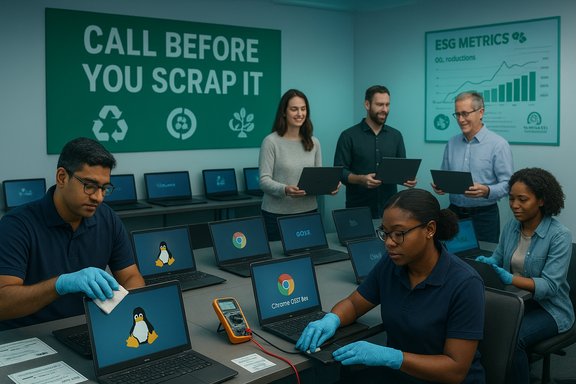
Tech workers refurbish laptops in a recycling lab, each screen showing the Linux penguin.Background / Overview​

Windows 10 reached the scheduled end of mainstream support, a milestone which changes how organisations should think about the lifecycle of older PCs and laptops. Industry surveys and platform telemetry gathered in the run‑up to the support cutoff showed a large installed base of devices still running Windows 10; independent datasets compiled from large samples reported that more than four in ten endpoints were still on Windows 10 in the months before the cutoff. Those numbers matter because the combination of widespread Windows 10 use and rising cyber risk makes safe, cost‑effective migration strategies — including reuse, refurbishment and alternative operating systems — a practical necessity for many organisations.
At the same time, the technological reason many devices were excluded from a straightforward Windows 11 upgrade is well established: Windows 11 enforces tighter hardware prerequisites (TPM 2.0 support, UEFI/Secure Boot and a limited processor compatibility list), leaving a large class of otherwise serviceable hardware unable to receive a Microsoft‑supported upgrade. The result is a compelling operational and environmental question: when enterprise IT refreshes arrive, what should be done with still‑working Windows 10 laptops that lack the hardware to run Windows 11?
SocialBox.Biz answers that question with a reuse‑first approach. Rather than sending functional devices into energy‑intensive recycling or export flows, the organisation refurbishes items, installs open‑source operating systems where appropriate, verifies data sanitisation and distributes the equipment to charities and community partners across London and the wider UK. In parallel, SocialBox.Biz sells an outcome many corporates need: verifiable impact metrics and storytelling assets for ESG and CSR reporting, plus practical Scope 3 emissions reductions achieved by avoiding the carbon cost of replacing devices with newly manufactured units.

Why this matters now: security, economics and the circular imperative​

The security and compliance angle​

When an operating system reaches end of vendor support, routine security patches and quality updates stop. For organisations that care about predictable risk exposure, leaving large numbers of unmanaged, unsupported endpoints on their networks is a liability. Where budgets or hardware constraints prevent a mass hardware refresh to Windows 11, three practical options appear:
  • Purchase extended security update (ESU) coverage where available.
  • Migrate devices to supported alternative OSes (Linux distributions, ChromeOS Flex).
  • Reassess the device’s role and, where suitable, move it out of the corporate domain and into secure, audited reuse channels.
The reuse option must be handled with documented data‑sanitisation and chain‑of‑custody controls. Certified data erasure, ADISA/R2/NIST‑aligned processes and traceable certificates reduce legal exposure under data‑protection frameworks such as the UK GDPR. SocialBox.Biz’s model — which includes secure wiping and open‑source OS installs — addresses many of these operational concerns while converting otherwise stranded assets into social value.

The economic reality​

Replacing hundreds or thousands of endpoints is expensive. For many mid‑sized organisations the balance sheet and procurement cycles make a phased approach inevitable. Reuse and refurbishment programmes can offset replacement costs while delivering social value and verified emissions reductions that count in suppliers’ and customers’ sustainability narratives. Corporate teams that incorporate reuse before recycling can convert an IT refresh into a measurable impact programme without incurring the full capital cost of buying only new devices.

The carbon imperative​

A growing body of industry research and independent analyses shows that the manufacture of a new laptop carries a significant carbon and resource footprint. Reuse or remanufacturing of a device commonly prevents several hundred kilograms of CO₂ emissions compared to buying new. SocialBox.Biz’s headline figure — that donating 500 functioning computers can prevent roughly 155 tonnes of CO₂e — is consistent with industry benchmarks that place the avoided emissions from redeploying or remanufacturing a laptop at around 300–320 kg CO₂e per unit. Put simply, diverting even modest volumes of devices from new‑build replacements yields measurable Scope 3 reductions for corporate sponsors.

SocialBox.Biz’s “Call Before You Scrap It” campaign: the promise and the process​

What the campaign asks organisations to do​

SocialBox.Biz urges companies to contact the charity before disposing of surplus IT hardware so the organisation can:
  • Triage equipment for reuse potential.
  • Securely collect devices and verify what can be salvaged and refurbished.
  • Install open‑source operating systems where commercial licenses are impractical.
  • Deliver refurbished devices through established charity partners to people in need.
  • Provide donors with tailored impact plans, case studies and reporting materials suitable for annual ESG disclosures.
The pitch is designed to slot into existing IT asset disposition (ITAD) workflows: call SocialBox.Biz first, assess items, accept verified reuse where possible, then only recycle or destroy hardware that’s irreparably damaged or contains non‑removable hazardous components.

Typical device flows and the open‑source option​

SocialBox.Biz typically handles:
  • Laptops and MacBooks that remain functionally sound but cannot run Windows 11.
  • iPhones and iPads where reuse makes sense in charity or training settings.
  • Chromebooks and larger‑screen MacBooks that are in demand for accessibility reasons.
Where commercial Windows licensing is impractical or undesirable, refurbished machines are identified for Linux distributions or ChromeOS Flex installations; both options reduce license costs and offer a usable, secure environment for recipients. Using open‑source software also eliminates the need for corporate licence transfers, simplifying the compliance side of donations.

Partnership model and beneficiary outcomes​

The organisation works with frontline charities, shelters and inclusion projects to place devices into contexts where they will support education, job search, remote care and social reconnection. Public stories — for example of beneficiaries who accessed training or returned to education because they received a refurbished machine — illustrate the social impact model. SocialBox.Biz also prepares documented impact reports and marketing collateral corporates can use in CSR or annual reports.

Verifying the key claims: what checks were made​

  • Windows 10 end of support: the vendor‑published lifecycle for Windows 10 stipulated an end to mainstream security patching on the scheduled EoL date. This creates the real operational drivers behind reuse campaigns.
  • Installed base size: independent telemetry analyses from large support platforms and industry press coverage in the weeks preceding the EoL showed over 40% of endpoints in sampled populations still running Windows 10. That scale supports SocialBox.Biz’s argument that many viable devices will free up during business refresh cycles.
  • CO₂ avoided per reused laptop: sector studies and remanufacturing vendors commonly cite a figure in the order of 300–320 kg CO₂e avoided per reused/remanufactured laptop; SocialBox.Biz’s arithmetic (500 devices ≈ 155 tonnes CO₂e avoided) is consistent with those per‑device estimates and with how widely‑used equivalence metrics (cars removed from the road, trees grown) are calculated.
  • European Week for Waste Reduction: the campaign period for e‑waste awareness and reuse programmes is widely recognised and falls in late November, making the timing of SocialBox.Biz’s appeal logical for organisations planning year‑end sustainability reporting.
Where direct third‑party confirmation of some personal anecdotes (for example an individual beneficiary named in a single press snapshot) could not be independently located in public records, those items are reported as claims from the campaign’s communications and flagged as such.

The strengths of the reuse approach​

  • Immediate Scope 3 reductions: Reuse directly avoids the carbon intensity of manufacturing a new device and the emissions associated with transcontinental logistics for new hardware.
  • Tangible social impact: Disadvantaged people receive usable devices that enable job searches, education and health‑related communications.
  • Cost efficiency for donors: Where equipment is functional, donating can be cheaper and faster than full redeployment, inventory transfer or complex resale processes.
  • Narrative and reporting value: Verified impact plans and certificates give corporate sustainability teams measurable outputs to include in ESG disclosures.
  • Circular economy alignment: The approach keeps materials in use and reduces the pressure on raw material extraction and energy‑intensive recycling.

Real risks and governance challenges — what to watch for​

1. Data protection and legal exposure​

Donating used corporate hardware without robust erasure, audit trails and certified destruction for non‑reusable drives is a major risk. Organisations must insist on verifiable data‑sanitisation certificates, serial‑number level asset tracking and a clear chain‑of‑custody. Any reuse partner must be able to demonstrate accredited wiping tools or physically destroy storage media that cannot be securely sanitised.
Best practice features to demand:
  • Certificates for each batch and, where possible, per‑serial number audits.
  • Wiping standards conformant with recognised guidelines (NIST 800‑88 / ADISA / ISO‑aligned tools).
  • On‑site or secure transfer options to avoid uncertain third‑party handling.

2. Licence and software compliance​

Where donated devices ship with installed commercial software, licensing needs to be verified. Social‑use scenarios often avoid this problem by installing open‑source distributions or ChromeOS Flex, but donors should confirm the destination OS and the licensing model to prevent accidental non‑compliance.

3. Quality control and user support​

Refurbished devices must be fit for the recipients’ needs. Poor battery life, failing hardware or insufficient RAM will rapidly limit usefulness. Organisations that accept donations like SocialBox.Biz must have robust testing, battery replacement strategies and realistic grading to ensure recipients receive durable equipment.

4. Reputation and greenwashing risk​

Communications around Scope 3 reductions and carbon equivalences must be measured and auditable. Vague or inflated claims can attract media and stakeholder scrutiny. Donor companies should ensure that impact claims are tied to verifiable metrics and that reporting aligns with recognised frameworks and internal audit processes.

5. Logistics, capacity and end‑of‑life downstream​

Refurbishment capacity can be a bottleneck during mass IT refreshes. Corporates should plan timing to avoid seasonal surges and confirm that non‑reusable components will be processed through certified recyclers with transparent downstream flows.

How companies should evaluate reuse partners and make operational decisions​

  • Audit internal inventory and identify devices suitable for reuse (functioning hardware, battery condition, screen and keyboard integrity).
  • Require a full service level agreement (SLA) from any reuse partner covering secure collection, certified wiping, refurbishment standards, final disposition and reporting.
  • Insist on traceable documentation: serial‑number manifest, sanitisation certificates, recipient reporting and environmental metrics.
  • Align an internal communications plan: factual, transparent impact statements with caveats; include the number of devices donated, the partner charities, and clear metrics about CO₂ avoided and beneficiaries served.
  • Integrate reuse into procurement and replacement cycles to ensure predictable volumes and to avoid ad‑hoc disposal that overloads refurbishers.
  • Where devices cannot be reused, ensure end‑of‑life components are recycled by R2/ISO‑certified operators with transparent downstream accountability.

Practical benefits and a small set of common objections answered​

  • Objection: “We cannot release devices because of data risk.”
  • Response: Certified wiping and physical destruction for non‑sanitisable media are industry standard. Demand certificates and chain‑of‑custody at handover.
  • Objection: “These laptops can’t run Windows 11 and are therefore worthless.”
  • Response: Many devices still have useful life for education, web access and basic productivity when supplied with Linux or ChromeOS Flex; the functional utility for beneficiaries is often high.
  • Objection: “Reuse is just a PR stunt.”
  • Response: When backed by auditable impact plans, serialised reporting and realistic CO₂ accounting, reuse delivers measurable environmental and social outcomes — not marketing spin.

Strategic considerations for IT and sustainability teams​

  • Treat IT asset reuse as a cross‑functional initiative encompassing Procurement, Legal, Security, Facilities and CSR teams. Success depends on integrated workflows.
  • Add reuse checks into procurement contracts with disposal vendors: a “call before you scrap” clause ensures reuse is considered before recycling is mandated.
  • Build a vendor scorecard for reuse partners covering data security, refurbishment standards, policy alignment, CO₂ methodology and auditability.
  • Consider sponsoring impact plans (training slots, tech labs, or certification vouchers) in addition to donating hardware — this increases the long‑term value of each device for recipients.

Where to be cautious and what remains unverifiable​

  • Personal anecdotes cited by campaign materials (individual beneficiary names and single case histories) are powerful but not always independently verifiable in public records. Treat such stories as illustrative rather than proof of systemic outcomes unless accompanied by documented case studies with partner charities.
  • Some operational claims — for example, the statement that the UK has “no dedicated IT smelters” — require context. The UK has extensive metal recycling but the global smelting and precious‑metal recovery infrastructure for printed‑circuit boards and e‑waste is complex and often cross‑border; therefore such assertions should be qualified and confirmed against specific waste‑processing and metallurgical capacity audits if used in regulatory reporting.
  • Carbon equivalence statements (cars removed from the road, trees planted/required to offset emissions) depend on the per‑unit assumptions used for vehicle emissions and tree sequestration rates. SocialBox.Biz’s headline comparisons align with commonly used industry factors (roughly 300–320 kg CO₂e saved per refurbished laptop; typical annual car emissions averages and per‑tree annual sequestration figures used in public sector reports), but corporates should reproduce the math with their preferred conversion factors when claiming precise equivalences.

The bottom line: a pragmatic call for “reuse before recycle”​

SocialBox.Biz’s campaign combines a simple technical reality — many corporate Windows 10 machines remain serviceable but cannot be upgraded to Windows 11 — with an operationally attractive offer: let us assess and repurpose what’s still useful, and give you verifiable impact that helps meet Scope 3 reduction goals and social inclusion objectives. For companies facing the twin pressures of cybersecurity and sustainability reporting, a structured reuse programme is a pragmatic complement to hardware refresh budgets and recycling contracts.
The approach is not risk‑free, and the governance bar must be high: certified data erasure, careful device grading, robust downstream recycling for irreparable components and transparent reporting are minimum requirements. But when those safeguards are in place, reuse yields measurable social benefit, credible carbon savings and a defensible narrative for stakeholders that want concrete action rather than rhetoric.

Action checklist for corporate decision makers​

  • Inventory and triage: identify volumes and categories of surplus hardware from your next refresh cycle.
  • Verify candidate partners: request ADISA/NIST/Blancco certificates, refurbishment standards, warranty terms and chain‑of‑custody reports.
  • Confirm legal safeguards: ensure data‑protection clauses, indemnities and audit rights are in place.
  • Request an impact plan: get a template showing how your donated volume maps to CO₂e avoided, beneficiary numbers and case study opportunities.
  • Time the programme: align collections with European Week for Waste Reduction and year‑end reporting windows to maximise publicity value and reporting clarity.
  • Document everything: retain serial manifests, sanitisation certificates, distribution logs and impact reports for auditors and stakeholders.

SocialBox.Biz’s “Call Before You Scrap It” is a concrete example of how an organisation can turn an IT refresh problem into an opportunity to reduce emissions, meet stakeholder expectations and deliver social value. The case for reuse is supported by established remanufacturing science on per‑device carbon avoidance, telemetry that shows a sizable Windows 10 installed base, and the operational reality that many devices can be usefully repurposed with open‑source software. For organisations preparing to refresh fleets or finalise year‑end sustainability narratives, reuse before recycling is a practical, measurable step that aligns environmental responsibility with inclusion — provided the partnership is built on rigorous data‑sanitisation, transparent reporting and realistic, auditable impact claims.

Source: BusinessMole “SocialBox.Biz Urges Companies to Repurpose Windows 10 Laptops and Excess IT in Westminster and Beyond, Offering Impact Plans for Those Without Access to Items”
 

SocialBox.Biz’s “Call Before You Scrap It” appeal lands at a practical crossroads: as Microsoft’s support for Windows 10 ends and large corporate refresh cycles roll through office parks, a tranche of still‑useful laptops and desktops is becoming available — and a London social enterprise is asking companies to pause before they recycle, offer devices for secure refurbishment, and route them into local social‑impact pipelines instead.

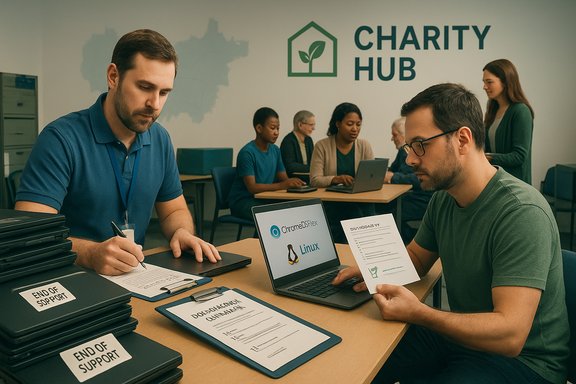
Volunteers at a Charity Hub work on laptops and paperwork.Background / Overview​

Microsoft formally ended mainstream support for Windows 10 on October 14, 2025, a watershed moment that changes the security and lifecycle calculus for millions of endpoints worldwide. After that date Microsoft stopped routine security and feature updates for Windows 10; organisations can opt to upgrade to Windows 11 where hardware permits, enrol eligible devices in short‑term Extended Security Updates (ESU), or retire affected kit. The decision to stop mainstream patching has practical knock‑on effects. Windows 11 enforces hardware gates (UEFI Secure Boot, TPM 2.0, a supported CPU family and minimum storage/RAM) that make many mid‑2010s machines ineligible for in‑place upgrades — precisely the class of devices refurbishers can most easily repurpose for web‑centric tasks. That hardware gating helps explain the supply of candidate devices SocialBox.Biz wants to intercept. SocialBox.Biz packages a proposition that is simple on its face: ask companies to contact the organisation before consigning Windows 10 laptops and surplus IT to recyclers, let SocialBox.Biz triage, securely wipe and refurbish suitable machines, reimage with lightweight or open‑source operating systems when Windows licensing or hardware compatibility is an obstacle, and then rehome devices to vetted charities and vulnerable beneficiaries in and around Westminster. The campaign is positioned as both an environmental and social intervention: lower e‑waste and embodied carbon, while increasing access to devices for education, job search and social services.

Why this matters now​

Security and operational risk​

  • When vendor patching stops, risk increases for internet‑exposed endpoints. Organisations that leave unsupported Windows 10 machines on internal networks accept growing exposure to newly discovered vulnerabilities. ESU exists as a time‑boxed bridge for some users, but it is not a long‑term fix and has limited enrolment rules.
  • For many corporate fleets the practical upgrade path is blocked by Windows 11 hardware prerequisites: TPM 2.0 and UEFI Secure Boot are treated as non‑negotiable requirements for a supported Windows 11 environment, which leaves a predictable supply of otherwise serviceable machines for reuse programmes.

Environmental and circular‑economy logic​

  • Manufacturing a new laptop carries a significant embodied carbon footprint. Independent LCAs and industry remanufacturing practitioners commonly place the manufacturing and cradle‑to‑gate emissions for laptops in the low‑to‑mid hundreds of kilograms of CO₂e per device; extending device life or repurposing hardware therefore produces measurable avoided emissions versus immediate replacement. Specific per‑device figures vary by model and LCA boundaries, but reuse is almost always better than premature replacement on GWP grounds.
  • SocialBox.Biz’s headline example — that donating 500 functional laptops can avoid roughly 155 tonnes CO₂e — sits within the mid‑range of industry practice when using per‑device avoided emissions in the 300–320 kg CO₂e band. That arithmetic is persuasive for storytelling, but the methodology matters: corporate teams should insist on the underlying LCA assumptions before counting donations against formal Scope‑3 inventories.

Social inclusion​

  • Digital exclusion remains acute: households leaving homelessness, low‑income families and older adults often lack suitable devices. Refurbished devices configured for web‑centric tasks can deliver immediate, measurable outcomes — helping beneficiaries apply for jobs, study, access health and housing services, or remain connected to family. SocialBox.Biz emphasises local placement with established charities to increase the likelihood of sustained use and impact.

The SocialBox.Biz proposition — what they ask companies to do​

SocialBox.Biz’s campaign boils down to a simple operational ask with several complementary deliverables:
  • Pause before you recycle: contact SocialBox.Biz prior to consigning surplus IT to recyclers or anonymous e‑waste channels.
  • Provide inventory details: model, CPU family, RAM, storage, battery health and any TPM/UEFI details — these triage fields determine whether a device can be repurposed.
  • Require certified data erasure: insist on verifiable erasure certificates and a documented chain of custody to manage legal and compliance risk.
  • Accept reimaging choices: allow refurbishers to install ChromeOS Flex or a mainstream Linux distribution where Windows licensing or compatibility make Windows unsuited to the device.
  • Budget modest aftercare: pair donated devices with connectivity/top‑up vouchers or minimal onboarding support to increase long‑term utility for beneficiaries.
Benefits offered to corporate donors include tailored impact reports and marketing assets suitable for CSR and annual reporting, plus a concrete narrative for Scope‑3 avoided‑emissions claims — provided the numbers are supported by transparent LCA inputs.

Technical pathways for repurposing devices​

Preferred OS options​

  • ChromeOS Flex: a Google‑supported, cloud‑centric OS aimed at repurposing PCs and Macs. It runs on many x86‑64 devices, receives regular automatic updates following the ChromeOS release cycle, and is attractive for web‑first education and social use. Google maintains a certified models list and publishes “certified until” dates for supported models. Using ChromeOS Flex removes Windows licensing friction and restores an automatic update path in many cases.
  • Linux distributions: Ubuntu, Linux Mint, Zorin and lighter distributions are practical for general‑purpose productivity. They are flexible for offline use and for running open‑source productivity stacks. Where beneficiaries require Windows‑only apps, options include cloud‑hosted Windows desktops or selective retention of a small number of licensed Windows machines.

Common caveats and failure modes​

  • Driver and peripheral compatibility: Not every Wi‑Fi adapter, fingerprint sensor or webcam will work on a generic reimage. Google’s certified list identifies models with guaranteed functionality; unlisted devices can work but may lose certain features or suffer post‑update breakage.
  • Battery and hardware health: Machines with degraded batteries, failing storage or faulty displays may require modest repairs (battery or SSD replacement) to be economically viable. Refurbishers will grade devices and recommend either minor repairs, reuse or recycling.
  • Data protection risk: Any donation process must deliver signed erasure certificates, an auditable chain of custody, and preferably ADISA/R2/NIST‑aligned processes to avoid GDPR or corporate data‑breach exposure. This is non‑negotiable for corporate IT teams.

Practical playbook for IT teams — a step‑by‑step guide​

  • Inventory and triage your Windows 10 estate now: capture model numbers, OS build, RAM, storage and TPM/UEFI status. This will identify likely reuse candidates and mission‑critical machines that must stay Windows‑native.
  • Run a pilot: select a small, representative batch (10–50 devices) and engage a trusted refurbisher to perform secure erasure, hardware testing, and a trial reimage (ChromeOS Flex or Linux). Treat this as a proof‑point for operational and reporting processes.
  • Require documentation: insist on erasure certificates, chain‑of‑custody receipts, a hardware test report and a defensible carbon‑savings calculation (with LCA inputs) before accepting impact claims into your ESG reporting.
  • Match to beneficiaries and add support: pair devices with a local charity partner and allocate small funds for connectivity, onboarding or basic training to ensure devices move beyond one‑off handouts to sustained use.
  • Gate sustainability claims: ask the refurbisher for the per‑device LCA assumptions (what baseline was used, whether a monitor was included, assumed remaining life extension) and keep methodology annexes with your Scope‑3 narrative. Avoid citing headline tonnes without the annex.

Metrics and verification — what to ask from your refurbisher​

  • Certified data‑erasure log and chain‑of‑custody (time‑stamped, signed).
  • Per‑device hardware test report (battery health, storage health, CPU/GPU errors).
  • OS image and licensing statement (what was installed and whether any proprietary licenses were transferred or avoided).
  • Carbon‑savings calculation with LCA inputs and assumptions (per‑device avoided GWP, functional unit, and lifetime extension assumptions).
  • Beneficiary follow‑up plan (which charity, onboarding metrics, usage checks).

Strengths of the reuse model​

  • Immediate Scope‑3 potential: Reuse avoids new manufacturing emissions and therefore offers an immediate, measurable lever for procurement‑driven Scope‑3 narratives. When the refurbisher’s methodology is transparent, donations can be credibly reported as avoided emissions.
  • Tangible social outcomes: Placing devices with local charities produces immediate benefits that are easily articulated in CSR and internal communications: education, job hunting, social support and access to services for digitally excluded people.
  • Cost efficiency: For many mid‑sized organisations, diverting reusable assets into social pipelines reduces disposal costs and can offset procurement cadence—turning an IT refresh into an impact programme rather than pure capital spend.
  • Reduced e‑waste flows: Prioritising reuse reduces pressure on recycling and export chains and reduces the volume of electronics requiring energy‑intensive material recovery. This is especially valuable while domestic smelting/recovery capacity scales up.

Risks and questions that need to be managed​

  • Methodology risk: Headline carbon claims can be misleading without an explicit LCA baseline. Per‑device embodied‑carbon figures can vary widely (some LCAs report cradle‑to‑gate GWP for modern modular laptops near ~200 kg CO₂e; other remanufacturers use 300+ kg CO₂e avoided figures for resale/refurbishment scenarios). Corporates must see the math.
  • Data security and legal exposure: Poorly documented erasure or ambiguous chain‑of‑custody can create privacy and compliance liabilities. Always require third‑party erasure certificates and insist refurbishers use validated erasure standards.
  • Hidden costs: Logistics, minor repairs, and aftercare (connectivity vouchers, basic support) are often overlooked in PR‑ready stories about donating equipment. Factor these into budgets; otherwise donated devices risk under‑use or abandonment.
  • Compatibility and user experience: Repurposed devices are ideal for web‑centric tasks, but not every recipient can adapt to a non‑Windows workflow. Where recipients require Windows‑only software, alternative models (cloud‑hosted Windows desktops, selective retention of some Windows devices) are necessary.
  • Greenwashing danger: Without transparent LCA annexes and independent verification, reuse programmes can be portrayed as larger carbon wins than the data supports. Corporates should seek third‑party validation when including avoided‑emissions figures in formal disclosures.

Cross‑checks and evidence behind the main claims​

  • Microsoft’s lifecycle notices and the Microsoft Learn reference confirm the end‑of‑support date and the practical options available to organisations (upgrade, ESU, or replace). These are primary facts that underpin the campaign’s timing.
  • ChromeOS Flex is a practical, supported alternative for many repurposing scenarios: Google publishes a certified models list and documents update cadences and management pathways for enterprise enrolment. For many refurbishers, ChromeOS Flex is the easiest route to give older hardware an automatic‑update channel.
  • Per‑device carbon figures are inherently dependent on LCA boundaries. Fraunhofer’s LCA work (Framework laptop report and related studies) and the University of Edinburgh pilot provide independent data points that locate avoided emissions in the low‑to‑mid hundreds of kg CO₂e per device depending on scope and assumptions. These should be treated as indicative midpoints rather than precise audit figures.
  • The SocialBox.Biz press materials and local briefings describe program design, partners and the “Call Before You Scrap It” ask. Where programme anecdotes or beneficiary quotes appear without third‑party verification, treat them as campaign claims and seek confirmation from partner charities or impact reports.

A pragmatic recommendation for IT decision‑makers​

  • Treat a refurbish‑and‑donate programme as a formal operational project, not an ad‑hoc PR activity. Run a controlled pilot, require certified erasure and chain‑of‑custody, capture hardware health data, and insist on an LCA annex for any carbon claims. Include a small budget for connectivity and recipient onboarding.
  • If you plan to claim avoided Scope‑3 emissions, document the per‑device assumptions: what model baseline did you use, how long will the refurbished device be in use, and what replacement device (if any) would have been purchased instead? Keep an independent LCA or third‑party calculation in your reporting packet.
  • Prefer local redistribution where practical. Local reuse reduces transport emissions, speeds beneficiary onboarding, and increases narrative authenticity in CSR reporting.

Conclusion​

SocialBox.Biz’s “Call Before You Scrap It” is a timely, operationally practical appeal that leverages a predictable supply of post‑Windows‑10 hardware for local social and environmental benefit. The logic is sound: many older Windows 10 machines are ineligible for Windows 11 but remain perfectly capable of web‑centric tasks after a secure wipe and light refurbishment. Using supported alternatives such as ChromeOS Flex or mainstream Linux narrows security and maintenance risks while restoring an automatic update path for recipients.
The opportunity is real, but the governance bar must be high. Corporate donors should treat reuse as a formal project — demand evidence on data erasure, hardware grading, and LCA methodology; budget for minor repairs and recipient support; and prefer transparent, independently verifiable metrics when folding avoided emissions into sustainability reporting. When those safeguards are in place, reuse before recycling is a credible way to reduce e‑waste, deliver measurable social impact and make a corporate IT refresh count for both people and the planet.

Source: London Daily News Socialbox.biz calls on companies to support reuse of expired windows 10 laptops and desktops | London Daily News
 

Back
Top