

CallTower said on July 1, 2026, that it has earned Microsoft’s Calling for Microsoft Teams Advanced Specialization, a partner designation validating its ability to deploy, manage, and support Teams Phone and enterprise voice workloads for customers worldwide. The announcement is not a product launch, and it will not change a Windows user’s Teams client overnight. But it matters because Microsoft’s voice strategy increasingly depends on a partner ecosystem that can make Teams calling behave like infrastructure rather than another collaboration feature. For IT departments, the real story is less the badge itself than the pressure it reveals: the office phone system has become a Microsoft 365 workload, and that changes who owns reliability, support, migration risk, and long-term vendor control.
Microsoft Teams has spent years absorbing the work once split across desk phones, PBXs, conferencing bridges, chat clients, and meeting-room appliances. That consolidation has been good for Microsoft, which wants Teams to remain the work hub inside Microsoft 365, but it has not made telephony simple. Voice is the part of collaboration where “mostly working” is not good enough.
A chat message can arrive late and still be useful. A meeting recording can process after the fact. A phone call to a customer, dispatcher, patient, hotel front desk, sales line, or emergency escalation path either connects cleanly or it becomes an operational incident.
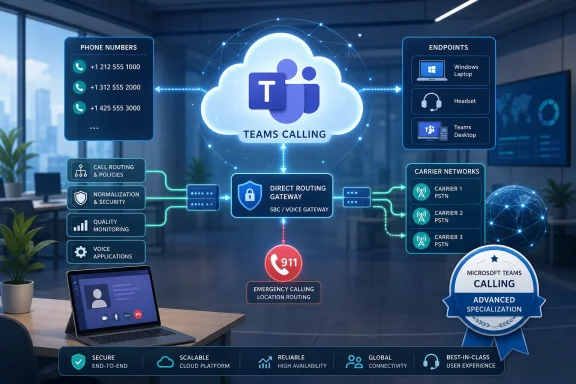
That is why Microsoft’s advanced specialization program matters. It is a mechanism for telling customers which partners have cleared Microsoft-defined thresholds for technical skill, deployments, customer references, and certifications. In CallTower’s case, the specialization specifically points to Microsoft Teams calling, including the practical work of voice enablement, PSTN connectivity, Direct Routing, network planning, and ongoing management.
This is Microsoft doing something it has done across Azure, security, identity, and Modern Work: turning complexity into a partner qualification ladder. The company provides the platform, but the last mile — the messy business of phone numbers, carrier relationships, porting, call queues, regional regulations, survivability expectations, and user adoption — is often delegated to specialists.
CallTower’s announcement should be read in that context. The company is not claiming that Teams Phone suddenly became easier. It is claiming that Microsoft has validated CallTower as one of the firms qualified to make it survivable for enterprises.
But the Calling for Microsoft Teams Advanced Specialization is not merely a participation trophy. Microsoft describes the specialization as aimed at partners that can demonstrate deep knowledge and proven success with Microsoft 365 Phone System deployments. The requirements include an active Modern Work partner designation, Teams Phone user growth, certified personnel, and customer references showing the ability to deploy and manage voice workloads.
That distinction matters because enterprise telephony is unforgiving in ways that ordinary SaaS deployment is not. The migration path usually includes number inventory cleanup, emergency calling validation, call routing redesign, device decisions, conferencing-room edge cases, analog line replacements, contact center integrations, and user training. A failed mailbox migration is painful; a failed phone migration can break revenue operations.
CallTower’s press release leans heavily on reliability, scalability, and user adoption. Those are vendor-approved words, but they are also the three areas where Teams calling projects most often succeed or collapse. Reliability is not just Microsoft’s cloud uptime. It is the full path from user device to network to Teams service to carrier to destination number.
Scalability is not just adding licenses. It is knowing whether a calling architecture still works when the organization spans countries, call centers, branch offices, compliance regimes, and mixed user populations. User adoption is not just sending a quick-start PDF; it is making sure people who have spent a decade pressing familiar buttons on a desk phone can perform the same task inside Teams without creating a help desk surge.
That argument becomes especially attractive when old PBX estates are approaching end-of-life. Traditional systems carry maintenance contracts, aging handsets, specialist knowledge, and hardware dependencies that feel increasingly anachronistic in a Microsoft 365 world. If employees already chat, meet, share files, and schedule work in Microsoft’s ecosystem, the phone system becomes the next obvious target.
But the “obvious” target is also the dangerous one. Voice projects expose the gulf between collaboration software and regulated communications infrastructure. A PBX replacement is not just a software rollout; it is a business-continuity project with a user-interface change attached.
That is where companies like CallTower position themselves. CallTower sells itself as a cloud communications provider that works across Microsoft Teams, Webex by Cisco, Zoom, contact center products, and carrier connectivity. Its Microsoft story is strengthened by the specialization, but its business case is broader: customers want one party to help stitch together the cloud collaboration layer and the telephony layer.
The result is a hybrid market. Microsoft owns the collaboration surface, Teams Phone owns much of the call control experience, and partners own pieces of delivery, carrier access, migration services, and support. That model is powerful, but it also means customers need to understand exactly where Microsoft ends and the partner begins.
Microsoft Calling Plans offer simplicity where available, but they may not fit every geographic, pricing, compliance, or feature requirement. Operator Connect gives customers a Microsoft-admin-integrated way to use participating carriers. Direct Routing gives organizations more flexibility, especially when they have complex carrier needs, legacy integrations, multinational footprints, or existing telecom contracts.
That flexibility comes at a price. Direct Routing introduces session border controllers, carrier configuration, routing policies, certificate management, dial plans, and more places where troubleshooting crosses organizational boundaries. If the user cannot make a call, is the problem in Teams, the user policy, the SBC, the carrier trunk, the number assignment, the network, the handset, or the emergency location configuration?
This is the real opportunity for specialized partners. The best ones are not merely resellers of Teams Phone licenses. They are translators between Microsoft 365 administration and telecom operations, two worlds that historically used different tools, teams, vocabulary, and escalation paths.
CallTower’s specialization gives it a stronger Microsoft-approved answer when customers ask whether it can handle that translation. It does not eliminate the need for diligence, but it moves the conversation from “can you do this?” to “how exactly will you do this for our environment?”
When a Teams calling deployment goes sideways, the blame often lands first on the endpoint. Users say the microphone does not work, the dial pad disappeared, calls drop when they undock, Bluetooth audio behaves unpredictably, or Teams consumes too much CPU during meetings. Those complaints arrive at the same help desk that manages Windows builds, Microsoft 365 Apps, Intune policies, device compliance, and security baselines.
The Teams Phone migration therefore expands the Windows admin’s blast radius. A desktop issue can become a telephony issue. A network policy change can become a call-quality issue. A conditional access decision can become a business-line interruption. A headset standardization project can suddenly matter as much as a laptop refresh.
There is also a security dimension. Moving voice into Teams means voice access becomes tied more closely to Entra ID, multifactor authentication, device trust, and Microsoft 365 governance. That is a defensible modernization path, but it requires discipline. Phone systems historically had their own security weaknesses; cloud identity has different ones.
For security-minded administrators, the central question is not whether Teams Phone is secure in some abstract sense. It is whether the organization can operate voice as part of its identity, endpoint, network, and incident-response program. A partner specialization may help on deployment, but the customer still owns governance.
That fear is rational. Voice migrations often reveal unknown dependencies. Fax lines still exist. Elevator phones still exist. Lobby phones, door systems, paging systems, shared area devices, analog adapters, emergency phones, call recording obligations, and industry-specific workflows all still exist. The cloud has not abolished these edge cases; it has forced IT to rediscover them.
The more distributed the company, the harder this becomes. A single headquarters migration is one thing. A global rollout involving offices in multiple countries, varying carrier rules, local emergency calling expectations, language differences, and business-unit autonomy is another. “Teams calling” can mean dramatically different things depending on the environment.
CallTower’s global positioning is designed for that complexity. The company says it works with more than 25 global carriers and offers its own platform for provisioning and management. That is not incidental. In Teams telephony, carrier reach and operational tooling can be as important as Microsoft certification.
The competitive implication is equally clear. Microsoft’s ecosystem rewards partners that can present themselves as both cloud-native and telecom-literate. A firm that can only sell Microsoft licenses is less useful than one that can manage migrations, carriers, support, contact center adjacency, and adoption.
That is not necessarily bad for customers. Consolidation can reduce tool sprawl, simplify training, centralize compliance, and improve collaboration. But it also increases dependency. The more Teams becomes the front door to work, the more Microsoft’s licensing, client performance, service reliability, and product roadmap matter.
Partner specializations soften that dependency by making the ecosystem look broader. Customers are not simply buying from Microsoft; they are choosing among certified partners, operators, integrators, and managed-service providers. That creates room for specialization and competition around delivery.
Still, the center of gravity remains Microsoft. Teams Phone deployments generally pull customers deeper into Microsoft 365 administration, Teams policy management, Entra identity, and Microsoft’s evolving licensing framework. Even when a third-party carrier is involved, the user experience is shaped by Teams.
That is why buyers should separate Microsoft’s platform narrative from operational reality. “Use Teams for calling” is a strategy. “Make Teams calling reliable for our users in 14 countries with old numbers, emergency requirements, call queues, and contact center dependencies” is a project. CallTower’s specialization is meaningful because it speaks to the second sentence, not the first.
That creates both value and risk. The value is that customers can use Microsoft’s partner framework to reduce the universe of possible vendors. A specialization does not guarantee success, but it indicates the partner has met criteria beyond self-attestation.
The risk is that procurement can over-index on the badge and under-index on fit. A specialized partner may be qualified in general but still wrong for a particular customer’s geography, industry, support model, pricing expectation, or integration estate. The badge should open the door, not close the evaluation.
For CallTower, the specialization is a credibility amplifier. It adds Microsoft’s validation to a portfolio that already spans UCaaS, CCaaS, carrier services, and collaboration platforms. That combination is useful in a market where customers increasingly want fewer vendors but not necessarily fewer capabilities.
For rivals, it raises the table stakes. If Microsoft continues to make specializations more visible in partner discovery and customer guidance, then voice partners without comparable validation may find themselves explaining the absence. That does not mean they are technically inferior, but it does mean they will fight uphill in Microsoft-centered deals.
That means inventory comes before migration. IT needs to know which numbers exist, who owns them, what they do, where they route, whether they are published publicly, whether they support emergency scenarios, and whether they connect to systems nobody has touched in years. The phone system is often a museum of organizational history.
Network readiness also matters. Teams calling depends on latency, jitter, packet loss, local internet breakout, VPN behavior, Wi-Fi quality, headset performance, and endpoint health. A partner can help assess these variables, but the customer must be willing to fix what the assessment reveals.
Then there is support. Users do not care whether a call failed because of Microsoft, CallTower, a carrier, a firewall, a headset driver, or an expired certificate. They care that the call failed. A successful Teams Phone program needs a support model that can triage across all of those layers without turning every incident into a conference call among vendors.
That is the hidden promise in CallTower’s announcement. The company is not merely saying it knows Teams. It is saying it can stand in the operational gap between Microsoft’s cloud platform and the customer’s daily voice requirements.
 Microsoft’s Phone Strategy Now Runs Through the Partner Channel
Microsoft Teams has spent years absorbing the work once split across desk phones, PBXs, conferencing bridges, chat clients, and meeting-room appliances. That consolidation has been good for Microsoft, which wants Teams to remain the work hub inside Microsoft 365, but it has not made telephony simple. Voice is the part of collaboration where “mostly working” is not good enough.A chat message can arrive late and still be useful. A meeting recording can process after the fact. A phone call to a customer, dispatcher, patient, hotel front desk, sales line, or emergency escalation path either connects cleanly or it becomes an operational incident.
That is why Microsoft’s advanced specialization program matters. It is a mechanism for telling customers which partners have cleared Microsoft-defined thresholds for technical skill, deployments, customer references, and certifications. In CallTower’s case, the specialization specifically points to Microsoft Teams calling, including the practical work of voice enablement, PSTN connectivity, Direct Routing, network planning, and ongoing management.
This is Microsoft doing something it has done across Azure, security, identity, and Modern Work: turning complexity into a partner qualification ladder. The company provides the platform, but the last mile — the messy business of phone numbers, carrier relationships, porting, call queues, regional regulations, survivability expectations, and user adoption — is often delegated to specialists.
CallTower’s announcement should be read in that context. The company is not claiming that Teams Phone suddenly became easier. It is claiming that Microsoft has validated CallTower as one of the firms qualified to make it survivable for enterprises.
The Badge Is Marketing, but the Work Behind It Is Not
Every partner ecosystem has its share of laminated achievements. Badges decorate homepages, procurement decks, and booth banners because buyers need shortcuts and vendors need differentiation. A specialization is not the same thing as a guaranteed outcome, and IT leaders should resist treating it as magic.But the Calling for Microsoft Teams Advanced Specialization is not merely a participation trophy. Microsoft describes the specialization as aimed at partners that can demonstrate deep knowledge and proven success with Microsoft 365 Phone System deployments. The requirements include an active Modern Work partner designation, Teams Phone user growth, certified personnel, and customer references showing the ability to deploy and manage voice workloads.
That distinction matters because enterprise telephony is unforgiving in ways that ordinary SaaS deployment is not. The migration path usually includes number inventory cleanup, emergency calling validation, call routing redesign, device decisions, conferencing-room edge cases, analog line replacements, contact center integrations, and user training. A failed mailbox migration is painful; a failed phone migration can break revenue operations.
CallTower’s press release leans heavily on reliability, scalability, and user adoption. Those are vendor-approved words, but they are also the three areas where Teams calling projects most often succeed or collapse. Reliability is not just Microsoft’s cloud uptime. It is the full path from user device to network to Teams service to carrier to destination number.
Scalability is not just adding licenses. It is knowing whether a calling architecture still works when the organization spans countries, call centers, branch offices, compliance regimes, and mixed user populations. User adoption is not just sending a quick-start PDF; it is making sure people who have spent a decade pressing familiar buttons on a desk phone can perform the same task inside Teams without creating a help desk surge.
Teams Phone Has Become the PBX Migration Microsoft Always Wanted
The deeper shift is that Teams Phone has matured from “nice add-on” to PBX replacement candidate. Microsoft’s cloud phone system pitch is no longer exotic. Many organizations already live in Teams all day, and the argument for moving calling into the same interface is straightforward: fewer clients, fewer contracts, fewer islands of communication.That argument becomes especially attractive when old PBX estates are approaching end-of-life. Traditional systems carry maintenance contracts, aging handsets, specialist knowledge, and hardware dependencies that feel increasingly anachronistic in a Microsoft 365 world. If employees already chat, meet, share files, and schedule work in Microsoft’s ecosystem, the phone system becomes the next obvious target.
But the “obvious” target is also the dangerous one. Voice projects expose the gulf between collaboration software and regulated communications infrastructure. A PBX replacement is not just a software rollout; it is a business-continuity project with a user-interface change attached.
That is where companies like CallTower position themselves. CallTower sells itself as a cloud communications provider that works across Microsoft Teams, Webex by Cisco, Zoom, contact center products, and carrier connectivity. Its Microsoft story is strengthened by the specialization, but its business case is broader: customers want one party to help stitch together the cloud collaboration layer and the telephony layer.
The result is a hybrid market. Microsoft owns the collaboration surface, Teams Phone owns much of the call control experience, and partners own pieces of delivery, carrier access, migration services, and support. That model is powerful, but it also means customers need to understand exactly where Microsoft ends and the partner begins.
Direct Routing, Operator Connect, and Calling Plans Are Really Governance Choices
For administrators, the practical Teams calling decision usually comes down to connectivity architecture. Microsoft offers its own Calling Plans in supported markets, Operator Connect through approved carriers, and Direct Routing for customers that want or need more control over PSTN connectivity. On paper, these are technical options. In practice, they are governance choices.Microsoft Calling Plans offer simplicity where available, but they may not fit every geographic, pricing, compliance, or feature requirement. Operator Connect gives customers a Microsoft-admin-integrated way to use participating carriers. Direct Routing gives organizations more flexibility, especially when they have complex carrier needs, legacy integrations, multinational footprints, or existing telecom contracts.
That flexibility comes at a price. Direct Routing introduces session border controllers, carrier configuration, routing policies, certificate management, dial plans, and more places where troubleshooting crosses organizational boundaries. If the user cannot make a call, is the problem in Teams, the user policy, the SBC, the carrier trunk, the number assignment, the network, the handset, or the emergency location configuration?
This is the real opportunity for specialized partners. The best ones are not merely resellers of Teams Phone licenses. They are translators between Microsoft 365 administration and telecom operations, two worlds that historically used different tools, teams, vocabulary, and escalation paths.
CallTower’s specialization gives it a stronger Microsoft-approved answer when customers ask whether it can handle that translation. It does not eliminate the need for diligence, but it moves the conversation from “can you do this?” to “how exactly will you do this for our environment?”
The Enterprise Voice Problem Is Also a Windows Problem
WindowsForum readers may reasonably ask why a cloud calling specialization deserves attention in a Windows community. The answer is that Teams voice lands squarely on the machines and workflows Windows admins already manage. Teams is not floating in the abstract cloud; it runs on Windows endpoints, depends on device drivers, headsets, audio stacks, network policies, identity controls, and update behavior.When a Teams calling deployment goes sideways, the blame often lands first on the endpoint. Users say the microphone does not work, the dial pad disappeared, calls drop when they undock, Bluetooth audio behaves unpredictably, or Teams consumes too much CPU during meetings. Those complaints arrive at the same help desk that manages Windows builds, Microsoft 365 Apps, Intune policies, device compliance, and security baselines.
The Teams Phone migration therefore expands the Windows admin’s blast radius. A desktop issue can become a telephony issue. A network policy change can become a call-quality issue. A conditional access decision can become a business-line interruption. A headset standardization project can suddenly matter as much as a laptop refresh.
There is also a security dimension. Moving voice into Teams means voice access becomes tied more closely to Entra ID, multifactor authentication, device trust, and Microsoft 365 governance. That is a defensible modernization path, but it requires discipline. Phone systems historically had their own security weaknesses; cloud identity has different ones.
For security-minded administrators, the central question is not whether Teams Phone is secure in some abstract sense. It is whether the organization can operate voice as part of its identity, endpoint, network, and incident-response program. A partner specialization may help on deployment, but the customer still owns governance.
CallTower Is Selling Assurance in a Market Full of Anxiety
CallTower’s announcement uses the language of confidence. Customers, it says, receive additional assurance that the company has been independently validated by Microsoft for complex Teams calling deployments and support. That is the right word: assurance. The market for Teams calling is full of organizations that want the benefits of consolidation but fear the cost of getting telephony wrong.That fear is rational. Voice migrations often reveal unknown dependencies. Fax lines still exist. Elevator phones still exist. Lobby phones, door systems, paging systems, shared area devices, analog adapters, emergency phones, call recording obligations, and industry-specific workflows all still exist. The cloud has not abolished these edge cases; it has forced IT to rediscover them.
The more distributed the company, the harder this becomes. A single headquarters migration is one thing. A global rollout involving offices in multiple countries, varying carrier rules, local emergency calling expectations, language differences, and business-unit autonomy is another. “Teams calling” can mean dramatically different things depending on the environment.
CallTower’s global positioning is designed for that complexity. The company says it works with more than 25 global carriers and offers its own platform for provisioning and management. That is not incidental. In Teams telephony, carrier reach and operational tooling can be as important as Microsoft certification.
The competitive implication is equally clear. Microsoft’s ecosystem rewards partners that can present themselves as both cloud-native and telecom-literate. A firm that can only sell Microsoft licenses is less useful than one that can manage migrations, carriers, support, contact center adjacency, and adoption.
Microsoft Benefits When the Hard Parts Look Partner-Solved
There is a strategic advantage for Microsoft in all of this. Every successful Teams Phone deployment makes Teams stickier. Once chat, meetings, calling, conferencing rooms, and contact workflows live inside the Microsoft stack, replacing Microsoft 365 becomes much harder.That is not necessarily bad for customers. Consolidation can reduce tool sprawl, simplify training, centralize compliance, and improve collaboration. But it also increases dependency. The more Teams becomes the front door to work, the more Microsoft’s licensing, client performance, service reliability, and product roadmap matter.
Partner specializations soften that dependency by making the ecosystem look broader. Customers are not simply buying from Microsoft; they are choosing among certified partners, operators, integrators, and managed-service providers. That creates room for specialization and competition around delivery.
Still, the center of gravity remains Microsoft. Teams Phone deployments generally pull customers deeper into Microsoft 365 administration, Teams policy management, Entra identity, and Microsoft’s evolving licensing framework. Even when a third-party carrier is involved, the user experience is shaped by Teams.
That is why buyers should separate Microsoft’s platform narrative from operational reality. “Use Teams for calling” is a strategy. “Make Teams calling reliable for our users in 14 countries with old numbers, emergency requirements, call queues, and contact center dependencies” is a project. CallTower’s specialization is meaningful because it speaks to the second sentence, not the first.
The Certification Arms Race Is Becoming Procurement Infrastructure
Advanced specializations are becoming part of enterprise procurement language. Buyers want objective signals, and Microsoft wants partners to align with its standards. Over time, these badges become filters in RFPs, partner shortlists, and board-level justification documents.That creates both value and risk. The value is that customers can use Microsoft’s partner framework to reduce the universe of possible vendors. A specialization does not guarantee success, but it indicates the partner has met criteria beyond self-attestation.
The risk is that procurement can over-index on the badge and under-index on fit. A specialized partner may be qualified in general but still wrong for a particular customer’s geography, industry, support model, pricing expectation, or integration estate. The badge should open the door, not close the evaluation.
For CallTower, the specialization is a credibility amplifier. It adds Microsoft’s validation to a portfolio that already spans UCaaS, CCaaS, carrier services, and collaboration platforms. That combination is useful in a market where customers increasingly want fewer vendors but not necessarily fewer capabilities.
For rivals, it raises the table stakes. If Microsoft continues to make specializations more visible in partner discovery and customer guidance, then voice partners without comparable validation may find themselves explaining the absence. That does not mean they are technically inferior, but it does mean they will fight uphill in Microsoft-centered deals.
Teams Calling Still Needs Adult Supervision
The most important takeaway for IT teams is that Teams Phone should not be treated as a routine Microsoft 365 toggle. Assigning licenses is the easy part. The hard part is designing a calling environment that reflects how the business actually communicates.That means inventory comes before migration. IT needs to know which numbers exist, who owns them, what they do, where they route, whether they are published publicly, whether they support emergency scenarios, and whether they connect to systems nobody has touched in years. The phone system is often a museum of organizational history.
Network readiness also matters. Teams calling depends on latency, jitter, packet loss, local internet breakout, VPN behavior, Wi-Fi quality, headset performance, and endpoint health. A partner can help assess these variables, but the customer must be willing to fix what the assessment reveals.
Then there is support. Users do not care whether a call failed because of Microsoft, CallTower, a carrier, a firewall, a headset driver, or an expired certificate. They care that the call failed. A successful Teams Phone program needs a support model that can triage across all of those layers without turning every incident into a conference call among vendors.
That is the hidden promise in CallTower’s announcement. The company is not merely saying it knows Teams. It is saying it can stand in the operational gap between Microsoft’s cloud platform and the customer’s daily voice requirements.
The CallTower Badge Is a Signal, Not a Shortcut
CallTower’s new specialization is most useful when treated as a starting point for sharper conversations. It validates capability, but it does not replace architecture review, commercial scrutiny, or operational planning.- CallTower announced on July 1, 2026, that it earned Microsoft’s Calling for Microsoft Teams Advanced Specialization.
- The specialization is designed for partners that can demonstrate technical depth and customer success in deploying and managing Teams Phone workloads.
- The practical value for customers is not the badge itself but the reduced uncertainty around complex voice migrations.
- Teams calling projects should be treated as infrastructure programs involving identity, endpoints, networks, carriers, emergency calling, and user adoption.
- Windows and Microsoft 365 administrators should expect Teams Phone to expand their operational responsibilities, especially around endpoint audio, policy management, and support triage.
- Buyers should use the specialization as a procurement signal while still validating geography, support model, migration method, pricing, and integration experience.
References
- Primary source: MarTech Cube
Published: Wed, 01 Jul 2026 18:25:59 GMT
Loading…
www.martechcube.com - Related coverage: globenewswire.com
Loading…
www.globenewswire.com - Official source: partner.microsoft.com
Loading…
partner.microsoft.com - Official source: learn.microsoft.com
Apply for specializations - Partner Center | Microsoft Learn
Strengthen your business profile in the Microsoft partner directory. Learn how to use Partner Center to apply for and earn advanced specializations.learn.microsoft.com - Official source: microsoft.com
Loading…
www.microsoft.com - Related coverage: entergrade.com
Entergrade | Entergrade Earns Advanced Calling for Microsoft Teams…
Entergrade is a Microsoft Partner and provider of software designed to help businesses get the most out of their Microsoft 365 services. We increase the… entergrade.com