

What if the operating system under your GPU — not the GPU itself — is the reason your favorite games stutter, spike, or feel less responsive? Recent community benchmarking focused on the Linux-based Bazzite distribution has reopened that question with concrete, repeatable examples: in several shader‑heavy, handheld‑style scenarios a lean, Proton-powered Linux image delivered noticeably steadier frame times and meaningful FPS uplifts compared with the same hardware running Windows 11. Those results are not universal, but they are significant enough to force a pragmatic re‑examination of the “Windows-only” gaming assumption.
Bazzite is a Fedora‑based, gaming‑first Linux distribution that bundles Proton, tuned Mesa builds, and a controller‑oriented UI to create a console‑like experience on PC hardware. It does not replace Valve’s SteamOS, but it follows similar design goals: a lightweight compositor, aggressive shader‑cache strategies, and user‑accessible power controls. Enthusiasts and handheld owners have used Bazzite as a testbed to see what a leaner OS stack does to gaming performance, especially in thermally constrained handheld power envelopes.
Proton — Valve’s compatibility layer that translates Windows API calls into Linux‑native calls — has evolved far beyond a stopgap. When paired with modern Mesa drivers and tuned kernels, Proton can run many Windows titles with high compatibility and surprisingly competitive performance. That combination is the core of the recent Bazzite benchmarking story.
Practical implications:
Benefits:
If the last few years taught the community anything, it’s that the gap between Linux and Windows is not static. Open‑source collaboration, vendor investments, and compatibility layers like Proton move fast. The prudent path for most gamers remains experimentation via dual‑boot, careful benchmarking with 1% lows and frame‑time traces, and a conservative approach to replacing factory images. The Bazzite story is not a proclamation that Linux has “won” gaming; it’s an invitation to rethink where OS optimizations can meaningfully change your play experience.
Source: Geeky Gadgets Linux vs Windows 11 : Proton PC Gaming GPU Benchmarks on Bazzite
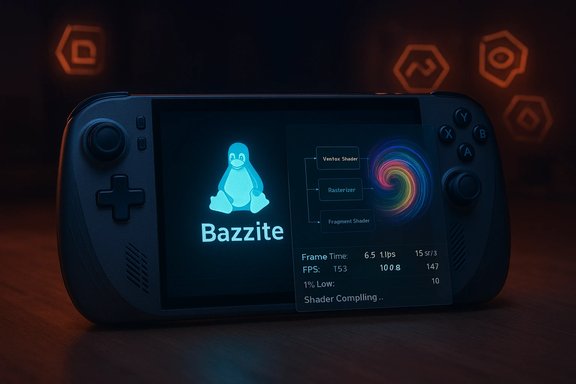 Background: why Bazzite and Proton matter now
Bazzite is a Fedora‑based, gaming‑first Linux distribution that bundles Proton, tuned Mesa builds, and a controller‑oriented UI to create a console‑like experience on PC hardware. It does not replace Valve’s SteamOS, but it follows similar design goals: a lightweight compositor, aggressive shader‑cache strategies, and user‑accessible power controls. Enthusiasts and handheld owners have used Bazzite as a testbed to see what a leaner OS stack does to gaming performance, especially in thermally constrained handheld power envelopes.Proton — Valve’s compatibility layer that translates Windows API calls into Linux‑native calls — has evolved far beyond a stopgap. When paired with modern Mesa drivers and tuned kernels, Proton can run many Windows titles with high compatibility and surprisingly competitive performance. That combination is the core of the recent Bazzite benchmarking story.
What the Bazzite benchmarks actually measured
The test scope and headline numbers
Community hands‑on tests — not vendor labs — took identical handheld hardware (examples include the ROG/Ally family and similar devices) and compared Windows 11 and Bazzite with matched power modes (13 W “Silent”, 17 W “Performance”, up to 35–50 W Turbo). Testers focused on:- Average FPS and 1%/0.2% lows
- Frame‑time consistency and hitch frequency
- Resume/suspend behavior and day‑to‑day responsiveness
Why these numbers are credible — and why to be cautious
Multiple independent reviewers and community testers observed similar directional gains under similar conditions, which adds weight to the signal. At the same time, the methodology matters: these were practical hands‑ons rather than multi‑run, version-locked lab tests, and results can change with driver updates, Proton versions, Mesa releases, firmware, and even small BIOS settings. Treat headline percentages as directional evidence showing where a lighter, tuned OS can influence perceived smoothness and sustained throughput.Technical anatomy: why Bazzite can outperform Windows in some scenarios
Linux gains in these tests are not mystical. They spring from three repeatable system‑level differences that matter most when power and thermal headroom are tight.1) Shader compilation and shader‑cache behavior
Modern AAA engines produce thousands of shader permutations. If the driver compiles those shaders synchronously at runtime, the result is a blocking spike — a hitch that kills perceived smoothness. Proton combined with tuned Mesa builds and smarter shader‑cache heuristics can reduce runtime shader compilation spikes by precompiling or better managing cache misses, which improves 1% lows and microstutter behavior in shader‑heavy scenes. This effect was repeatedly cited by analysts and community testers as the primary cause of the largest gains.2) Lower OS overhead and a console‑first compositor
Windows 11 is a full desktop OS with background services, telemetry, and OEM helpers that run even when an Xbox-style fullscreen experience is active. A purpose‑built Linux image boots to a lightweight compositor and runs fewer background threads, reducing scheduling noise and I/O interruptions that show up as frame‑time variance. The difference is especially visible on handheld devices with limited CPU/GPU budgets.3) Explicit power governors, fan profiles, and driver tweaks
Gaming‑focused Linux images commonly expose direct TDP and frequency controls and include kernel patches tuned for sustained performance. That leads to steadier sustained clocks and more deterministic thermal behavior. On Windows, reaching the same steady state often requires manual tuning across Armoury Crate or vendor utilities. In sustained mid‑range power windows (the region many handheld gamers live in), those differences can translate directly into better average throughput on Linux.Hardware vendor behavior: AMD, NVIDIA, and Intel on Linux
AMD: the open‑source advantage
AMD’s investment in open Linux drivers (the Mesa/RADV stack) has matured and offers compelling real‑world results in Vulkan‑native titles. In multiple tests AMD RDNA hardware has shown parity with — and in some titles superiority to — Windows performance, particularly where the workload favors Vulkan and where shader‑caching strategies avoid blocking hitches. AMD’s open approach makes it easier for community images like Bazzite to ship tuned stacks without fighting proprietary driver constraints.NVIDIA: driver power with persistent quirks
NVIDIA’s proprietary drivers remain the baseline for raw performance on many Windows builds, but on Linux they sometimes manifest frame‑pacing and compatibility challenges — particularly in demanding scenes (community reports single out titles like Cyberpunk 2077 and Starfield). NVIDIA’s drivers are functional and high‑performance, but closed‑source development means community patches and layered optimizations are limited, which can slow down fixes for platform‑specific issues. Those limitations showed up consistently in enthusiast testing on Bazzite.Intel: progress, but not yet friction‑free
Intel’s open‑source driver work has accelerated, especially for workstation and compute tasks, and the Arc family shows promise. That said, Intel GPUs have been less consistent in gaming on Linux compared with Windows; driver stability and feature parity remain works in progress. Benchmarks for Intel Arc “Battlemage” and related hardware show Linux trailing Windows in several DirectX‑centric titles, though improvements continue as Mesa and Intel’s open driver team iterate.Game‑specific realities: why some titles behave differently
Some games simply favor one platform or driver stack because of engine design, middleware, or anti‑cheat dependencies.- Vulkan‑native titles or those with high shader churn are the most likely to benefit from Bazzite’s shader‑cache behavior. In such titles AMD on Linux can even outpace Windows in specific scenes.
- DirectX‑heavy engines or titles optimized explicitly for Windows often retain an advantage on Windows, particularly when vendors ship DirectX‑specific optimizations. For those games, Windows remains the safer bet for maximum compatibility and peak performance.
- Multiplayer and competitive games can be blocked entirely by anti‑cheat middleware that requires Windows kernel drivers, regardless of how well the game runs under Proton. This remains the largest practical blocker for many players contemplating a Linux transition.
Methodology: the limits of community testing and the tools used
Linux benchmarking still lacks the same degree of automation and standard capture tooling available on Windows. Tools like MangoHud provide frame‑time, FPS, and GPU telemetry on Linux, but they don’t map one‑to‑one with Windows capture tools like PresentMon. That complicates exact cross‑platform apples‑to‑apples comparisons, and frequent updates to Proton, Mesa, or a kernel can change results overnight. Multiple community posts emphasize that these Bazzite comparisons are reproducible in direction but sensitive to driver and runtime versions.Practical implications:
- Always version‑lock your stacks (kernel, Mesa, Proton, game binary) when comparing results.
- Capture 1% and 0.2% lows, not just averages — for perceived smoothness they often matter more than a marginal FPS delta.
- Repeat runs across multiple scenes to avoid overinterpreting a single optimized scene.
Real‑world tradeoffs: what you gain and what you sacrifice
Bazzite and similar SteamOS‑style images can be transformative in certain contexts, but every gain comes with tradeoffs.Benefits:
- Cleaner, console‑like UX and instant resume behavior on handhelds.
- Lower OS overhead that can recover CPU/GPU headroom for sustained performance.
- Better shader‑cache behavior in many modern engines, reducing microstutter.
- Easier access to power and governor tuning for sustained performance.
- Anti‑cheat and multiplayer compatibility remain the single biggest blocker; many competitive titles remain Windows‑only.
- Vendor support and warranty implications if you overwrite factory images on handheld hardware. Community testers recommend preserving recovery partitions.
- Fragile stacks — driver, Proton, or kernel updates can change behavior unpredictably; expect occasional breakage and the need for troubleshooting.
Practical recommendations for gamers considering the switch
If the Bazzite story has piqued interest, here’s a practical, risk‑calibrated path forward.- Start with dual‑boot. Preserve your Windows 11 install to keep access to anti‑cheat and Game Pass titles while experimenting with Bazzite.
- Choose your use case: single‑player, Vulkan‑heavy titles and handheld play benefit most from Bazzite. Multiplayer and e‑sports titles often require Windows.
- Version‑lock and snapshot. Use tools to snapshot your Linux image and record exact versions of Proton, Mesa, and kernel you used for benchmarks. This makes rollbacks and reproduction easier.
- Use MangoHud and shader‑cache tools to measure 1% lows and capture frame‑time traces. Don’t rely solely on average FPS.
- Expect hands‑on tuning: install vendor firmware updates, test multiple Proton builds (Proton‑GE often helps), and try different Mesa branches if you’re comfortable rebuilding from source.
Where the story goes next: improvements and remaining gaps
- Anti‑cheat: Wider adoption of user‑space anti‑cheat implementations or vendor cooperation with Valve/Proton would remove the single largest barrier to Linux adoption for multiplayer. Until then, Linux will be an incomplete option for many competitive gamers.
- Driver maturity: AMD’s open path is encouraging and shows how vendor collaboration accelerates progress. Intel and NVIDIA improvements on Linux remain ongoing but uneven; expect periodic shifts as new Mesa releases and proprietary drivers evolve.
- Standardized benchmarks: The Linux community and independent labs need better standardized capture tooling and automated suites to reduce variance and improve reproducibility across OSes. That will turn today’s “directional wins” into robust, repeatable data sets.
Critical analysis: strengths, caveats, and risk assessment
Strengths of the Bazzite/Proton approach- Empirical wins in constrained power envelopes. Multiple hands‑on tests show measurable, repeatable improvements in frame‑time stability and 1% lows where shader compiles were the dominant bottleneck. This is not abstract — it changes the feel of gameplay on handhelds.
- Open‑source leverage. AMD’s open‑driver model and community‑driven Mesa work enable rapid iteration and targeted tuning that closed drivers can’t match in the same way.
- Non‑universal results. Gains are scene‑dependent and highly sensitive to driver/Proton/kernel versions; a single patch can flip outcomes. These are not drop‑in replacements for every player or title.
- Compatibility gaps dominate user experience. Anti‑cheat, store DRM, and certain middleware keep many titles off the table for Linux users — a practical showstopper for sizeable segments of the player base.
- Support exposure. Replacing factory images on handhelds or consoles can void support and complicate warranty claims; preserve recovery partitions and proceed with caution.
Final thoughts
The Bazzite benchmarks are a pragmatic reminder that performance is a system property, not just a silicon property. When shader compilation, OS overhead, and power governors are aligned, Linux stacks built around Proton and Mesa can deliver an experience that rivals — and in specific scenes beats — Windows 11 on identical hardware. For handheld owners and single‑player fans, that’s an actionable, exciting prospect. For competitive and multiplayer players, Windows still offers the broadest compatibility and the least risk.If the last few years taught the community anything, it’s that the gap between Linux and Windows is not static. Open‑source collaboration, vendor investments, and compatibility layers like Proton move fast. The prudent path for most gamers remains experimentation via dual‑boot, careful benchmarking with 1% lows and frame‑time traces, and a conservative approach to replacing factory images. The Bazzite story is not a proclamation that Linux has “won” gaming; it’s an invitation to rethink where OS optimizations can meaningfully change your play experience.
Source: Geeky Gadgets Linux vs Windows 11 : Proton PC Gaming GPU Benchmarks on Bazzite
