

Canada’s conversation about AI and work has shifted from abstract fear to a pragmatic how-to: learn to use these tools — and quickly — or risk being leapfrogged by people who do.
Marc Saltzman’s recent column arguing that Canadian workers should upskill to stay employed taps into a growing chorus of analysts, vendors and policymakers who say the labour market is already being reshaped by generative AI. The column blends survey findings, vendor messaging and hard corporate news — from a 2025 KPMG global study showing deep public concern about AI to Microsoft and AWS claims about productivity gains and training investments — with a timely reminder that large employers are both laying people off and hiring for AI-capable roles.
That tension — mass layoffs alongside massive reskilling promises — is the essential framing for anyone thinking about careers in 2026. It’s not enough to reassure workers that companies “will continue hiring.” The realism is closer to Saltzman’s main point: AI is both an amplifier of productivity and a driver of change in the kinds of skills employers prize. Workers who understand how to partner with AI tools will hold a distinct advantage.
The responsible route is clear and actionable: learn the tools, document practical outcomes, demand measured employer commitments to redeployment, and insist on public-policy programs that ensure access and verifiable quality. Workers who combine domain expertise, AI orchestration skills and high-trust professional behavior will not only remain employable — they will define the roles that drive organizations forward.
Upskilling isn’t a panacea, and it won’t make every layoff vanish. But it is a pragmatic hedge: the same technology that amplifies organizational capacity also rewards the people who can wield it thoughtfully. For Canadian workers, that’s the insurance Saltzman recommends — and the time to start buying the policy is now.
Source: Toronto Sun SALTZMAN: Canadian workers, consider upskilling to remain employed
 Background: why Marc Saltzman’s piece matters now
Marc Saltzman’s recent column arguing that Canadian workers should upskill to stay employed taps into a growing chorus of analysts, vendors and policymakers who say the labour market is already being reshaped by generative AI. The column blends survey findings, vendor messaging and hard corporate news — from a 2025 KPMG global study showing deep public concern about AI to Microsoft and AWS claims about productivity gains and training investments — with a timely reminder that large employers are both laying people off and hiring for AI-capable roles.That tension — mass layoffs alongside massive reskilling promises — is the essential framing for anyone thinking about careers in 2026. It’s not enough to reassure workers that companies “will continue hiring.” The realism is closer to Saltzman’s main point: AI is both an amplifier of productivity and a driver of change in the kinds of skills employers prize. Workers who understand how to partner with AI tools will hold a distinct advantage.
Overview: what the key data and claims say
- A global KPMG study released in 2025 surveyed tens of thousands of people and found wide variation in AI literacy and trust; many Canadians reported concern about negative outcomes and had limited formal AI training.
- Vendor research and vendor-led studies (Microsoft, AWS) point to tangible productivity improvements when employees use AI tools — especially for content creation, customer service and repetitive administrative work.
- AWS has publicly described large-scale training efforts (tens of millions of learners) and programs aimed at making cloud and AI skills accessible.
- Microsoft’s framing around “human-plus-AI” teams and the idea of the “agent boss” — a human manager who orchestrates AI agents — has entered mainstream corporate thinking about workflow redesign.
- Simultaneously, major employers such as Amazon announced additional rounds of cuts in late January 2026 affecting roughly 16,000 roles, which sharpened worries that organizational restructuring and automation-related efficiency programs can translate into job churn.
The nitty-gritty: which claims check out and which need caution
What’s verifiable and robust
- Large-scale concern and low AI literacy: Multiple independent studies show that public trust in AI is uneven and that many workers report little formal training. That makes Saltzman’s point — that workers are anxious and undertrained — factually grounded.
- Vendor training scale: AWS and other cloud providers have documented very large free training programs and have reached tens of millions of learners worldwide; these programs are real and part of vendor strategies to grow a talent pipeline.
- Productivity gains in specific tasks: Case studies and vendor surveys repeatedly show efficiency improvements using AI for drafting, summarization, basic analytics and chat-based customer support. For many small and medium businesses, generative AI is already reducing repetitive workloads.
- Amazon’s late-January 2026 restructure: Public corporate announcements confirm that Amazon announced organizational changes affecting thousands of roles around January 28, 2026. The company framed these cuts as part of reorganization and not strictly an AI-driven purge, while simultaneously saying it will continue to hire in strategic areas.
What needs careful interpretation
- Vendor-produced ROI claims: Statements like “an individual with AI outperforms a team without it” or “15 people with AI can compete with 150 without it” are vivid and directionally useful, but they are primarily vendor or executive soundbites. They reflect powerful potential, not universal truth across every role or industry. Independent, long-term studies of net employment effects and cross-sector productivity remain limited.
- Salary uplift figures tied to “AI skills”: Claims that “workers with AI skills can earn over $100,000 more per year than peers without those skills” require nuance. Compensation differentials exist — AI and cloud roles pay a premium — but whether the premium is $100,000+ depends heavily on base role, market, geography and seniority. Treat large headline numbers as directional signals rather than prescriptive salary guarantees.
- Layoff causality vs. correlation: When companies cut roles while investing in AI, it’s tempting to draw a straight line that “AI caused the layoffs.” In most public disclosures, employers cite structural reorganization, post-pandemic recalibration and efficiency drives alongside targeted hiring. The causal chain between AI investment and net headcount change is complex and often indirect.
Why “human-plus-AI” skills matter — and what they actually are
Saltzman echoes a simple principle increasingly echoed by HR chiefs and analysts: AI will shift the mix of skills employers value toward a combination of tool fluency and enduring human capabilities.- AI fluency: Knowing what AI can and cannot do; designing prompts; verifying outputs; and orchestrating agents or copilots inside workflow tools (email, spreadsheets, CRMs, ticketing systems).
- Data literacy: Interpreting model outputs, basic analytics, and error-tracing so business decisions are informed rather than blindly automated.
- Verification and governance: Understanding data privacy constraints, compliance rules, and how to validate the provenance and fairness of model outputs.
- Domain expertise plus orchestration: Deep knowledge of a field (finance, marketing, healthcare) combined with the ability to use AI to multiply your impact.
- Soft skills: Judgment, critical thinking, storytelling, client relationship management and ethical reasoning — skills AI cannot sustainably replicate.
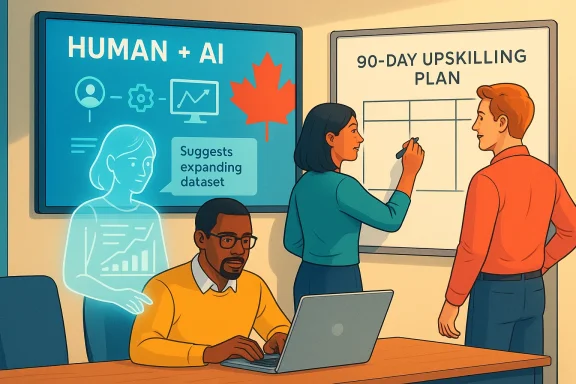
Practical advice for workers: a 90-day upskilling playbook
If you’re convinced by Saltzman’s premise and ready to act, here’s a tactical program that balances speed and substance.- Week 1–2: Baseline and plan
- Inventory your current role and identify repetitive tasks (reporting, drafting, data gathering) that AI could assist with.
- Choose 2–3 high-impact tools used in your industry (for many knowledge workers this will include Microsoft Copilot or similar, plus a cloud provider console or low-code automation tool).
- Week 3–6: Learn by doing
- Complete short, vendor-free foundational courses on AI concepts (one covering generative AI basics, one on data privacy and model verification).
- Run two small, reproducible projects: e.g., build a Copilot-augmented weekly status report and create a verified prompt library for a common team task.
- Week 7–10: Build proof of work
- Document outcomes: how many hours saved, error rates reduced, or customer response times improved. Create a one-page “audit” showing prompts used, edits made and verification steps.
- Publish a short portfolio artifact (Google Doc or PDF) that demonstrates tangible work — projects beat certifications alone.
- Week 11–12: Credential and network
- Earn a micro-credential or recognized short certificate (AWS Skill Builder, Microsoft Learn, a reputable MOOC) that aligns with your project.
- Share results with your manager and propose a pilot to scale the approach to a team process.
- Prompt engineering and agent orchestration
- Data hygiene and basic analytics (Excel + Power Query, SQL fundamentals)
- Cloud fundamentals (AWS or Azure essentials)
- Cybersecurity and privacy basics for safe AI use
- Soft skills: decision-making frameworks and communication
Advice for employers: how to avoid the “reskilling theater” trap
Employers must treat reskilling as a measurable operational program, not PR theater. Effective programs share these attributes:- Role-based training. Tailor learning to specific job tasks and include verification exercises tied to day-to-day workflows.
- Internal mobility windows. Provide clear, time-limited pathways for affected employees to move into adjacent roles with paid training and real placement targets.
- Measurable outcomes. Track not only course completion but downstream outcomes such as promotion rates, productivity metrics and internal placement success.
- Governance and secure tooling. Offer enterprise-grade copilots with enterprise controls, data residency options and audit logs. Train employees on safe usage and IP protection.
- Preserve learning opportunities. Redesign early-career tasks intentionally so junior staff still get foundation-building experiences — automate repetitive tasks but keep annotated, supervised practice opportunities.
- Pilot with a small, cross-functional team that includes an L&D lead and an IT security owner.
- Measure baseline productivity and error rates before the pilot, then set realistic targets for improvement.
- If the pilot hits targets, scale with role-based learning pathways tied to internal hiring commitments.
Policy and systemic risks to watch
Saltzman’s call to action for individuals is necessary but not sufficient. There are systemic issues that public policy and industry partnerships must address:- Access and equity: Free vendor training is valuable, but access gaps (rural, low-income, language barriers) mean some workers will be left behind without targeted public investment.
- Credential inflation: An oversupply of short badges without rigorous assessment risks credential devaluation. Governments and training providers should partner on validated micro-credentials with meaningful assessments.
- Jobs pipeline for juniors: If entry-level tasks vanish, nations risk a generation with weaker practical experience. Apprenticeships and paid rotational programs can preserve career ladders.
- Transparency in reorganizations: When companies restructure, claims that cuts are “not about AI” must be accompanied by transparent placement and retraining outcomes to maintain public trust.
Strengths and opportunities in Saltzman’s argument
- Clear, actionable advice: Saltzman’s framing — treat AI as career insurance — is pragmatic and reduces paralysis.
- Vendor and survey evidence aligns: Multiple independent and vendor-supplied studies point to improved efficiency in repeatable tasks and a real appetite among Canadian SMBs to invest in AI.
- Scalability of training resources: The growth of vendor training programs and public courses means there are diverse, often free, ways for workers to begin learning.
Risks and blind spots in the coverage
- Over-reliance on vendor messaging: Many headline claims about AI’s productivity come from vendors with commercial incentives. Independent evaluation of sustained productivity and net employment impacts is still emerging.
- Simplifying causality in layoffs: Reporting that pairs layoffs and AI investment can be misleading without careful causal analysis. Layoffs are multi-factorial; automation is one of several levers companies use.
- Uneven access to meaningful training: Not all “AI training” is equivalent; short awareness modules are not substitutes for hands-on, assessed learning with verifiable outcomes.
A checklist for readers: what to do next (workers and employers)
For individual workers- Do: Run a 90-day applied AI project and document results.
- Do: Learn two practical tools relevant to your field and an adjacent skill (cloud, analytics, security).
- Don’t: Rely only on awareness modules — prioritize hands-on learning, verification practice and portfolios.
- Do: Design role-based reskilling with measurable placement commitments.
- Do: Protect on-the-job learning for junior staff by reserving learning-rich tasks.
- Don’t: Use short micro-credentials as a PR substitute for internal mobility windows.
- Do: Fund validated micro-credentials with placement metrics and accessibility provisions.
- Do: Support employer-led apprenticeships and co-funded reskilling partnerships.
- Don’t: Assume vendor-funded training alone will close structural gaps in labor markets.
Final analysis: treat AI fluency like financial literacy — essential, not optional
Marc Saltzman’s central piece of advice — that Canadian workers should pursue upskilling and view AI as a competitive ally — is not techno-optimism masquerading as rhetoric. The evidence shows that AI is already altering workflows, reshaping employer demands and creating new premium roles. The choice facing workers and organizations is practical: will they treat AI as a tool to be mastered and governed, or as an external force to be feared?The responsible route is clear and actionable: learn the tools, document practical outcomes, demand measured employer commitments to redeployment, and insist on public-policy programs that ensure access and verifiable quality. Workers who combine domain expertise, AI orchestration skills and high-trust professional behavior will not only remain employable — they will define the roles that drive organizations forward.
Upskilling isn’t a panacea, and it won’t make every layoff vanish. But it is a pragmatic hedge: the same technology that amplifies organizational capacity also rewards the people who can wield it thoughtfully. For Canadian workers, that’s the insurance Saltzman recommends — and the time to start buying the policy is now.
Source: Toronto Sun SALTZMAN: Canadian workers, consider upskilling to remain employed
