Waimakariri District Council’s AI-generated royal holiday video, reposted on May 28 to advertise King’s Birthday Weekend service changes in North Canterbury, has become a small but revealing flashpoint in Canterbury’s wider move from experimental AI publicity to operational AI use. The complaint that ratepayer money was funding “AI slop” was not just a throwaway social-media jab. It captured the central tension now facing local government: councils are adopting AI because they are under pressure to do more with less, but residents mostly encounter the technology when it looks frivolous, synthetic, or faintly embarrassing.
The Waimakariri video was, on its face, a minor communications misfire. Councils have always tried to dress up public notices with seasonal graphics, puns, mascots, and holiday gimmicks; AI merely made the gimmick more conspicuous. A council reminding residents about long-weekend service changes is not exactly the stuff of democratic crisis.
But AI changes the optics. A bad poster looks like a bad poster; a bad AI video looks like a procurement choice, a labour choice, and a taste failure all at once. The phrase “AI slop” has become a shorthand for a broader public suspicion that organisations are using automation not to improve service, but to cheaply simulate effort.
That is why the Waimakariri episode matters. It was not primarily about King Charles, Queen Camilla, or a cartoon tour of North Canterbury. It was about the moment residents noticed that councils were experimenting with generative tools in public-facing work while rates bills, infrastructure demands, and service expectations remain painfully real.
That language is revealing. Councils are not presenting AI as magic. They are presenting it as administrative machinery — a way to summarise, classify, search, draft, analyse, and accelerate the routine work that fills the public-sector day.
For IT professionals, that distinction matters. The most consequential AI deployments in government are unlikely to be the ones residents can see on Facebook. They are more likely to be buried in workflows: meeting-note summaries, customer-service triage, consent-processing support, document search, mapping analysis, compliance prioritisation, and internal policy drafting.
The risk is that public debate gets stuck on the visible kitsch while the serious systems mature in the background. A synthetic royal video may be ugly, but an AI-assisted regulatory workflow is where accountability, bias, auditability, privacy, and institutional memory become urgent.
That does not mean the objection is always fair. A staff member using an approved AI tool to draft a 20-second social-media clip may cost less than a traditional video production process, and some uses of AI may genuinely reduce administrative drag. In a council environment where communications teams, planners, consent staff, and customer-service desks are under pressure, the attraction is obvious.
But the public-sector test is not merely whether AI is cheaper. It is whether it makes the service better, more accessible, more transparent, and more reliable. A council can save half an hour producing a video and still lose trust if the result signals that public communication has been delegated to a machine with no local ear.
That is the political trap for councils. They may adopt AI to look modern and efficient, only to discover that residents interpret the output as evidence of institutional laziness. In local government, where trust is accumulated through boring competence, cheap-looking can be more damaging than expensive.
Copilot-style assistants, meeting summarisation, document drafting, search augmentation, and analytics features are being embedded into Microsoft 365, Teams, Edge, Windows, Power Platform, Azure services, and line-of-business integrations. The organisational question is shifting from “Should we buy AI?” to “Which of the AI features we already have should we allow, log, govern, or disable?”
That distinction is important for councils. Local authorities do not typically have the luxury of building bespoke AI platforms from scratch. They inherit technology through enterprise licences, vendor upgrades, cloud migrations, and productivity suites. The path of least resistance is not a grand AI strategy; it is a staff member discovering that a familiar tool can now summarise a document, draft an email, or rewrite a public notice.
This is where quiet adoption becomes hard to see. A council can say it is not using AI to make decisions while staff still use AI to prepare the material around those decisions. That may be entirely defensible, but only if the organisation understands where assistance ends and influence begins.
A planner who receives an AI summary of submissions is still human. A compliance officer who reviews an AI-assisted risk ranking is still human. A communications adviser who approves an AI-generated post is still human. The question is whether those humans have the time, expertise, and institutional permission to challenge what the system produces.
This is especially relevant in councils, where workload pressures are not theoretical. Building consent demand, infrastructure planning, environmental monitoring, transport obligations, emergency management, community engagement, and reform programmes all compete for staff attention. AI is attractive because it promises relief from volume. That same volume can also make rubber-stamping more likely.
If AI is used only where staff can meaningfully verify it, the risk is manageable. If it is used to accelerate work beyond the point where verification is realistic, “human oversight” becomes a ritual phrase. In regulated public services, that is not good enough.
That matters because technology decisions made during structural reform tend to become the plumbing of the next system. Shared services, common consent platforms, regional data systems, customer portals, mapping tools, and document-management systems can outlast the political arguments that created them. AI could become part of that plumbing before residents have had a clear debate about what kind of automated assistance is acceptable.
Waimakariri, Christchurch, Selwyn, and Environment Canterbury already operate in overlapping realities. People live in one district, work in another, commute across boundaries, use shared infrastructure, and expect digital services to behave consistently. The logic for shared tools is strong.
But shared tools also diffuse accountability. If an AI-assisted system helps triage a building consent across multiple councils, who explains the model’s limits? If a regional data tool influences infrastructure planning, who owns the assumptions? If a chatbot gives incorrect advice about a council process, which elected members carry the political cost?
These are not reasons to reject AI. They are reasons to treat it as governance infrastructure, not office stationery.
The first temptation is summarisation. Feed in a long report, get a digest. Feed in submissions, get themes. Feed in a policy draft, get plain-English alternatives. This is genuinely useful work when handled carefully.
But public records are not ordinary office clutter. They are evidence. They can be subject to information requests, audits, judicial review, ombudsman scrutiny, privacy obligations, and political dispute. If an AI tool summarises or transforms a record, the organisation needs to know what was input, what was output, who checked it, and whether the intermediate work should itself be retained.
This is where informal adoption is risky. A staff member pasting text into an external tool may solve an immediate problem while creating a future records, privacy, or confidentiality issue. A council-approved AI environment may reduce that risk, but approval alone is not enough. The workflow has to preserve accountability.
Anyone who has tried to find the right council page for a dog registration, rates query, building inspection, rubbish collection change, noise complaint, or flood-related update knows the problem. Council websites contain huge amounts of information, but the resident usually arrives with a messy human question. AI search and conversational interfaces are well suited to that gap.
The catch is that councils cannot treat a chatbot like a marketing widget. Local-government advice is consequential. A wrong answer about a deadline, fee, consent requirement, parking rule, hazardous waste process, or emergency instruction can create real harm.
That means the performance bar is higher than it is for a retail FAQ bot. A council AI assistant must know when not to answer, when to cite official material, when to escalate, and when the answer depends on a person’s property, consent history, or legal circumstances. The safest design may often be the least dazzling: narrow scope, clear disclaimers, auditable sources, and fast handoff to staff.
In that context, a council’s AI joke lands badly. It appears at the surface as playfulness, but underneath it suggests a deeper possibility: that public institutions may be tempted to substitute synthetic communication for genuine engagement.
Councils should take that seriously. Local government is already a difficult communications environment. Residents often notice the council only when something breaks, costs more, gets delayed, or imposes a rule. AI-generated messaging that feels generic or uncanny reinforces the belief that the institution is talking at people rather than with them.
The irony is that AI could help councils communicate better if used modestly. It can translate jargon, improve accessibility, produce draft plain-language summaries, and help staff tailor information for different audiences. But that work needs editorial judgment. Without it, AI does not humanise bureaucracy; it automates its worst habits.
These questions are familiar to sysadmins and IT managers, but they are often invisible in public debate. Residents see the output; IT teams inherit the risk. A casual AI pilot can become operational dependency with astonishing speed.
Vendor lock-in is especially relevant for smaller councils. A large city may have the internal capability to negotiate, test, monitor, and integrate AI tools. A district council may rely more heavily on vendor assurances, shared-service arrangements, or templates borrowed from peers. That is not a failure; it is the reality of local-government resourcing.
The answer is not for every council to build an AI bureaucracy. It is for councils to be brutally clear about which uses are low-risk, which require formal approval, and which should be off-limits until governance catches up. A staff productivity tool is not the same as a regulatory decision-support tool. A social-media draft is not the same as an environmental compliance model.
Councils should resist both extremes. Labeling every spell-check, grammar suggestion, or formatting assist as AI would be absurd. But synthetic video, AI-generated imagery of public figures, automated customer advice, AI-assisted consultation summaries, and algorithmic analysis used in reports deserve clearer disclosure.
The purpose of disclosure is not ritual confession. It is to help residents understand when a machine-generated or machine-assisted process may have shaped what they are seeing. That understanding is essential if people are to challenge errors, request records, or trust the result.
The Waimakariri video shows the reputational cost of getting this wrong. Residents are less forgiving when they feel they discovered AI use rather than being told about it plainly. In public service, surprise is rarely a good governance strategy.
That is the standard councils should apply. AI should reduce friction in the service of public work, not become the centrepiece of the communication. If residents are talking more about the tool than the service, something has probably gone wrong.
This is also where IT governance has to become practical. Councils need approved toolsets, staff training, prompt and output handling rules, privacy controls, logging, retention policies, escalation paths, and review processes. But they also need cultural rules: do not use AI to fake local voice; do not use it to avoid accountability; do not let synthetic polish substitute for substance.
There is a lesson here for every organisation, public or private. AI adoption succeeds when it is boring enough to be trusted. It fails when it looks like a shortcut around competence.
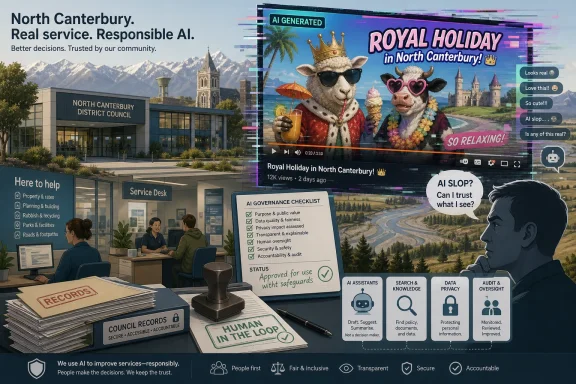 The cartoon king was the least important part of the story
The Waimakariri video was, on its face, a minor communications misfire. Councils have always tried to dress up public notices with seasonal graphics, puns, mascots, and holiday gimmicks; AI merely made the gimmick more conspicuous. A council reminding residents about long-weekend service changes is not exactly the stuff of democratic crisis.But AI changes the optics. A bad poster looks like a bad poster; a bad AI video looks like a procurement choice, a labour choice, and a taste failure all at once. The phrase “AI slop” has become a shorthand for a broader public suspicion that organisations are using automation not to improve service, but to cheaply simulate effort.
That is why the Waimakariri episode matters. It was not primarily about King Charles, Queen Camilla, or a cartoon tour of North Canterbury. It was about the moment residents noticed that councils were experimenting with generative tools in public-facing work while rates bills, infrastructure demands, and service expectations remain painfully real.
Local government has found AI before local democracy has found the vocabulary for it
Across Canterbury, AI is no longer confined to novelty content. Environment Canterbury has moved to re-establish an Artificial Intelligence Working Group to examine how AI is being used for data analysis, decision support, and community service. Its public explanation is careful: AI does not make decisions about individuals, funding, regulatory action, or submissions; staff remain accountable; personal information is not meant to be fed into tools.That language is revealing. Councils are not presenting AI as magic. They are presenting it as administrative machinery — a way to summarise, classify, search, draft, analyse, and accelerate the routine work that fills the public-sector day.
For IT professionals, that distinction matters. The most consequential AI deployments in government are unlikely to be the ones residents can see on Facebook. They are more likely to be buried in workflows: meeting-note summaries, customer-service triage, consent-processing support, document search, mapping analysis, compliance prioritisation, and internal policy drafting.
The risk is that public debate gets stuck on the visible kitsch while the serious systems mature in the background. A synthetic royal video may be ugly, but an AI-assisted regulatory workflow is where accountability, bias, auditability, privacy, and institutional memory become urgent.
The rates argument is politically potent because it sounds like common sense
The “my rates shouldn’t fund this” objection is powerful because it collapses a complex technology debate into a household-budget complaint. Ratepayers do not need to understand model weights, prompt engineering, or Microsoft Copilot licensing to ask whether council money is being spent wisely.That does not mean the objection is always fair. A staff member using an approved AI tool to draft a 20-second social-media clip may cost less than a traditional video production process, and some uses of AI may genuinely reduce administrative drag. In a council environment where communications teams, planners, consent staff, and customer-service desks are under pressure, the attraction is obvious.
But the public-sector test is not merely whether AI is cheaper. It is whether it makes the service better, more accessible, more transparent, and more reliable. A council can save half an hour producing a video and still lose trust if the result signals that public communication has been delegated to a machine with no local ear.
That is the political trap for councils. They may adopt AI to look modern and efficient, only to discover that residents interpret the output as evidence of institutional laziness. In local government, where trust is accumulated through boring competence, cheap-looking can be more damaging than expensive.
The real adoption curve runs through Microsoft, not science fiction
For WindowsForum readers, the Canterbury story should feel familiar because it mirrors what is happening inside many organisations running Microsoft-centric estates. AI is not arriving as a robot clerk. It is arriving as a button in the tools people already use.Copilot-style assistants, meeting summarisation, document drafting, search augmentation, and analytics features are being embedded into Microsoft 365, Teams, Edge, Windows, Power Platform, Azure services, and line-of-business integrations. The organisational question is shifting from “Should we buy AI?” to “Which of the AI features we already have should we allow, log, govern, or disable?”
That distinction is important for councils. Local authorities do not typically have the luxury of building bespoke AI platforms from scratch. They inherit technology through enterprise licences, vendor upgrades, cloud migrations, and productivity suites. The path of least resistance is not a grand AI strategy; it is a staff member discovering that a familiar tool can now summarise a document, draft an email, or rewrite a public notice.
This is where quiet adoption becomes hard to see. A council can say it is not using AI to make decisions while staff still use AI to prepare the material around those decisions. That may be entirely defensible, but only if the organisation understands where assistance ends and influence begins.
“Human in the loop” is not a policy unless the human has time to think
The standard reassurance in public-sector AI is that humans remain responsible. It is a necessary principle, but it can become a slogan if nobody examines the working conditions around it.A planner who receives an AI summary of submissions is still human. A compliance officer who reviews an AI-assisted risk ranking is still human. A communications adviser who approves an AI-generated post is still human. The question is whether those humans have the time, expertise, and institutional permission to challenge what the system produces.
This is especially relevant in councils, where workload pressures are not theoretical. Building consent demand, infrastructure planning, environmental monitoring, transport obligations, emergency management, community engagement, and reform programmes all compete for staff attention. AI is attractive because it promises relief from volume. That same volume can also make rubber-stamping more likely.
If AI is used only where staff can meaningfully verify it, the risk is manageable. If it is used to accelerate work beyond the point where verification is realistic, “human oversight” becomes a ritual phrase. In regulated public services, that is not good enough.
Canterbury’s AI moment is colliding with a local-government shake-up
The timing is awkward. Canterbury councils are not discussing AI in a stable institutional environment. They are also navigating central-government pressure for local-government reform, possible amalgamation, and questions about the future shape of regional governance after 2028.That matters because technology decisions made during structural reform tend to become the plumbing of the next system. Shared services, common consent platforms, regional data systems, customer portals, mapping tools, and document-management systems can outlast the political arguments that created them. AI could become part of that plumbing before residents have had a clear debate about what kind of automated assistance is acceptable.
Waimakariri, Christchurch, Selwyn, and Environment Canterbury already operate in overlapping realities. People live in one district, work in another, commute across boundaries, use shared infrastructure, and expect digital services to behave consistently. The logic for shared tools is strong.
But shared tools also diffuse accountability. If an AI-assisted system helps triage a building consent across multiple councils, who explains the model’s limits? If a regional data tool influences infrastructure planning, who owns the assumptions? If a chatbot gives incorrect advice about a council process, which elected members carry the political cost?
These are not reasons to reject AI. They are reasons to treat it as governance infrastructure, not office stationery.
Public-sector AI fails first as a records-management problem
One of the most underappreciated issues in council AI is records. Local government runs on documents: submissions, agendas, minutes, reports, consents, enforcement notices, engineering assessments, consultation feedback, correspondence, legal advice, and archives. AI tools are being sold into precisely that document-heavy environment.The first temptation is summarisation. Feed in a long report, get a digest. Feed in submissions, get themes. Feed in a policy draft, get plain-English alternatives. This is genuinely useful work when handled carefully.
But public records are not ordinary office clutter. They are evidence. They can be subject to information requests, audits, judicial review, ombudsman scrutiny, privacy obligations, and political dispute. If an AI tool summarises or transforms a record, the organisation needs to know what was input, what was output, who checked it, and whether the intermediate work should itself be retained.
This is where informal adoption is risky. A staff member pasting text into an external tool may solve an immediate problem while creating a future records, privacy, or confidentiality issue. A council-approved AI environment may reduce that risk, but approval alone is not enough. The workflow has to preserve accountability.
The chatbot is the friendly face of a harder service problem
Residents will probably encounter council AI most directly through customer-service interfaces. That could mean chatbots, smarter search, voice transcription, email triage, or form-filling assistance. Done well, these tools could make council services less painful.Anyone who has tried to find the right council page for a dog registration, rates query, building inspection, rubbish collection change, noise complaint, or flood-related update knows the problem. Council websites contain huge amounts of information, but the resident usually arrives with a messy human question. AI search and conversational interfaces are well suited to that gap.
The catch is that councils cannot treat a chatbot like a marketing widget. Local-government advice is consequential. A wrong answer about a deadline, fee, consent requirement, parking rule, hazardous waste process, or emergency instruction can create real harm.
That means the performance bar is higher than it is for a retail FAQ bot. A council AI assistant must know when not to answer, when to cite official material, when to escalate, and when the answer depends on a person’s property, consent history, or legal circumstances. The safest design may often be the least dazzling: narrow scope, clear disclaimers, auditable sources, and fast handoff to staff.
Residents are right to distrust AI theatre
The public backlash to AI content is not just technophobia. It is a rational response to a decade of institutions using digital transformation language to justify worse service. People have learned to be suspicious when organisations promise efficiency, because efficiency often means fewer humans, longer queues, worse accountability, and more self-service.In that context, a council’s AI joke lands badly. It appears at the surface as playfulness, but underneath it suggests a deeper possibility: that public institutions may be tempted to substitute synthetic communication for genuine engagement.
Councils should take that seriously. Local government is already a difficult communications environment. Residents often notice the council only when something breaks, costs more, gets delayed, or imposes a rule. AI-generated messaging that feels generic or uncanny reinforces the belief that the institution is talking at people rather than with them.
The irony is that AI could help councils communicate better if used modestly. It can translate jargon, improve accessibility, produce draft plain-language summaries, and help staff tailor information for different audiences. But that work needs editorial judgment. Without it, AI does not humanise bureaucracy; it automates its worst habits.
The procurement question is hiding in plain sight
Every council AI deployment eventually becomes a procurement story. Which vendor hosts the data? Where is it processed? What contractual terms govern training, retention, logging, and deletion? Can the council audit outputs? What happens when prices rise after staff become dependent on the tool?These questions are familiar to sysadmins and IT managers, but they are often invisible in public debate. Residents see the output; IT teams inherit the risk. A casual AI pilot can become operational dependency with astonishing speed.
Vendor lock-in is especially relevant for smaller councils. A large city may have the internal capability to negotiate, test, monitor, and integrate AI tools. A district council may rely more heavily on vendor assurances, shared-service arrangements, or templates borrowed from peers. That is not a failure; it is the reality of local-government resourcing.
The answer is not for every council to build an AI bureaucracy. It is for councils to be brutally clear about which uses are low-risk, which require formal approval, and which should be off-limits until governance catches up. A staff productivity tool is not the same as a regulatory decision-support tool. A social-media draft is not the same as an environmental compliance model.
Disclosure should be boring, consistent, and useful
One reason AI controversies flare is that disclosure is inconsistent. Sometimes organisations label AI-generated content. Sometimes they do not. Sometimes they disclose only after criticism. Sometimes they hide behind vague language about “digital tools.”Councils should resist both extremes. Labeling every spell-check, grammar suggestion, or formatting assist as AI would be absurd. But synthetic video, AI-generated imagery of public figures, automated customer advice, AI-assisted consultation summaries, and algorithmic analysis used in reports deserve clearer disclosure.
The purpose of disclosure is not ritual confession. It is to help residents understand when a machine-generated or machine-assisted process may have shaped what they are seeing. That understanding is essential if people are to challenge errors, request records, or trust the result.
The Waimakariri video shows the reputational cost of getting this wrong. Residents are less forgiving when they feel they discovered AI use rather than being told about it plainly. In public service, surprise is rarely a good governance strategy.
The councils that win with AI will make it less visible, not more magical
The best AI use in local government may be almost invisible to residents. Faster routing of service requests, better search of internal knowledge bases, clearer public notices, quicker transcription of meetings, improved accessibility, and more consistent answers across channels are not glamorous. They are useful.That is the standard councils should apply. AI should reduce friction in the service of public work, not become the centrepiece of the communication. If residents are talking more about the tool than the service, something has probably gone wrong.
This is also where IT governance has to become practical. Councils need approved toolsets, staff training, prompt and output handling rules, privacy controls, logging, retention policies, escalation paths, and review processes. But they also need cultural rules: do not use AI to fake local voice; do not use it to avoid accountability; do not let synthetic polish substitute for substance.
There is a lesson here for every organisation, public or private. AI adoption succeeds when it is boring enough to be trusted. It fails when it looks like a shortcut around competence.
The North Canterbury video leaves councils with a harder checklist
The Waimakariri episode should not become a simplistic morality tale in which AI is bad and handmade communications are good. The more useful lesson is that councils need a clearer bargain with residents before AI becomes normalised across core services.- Councils should distinguish publicly between novelty content, staff productivity tools, customer-service automation, analytical support, and systems that touch regulatory or funding decisions.
- AI-generated public-facing media should be disclosed when synthetic content is material to what residents are seeing or hearing.
- Staff should be barred from putting personal, confidential, legally sensitive, or submission-identifiable information into unapproved AI tools.
- AI-assisted summaries used in consultation, compliance, planning, or reporting should remain traceable to original records and subject to human verification.
- Procurement should address data location, retention, model training, audit rights, price escalation, and exit options before tools become embedded.
- Elected members should treat AI governance as part of service accountability, not as a technical side issue delegated entirely to IT.
References
- Primary source: The Press
Published: 2026-06-28T16:50:12.819163

The Press
www.thepress.co.nz
- Related coverage: guardianonline.co.nz
Government sets merger clock ticking for Canterbury councils
The Government’s message is consider amalgamation or be merged, but some Canterbury councils won’t be rushing into a decision. The government has given councils an ultimatum to prepare amalgamation plans within three months, or the government will do it. Local Government Minister Simon Watts... www.guardianonline.co.nz
- Related coverage: waimakariri.govt.nz
- Related coverage: ecan.govt.nz
Environment Canterbury's role in urban development | Environment Canterbury
Our roles and responsibilities in the region.www.ecan.govt.nz - Related coverage: rnz.co.nz
Division emerges in Canterbury over local government overhaul | RNZ
Canterbury councils are divided over a government proposal to replace regional councils with a mayor-led board. www.rnz.co.nz
- Related coverage: treasury.govt.nz