

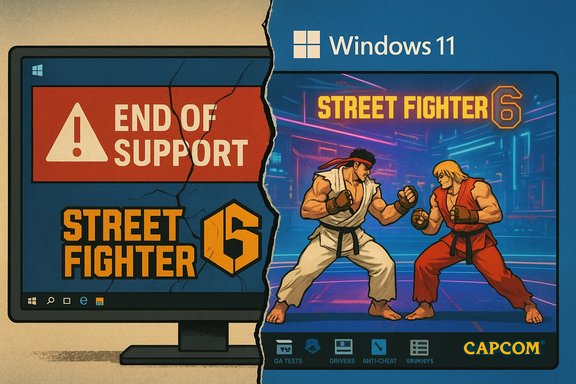
Capcom has formally shifted its Windows 10 support posture for the PC version of Street Fighter 6, telling players that it can no longer guarantee the game will run on Windows 10 following Microsoft’s October 14, 2025 end-of-support milestone — a practical warning that places the burden of long-term compatibility on players who remain on the older OS while pushing active development and QA toward Windows 11.
Microsoft ended mainstream support for consumer editions of Windows 10 on October 14, 2025, meaning the company no longer issues routine feature updates, non-security patches, or guaranteed technical assistance for Windows 10 Home and Pro. Microsoft’s lifecycle guidance explicitly recommends upgrading eligible PCs to Windows 11 or enrolling in short-term Extended Security Updates (ESU) for those that can’t immediately transition. That calendar decision — a vendor-level end of support — has cascading consequences across the software ecosystem. Hardware vendors, middleware and anti‑cheat providers, and game publishers typically keep testing and engineering resources focused on supported OS baselines; when that baseline is withdrawn, those third parties increasingly treat legacy platforms as a best-effort proposition rather than a guaranteed configuration. Capcom’s advisory for Street Fighter 6 is an example of this industry-wide realignment.
Players should treat the notice as a planning signal: back up, evaluate Windows 11 eligibility, document current working drivers/configurations, and consider ESU or alternative platforms if immediate migration isn’t possible. Capcom’s notice does not, at present, represent an immediate technical lockout of Street Fighter 6 from Windows 10, but it does mark a turning point. The long-term playability of Windows 10 installations will increasingly depend on community ingenuity, driver stability, and whether anti‑cheat/middleware vendors continue to support legacy builds — not on publisher guarantees.
Source: EventHubs Capcom releases end of support notice of Windows 10 for the PC version of Street Fighter 6
 Background
Microsoft ended mainstream support for consumer editions of Windows 10 on October 14, 2025, meaning the company no longer issues routine feature updates, non-security patches, or guaranteed technical assistance for Windows 10 Home and Pro. Microsoft’s lifecycle guidance explicitly recommends upgrading eligible PCs to Windows 11 or enrolling in short-term Extended Security Updates (ESU) for those that can’t immediately transition. That calendar decision — a vendor-level end of support — has cascading consequences across the software ecosystem. Hardware vendors, middleware and anti‑cheat providers, and game publishers typically keep testing and engineering resources focused on supported OS baselines; when that baseline is withdrawn, those third parties increasingly treat legacy platforms as a best-effort proposition rather than a guaranteed configuration. Capcom’s advisory for Street Fighter 6 is an example of this industry-wide realignment.What Capcom actually said (and what it didn’t)
- Capcom’s notice states that because Microsoft ended Windows 10 support on October 14, 2025, Capcom “will no longer guarantee that Street Fighter 6 will run on Windows 10 systems.” The company allowed that the game may continue to launch on Windows 10 after that date, but it warned that future system updates or title updates may render the game incompatible on Windows 10 and that services for investigating Windows‑10‑specific problems would be discontinued.
- Importantly, Capcom’s statement is framed as a support-policy change, not a hard technical lockout. There was no public announcement that the game will immediately refuse to launch on Windows 10, nor did Capcom publish an OS-level enforcement mechanism in the statement. The company’s message is primarily a disclaimer: if you stay on Windows 10 you accept rising risk and limited publisher support going forward.
- Some outlets and community posts have paraphrased that Street Fighter 6 “now requires Windows 11.” That specific phrasing goes beyond Capcom’s wording. Capcom’s notice withdraws guaranteed compatibility for Windows 10, but it does not explicitly say that the game has been re‑released with a hard Windows 11 prerequisite. Treat statements saying the game “requires Windows 11” as partially unverified unless Capcom or the storefront(s) publish a new system‑requirements entry that removes Windows 10 entirely. Event pages and store system requirements continue to show Windows 10 in various listings as of this writing.
Why publishers make this call: the technical and operational logic
Game development and live-service operations increasingly depend on a complex stack of platform services and low-level drivers:- Modern game engines rely on updated OS kernel features, graphics runtime libraries, and driver models. New optimizations (for example, DirectStorage integrations or newer DirectX behaviors) are validated primarily on currently supported OS versions.
- Anti‑cheat and anti‑tamper systems operate close to the kernel and often require active compatibility testing. When the OS vendor stops updating kernel subsystems, maintaining kernel-mode drivers for an unsupported platform becomes risky and expensive.
- The QA test matrix multiplies rapidly (OS build × GPU driver × anti‑cheat version × middleware). Narrowing the baseline to supported OS versions reduces that engineering surface and focuses patch validation on a smaller, more reliable set of configurations.
What this means for PC gamers who play Street Fighter 6
Short-term practical impact- The game will most likely continue to run on many Windows 10 machines immediately after Microsoft’s cutoff. There is no evidence of an instantaneous "kill switch." Capcom’s statement, by its wording, permits continued play where nothing breaks.
- Future game updates, GPU driver changes, or middleware/anti‑cheat revisions can introduce behaviors and regressions that manifest only on Windows 10. In those cases Capcom has signaled it will not be required to investigate or fix Windows‑10‑only regressions introduced after October 14, 2025. Players who opt to remain on Windows 10 will be expected to rely on community workarounds, OEM or driver rollbacks, or upgrade to Windows 11 to regain vendor-backed fixes.
- Third parties may stop certifying drivers or pushing updates for legacy OS configurations, making it harder to find compatible GPU drivers or anti‑cheat versions that are known to work with an older OS and a modern live-service title.
- For tournament competitors, streamers, or those who maintain purpose-built rigs, the absence of guaranteed vendor support introduces operational risk for events and ranked play: an unforeseen Windows‑10-only regression could sideline players with no official hotfix from Capcom.
- For households or labs running older hardware that cannot meet Windows 11’s requirements (TPM 2.0, Secure Boot, UEFI firmware, certain CPU families), the options narrow to enrolling in Microsoft’s ESU (if eligible) or migrating to alternative platforms (console, cloud, or Linux where feasible) to preserve long-term playability.
What Capcom’s notice does not settle (open questions and unverifiable claims)
- Whether Capcom will eventually modify the Steam / storefront system requirements to require Windows 11 is not confirmed by the November notice. Some coverage and community messages have shortened the nuance into “Street Fighter 6 requires Windows 11.” That is not the same as Capcom explicitly changing the minimum OS requirement in the store listing. Until Capcom or the major stores publish an updated system requirement removing Windows 10, the requirement claim should be treated as unverified.
- The exact lifecycle and timeline for anti‑cheat or DRM vendors to drop Windows 10 support is not controlled by Capcom. If the anti‑cheat supplier updates kernel‑mode components and validates them only on Windows 11, that could create a forced compatibility break independent of Capcom’s policy decision. These third‑party timelines are dynamic and can vary widely; they should be monitored on vendor channels.
Practical checklist for Street Fighter 6 players on Windows 10
If you own or play Street Fighter 6 on a Windows 10 machine, treat Capcom’s notice as a planning signal. The following checklist prioritizes safety, portability, and continuity of play:- Backup strategy
- Make a full system image or at minimum back up saved profiles and key configuration files for Street Fighter 6.
- Verify upgrade eligibility
- Run Microsoft’s PC Health Check or OEM compatibility tools to see whether your PC can upgrade to Windows 11 without hardware changes. If eligible, plan a tested upgrade to Windows 11.
- Consider Extended Security Updates (ESU)
- If your device cannot run Windows 11 immediately and you need more time, investigate Microsoft’s consumer ESU options to keep receiving security updates for a limited period. ESU is a temporary stopgap, not a long-term fix.
- Keep drivers stable and note working versions
- If Street Fighter 6 runs correctly today, document the GPU driver and anti‑cheat/middleware versions that work. That data can help you rollback a problematic update later.
- Track official channels
- Follow Capcom’s official Steam/store notices and Capcom Support pages for any further lifecycle updates or a formal change to system requirements.
- For competitive players: maintain a test rig
- If you compete, keep one validated machine on Windows 11 (or a supported console) to avoid being affected by Windows‑10‑specific regressions during events.
How publishers and platform operators are responding industry-wide
Capcom’s move is not unique. Multiple publishers that operate actively updated titles have begun aligning their support commitments with Microsoft’s lifecycle. Platform operators are also pruning legacy footprints:- Valve has signalled a related housekeeping step by dropping support for 32‑bit Windows clients beginning January 1, 2026, which narrows the number of legacy OS combinations that stores will validate. Many publishers interpret this trend as permission to refocus QA on 64‑bit, supported OS baselines.
- Other large studios have issued similar advisories for their live-service titles, warning that Windows 10 may not be tested against future patches and that support for post-ESOL problems will be limited. These moves reflect the practical economics of long-term live service support.
Technical scenarios where Windows 10 users are most exposed
- Anti‑cheat update breaks: kernel-mode anti‑cheat drivers updated for Windows 11 might rely on kernel changes or driver signing enforcement that causes the anti‑cheat to fail on older Windows 10 builds, resulting in launch blocks or crashes.
- GPU driver regressions: GPU vendors prioritize testing their newest drivers on supported OSes. A driver update optimized for Windows 11 might unintentionally change shader compilation or memory handling behaviors that break a Windows‑10-only path in the game.
- Middleware/Runtime updates: Libraries for audio, networking, or physics may receive updates that assume modern platform APIs; if a title ships an update compiled against newer runtime expectations, Windows 10 can be left behind.
Mitigations and fallback options
- Roll back drivers or platform updates that introduce regressions. Keep installers for known-good GPU drivers and OS updates.
- Use cloud or console alternatives. If continuity matters more than OS fidelity, playing Street Fighter 6 on a supported console or via a cloud gaming service reduces the dependency on your local OS lifecycle.
- Community troubleshooting and mod solutions. Enthusiast communities are often first to publish workarounds or compatible driver combinations when vendors stop offering official support. Those solutions are community-maintained and may carry security or reliability trade-offs.
- Maintain a Windows 11 reference machine. For tournament-ready stability, keep one system updated and validated on Windows 11 to avoid last-minute compatibility surprises.
Capcom support pages and the current system requirements — the present picture
At the time of writing, Steam’s system requirements and Capcom’s support/troubleshooting pages still list Windows 10 in the OS compatibility fields for Street Fighter 6, which further underscores that Capcom’s notice is a precautionary support posture rather than an immediate hard requirement change. If Capcom later updates the store entry to remove Windows 10, that would be the clearest indicator of an enforced minimum OS change. Until then, players should read the notice as a limitation on future guarantees rather than an immediate refusal to run.Editorial assessment: strengths, risks, and the fairness question
Strengths of Capcom’s approach- Practical alignment with the platform vendor. It is operationally rational for a game publisher to sync long-term QA efforts with the OS vendor’s lifecycle. This lets engineers focus on a narrower matrix and reduces the risk that resources are spread thin across unsupported configurations.
- Clear consumer signaling. The public notice gives players information to plan upgrades, backups, or migration to other platforms — better than silent breaks after an unexpected update.
- Abrupt friction for late adopters. Some players bought or installed Street Fighter 6 recently and may now find themselves without guaranteed support. While the move is defensible from a lifecycle perspective, the timing and communication channel (store/community posts rather than a consolidated lifecycle policy page) can feel abrupt.
- Potential fragmentation in competitive play. If a subset of the player base stays on Windows 10 and experiences unique regressions, the competitive landscape could become fragmented, causing fairness and logistics headaches for events.
- Security and reliability trade-offs. Users who delay upgrading face accumulating security risk as Windows 10 stops receiving platform updates. This is independent of games but compounds the overall cost of staying on an unsupported OS.
- The broad principle — “we won’t guarantee support for an OS the vendor stopped supporting” — is defensible. The fairness question is in the execution: publishers and stores should communicate clearly, give ample lead time when possible, and provide practical guidance for players who cannot upgrade immediately (for example, by documenting known-good driver versions or offering fallback builds where feasible). Capcom’s notice is a step in that direction but leaves room for clearer, consolidated lifecycle documentation.
What to watch next (tracking indicators and signals)
- Store system-requirements updates: a removal of Windows 10 from the official store entry is the clearest signal that a hard minimum has changed. Monitor storefront listings for Street Fighter 6.
- Capcom Support and Steam news posts: changes to troubleshooting, rollback guidance, or published known‑good driver lists will matter.
- Anti‑cheat vendor advisories: if the anti‑cheat vendor (or any critical middleware provider) publishes a Windows 10 deprecation schedule, that timeline can produce forced incompatibilities independent of Capcom.
- Valve/Steam policy changes: broader platform-level shifts (like the end of 32‑bit client support) will reduce the range of legacy configurations that publishers can reasonably test.
Conclusion
Capcom’s end-of-support notice for Windows 10 users of Street Fighter 6 is a clear example of how software lifecycles ripple through the gaming ecosystem. Microsoft’s October 14, 2025 end-of-support decision forced an industry recalibration: publishers must choose whether to keep shouldering the QA burden for an unsupported OS or to focus resources on the platform that continues to receive vendor fixes. Capcom chose the latter in its support policy for Street Fighter 6 — a defensible move technically and economically, but one that leaves Windows 10 holdouts with higher risk and diminished official assistance.Players should treat the notice as a planning signal: back up, evaluate Windows 11 eligibility, document current working drivers/configurations, and consider ESU or alternative platforms if immediate migration isn’t possible. Capcom’s notice does not, at present, represent an immediate technical lockout of Street Fighter 6 from Windows 10, but it does mark a turning point. The long-term playability of Windows 10 installations will increasingly depend on community ingenuity, driver stability, and whether anti‑cheat/middleware vendors continue to support legacy builds — not on publisher guarantees.
Source: EventHubs Capcom releases end of support notice of Windows 10 for the PC version of Street Fighter 6
