

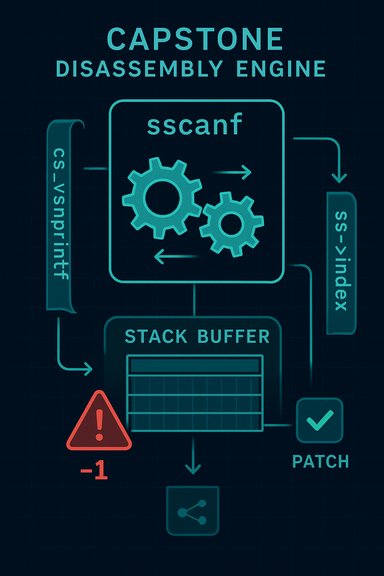
Capstone, the widely used disassembly framework, contains a memory‑safety bug (CVE‑2025‑68114) in SStream_concat where an unchecked return from vsnprintf can drive the stream index negative or past its end — a flaw fixed upstream in a December 2025 commit but one that can produce stack buffer underflow and stack buffer overflow in affected builds.
Background
Capstone is a modular, multi‑architecture disassembly engine embedded across many security tools, reverse‑engineering toolchains, debuggers, and binary analysis projects. The project exposes runtime hooks that let embedders override memory allocation and formatting functions; that flexibility is useful for integration but expands the attack surface when those hooks are supplied by untrusted code or misused by plugins.The flaw described by CVE‑2025‑68114 arises from this very flexibility: Capstone’s SStream code path takes the return value of a user‑controlled vsnprintf replacement and adds it directly to the stream’s internal index without verifying that the return was non‑negative and that the addition fits in the remaining buffer. That unchecked arithmetic can cause the index to underflow (become negative when interpreted as signed) or jump beyond buffer bounds, enabling subsequent writes to touch memory before or after the stack allocation. The project patched the bug in a commit that adds a negative‑return check and an overflow guard.
What the vulnerability is (plain technical summary)
- Component: SStream_concat in the Capstone codebase (SStream.c/SStream.h).
- Root cause: Unchecked return value from cs_vsnprintf (Capstone’s wrapper/hook for vsnprintf), combined with index arithmetic that assumed ret ≥ 0.
- Result: If cs_vsnprintf (the embedder‑supplied vsnprintf) returns a negative value, ss->index is decremented or underflows; if it returns a large positive number without a bounds check, the index can skip overflow detection and subsequent writes can overflow the stack buffer.
- Practical consequence: stack buffer underflow (writes before the buffer start) or overflow (writes past the buffer end), producing memory corruption, crashes under sanitizers, and — in some environments — a theoretical path to arbitrary code execution.
Timeline and discovery
- Disclosure and CVE assignment: The issue was recorded as CVE‑2025‑68114 in mid‑December 2025.
- Upstream action: A patch (commit 2c77971... was merged that adds return‑value validation, overflow guards, and unit tests that exercise malicious vsnprintf behavior.
- Public advisory: A GitHub Security Advisory and advisory text describe the vulnerability, PoC steps for reproducing under AddressSanitizer (ASan), and the recommended mitigation (upgrade Capstone to a patched revision).
Reproduction and proof‑of‑concept (PoC)
The upstream advisory includes a minimal PoC that demonstrates how an embedder‑supplied vsnprintf returning −1 will force ss->index to underflow and make the next single‑character write land before the buffer. The advisory shows exact build steps using CMake, AddressSanitizer, and a small test program that installs a custom cs_opt_mem struct with a malicious vsnprintf. Running the PoC under ASan reliably triggers a stack‑buffer‑overflow report on vulnerable builds. Why this PoC matters:- It shows the bug is not merely theoretical — the code path can be directly manipulated by replacing the formatting hook.
- When an application allows untrusted plugins or scripts to register memory/formatting hooks, attackers can supply a malicious vsnprintf to weaponize the defect.
- The ASan reproduction demonstrates crashability and memory corruption in practice; whether that corruption can be turned into reliable code execution depends on the target process’s runtime mitigations and layout.
Affected versions and scope
Upstream tags referenced in advisories point to Capstone builds up to and including 6.0.0‑Alpha5 as affected. Embedders and downstream packages that incorporate the vulnerable source, or shipping distributions that package that Capstone release, are in scope. Several public trackers list the affected range and assign a Medium severity (CVSS v3.1 base score 4.8) that reflects the local attack vector, required user interaction, and limited confidentiality/integrity impact absent further chaining. Key practical caveats about “who’s affected”:- Not all users of Capstone are equally exposed. The vulnerability requires control over cs_opt_mem.vsnprintf; pure disassembly of untrusted input alone is not sufficient unless the embedding application already exposes or uses the cs_option memory hooks in an untrusted context.
- Toolchains that allow third‑party extensions, scripting engines, or plugin loading that can alter Capstone’s memory hooks are the highest risk.
- Statically linked applications that bundle an affected Capstone release should be reviewed and rebuilt with the patched source.
Severity, exploitability, and real‑world risk
Multiple independent trackers (NVD/OSV/Ubuntu) record the same high‑level facts and converge on a moderate/medium severity score. The canonical CVSS vector used by these entries is AV:L/AC:L/PR:L/UI:R/S:U/C:L/I:L/A:L (local, low complexity, low privileges, user interaction required). Practical risk analysis:- Availability: Immediate — a crafted vsnprintf can crash a process or produce ASan-detectable corruption, making denial‑of‑service a credible outcome.
- Integrity / Confidentiality: Low to conditional — by itself the bug overwrites stack memory adjacent to the SStream buffer. Achieving reliable arbitrary code execution from this primitive typically requires additional favorable conditions (predictable stack layout, lack of modern mitigations like stack canaries, full RELRO/PIE/ASLR disabled), or other bugs to be chained together.
- Attack surface: Local and operational — the attacker needs to run code that can set the memory hook or convince a user to run a malicious plugin in an application that exposes those hooks.
- Evidence of active exploitation: No public in‑the‑wild exploitation reports are available at the time of disclosure; the GitHub advisory provides an explicit PoC for testing, which raises the urgency to patch embedded builds.
The upstream fix and what changed
Upstream developers merged a small, targeted change that:- Checks the return value of cs_vsnprintf and returns early if the value is negative, preventing index underflow.
- Adds an explicit overflow check before adding the vsnprintf return to ss->index, ensuring the added value fits the remaining buffer capacity.
- Adjusts the SStream index type (to size_t) and adds unit tests that simulate malicious vsnprintf behavior.
Recommended mitigations and upgrade guidance
Immediate actions for integrators and administrators:- Upgrade Capstone to the patched revision (the commit containing the check) or to any official release that explicitly states it includes the fix. Many distribution security trackers and advisories point to the same commit as the fix.
- If you ship or deploy applications that statically link vulnerable Capstone code, rebuild those applications against a patched Capstone tree and redeploy.
- Where immediate upgrading is impossible, adopt temporary mitigations:
- Disallow or sandbox any third‑party plugin, script, or extension that can call cs_option(CS_OPT_MEM) or register a custom vsnprintf hook.
- Run Capstone‑using processes with hardened runtime mitigations (stack canaries, PIE, ASLR, full RELRO). These do not eliminate the risk, but they raise the difficulty of turning stack corruption into code execution.
- Restrict the contexts in which user‑supplied code can run; prefer out‑of‑process or sandboxed disassembly engines when analyzing untrusted artifacts.
- Test upgrades: reproduce unit/test harnesses that exercise SStream behavior and run the PoC under ASan/UBSan in a controlled lab to confirm the patch removes the crash and does not introduce regressions. The upstream test additions are designed to catch the regression class.
- Identify all binaries that include Capstone (linked or embedded).
- Determine the Capstone version / source commit used.
- Rebuild with patched Capstone or apply the commit to your vendor fork.
- Run regression tests and ASan builds against the PoC.
- Deploy updates and notify downstream users about the embedded fix.
Who should care most
- Reverse‑engineering and malware analysis tool vendors that embed Capstone and expose plugin APIs.
- Binary instrumentation frameworks and IDEs that allow third‑party extensions to change memory/formatting hooks or that load untrusted plugins.
- Distribution package maintainers (Linux distros, container images) who ship Capstone as a library to many consumer applications.
- Security teams that run automated disassembly services or cloud‑based binary analysis pipelines, where user‑supplied files and third‑party hooks coexist.
Critical analysis — strengths of the upstream response and remaining risks
Strengths:- The upstream patch is minimal, well‑focused, and corrects both the root check (negative returns) and the arithmetic overflow condition. The commit also adds unit tests that target the malicious vsnprintf scenario, which improves regression defenses.
- The advisory includes a clear PoC and build instructions (ASan), making the vulnerability easy to validate for maintainers and security teams. That transparency accelerates triage and ensures downstream packages can be confidently rebuilt.
- Multiple independent trackers and mirrors (NVD, Ubuntu security pages, OSV) have indexed the CVE and enumerated the same facts, reducing single‑source ambiguity.
- The exploitability analysis in public trackers correctly identifies that control over cs_opt_mem.vsnprintf is required for exploitation. That means the issue is highest risk in extensible tools or systems that expose that hook. However, the GitHub PoC shows the code is trivially crashable in lab conditions; defenders must not conflate “local requirement to register a malicious hook” with “no practical risk” — in many real deployments, plugin models make this realistic.
- Some statements on secondary sites that generalize the vulnerability into a broad remote RCE risk are not supported by the public technical material. Claims of easily attainable remote code execution should be treated with caution unless a reliable exploit chain that bypasses modern mitigations is published and correlated by reputable vendors.
- Vendor pages (for example the Microsoft Security Update Guide) may present mapping or KB information differently; the specific MSRC page referenced by the user context was unavailable — always cross‑check vendor KBs for mapped products and patch availability.
Practical advice for defenders (operational priorities)
- Prioritize updates in environments where Capstone is embedded in extensible products or where plugins/scripts can alter memory hooks.
- For host‑level triage, run the upstream PoC in a sandboxed test environment against your current build to determine if your particular packaging or customizations are vulnerable.
- Add a temporary detection rule: monitor for crashes or ASan reports referencing SStream_concat or SStream_concat1 in your fleet. Unexpected crashes of disassembly binaries or analysis workers merit immediate investigation.
- If you cannot patch quickly, remove or disable plugin capability that allows overriding cs_opt_mem functions, or run such components in a tight sandbox (e.g., separate user accounts, seccomp, or containerization).
Final verdict
CVE‑2025‑68114 is a legitimate memory‑safety defect with a concise, verifiable PoC and an upstream fix. While the attack surface is specialized — requiring control over Capstone’s memory/formatting hooks — the presence of a simple reproduction and the potential for stack corruption mean any embedder that allows plugins or untrusted hook registration should treat this as a high‑priority code‑integrity and update task. The correct operational response is straightforward: inventory embedded Capstone usage, rebuild or upgrade to the patched commit or release, and harden extension points to prevent untrusted code from registering format/memory hooks. Caveat: statements about guaranteed remote code execution from this single CVE are not supported by the public analysis; such escalation would require additional favorable conditions or chaining with other bugs. Until such exploitation paths are publicly demonstrated and corroborated, defenders should focus on immediate patching and hardening rather than on worst‑case speculative claims.Conclusion
The Capstone SStream_concat bug is an instructive example of how flexible integration hooks (here, a custom vsnprintf) can increase attack surface when the core library assumes well‑behaved return values. The upstream team responded with an appropriate, minimal fix and tests; the operational burden falls to integrators and packagers to update embedded code, rebuild binaries, and lock down plugin/extension models that could provide an attacker the needed control. Apply the patch, validate with the provided PoC under sanitized test conditions, and prioritize mitigations in environments that expose third‑party hooks.
Source: MSRC Security Update Guide - Microsoft Security Response Center
