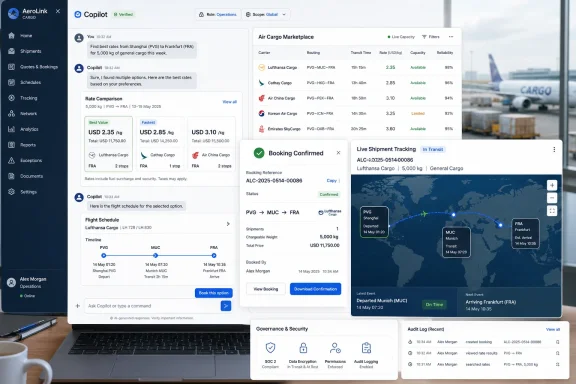
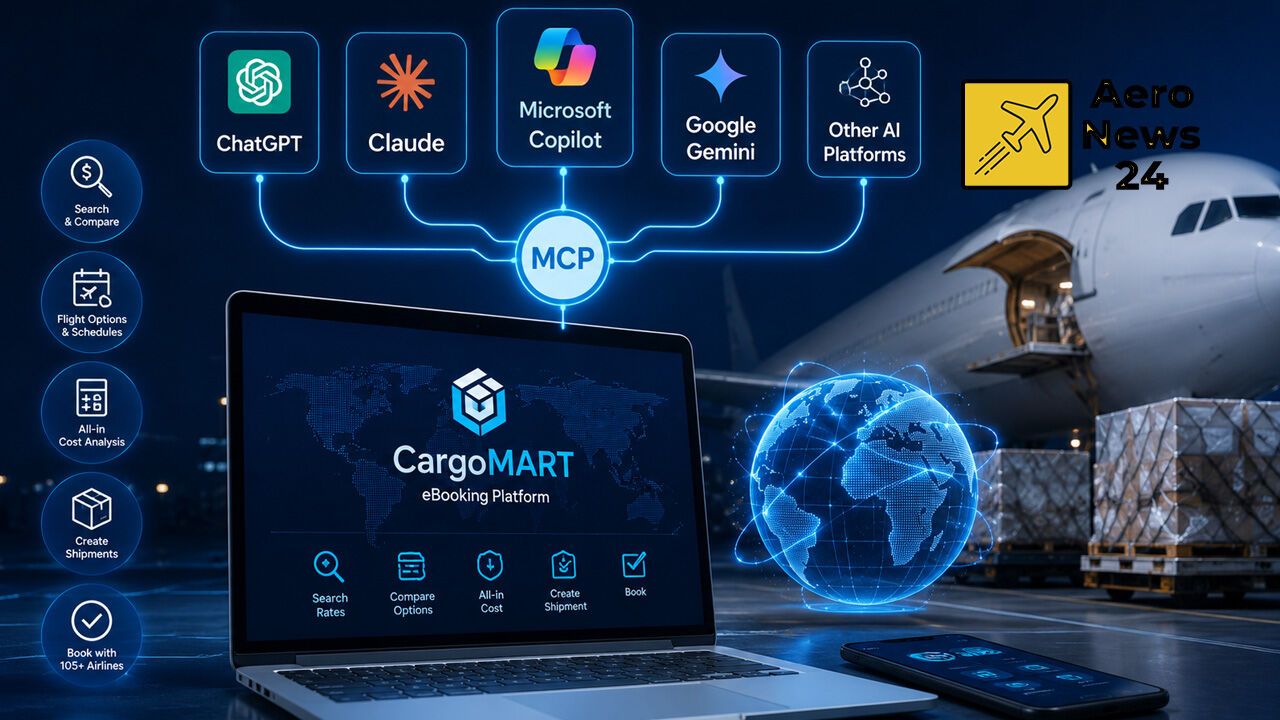
CargoAi announced on June 5, 2026, that its CargoMART marketplace can now be accessed from AI assistants including ChatGPT, Claude, Microsoft Copilot, and other platforms that support the Model Context Protocol, letting air cargo users search, book, and track shipments through natural-language prompts. The announcement is not just another chatbot wrapper on top of a vertical SaaS product. It is a small but telling example of where enterprise software is heading: away from applications as destinations and toward AI clients as the working surface. For WindowsForum readers, the Microsoft Copilot angle matters because this is exactly the kind of industry-specific connector that will decide whether Copilot becomes a useful operational console or just another pane of generated text.
CargoAi’s pitch is straightforward: if freight forwarders, airlines, general sales agents, and logistics teams already spend their day in AI assistants, CargoMART should meet them there. The company says users can connect CargoMART through MCP and then ask for live cargo rates, flight options, departure times, all-in costs, shipment creation, bookings, and tracking without returning to the marketplace interface for every step.
That sounds like a convenience feature. It is more than that. Air cargo is a world of time-sensitive decisions, fragmented capacity, variable pricing, and exception handling; if an AI assistant can reliably combine rate intelligence, schedules, booking workflows, and shipment visibility, the assistant becomes a coordination layer rather than a search box.
CargoAi says CargoMART users can book with more than 105 airlines and track shipments across more than 240 airlines through these connected workflows. Those numbers are important because they separate this from a demo integration. A tool that can only answer questions is one thing; a tool that can expose a transactional marketplace inside Copilot or ChatGPT is a different proposition.
The larger claim is that users can build their own AI agents around CargoMART capabilities. In plain English, a forwarder might configure an assistant to compare routes, filter by total cost and departure time, generate a shipment, and prepare a booking path, all from a prompt. That is the promise, and also the risk: the closer AI gets to operational execution, the less forgiving the system becomes.
That is why CargoAi’s announcement matters beyond air cargo. The company is not merely saying it has added AI search to CargoMART. It is saying CargoMART functions can be called from the broader AI ecosystem, including the Microsoft stack many enterprises already standardize around.
For Microsoft, this is the enterprise Copilot story in miniature. Copilot only becomes strategically important when it can operate against real business systems: ERP data, CRM records, ticketing queues, procurement platforms, shipment trackers, and compliance repositories. Otherwise, it remains a better autocomplete engine for Office documents.
CargoAi is moving into that more consequential territory. A logistics team using Microsoft Copilot could, in theory, query air cargo options from the same environment where it already handles email, spreadsheets, customer documents, and internal approvals. The assistant becomes a broker of actions across systems.
The caveat is that MCP does not magically make the underlying workflow simple. Air cargo bookings involve constraints, liabilities, cut-off times, cargo restrictions, customs details, and customer commitments. A protocol can expose tools, but it cannot eliminate the need for guardrails, audit trails, permissions, and human judgment.
A forwarder does not simply “book cargo.” The forwarder weighs cost against departure time, capacity, service level, routing, customer deadlines, and the risk of disruption. When the cargo is urgent, oversized, temperature-sensitive, or subject to special handling, the decision tree gets messy quickly.
That is where conversational AI looks attractive. Natural-language prompting fits the way operators actually think: “Find me the fastest available option from Frankfurt to Singapore tomorrow under this budget,” or “Compare the all-in cost for the next three departures and flag any routing risk.” A well-connected assistant can turn that into a structured query across marketplace data.
But the same messiness that makes AI appealing also makes it dangerous. If an assistant misreads a constraint, overlooks a surcharge, uses stale schedule information, or books against an assumption the operator did not intend, the resulting error is not a funny hallucination. It is cargo in the wrong place, a missed uplift, a customer escalation, or a financial loss.
CargoAi’s strongest argument is that it already has operational air cargo data and workflows rather than a generic chatbot looking for a use case. Its weakest point, shared by the entire agentic AI market, is that execution requires trust at a level most organizations have not yet fully earned from AI systems.
CargoAi’s MCP move fits that shift. CargoMART remains the system of record and transaction environment, but the user’s first point of contact may be ChatGPT, Claude, Copilot, or an internal assistant. That repositions CargoMART from a destination to a service layer.
This is happening across enterprise software. Specialized applications are being reimagined as tool providers for AI agents. The user interface becomes less important than the quality, security, and completeness of the actions exposed to the assistant.
There is a strategic trade-off here. If CargoAi succeeds, it may increase usage because CargoMART becomes available wherever users work. But it also risks making the front-end marketplace less central to the user relationship. The assistant, not the application, becomes the place where loyalty forms.
That is why MCP adoption is both defensive and offensive. It lets CargoAi participate in AI-native workflows before someone else abstracts the marketplace away. At the same time, it gives users more freedom to combine CargoMART with other enterprise systems, which could reduce the stickiness of any single interface.
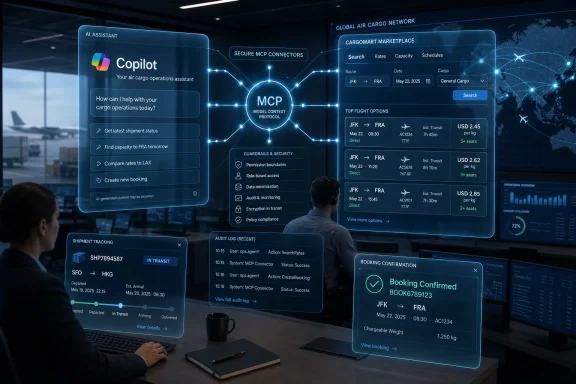
CargoMART in Copilot is the kind of scenario that will test whether Microsoft’s AI platform can handle real operational work. A logistics user does not need Copilot to write a polished paragraph about air cargo trends. The user needs it to retrieve current options, compare costs, respect permissions, trigger approved actions, and leave an audit trail.
That difference matters for Windows and Microsoft 365 environments. Many organizations already have identity, device management, data-loss prevention, and compliance policies built around Microsoft infrastructure. If Copilot can safely broker access to tools such as CargoMART, it becomes more attractive than a standalone AI assistant living outside the corporate control plane.
But “available in Copilot” should not be confused with “safe to automate.” Enterprises will need to decide which CargoMART actions can be performed directly, which require confirmation, which require role-based approval, and which should remain read-only. The practical deployment work will be less glamorous than the announcement.
The security model also becomes more complicated when AI agents can call external business systems. Authentication, authorization, logging, data residency, prompt injection defenses, and connector governance all become operational concerns. The agent is no longer just answering; it is touching workflows.
That history matters because the market is full of companies retrofitting “AI-native” language onto ordinary API integrations. CargoAi at least has a plausible claim that AI has been part of its product direction before the latest wave of agent hype. The distinction is not cosmetic; operational AI depends heavily on domain-specific data, workflow knowledge, and exception handling.
Still, the announcement leans on a familiar 2026 enterprise AI narrative: workers are moving from core systems into AI interfaces, and vendors must follow. There is truth in that, but it is not evenly distributed. Some teams are already experimenting with AI agents; others are still struggling with data quality, access controls, and internal policy.
The phrase “natural language” also deserves scrutiny. Natural language is a friendlier interface, not a substitute for process design. A prompt can express intent, but the system underneath must still map that intent to valid fields, available capacity, pricing logic, booking rules, and operational constraints.
The best version of CargoAi’s approach is not an AI that pretends freight operations are simple. It is an AI that absorbs the busywork while exposing uncertainty clearly. If a rate is provisional, a flight option has restrictions, or a shipment requires manual review, the assistant should say so plainly and stop short of false confidence.
The bigger opportunity is workflow composition. A forwarder could connect CargoMART with internal customer data, shipment history, quoting templates, and approval processes. The assistant could become a first-pass operator that gathers options, drafts customer responses, and prepares bookings for human sign-off.
That is a practical use of AI because it narrows the job. The assistant does not need to “understand logistics” in the grand philosophical sense. It needs to retrieve the right structured data, call the right tools, preserve context, and know when not to proceed.
The governance challenge is equally obvious. If every team can build its own AI agents, every team can also build its own failure modes. One group may automate too aggressively, another may expose sensitive commercial data to the wrong assistant, and another may create a workflow no one can audit six months later.
This is where IT departments will have to get involved early. The operational people will see the productivity gain first; the security, compliance, and architecture teams will see the blast radius. The winning deployments will be the ones that treat AI workflow design as enterprise integration, not shadow automation.
That raises subtle commercial questions. How does an assistant rank options? Does it optimize for lowest total cost, fastest departure, preferred carrier, emissions data, historical reliability, contractual terms, or user-defined policy? In a traditional interface, ranking logic is visible enough to be inspected. In an AI-mediated interface, the logic may feel more opaque unless carefully designed.
Airlines will want their capacity represented accurately and competitively. They will also want to understand whether AI-driven workflows change conversion rates, booking patterns, or customer behavior. If agents begin to automate routine searches, the shape of demand could shift toward whatever criteria the agents are configured to prioritize.
For GSAs, the same dynamic applies. Digital distribution already pressures intermediaries to show value beyond access. AI agents may intensify that pressure by making capacity comparison faster and more standardized. The differentiator becomes service quality, exception handling, and the ability to feed reliable data into the platforms where customers now work.
This is not necessarily bad for airlines or GSAs. Better digital access can expand reach and reduce manual overhead. But it does mean the competitive battlefield moves closer to data quality, integration reliability, and machine-readable commercial rules.
Windows shops have seen this movie before. Microsoft wins when it becomes the place where identity, productivity, endpoint management, collaboration, and administration converge. Copilot is the company’s attempt to extend that gravitational pull into AI-mediated work.
CargoAi’s announcement gives that strategy a vertical proof point. Air cargo is not a generic office productivity scenario. It is operational, time-sensitive, and commercially consequential. If Copilot can safely host connectors like CargoMART, Microsoft can argue that its assistant is not merely for summarizing meetings but for executing industry workflows.
That said, Microsoft’s ecosystem is only as strong as the connectors and policies around it. MCP support gives Copilot a way to talk to external tools, but administrators will still need to decide what is approved, who can use it, and how actions are monitored. In regulated or high-value logistics environments, those controls are not optional.
For IT pros, the practical question is not whether users will try these tools. They will. The question is whether the organization provides a sanctioned path that is safer than ad hoc browser extensions, personal AI accounts, and copied shipment data pasted into unmanaged chat windows.
In cargo operations, the risk is not limited to data leakage. It includes unauthorized bookings, incorrect shipment creation, exposure of customer rates, mishandled tracking data, and operational decisions made from incomplete context. The more useful the assistant becomes, the more consequential its mistakes become.
The answer is not to reject AI integration. The answer is to design it like production infrastructure. That means scoped permissions, human confirmation for high-impact actions, clear logs, separation between read and write operations, and testing against adversarial prompts or malformed data.
CargoAi’s enterprise customers should also demand clarity on where data flows. If a user invokes CargoMART from ChatGPT, Claude, Copilot, or an internal assistant, the relevant questions include what data is sent to the AI platform, what is retained, how identity is passed, and whether commercial information is used for training or analytics. Those details will shape adoption more than the elegance of the prompt.
Microsoft-oriented organizations may prefer Copilot precisely because it can fit into existing identity and compliance frameworks. But preference is not proof. Admins still need documentation, policy enforcement, and a clear operational model before letting AI assistants perform booking-related actions at scale.
That changes product strategy. The best interface may be the one a user never opens. The most valuable product surface may be a set of well-described tools exposed to AI clients. The strongest moat may be the data and transaction network underneath, not the screen on top.
CargoAi appears to understand this. By making CargoMART accessible through MCP, it is effectively saying that its marketplace should be wherever the user’s AI environment is. That is a smart hedge against a future in which enterprise assistants become the front door to many systems.
But the transition will be uneven. Power users will still need rich interfaces for complex review, exception management, and audit. Managers will still need dashboards. IT will still need admin consoles. AI does not eliminate software surfaces; it rearranges which ones matter first.
The near-term winner is likely a hybrid model. Natural language handles discovery, comparison, drafting, and routine orchestration. Traditional interfaces handle verification, advanced configuration, oversight, and edge cases. The companies that blend those modes without hiding critical information will earn more trust than those that pretend chat can replace everything.
 CargoAi Is Betting That the Interface Has Already Moved
CargoAi’s pitch is straightforward: if freight forwarders, airlines, general sales agents, and logistics teams already spend their day in AI assistants, CargoMART should meet them there. The company says users can connect CargoMART through MCP and then ask for live cargo rates, flight options, departure times, all-in costs, shipment creation, bookings, and tracking without returning to the marketplace interface for every step.That sounds like a convenience feature. It is more than that. Air cargo is a world of time-sensitive decisions, fragmented capacity, variable pricing, and exception handling; if an AI assistant can reliably combine rate intelligence, schedules, booking workflows, and shipment visibility, the assistant becomes a coordination layer rather than a search box.
CargoAi says CargoMART users can book with more than 105 airlines and track shipments across more than 240 airlines through these connected workflows. Those numbers are important because they separate this from a demo integration. A tool that can only answer questions is one thing; a tool that can expose a transactional marketplace inside Copilot or ChatGPT is a different proposition.
The larger claim is that users can build their own AI agents around CargoMART capabilities. In plain English, a forwarder might configure an assistant to compare routes, filter by total cost and departure time, generate a shipment, and prepare a booking path, all from a prompt. That is the promise, and also the risk: the closer AI gets to operational execution, the less forgiving the system becomes.
MCP Turns the AI Assistant Into a Freight Desk
The Model Context Protocol has become the fashionable plumbing layer for AI tools because it gives developers a common way to expose data sources and actions to AI clients. Instead of building one integration for ChatGPT, another for Claude, another for Copilot, and another for an internal assistant, a company can expose an MCP server and let compatible clients discover what tools and data are available.That is why CargoAi’s announcement matters beyond air cargo. The company is not merely saying it has added AI search to CargoMART. It is saying CargoMART functions can be called from the broader AI ecosystem, including the Microsoft stack many enterprises already standardize around.
For Microsoft, this is the enterprise Copilot story in miniature. Copilot only becomes strategically important when it can operate against real business systems: ERP data, CRM records, ticketing queues, procurement platforms, shipment trackers, and compliance repositories. Otherwise, it remains a better autocomplete engine for Office documents.
CargoAi is moving into that more consequential territory. A logistics team using Microsoft Copilot could, in theory, query air cargo options from the same environment where it already handles email, spreadsheets, customer documents, and internal approvals. The assistant becomes a broker of actions across systems.
The caveat is that MCP does not magically make the underlying workflow simple. Air cargo bookings involve constraints, liabilities, cut-off times, cargo restrictions, customs details, and customer commitments. A protocol can expose tools, but it cannot eliminate the need for guardrails, audit trails, permissions, and human judgment.
Air Cargo Was Never a Clean Software Problem
The air freight industry has spent years trying to move away from phone calls, email chains, spreadsheet comparisons, and portal-hopping. Marketplaces such as CargoMART exist because forwarders need faster access to capacity and rates, while airlines need more efficient digital distribution. The problem has never been a lack of software; it has been that the software rarely lines up with how the work actually happens.A forwarder does not simply “book cargo.” The forwarder weighs cost against departure time, capacity, service level, routing, customer deadlines, and the risk of disruption. When the cargo is urgent, oversized, temperature-sensitive, or subject to special handling, the decision tree gets messy quickly.
That is where conversational AI looks attractive. Natural-language prompting fits the way operators actually think: “Find me the fastest available option from Frankfurt to Singapore tomorrow under this budget,” or “Compare the all-in cost for the next three departures and flag any routing risk.” A well-connected assistant can turn that into a structured query across marketplace data.
But the same messiness that makes AI appealing also makes it dangerous. If an assistant misreads a constraint, overlooks a surcharge, uses stale schedule information, or books against an assumption the operator did not intend, the resulting error is not a funny hallucination. It is cargo in the wrong place, a missed uplift, a customer escalation, or a financial loss.
CargoAi’s strongest argument is that it already has operational air cargo data and workflows rather than a generic chatbot looking for a use case. Its weakest point, shared by the entire agentic AI market, is that execution requires trust at a level most organizations have not yet fully earned from AI systems.
The Marketplace Is Becoming an API With a Conversation Layer
The old enterprise software model asked users to go where the application lived. Open the portal, search the database, compare the records, export the report, send the email, repeat. The new model assumes the user may never want to visit the application directly unless something goes wrong.CargoAi’s MCP move fits that shift. CargoMART remains the system of record and transaction environment, but the user’s first point of contact may be ChatGPT, Claude, Copilot, or an internal assistant. That repositions CargoMART from a destination to a service layer.
This is happening across enterprise software. Specialized applications are being reimagined as tool providers for AI agents. The user interface becomes less important than the quality, security, and completeness of the actions exposed to the assistant.
There is a strategic trade-off here. If CargoAi succeeds, it may increase usage because CargoMART becomes available wherever users work. But it also risks making the front-end marketplace less central to the user relationship. The assistant, not the application, becomes the place where loyalty forms.
That is why MCP adoption is both defensive and offensive. It lets CargoAi participate in AI-native workflows before someone else abstracts the marketplace away. At the same time, it gives users more freedom to combine CargoMART with other enterprise systems, which could reduce the stickiness of any single interface.
Copilot’s Real Test Is Boring, Vertical Work
Microsoft’s Copilot strategy has always sounded most convincing in the abstract: a universal assistant grounded in work data, available across the productivity suite, extensible through connectors and agents. The trouble is that enterprise value rarely arrives through abstract demos. It arrives when a specific department can stop doing some specific, repetitive, error-prone task.CargoMART in Copilot is the kind of scenario that will test whether Microsoft’s AI platform can handle real operational work. A logistics user does not need Copilot to write a polished paragraph about air cargo trends. The user needs it to retrieve current options, compare costs, respect permissions, trigger approved actions, and leave an audit trail.
That difference matters for Windows and Microsoft 365 environments. Many organizations already have identity, device management, data-loss prevention, and compliance policies built around Microsoft infrastructure. If Copilot can safely broker access to tools such as CargoMART, it becomes more attractive than a standalone AI assistant living outside the corporate control plane.
But “available in Copilot” should not be confused with “safe to automate.” Enterprises will need to decide which CargoMART actions can be performed directly, which require confirmation, which require role-based approval, and which should remain read-only. The practical deployment work will be less glamorous than the announcement.
The security model also becomes more complicated when AI agents can call external business systems. Authentication, authorization, logging, data residency, prompt injection defenses, and connector governance all become operational concerns. The agent is no longer just answering; it is touching workflows.
The AI-First Claim Meets the Enterprise Reality Check
CargoAi describes this as part of a long-running AI-first strategy, not a sudden pivot. The company says it was founded in 2019 with AI as a platform foundation and has deployed AI-driven capabilities across rate intelligence, predictive tracking, automated quoting, and conversational workflows. It also points to CargoCOPILOT across CargoMART, email, and WhatsApp as evidence that it has been working toward multi-channel automation for some time.That history matters because the market is full of companies retrofitting “AI-native” language onto ordinary API integrations. CargoAi at least has a plausible claim that AI has been part of its product direction before the latest wave of agent hype. The distinction is not cosmetic; operational AI depends heavily on domain-specific data, workflow knowledge, and exception handling.
Still, the announcement leans on a familiar 2026 enterprise AI narrative: workers are moving from core systems into AI interfaces, and vendors must follow. There is truth in that, but it is not evenly distributed. Some teams are already experimenting with AI agents; others are still struggling with data quality, access controls, and internal policy.
The phrase “natural language” also deserves scrutiny. Natural language is a friendlier interface, not a substitute for process design. A prompt can express intent, but the system underneath must still map that intent to valid fields, available capacity, pricing logic, booking rules, and operational constraints.
The best version of CargoAi’s approach is not an AI that pretends freight operations are simple. It is an AI that absorbs the busywork while exposing uncertainty clearly. If a rate is provisional, a flight option has restrictions, or a shipment requires manual review, the assistant should say so plainly and stop short of false confidence.
Forwarders Get Speed, But Governance Gets Harder
For freight forwarders, the appeal is obvious. Instead of jumping between airline portals, marketplace screens, email threads, and transport management systems, an operator can ask an assistant for options and act on the result. In a margin-sensitive business, fewer clicks and faster comparisons can matter.The bigger opportunity is workflow composition. A forwarder could connect CargoMART with internal customer data, shipment history, quoting templates, and approval processes. The assistant could become a first-pass operator that gathers options, drafts customer responses, and prepares bookings for human sign-off.
That is a practical use of AI because it narrows the job. The assistant does not need to “understand logistics” in the grand philosophical sense. It needs to retrieve the right structured data, call the right tools, preserve context, and know when not to proceed.
The governance challenge is equally obvious. If every team can build its own AI agents, every team can also build its own failure modes. One group may automate too aggressively, another may expose sensitive commercial data to the wrong assistant, and another may create a workflow no one can audit six months later.
This is where IT departments will have to get involved early. The operational people will see the productivity gain first; the security, compliance, and architecture teams will see the blast radius. The winning deployments will be the ones that treat AI workflow design as enterprise integration, not shadow automation.
Airlines and GSAs Face a New Distribution Layer
CargoAi’s move also matters for airlines and general sales agents because it changes where demand may originate. If forwarders increasingly search and book from AI assistants, the marketplace’s role as a distribution channel becomes intertwined with the AI client’s role as decision-maker.That raises subtle commercial questions. How does an assistant rank options? Does it optimize for lowest total cost, fastest departure, preferred carrier, emissions data, historical reliability, contractual terms, or user-defined policy? In a traditional interface, ranking logic is visible enough to be inspected. In an AI-mediated interface, the logic may feel more opaque unless carefully designed.
Airlines will want their capacity represented accurately and competitively. They will also want to understand whether AI-driven workflows change conversion rates, booking patterns, or customer behavior. If agents begin to automate routine searches, the shape of demand could shift toward whatever criteria the agents are configured to prioritize.
For GSAs, the same dynamic applies. Digital distribution already pressures intermediaries to show value beyond access. AI agents may intensify that pressure by making capacity comparison faster and more standardized. The differentiator becomes service quality, exception handling, and the ability to feed reliable data into the platforms where customers now work.
This is not necessarily bad for airlines or GSAs. Better digital access can expand reach and reduce manual overhead. But it does mean the competitive battlefield moves closer to data quality, integration reliability, and machine-readable commercial rules.
The Windows Angle Is Not the Logo, It Is the Control Plane
It would be easy for WindowsForum readers to treat the Microsoft Copilot mention as a branding footnote. That would miss the point. The significance is not that CargoMART can sit next to Word and Excel in some AI future; it is that Microsoft wants Copilot to become the enterprise control plane for third-party actions.Windows shops have seen this movie before. Microsoft wins when it becomes the place where identity, productivity, endpoint management, collaboration, and administration converge. Copilot is the company’s attempt to extend that gravitational pull into AI-mediated work.
CargoAi’s announcement gives that strategy a vertical proof point. Air cargo is not a generic office productivity scenario. It is operational, time-sensitive, and commercially consequential. If Copilot can safely host connectors like CargoMART, Microsoft can argue that its assistant is not merely for summarizing meetings but for executing industry workflows.
That said, Microsoft’s ecosystem is only as strong as the connectors and policies around it. MCP support gives Copilot a way to talk to external tools, but administrators will still need to decide what is approved, who can use it, and how actions are monitored. In regulated or high-value logistics environments, those controls are not optional.
For IT pros, the practical question is not whether users will try these tools. They will. The question is whether the organization provides a sanctioned path that is safer than ad hoc browser extensions, personal AI accounts, and copied shipment data pasted into unmanaged chat windows.
The Security Story Must Be Stronger Than the Demo
Every agentic workflow announcement now arrives with a shadow: what happens when the assistant is wrong, manipulated, over-permissioned, or poorly monitored? MCP helps standardize connections, but standardization does not equal safety. A bad connector, a sloppy permission model, or a malicious instruction embedded in retrieved content can still create real problems.In cargo operations, the risk is not limited to data leakage. It includes unauthorized bookings, incorrect shipment creation, exposure of customer rates, mishandled tracking data, and operational decisions made from incomplete context. The more useful the assistant becomes, the more consequential its mistakes become.
The answer is not to reject AI integration. The answer is to design it like production infrastructure. That means scoped permissions, human confirmation for high-impact actions, clear logs, separation between read and write operations, and testing against adversarial prompts or malformed data.
CargoAi’s enterprise customers should also demand clarity on where data flows. If a user invokes CargoMART from ChatGPT, Claude, Copilot, or an internal assistant, the relevant questions include what data is sent to the AI platform, what is retained, how identity is passed, and whether commercial information is used for training or analytics. Those details will shape adoption more than the elegance of the prompt.
Microsoft-oriented organizations may prefer Copilot precisely because it can fit into existing identity and compliance frameworks. But preference is not proof. Admins still need documentation, policy enforcement, and a clear operational model before letting AI assistants perform booking-related actions at scale.
The User Interface Is Losing Its Monopoly
The most disruptive part of this announcement is not that CargoAi added AI access. It is that the traditional SaaS interface is losing its monopoly on user attention. For years, software companies competed by building better dashboards, portals, and workflows. Now they must assume users may interact through a general-purpose assistant instead.That changes product strategy. The best interface may be the one a user never opens. The most valuable product surface may be a set of well-described tools exposed to AI clients. The strongest moat may be the data and transaction network underneath, not the screen on top.
CargoAi appears to understand this. By making CargoMART accessible through MCP, it is effectively saying that its marketplace should be wherever the user’s AI environment is. That is a smart hedge against a future in which enterprise assistants become the front door to many systems.
But the transition will be uneven. Power users will still need rich interfaces for complex review, exception management, and audit. Managers will still need dashboards. IT will still need admin consoles. AI does not eliminate software surfaces; it rearranges which ones matter first.
The near-term winner is likely a hybrid model. Natural language handles discovery, comparison, drafting, and routine orchestration. Traditional interfaces handle verification, advanced configuration, oversight, and edge cases. The companies that blend those modes without hiding critical information will earn more trust than those that pretend chat can replace everything.
CargoAi’s MCP Move Shows Where the Next Integration Fight Will Happen
The concrete news is easy to summarize, but the strategic implications are bigger than a feature launch.- CargoMART users can now access marketplace data and functions through AI assistants that support MCP, including ChatGPT, Claude, Microsoft Copilot, and approved internal AI environments.
- CargoAi says users can search and compare rates, review flight options, analyze all-in costs, create shipments, book with more than 105 airlines, and track shipments across more than 240 airlines.
- The announcement extends CargoAi’s existing AI work, including rate intelligence, predictive tracking, automated quoting, and the CargoCOPILOT conversational agent.
- The Microsoft Copilot angle matters because it points to a future where Windows and Microsoft 365 environments become controlled entry points for vertical operational workflows.
- The main enterprise risk is not the chat interface itself, but the governance of permissions, confirmations, data flows, and audit trails once AI agents can take action.
- The broader software lesson is that marketplaces and SaaS platforms are increasingly becoming tool layers for AI clients rather than destinations users must visit directly.
References
- Primary source: Air Cargo Week
Published: 2026-06-05T07:50:12.513931
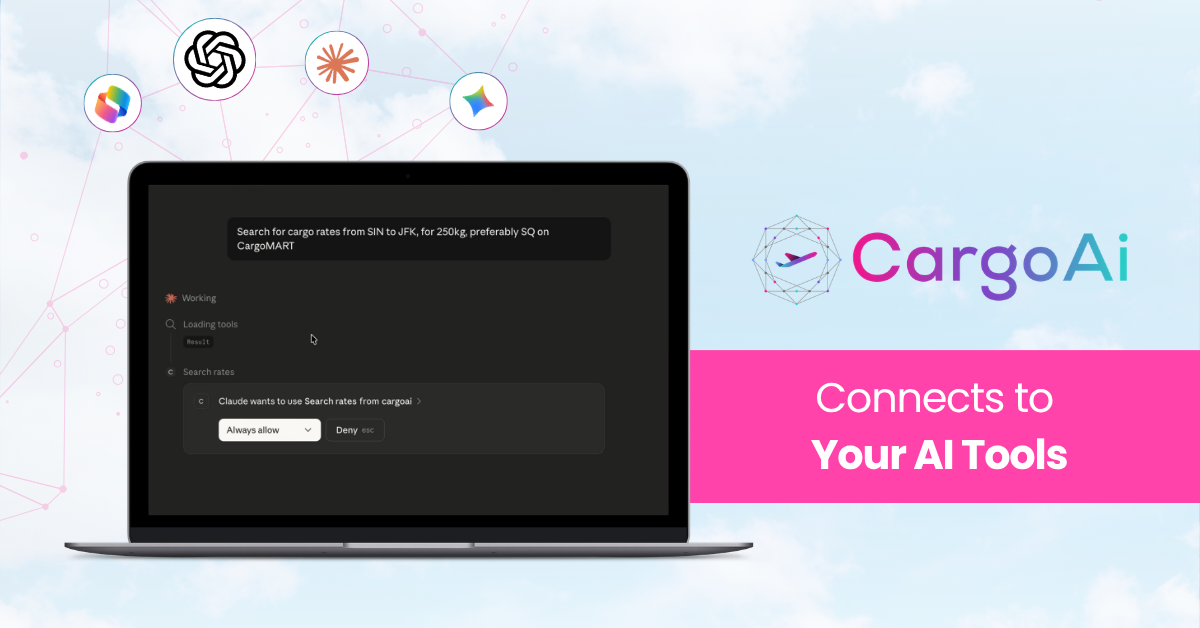
CargoAi Connects CargoMART Air Cargo Intelligence to AI platforms - Air Cargo Week
CargoAi has announced that CargoMART marketplace data and capabilities are now accessible from any AI assistant, including ChatGPT, Claude, Microsoft Copilot, aircargoweek.com
- Related coverage: airfreight.news

CargoAi connects CargoMART Air Cargo Intelligence to ChatGPT, Claude, Copilot and any AI platform
CargoAi, the AI-native technology company transforming air cargo operations, today announced that CargoMART marketplace data and capabilities are now accessible from any AI assistant, including ChatGPT, Claude, Microsoft Copilot, and any platform supporting the Model Context Protocol (MCP). airfreight.news
- Related coverage: cargoai.co
CargoAi - another way to think cargo
CargoAi is revolutionizing the air cargo industry by providing you the best digitized solutions. From booking to tracking, we have everything covered. www.cargoai.co
- Related coverage: help.cargoai.co
- Related coverage: cargobreakingnews.com
- Related coverage: payloadasia.com
CargoAi unveils CargoCoPilot Agent — Unified AI for air cargo - Payload Asia
CargoAi launches CargoCoPilot Agent, a multilingual AI for air cargo that automates tracking, bookings, and customer queries across email, web, and WhatsApp. payloadasia.com
- Related coverage: cargotalkgcc.com

CargoAi launches interline bookings on CargoMart portal
CargoAi has introduced interline bookings on its CargoMart portal after a trial with Emirates SkyCargo, said Matt Petot, Chief Executive, CargoAi. “With the new tool, airlines can scale their partnerships, maximise revenue, and prepare for a new era where forwarders can directly book interline... www.cargotalkgcc.com
- Related coverage: stattimes.com

CargoAi unveils real-time AI-based intelligent assistance
CargoCoPilot has been available to forwarders and airline CargoMART Pro users since early October.www.stattimes.com
- Related coverage: unitedcargo.com
- Related coverage: aircargonews.net

CargoAi adds new interline booking tool - Air Cargo News
CargoAi has added interline bookings to its CargoMart third-party booking portal following a test project with Emirates SkyCargo CargoAi has added interline bookings to its CargoMart third-party booking portal following a test project with Emirates SkyCargo. The air cargo software firm said that...www.aircargonews.net
- Related coverage: cargonewswire.com
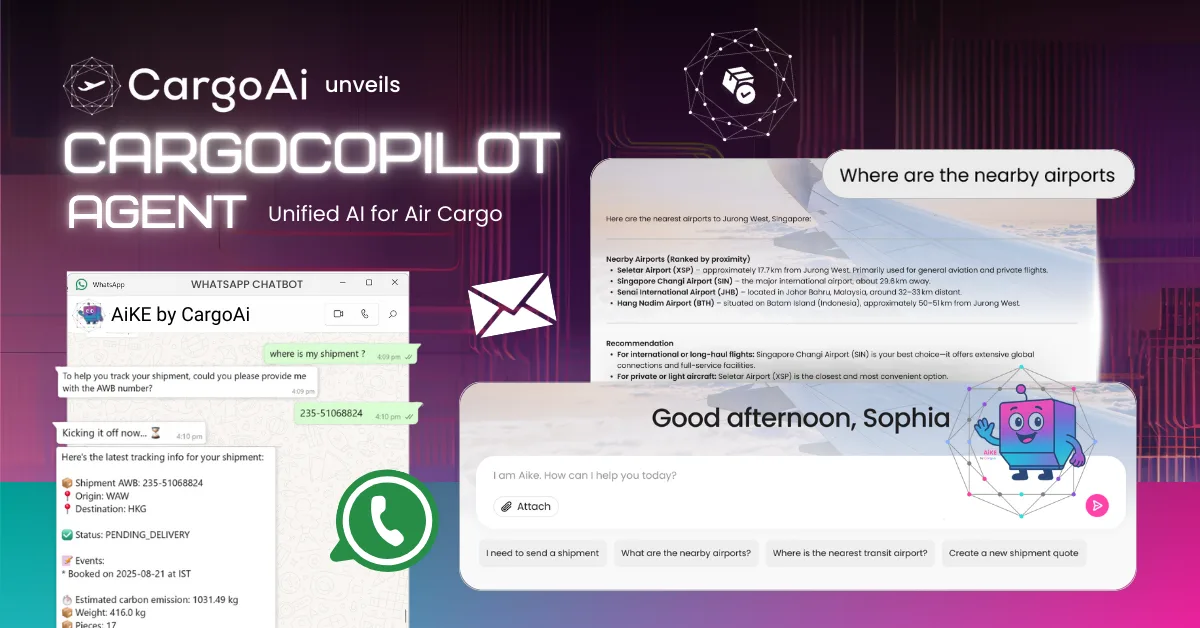
CargoAi Launches CargoCoPilot Agent: Unified AI Set to Transform Air Cargo Communications - Cargo Newswire
CargoAi, a global leader in artificial intelligence solutions for airfreight, has unveiled its latest innovation — CargoCoPilot Agent: Unified AI for Air Cargo. The new conversational platform is designed to streamline […] cargonewswire.com
- Related coverage: iata.org
- Related coverage: tomshardware.com

Anthropic's Model Context Protocol includes a critical remote code execution vulnerability — newly discovered exploit puts 200,000 AI servers at risk
A design choice in the MCP SDKs allows remote code execution across the AI supply chain.www.tomshardware.com
- Related coverage: itpro.com

What is model context protocol (MCP)?
MCP underpins many agentic AI systems – but how does it work and is it easy to use? www.itpro.com
- Related coverage: windowscentral.com