

ZoomInfo made GTM.AI generally available on June 1, 2026, positioning it as a headless go-to-market context layer that connects verified B2B data to AI agents inside tools including Claude, ChatGPT, Microsoft Copilot, Salesforce Agentforce, HubSpot Breeze, and Microsoft Copilot Studio. The pitch is simple: the next sales-tech battleground is not another chatbot interface, but the data substrate underneath every agent that claims it can prospect, enrich, prioritize, and act. ZoomInfo is betting that go-to-market AI will fail without a constantly refreshed commercial graph, and that the company’s long-standing data business can become infrastructure for the agent era.
The phrase “headless GTM context layer” sounds like the kind of enterprise software label that could have been assembled by committee, but the strategic move behind it is clear. ZoomInfo does not want GTM.AI judged as another destination app competing for a seller’s browser tab. It wants to be the intelligence layer that other applications call when an AI assistant needs to know which companies exist, who works there, what signals they are emitting, and whether a contact is likely to be reachable.
That is a more ambitious position than “we have an AI feature.” The sales and marketing software market is already stuffed with copilots, assistants, prospecting bots, sequence writers, account research tools, CRM agents, and meeting-prep widgets. ZoomInfo’s argument is that many of those systems are only as useful as the data they can reach at the moment they act.
This is where GTM.AI becomes interesting for WindowsForum’s IT-pro audience, even if the product lives in sales operations rather than endpoint management. Microsoft Copilot, Copilot Studio, Salesforce Agentforce, HubSpot Breeze, Claude, ChatGPT, and IBM watsonx Orchestrate all represent the same operational shift: business users are being encouraged to let AI systems move from summarizing work to initiating work. Once that happens, the reliability of the context becomes a governance issue, not just a productivity issue.
ZoomInfo’s move also reflects a broader truth about enterprise AI in 2026. The model layer is increasingly interchangeable for many business workflows, while trusted data access, authorization, auditability, freshness, and workflow-specific semantics are becoming the defensible parts of the stack. In that world, the company with the best prompt does not necessarily win. The company with the most useful context at the exact moment of action might.
ZoomInfo is using MCP as the bridge between its data estate and the places where revenue teams already work. In the company’s framing, GTM.AI exposes company search, contact discovery, real-time enrichment, intent retrieval, and AI-powered recommendation through an MCP server and APIs. The result is an architecture in which an AI assistant can request ZoomInfo intelligence without forcing the user to leave the assistant’s native interface.
That is the promise, at least. In practice, MCP does not magically solve every integration problem. Someone still has to govern authentication, entitlement, logging, rate limits, data handling, and what each agent is allowed to do with retrieved information. A protocol can standardize the handshake; it cannot guarantee that every workflow built on top of it is well designed.
Still, the significance is hard to ignore. For years, enterprise software vendors competed by owning the user interface. Now many are preparing for a world in which the interface is a chat window, a workflow builder, or an autonomous agent sitting inside someone else’s product. If that future arrives, the most valuable vendors may be the ones that agents call in the background.
ZoomInfo is plainly trying to occupy that background layer before someone else does. The company’s ticker change from ZI to GTM in 2025 was a branding move, but GTM.AI gives that repositioning a more technical edge. It says ZoomInfo does not merely sell a database; it sells the operational graph that AI systems need to execute go-to-market work.
That matters because go-to-market data is unusually perishable. People change jobs, companies rename departments, buying committees shift, budgets freeze, technology stacks evolve, and intent signals age quickly. A human seller working from stale data wastes time. An autonomous agent working from stale data can waste time at scale, pollute CRM records, misroute campaigns, and generate outreach that is not merely ineffective but embarrassing.
ZoomInfo’s argument is that verified data is the missing constraint in agentic sales work. A large language model can reason over a request such as “find VP-level marketing leaders at fast-growing fintech companies using Snowflake where a former champion recently changed jobs,” but it cannot invent the underlying commercial reality. It needs structured records, current employment data, technology signals, company attributes, org relationships, and permissions-aware access to customer context.
This is where GTM.AI’s “headless” framing becomes more than a branding flourish. If the same graph can serve Claude for research, ChatGPT for call prep, Copilot for productivity workflows, Copilot Studio for custom agents, and Salesforce or HubSpot for CRM-native actions, the graph becomes the point of consistency. The interface can vary; the source of truth is supposed to remain stable.
But this also places a burden on ZoomInfo. If the company wants to be treated as infrastructure, customers will judge it like infrastructure. Availability, latency, permissioning, observability, contractual data rights, and error behavior become part of the buying decision. A data platform used by humans can occasionally hide behind manual correction. A data platform used by agents has fewer places to hide.
That has obvious appeal for IT departments already standardizing identity, access, compliance, and data loss prevention around Microsoft’s stack. A go-to-market team may want AI-powered prospecting; the CIO wants to know whether that prospecting tool respects enterprise controls. The closer these systems get to Copilot Studio and Entra-governed workflows, the more they will be evaluated through the same lens as any other enterprise integration.
The risk is that business teams will hear “Copilot integration” and assume governance has been solved. It has not. A Copilot Studio agent connected to an external MCP server is still only as safe as its permissions model, the actions exposed by the server, the prompts and policies controlling the agent, and the organization’s understanding of what data is flowing where.
This is especially important in sales and marketing, where contact data, intent signals, CRM notes, call summaries, and account plans can blur the line between commercially useful intelligence and sensitive business context. The agent may be doing “just research,” but that research can involve customer records, prospect profiles, internal notes, and inferred purchasing interest. IT needs to treat that as data movement, not as a harmless chatbot session.
ZoomInfo’s launch language emphasizes entitlements and permissions, which is exactly the right direction. But buyers should press for the operational details: what is logged, what is retained, what the AI client sees, what ZoomInfo sees, how customer-specific context is scoped, how revocation works, and whether administrators can constrain tools by role, workspace, region, or use case.
ZoomInfo describes its data engine as drawing from proprietary collection technology, machine learning, public-source signal processing, and a contributory network. That is broadly consistent with how major B2B data providers operate: they combine public records, web signals, user-contributed updates, inferred relationships, email and phone validation, integrations, and feedback loops. The useful question for customers is not whether a vendor has a verification process, but how that process behaves under automation.
For example, what happens when an agent retrieves a direct dial with moderate confidence? Does the interface expose confidence levels? Can the agent decide to exclude lower-confidence contacts? Can a workflow require human approval before outreach? Can a CRM enrichment job distinguish between “newly verified,” “inferred,” “stale,” and “conflicting” records?
These questions matter because AI agents tend to flatten uncertainty. A human analyst may look at a list and instinctively distrust a suspicious title or outdated domain. An agent may treat each returned object as equally actionable unless the tool design and prompts preserve uncertainty. If the vendor’s data model contains nuance but the agent interface hides it, automation can convert messy probability into false certainty.
This is the central governance challenge of GTM.AI and products like it. The agent era does not eliminate the need for data stewardship. It makes stewardship more urgent because the speed of execution increases while human review often decreases.
Inside a CRM agent platform, the system could monitor accounts for signals, prioritize outreach, suggest next-best actions, or initiate prospecting tasks against accounts that match a campaign. In an engagement platform, an agent could assemble a sequence only after validating that the person still holds the role, the company fits the segment, and the account is showing relevant buying signals.
Those workflows are exactly why business leaders are excited. They replace manual tab-hopping and list-building with conversational orchestration. They also create a new kind of operational dependency. If the agent is wrong, it may be wrong everywhere the context layer is used.
That is why IT teams should think in terms of blast radius. A bad answer in a single chat is one thing. A bad enrichment workflow pushed into Salesforce, HubSpot, Outreach, or a Microsoft-built agent can affect thousands of records and trigger downstream automation. The more central the context layer becomes, the more carefully organizations need to stage rollout, permissions, and monitoring.
A sensible deployment would begin with read-only research workflows before moving into enrichment, CRM updates, or outbound engagement. It would separate “retrieve and summarize” from “write back and act.” It would also require clear ownership between sales operations, security, privacy, legal, and IT, because the system touches all of their domains.
This creates a delicate balance for ZoomInfo. By making its intelligence available everywhere, it increases its relevance across the stack. But by sitting beneath other agents, it also risks becoming invisible to end users. Infrastructure can be lucrative, but it is also judged on price, reliability, and replaceability.
The company’s best defense is depth. A shallow contact database can be swapped out. A living graph that connects companies, people, technologies, intent, employment changes, website traffic, CRM context, and permissions-aware recommendations is harder to replace. That is the story ZoomInfo wants customers to believe.
The challenge is that every major platform is telling a version of the same story. Salesforce wants Agentforce to be grounded in CRM and Data Cloud. Microsoft wants Copilot and Copilot Studio grounded in Microsoft Graph, Dataverse, Fabric, and enterprise connectors. HubSpot wants Breeze grounded in its customer platform. The more each ecosystem builds its own context layer, the more buyers will ask whether ZoomInfo is additive or redundant.
The answer may vary by organization. Companies with mature revenue operations and complex outbound motions may find specialized GTM intelligence essential. Smaller teams that live entirely inside one CRM ecosystem may prefer native context, even if it is less broad. The market will not decide this by press release; it will decide it through renewal conversations, data-quality audits, and whether agents produce measurable pipeline rather than attractive demos.
The harder questions are about data minimization and purpose limitation. When an AI agent retrieves prospect information, is it retrieving only what the user needs for the immediate task? When it combines ZoomInfo data with CRM data, internal meeting notes, or email context, where does that combined context live? When a user asks a frontier model to draft outreach using account intelligence, what is sent to the model provider and under what terms?
These questions become more acute when the workflow crosses multiple vendors. A seller may be sitting in ChatGPT, calling ZoomInfo through MCP, referencing Salesforce records, and drafting an email that will be sent through an engagement platform. Each hop may be individually approved, but the composite workflow is what regulators, auditors, and customers will care about if something goes wrong.
MCP itself is not a compliance shield. It can make integrations more standardized, and standardization can make governance easier. But an MCP server is still a tool endpoint exposed to an AI client. Organizations need to know what tools exist, who can call them, what parameters they accept, what data they return, and whether the AI client can chain them in ways administrators did not anticipate.
This is the point at which agentic enthusiasm meets enterprise reality. The more useful the agent, the more privileges it wants. The more privileges it has, the more it resembles software that must be managed, audited, and constrained.
Identity resolution is boring until duplicate records poison a territory plan. Permission inheritance is boring until a contractor sees accounts they should not. Data freshness is boring until an agent books meetings with people who left the company six months ago. Audit logs are boring until legal asks who accessed a record, through which agent, and why.
This is why ZoomInfo’s headless strategy is more credible than a simple chatbot launch would have been. Revenue teams do not need yet another place to ask AI for sales copy. They need trusted commercial context to follow them into the tools where they already make decisions. That is infrastructure work.
The same is true for Microsoft-oriented organizations. Copilot Studio, Power Platform, Dynamics, Microsoft 365, and external MCP servers can form powerful business automation chains. But the winners will be the teams that treat those chains like production systems rather than experiments. They will document tool access, define acceptable actions, monitor outcomes, and keep humans in the loop where the cost of error is high.
ZoomInfo is trying to sell into that seriousness. Its message is not “let AI improvise.” It is “give AI verified ground to stand on.” That is a stronger message than most agentic marketing, because it acknowledges the model is not enough.
For sales operations teams, that trade may be worthwhile. Manual research, list cleaning, enrichment, and account prioritization are expensive, inconsistent, and often disliked. If GTM.AI can make those workflows faster while improving data quality, the productivity case is obvious.
For IT and security teams, the calculation is different. They will want to know whether the integration can be centrally managed, whether it respects existing identity controls, whether it introduces new data exposure risks, and whether business teams can connect it to agents without adequate review. The answer will determine whether GTM.AI becomes an approved platform capability or another shadow-AI concern.
For end users, the test will be more practical. Does the assistant return contacts they can actually reach? Does it understand account relationships? Does it avoid hallucinating org charts? Does it save enough time to change daily behavior? Sales software history is littered with tools that impressed executives and annoyed sellers.
ZoomInfo’s advantage is that it is not starting from scratch. Its installed base already understands the value of B2B intelligence. GTM.AI is an attempt to make that intelligence callable by agents rather than merely searchable by humans. That is a meaningful evolution if the implementation lives up to the architecture.
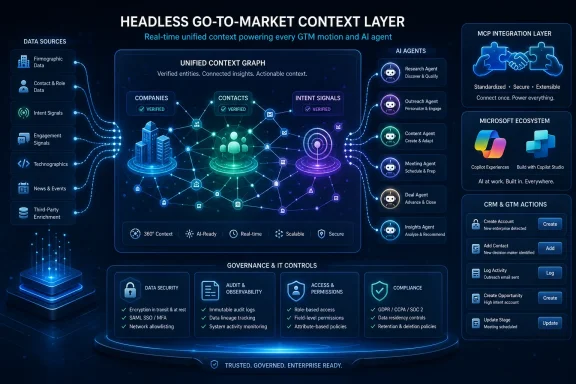 ZoomInfo Wants to Be the Layer Beneath the Agent
The phrase “headless GTM context layer” sounds like the kind of enterprise software label that could have been assembled by committee, but the strategic move behind it is clear. ZoomInfo does not want GTM.AI judged as another destination app competing for a seller’s browser tab. It wants to be the intelligence layer that other applications call when an AI assistant needs to know which companies exist, who works there, what signals they are emitting, and whether a contact is likely to be reachable.That is a more ambitious position than “we have an AI feature.” The sales and marketing software market is already stuffed with copilots, assistants, prospecting bots, sequence writers, account research tools, CRM agents, and meeting-prep widgets. ZoomInfo’s argument is that many of those systems are only as useful as the data they can reach at the moment they act.
This is where GTM.AI becomes interesting for WindowsForum’s IT-pro audience, even if the product lives in sales operations rather than endpoint management. Microsoft Copilot, Copilot Studio, Salesforce Agentforce, HubSpot Breeze, Claude, ChatGPT, and IBM watsonx Orchestrate all represent the same operational shift: business users are being encouraged to let AI systems move from summarizing work to initiating work. Once that happens, the reliability of the context becomes a governance issue, not just a productivity issue.
ZoomInfo’s move also reflects a broader truth about enterprise AI in 2026. The model layer is increasingly interchangeable for many business workflows, while trusted data access, authorization, auditability, freshness, and workflow-specific semantics are becoming the defensible parts of the stack. In that world, the company with the best prompt does not necessarily win. The company with the most useful context at the exact moment of action might.
MCP Turns Data Access Into the New Integration War
The Model Context Protocol matters here because it changes how vendors talk about integrations. Instead of building bespoke connectors for every pair of model and application, MCP gives AI clients a standardized way to discover and call tools exposed by external services. Anthropic introduced MCP in late 2024, and by 2025 Microsoft had brought MCP support into Copilot Studio, making it a practical enterprise integration pattern rather than an AI lab curiosity.ZoomInfo is using MCP as the bridge between its data estate and the places where revenue teams already work. In the company’s framing, GTM.AI exposes company search, contact discovery, real-time enrichment, intent retrieval, and AI-powered recommendation through an MCP server and APIs. The result is an architecture in which an AI assistant can request ZoomInfo intelligence without forcing the user to leave the assistant’s native interface.
That is the promise, at least. In practice, MCP does not magically solve every integration problem. Someone still has to govern authentication, entitlement, logging, rate limits, data handling, and what each agent is allowed to do with retrieved information. A protocol can standardize the handshake; it cannot guarantee that every workflow built on top of it is well designed.
Still, the significance is hard to ignore. For years, enterprise software vendors competed by owning the user interface. Now many are preparing for a world in which the interface is a chat window, a workflow builder, or an autonomous agent sitting inside someone else’s product. If that future arrives, the most valuable vendors may be the ones that agents call in the background.
ZoomInfo is plainly trying to occupy that background layer before someone else does. The company’s ticker change from ZI to GTM in 2025 was a branding move, but GTM.AI gives that repositioning a more technical edge. It says ZoomInfo does not merely sell a database; it sells the operational graph that AI systems need to execute go-to-market work.
The Data Claim Is the Product Claim
ZoomInfo says the GTM Context Graph behind GTM.AI resolves more than 100 million companies, hundreds of millions of contacts, billions of buying signals, and identity-resolved IP-to-organization pairings into a connected graph. Those numbers are doing a lot of work in the launch. They are meant to reassure buyers that an agent can ask for a tightly defined target account list and receive something more useful than a plausible hallucination.That matters because go-to-market data is unusually perishable. People change jobs, companies rename departments, buying committees shift, budgets freeze, technology stacks evolve, and intent signals age quickly. A human seller working from stale data wastes time. An autonomous agent working from stale data can waste time at scale, pollute CRM records, misroute campaigns, and generate outreach that is not merely ineffective but embarrassing.
ZoomInfo’s argument is that verified data is the missing constraint in agentic sales work. A large language model can reason over a request such as “find VP-level marketing leaders at fast-growing fintech companies using Snowflake where a former champion recently changed jobs,” but it cannot invent the underlying commercial reality. It needs structured records, current employment data, technology signals, company attributes, org relationships, and permissions-aware access to customer context.
This is where GTM.AI’s “headless” framing becomes more than a branding flourish. If the same graph can serve Claude for research, ChatGPT for call prep, Copilot for productivity workflows, Copilot Studio for custom agents, and Salesforce or HubSpot for CRM-native actions, the graph becomes the point of consistency. The interface can vary; the source of truth is supposed to remain stable.
But this also places a burden on ZoomInfo. If the company wants to be treated as infrastructure, customers will judge it like infrastructure. Availability, latency, permissioning, observability, contractual data rights, and error behavior become part of the buying decision. A data platform used by humans can occasionally hide behind manual correction. A data platform used by agents has fewer places to hide.
The Microsoft Angle Is Bigger Than a Logo in the Integration List
For Windows and Microsoft ecosystem watchers, the Microsoft Copilot and Copilot Studio mentions are not decorative. Copilot Studio is Microsoft’s route for organizations that want to build, customize, and govern agents across Microsoft 365, Dynamics, Power Platform, and external systems. If ZoomInfo’s MCP server can be connected into that world, sales and marketing teams may be able to build agents that pull ZoomInfo data into Microsoft-centered workflows without waiting for a custom one-off integration.That has obvious appeal for IT departments already standardizing identity, access, compliance, and data loss prevention around Microsoft’s stack. A go-to-market team may want AI-powered prospecting; the CIO wants to know whether that prospecting tool respects enterprise controls. The closer these systems get to Copilot Studio and Entra-governed workflows, the more they will be evaluated through the same lens as any other enterprise integration.
The risk is that business teams will hear “Copilot integration” and assume governance has been solved. It has not. A Copilot Studio agent connected to an external MCP server is still only as safe as its permissions model, the actions exposed by the server, the prompts and policies controlling the agent, and the organization’s understanding of what data is flowing where.
This is especially important in sales and marketing, where contact data, intent signals, CRM notes, call summaries, and account plans can blur the line between commercially useful intelligence and sensitive business context. The agent may be doing “just research,” but that research can involve customer records, prospect profiles, internal notes, and inferred purchasing interest. IT needs to treat that as data movement, not as a harmless chatbot session.
ZoomInfo’s launch language emphasizes entitlements and permissions, which is exactly the right direction. But buyers should press for the operational details: what is logged, what is retained, what the AI client sees, what ZoomInfo sees, how customer-specific context is scoped, how revocation works, and whether administrators can constrain tools by role, workspace, region, or use case.
“Verified” Is a Governance Promise, Not a Magic Word
The word “verified” appears throughout ZoomInfo’s positioning, and for good reason. In a market saturated with generative AI promises, verified data is the differentiator the company wants to own. But verification in go-to-market intelligence is not binary. It is a methodology, a confidence model, and a maintenance discipline.ZoomInfo describes its data engine as drawing from proprietary collection technology, machine learning, public-source signal processing, and a contributory network. That is broadly consistent with how major B2B data providers operate: they combine public records, web signals, user-contributed updates, inferred relationships, email and phone validation, integrations, and feedback loops. The useful question for customers is not whether a vendor has a verification process, but how that process behaves under automation.
For example, what happens when an agent retrieves a direct dial with moderate confidence? Does the interface expose confidence levels? Can the agent decide to exclude lower-confidence contacts? Can a workflow require human approval before outreach? Can a CRM enrichment job distinguish between “newly verified,” “inferred,” “stale,” and “conflicting” records?
These questions matter because AI agents tend to flatten uncertainty. A human analyst may look at a list and instinctively distrust a suspicious title or outdated domain. An agent may treat each returned object as equally actionable unless the tool design and prompts preserve uncertainty. If the vendor’s data model contains nuance but the agent interface hides it, automation can convert messy probability into false certainty.
This is the central governance challenge of GTM.AI and products like it. The agent era does not eliminate the need for data stewardship. It makes stewardship more urgent because the speed of execution increases while human review often decreases.
Sales Teams Want Autonomy; IT Wants Blast-Radius Control
The strongest use cases for GTM.AI are easy to imagine. A seller preparing for a discovery call can ask ChatGPT or Claude for a briefing that includes company structure, recent news, relevant contacts, intent signals, and account history. A revenue operations analyst can ask an assistant to build a segment of high-fit accounts that match an ideal customer profile and then enrich the list with verified buying-committee contacts.Inside a CRM agent platform, the system could monitor accounts for signals, prioritize outreach, suggest next-best actions, or initiate prospecting tasks against accounts that match a campaign. In an engagement platform, an agent could assemble a sequence only after validating that the person still holds the role, the company fits the segment, and the account is showing relevant buying signals.
Those workflows are exactly why business leaders are excited. They replace manual tab-hopping and list-building with conversational orchestration. They also create a new kind of operational dependency. If the agent is wrong, it may be wrong everywhere the context layer is used.
That is why IT teams should think in terms of blast radius. A bad answer in a single chat is one thing. A bad enrichment workflow pushed into Salesforce, HubSpot, Outreach, or a Microsoft-built agent can affect thousands of records and trigger downstream automation. The more central the context layer becomes, the more carefully organizations need to stage rollout, permissions, and monitoring.
A sensible deployment would begin with read-only research workflows before moving into enrichment, CRM updates, or outbound engagement. It would separate “retrieve and summarize” from “write back and act.” It would also require clear ownership between sales operations, security, privacy, legal, and IT, because the system touches all of their domains.
The Competitive Threat Is Not Another Database
ZoomInfo’s real competition is not only other B2B data providers. It is the possibility that CRM platforms, productivity suites, and AI assistant vendors will try to absorb enough data and context to make external GTM intelligence feel optional. Salesforce, Microsoft, HubSpot, Google, OpenAI, Anthropic, and a long list of sales-tech vendors all have incentives to own more of the agent workflow.This creates a delicate balance for ZoomInfo. By making its intelligence available everywhere, it increases its relevance across the stack. But by sitting beneath other agents, it also risks becoming invisible to end users. Infrastructure can be lucrative, but it is also judged on price, reliability, and replaceability.
The company’s best defense is depth. A shallow contact database can be swapped out. A living graph that connects companies, people, technologies, intent, employment changes, website traffic, CRM context, and permissions-aware recommendations is harder to replace. That is the story ZoomInfo wants customers to believe.
The challenge is that every major platform is telling a version of the same story. Salesforce wants Agentforce to be grounded in CRM and Data Cloud. Microsoft wants Copilot and Copilot Studio grounded in Microsoft Graph, Dataverse, Fabric, and enterprise connectors. HubSpot wants Breeze grounded in its customer platform. The more each ecosystem builds its own context layer, the more buyers will ask whether ZoomInfo is additive or redundant.
The answer may vary by organization. Companies with mature revenue operations and complex outbound motions may find specialized GTM intelligence essential. Smaller teams that live entirely inside one CRM ecosystem may prefer native context, even if it is less broad. The market will not decide this by press release; it will decide it through renewal conversations, data-quality audits, and whether agents produce measurable pipeline rather than attractive demos.
Compliance Will Decide How Far the Agents Can Run
ZoomInfo’s launch highlights enterprise compliance credentials including ISO 27001, ISO 27701, SOC 2 Type II, and TRUSTe GDPR-related validation. Those signals matter, especially for large customers. But certifications are table stakes, not a full answer to the AI governance problem.The harder questions are about data minimization and purpose limitation. When an AI agent retrieves prospect information, is it retrieving only what the user needs for the immediate task? When it combines ZoomInfo data with CRM data, internal meeting notes, or email context, where does that combined context live? When a user asks a frontier model to draft outreach using account intelligence, what is sent to the model provider and under what terms?
These questions become more acute when the workflow crosses multiple vendors. A seller may be sitting in ChatGPT, calling ZoomInfo through MCP, referencing Salesforce records, and drafting an email that will be sent through an engagement platform. Each hop may be individually approved, but the composite workflow is what regulators, auditors, and customers will care about if something goes wrong.
MCP itself is not a compliance shield. It can make integrations more standardized, and standardization can make governance easier. But an MCP server is still a tool endpoint exposed to an AI client. Organizations need to know what tools exist, who can call them, what parameters they accept, what data they return, and whether the AI client can chain them in ways administrators did not anticipate.
This is the point at which agentic enthusiasm meets enterprise reality. The more useful the agent, the more privileges it wants. The more privileges it has, the more it resembles software that must be managed, audited, and constrained.
The Agent Era Rewards Boring Architecture
There is a temptation to evaluate GTM.AI through the flashiest demo: a seller types a request, an assistant returns a ranked list of perfect prospects, and the system prepares outreach before the coffee cools. That demo is compelling, but the durable value is likely to come from less glamorous plumbing.Identity resolution is boring until duplicate records poison a territory plan. Permission inheritance is boring until a contractor sees accounts they should not. Data freshness is boring until an agent books meetings with people who left the company six months ago. Audit logs are boring until legal asks who accessed a record, through which agent, and why.
This is why ZoomInfo’s headless strategy is more credible than a simple chatbot launch would have been. Revenue teams do not need yet another place to ask AI for sales copy. They need trusted commercial context to follow them into the tools where they already make decisions. That is infrastructure work.
The same is true for Microsoft-oriented organizations. Copilot Studio, Power Platform, Dynamics, Microsoft 365, and external MCP servers can form powerful business automation chains. But the winners will be the teams that treat those chains like production systems rather than experiments. They will document tool access, define acceptable actions, monitor outcomes, and keep humans in the loop where the cost of error is high.
ZoomInfo is trying to sell into that seriousness. Its message is not “let AI improvise.” It is “give AI verified ground to stand on.” That is a stronger message than most agentic marketing, because it acknowledges the model is not enough.
The Real Test Is Whether GTM.AI Reduces Work or Just Moves It
Every platform launch in the AI era promises fewer manual steps. The more honest question is whether it removes work or relocates it. GTM.AI may reduce the time sellers spend searching for accounts and contacts, but it will increase the importance of configuring entitlements, validating workflows, monitoring outputs, and maintaining data governance.For sales operations teams, that trade may be worthwhile. Manual research, list cleaning, enrichment, and account prioritization are expensive, inconsistent, and often disliked. If GTM.AI can make those workflows faster while improving data quality, the productivity case is obvious.
For IT and security teams, the calculation is different. They will want to know whether the integration can be centrally managed, whether it respects existing identity controls, whether it introduces new data exposure risks, and whether business teams can connect it to agents without adequate review. The answer will determine whether GTM.AI becomes an approved platform capability or another shadow-AI concern.
For end users, the test will be more practical. Does the assistant return contacts they can actually reach? Does it understand account relationships? Does it avoid hallucinating org charts? Does it save enough time to change daily behavior? Sales software history is littered with tools that impressed executives and annoyed sellers.
ZoomInfo’s advantage is that it is not starting from scratch. Its installed base already understands the value of B2B intelligence. GTM.AI is an attempt to make that intelligence callable by agents rather than merely searchable by humans. That is a meaningful evolution if the implementation lives up to the architecture.
The GTM.AI Bet Comes Down to Five Operating Realities
ZoomInfo’s announcement should not be read as a finished verdict on agentic sales. It is a sign that the market is moving from AI as interface to AI as operator, and operators need dependable context. For buyers, the practical implications are concrete.- GTM.AI is generally available to ZoomInfo customers as a headless context layer that exposes ZoomInfo intelligence through APIs and MCP-compatible agent workflows.
- The product’s strategic value depends less on chat features than on whether ZoomInfo’s data graph stays fresh, permission-aware, and reliable when called by autonomous systems.
- Microsoft Copilot and Copilot Studio support make the launch relevant to organizations building agents inside the Microsoft ecosystem, but those integrations still require careful governance.
- MCP reduces integration friction, but it does not remove responsibility for authentication, authorization, logging, data handling, or workflow design.
- The safest early deployments will keep agents in research and recommendation modes before allowing them to write back to CRM systems or trigger outbound engagement.
- The long-term competitive question is whether specialized GTM intelligence remains indispensable as CRM, productivity, and AI assistant platforms build their own context layers.
References
- Primary source: 01net
Published: 2026-06-02T04:50:39.814367
ZoomInfo Launches GTM.AI, the Headless GTM Context Layer, to Ground Every AI Agent in Verified GTM Data
ZoomInfo has made GTM.AI generally available as the verified data foundation that grounds AI agents across the go-to-market ecosystem, from Claude, ChatGPT, Microsoft Copilot to Salesforce Agentforce, HubSpot Breeze, and dozens more, in continuously v... www.01net.it
- Related coverage: nasdaq.com
ZoomInfo Cements Go-To-Market Leadership with New Nasdaq Trading Symbol ‘GTM’ and Launch of GTM Studio | Nasdaq
ZoomInfo, the category-defining Go-To-Market Intelligence Platform, today announced it is changing its Nasdaq trading symbol from‘ ZI’ to‘ GTM,’ reflecting the company’ s expanded mission to power every element of the go-to-market engine. The new symbol goes live after market close today, where...www.nasdaq.com - Related coverage: businesswire.com
- Related coverage: resources.rework.com
- Related coverage: gtmnow.com
ZoomInfo Just Changed Its Ticker to $GTM - Here’s Why That Matters - GTMnow
Why it matters, what is means, and shares jumped 7.4%.gtmnow.com - Related coverage: assets.ctfassets.net
From B2B Data to GTM Intelligence: ZoomInfo's Bold Repositioning and Product Launch
PDF documentassets.ctfassets.net

- Related coverage: sec.gov
- Official source: anthropic.com
Introducing the Model Context Protocol \ Anthropic
The Model Context Protocol (MCP) is an open standard for connecting AI assistants to the systems where data lives, including content repositories, business tools, and development environments. Its aim is to help frontier models produce better, more relevant responses.www.anthropic.com - Official source: microsoft.com
Extend agents with Model Context Protocol (MCP) in Copilot Studio | Microsoft Copilot Blog
Discover how Model Context Protocol (MCP) extends Microsoft Copilot Studio, connecting agents to data, APIs, and external systems.www.microsoft.com - Related coverage: noze.it
MCP: Anthropic's Model Context Protocol | noze
Anthropic published MCP on 25 November 2024: an open JSON-RPC 2.0 standard for connections between LLM agents and data sources. MIT licence, three primitives: Resources, Tools, Prompts.www.noze.it - Official source: learn.microsoft.com
Extend your agent with Model Context Protocol - Microsoft Copilot Studio | Microsoft Learn
Extend the capabilities of your agent by connecting to tools from a Model Context Protocol (MCP) server.learn.microsoft.com - Related coverage: observatory.cooperate.social
- Related coverage: dataphoenix.info
Anthropic released a new, unified open-source method to connect models with data
Anthropic has open-sourced the Model Context Protocol (MCP), an innovative standard designed to help AI systems break through data silos by providing a universal, secure framework for connecting AI assistants to diverse data sources and enterprise tools. dataphoenix.info
- Related coverage: dataconomy.com
How Anthropic’s MCP might finally make AI less dumb about context
Anthropic has introduced a new open-source protocol for connecting AI systems to diverse data sources, potentially enhancing the efficiency ofdataconomy.com - Related coverage: tomshardware.com
Anthropic's Model Context Protocol includes a critical remote code execution vulnerability — newly discovered exploit puts 200,000 AI servers at risk | Tom's Hardware
A design choice in the MCP SDKs allows remote code execution across the AI supply chain.www.tomshardware.com - Related coverage: techradar.com
How to reliably connect LLMs to real-world data and systems | TechRadar
MCP Is great, but it isn’t the whole AI answerwww.techradar.com - Related coverage: itpro.com
What is MCP? | IT Pro
MCP now underpins agentic AI systems – but how does it work and is it easy to use?www.itpro.com - Related coverage: axios.com
Model Context Protocol is an open source standard supported by OpenAI, Microsoft, Google
Anthropic's Model Context Protocol makes it easy for chatbots to connect with everyday apps.www.axios.com
- Related coverage: cirra.ai
- Related coverage: context-lab.com
- Related coverage: djamgamind.com
