

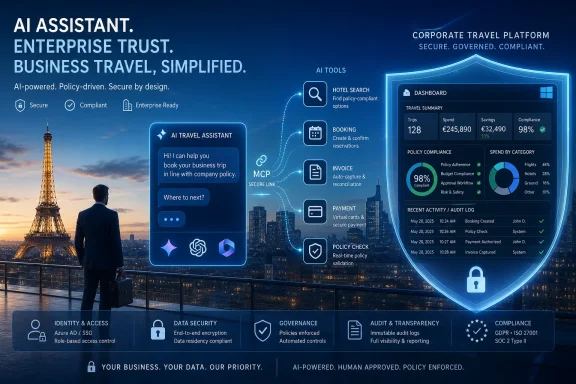
That makes this more than a travel-industry product update. It is a preview of how enterprise software may be consumed if AI assistants become the front door to work: not by replacing back-end systems, but by standing in front of them, asking for permission, calling tools, applying policy, and returning a completed transaction. For WindowsForum readers, the interesting part is not the hotel room. It is the shape of the integration model Microsoft, OpenAI, Anthropic, and enterprise vendors are all converging around.
The Travel Agent Is Becoming an AI Tool Call
Corporate travel has always been an awkward test case for automation because it looks simple only from the outside. A traveler wants a hotel near a meeting, under a price cap, with the right billing method, loyalty eligibility, invoice workflow, cancellation policy, duty-of-care visibility, and sometimes approval routing. Consumer travel sites can optimize for speed and persuasion; business travel platforms have to optimize for compliance.
That is why CDS’s example prompt is revealing. The user does not merely ask for “a hotel in Paris.” The request includes a star rating, a location constraint, travel-policy compliance, centralized payment, and a dematerialized invoice. In the old world, those requirements are scattered across filters, profile data, negotiated-rate tables, finance rules, and expense systems. In the MCP world, the assistant becomes the conversational surface while the travel platform remains the system of record.
This is the promise vendors are now selling: the user speaks naturally, but the transaction still runs through corporate controls. The assistant is not meant to scrape a website and improvise. It is meant to discover permitted tools, submit structured requests, receive authorized responses, and hand the user back a set of options that already respect company rules.
That distinction matters. Generative AI is notoriously good at confident approximations, and travel booking is a domain where approximations become expensive quickly. A hallucinated room rate is not a minor factual error if an employee builds an itinerary around it. A missing invoice flag is not a user-experience bug if it breaks VAT recovery or expense reconciliation.
MCP Gives AI Assistants a Door Into Enterprise Software
Model Context Protocol was introduced by Anthropic in late 2024 as an open way for AI systems to connect to external data sources and tools. The analogy most vendors reach for is “USB-C for AI,” and while that comparison is too neat, it captures the ambition. Instead of every assistant needing a bespoke integration with every business system, MCP defines a common way for clients and servers to expose capabilities.
In practice, an MCP server can tell an AI assistant what tools are available, what inputs those tools accept, and what outputs they can return. A travel platform might expose hotel search, booking, policy validation, traveler-profile lookup, payment routing, invoice retrieval, or trip-status capabilities. The assistant does not need to know the travel platform’s internal architecture; it needs to know how to invoke the tool safely and how to present the result.
That is why CDS and BCD are treating MCP as infrastructure rather than a novelty feature. For CDS, the immediate play is hotel booking through AI assistants such as ChatGPT, Claude, and Microsoft Copilot. For BCD, the TripSource announcement is broader, covering agentic AI capabilities across booking, trip management, program intelligence, and spend management.
The business value is obvious if the plumbing works. Corporate travel platforms spend years trying to get employees to use approved booking channels because unmanaged bookings create cost leakage, security blind spots, and finance headaches. If employees increasingly live inside AI assistants, the approved channel has to follow them there.
CDS Is Selling Control, Not Just Convenience
The most important line in CDS’s announcement is not the one about booking in seconds. It is the assurance that sensitive data remains under CDS control and is not transferred, replicated, or exposed to AI models. That promise is doing a lot of work.
Enterprise adoption of AI assistants is constrained less by curiosity than by trust. Companies may be willing to let employees use AI to draft an email or summarize public material, but booking travel requires personal data, payment data, negotiated supplier rates, internal travel policy, approval rules, and potentially location-sensitive information. The assistant must be useful without becoming a data spill.
CDS’s answer is to frame MCP as a controlled interaction layer. The assistant receives only what it needs to perform the task, while authentication, two-factor access, traceability, policy enforcement, and validation remain anchored in the travel platform. The AI is the interface; the regulated workflow remains inside the vendor’s environment.
That is the enterprise version of the AI story, and it is much less glamorous than the consumer version. It is not about a magical agent roaming the internet on your behalf. It is about permissions, logs, scopes, tokens, and audit trails. The assistant becomes powerful only because the boring parts are constrained.
BCD’s TripSource Move Shows the Bigger Platform Ambition
BCD’s announcement puts the same protocol into a broader corporate travel-management frame. TripSource is not just a booking app; it is BCD’s traveler engagement and program-management platform. By adding MCP, BCD is trying to make its services consumable by agents across air, hotel, car, and eventually rail, while keeping content and policy embedded in the interaction.
That last phrase is the strategic point. In many travel workflows, policy is treated as a downstream correction. The traveler shops first, then the platform flags what is out of policy, or the expense team catches the problem later. In an agentic model, the policy needs to be part of the answer from the beginning.
If an AI assistant recommends five hotels, only two of which are compliant, it has already failed the enterprise use case. If it books a room without the correct payment rail or invoice workflow, it has merely accelerated a bad process. BCD is effectively arguing that AI-native travel should not mean “free-form travel search with a corporate wrapper.” It should mean travel search where compliance is part of the query itself.
That ambition also explains why BCD talks about program intelligence and spend management, not just booking. Once AI assistants can ask structured questions of enterprise data lakes, a travel manager might ask where hotel rates are drifting above negotiated caps, which markets have poor policy adherence, or where unused credits are accumulating. In that scenario, MCP is not only a traveler interface. It becomes an analytics and operations interface.
The API Analogy Is Useful Until It Becomes Too Comforting
CDS compares MCP’s potential role in AI-driven services to the role APIs played for the web. The analogy is fair, but it risks understating the governance problem. APIs let software systems talk to each other; MCP lets probabilistic AI systems discover and invoke software capabilities on behalf of users.
That changes the threat model. A traditional API integration is usually built around a known application flow. Developers decide which endpoints to call, when to call them, and what to do with the response. With agentic AI, the assistant may choose from available tools dynamically, based on a natural-language instruction and context that can include user messages, documents, emails, calendar entries, or prior steps.
This is where enterprise IT will be both intrigued and nervous. A well-designed MCP server can reduce integration sprawl by creating a standard interface. A poorly governed one can create a new attack surface where prompt injection, excessive permissions, confused-deputy problems, or bad tool descriptions lead to unintended actions.
The travel example is relatively contained, but the pattern generalizes quickly. If an assistant can book hotels, it can eventually amend bookings, cancel trips, approve exceptions, request refunds, retrieve invoices, or reconcile expenses. Each added capability increases usefulness and risk at the same time.
That is why the security details are not footnotes. Strong authentication, two-factor access, traceability, and vendor-controlled data boundaries are the core product. Without them, MCP is just another way to connect a chatbot to sensitive systems.
Microsoft Copilot’s Presence Makes This a Windows Workplace Story
The inclusion of Microsoft Copilot in CDS’s assistant list is not incidental. For many enterprises, Copilot is the AI surface most likely to be sanctioned by IT because it sits inside the Microsoft 365 and Windows productivity stack. If business-travel tools become available through Copilot, the travel workflow moves closer to the place employees already manage calendars, email, Teams messages, and documents.
That could make the user experience feel almost inevitable. A worker receives a meeting invitation in Paris, asks Copilot to arrange a compliant hotel, and the assistant uses context from the calendar while calling the company-approved travel platform through MCP. The employee does not need to remember the booking portal, the finance policy, or the right hotel program. The organization still gets policy enforcement, auditability, and centralized billing.
This is also where Microsoft’s enterprise position matters. Copilot is not just a chatbot brand; it is Microsoft’s attempt to make AI the orchestration layer across work. MCP support in Microsoft tooling gives vendors a plausible route into that layer without building one-off integrations for every assistant environment.
The Windows angle is practical. The more enterprise workflows move into AI assistants, the more desktop management, identity, conditional access, endpoint security, browser policy, and data-loss prevention become part of the AI deployment story. AI travel booking is not a separate island. It is another workload flowing through the same identity and governance fabric admins already maintain.
The User Interface Is Shrinking, but the Stack Is Getting Deeper
There is a seductive simplicity to the demo. Ask for a hotel in plain English; get compliant options; confirm the booking. The interface shrinks from screens and filters to a sentence. But under that simplicity, the stack becomes more layered.
The assistant has to understand intent, but it should not be trusted to enforce policy by itself. The MCP server has to expose useful capabilities, but not more than the user is authorized to use. The travel platform has to return live availability and rates, but also respect negotiated contracts, approval flows, payment rules, and local invoicing obligations. The enterprise has to log the action in a way that support teams, finance teams, and auditors can understand later.
This is the paradox of agentic software. The front end becomes conversational and forgiving; the back end has to become stricter. Every ambiguity the user no longer handles manually must be resolved somewhere else in the system.
That is good news for mature enterprise vendors and bad news for shallow AI wrappers. A chatbot that can describe a hotel is not a travel-management platform. A booking platform that can expose policy-aware tools to AI assistants might be. The difference will matter as companies move from pilots to production.
Business Travel Is a Harder Test Than Vacation Planning
Consumer travel AI demos often begin with inspiration: find me a beach vacation, compare neighborhoods, build a five-day itinerary, suggest restaurants. Business travel begins with constraints. The meeting is fixed, the budget is fixed, the traveler profile is known, the payment path is prescribed, and the company may need to know where the traveler is if something goes wrong.
That makes corporate hospitality a useful stress test for MCP. It requires the AI assistant to act less like a creative planner and more like a compliant operator. The assistant must be flexible in language but disciplined in execution.
CDS’s staged rollout across the S4BT group also points to the complexity ahead. The company says the architecture is intended to extend beyond CDS to Goelett, Corporate Rates Club, SIAP, and HotelHub, covering areas such as multimodal booking, payment, electronic invoicing, and agency services. Each of those domains adds systems, permissions, and edge cases.
The payoff, if the integration is robust, is a more unified experience across a fragmented travel stack. The risk is that a conversational front end hides fragmentation rather than solving it. Enterprises will need to ask whether the assistant is truly orchestrating governed services or merely passing users into another maze with nicer language.
The Protocol Race Is Really a Distribution Race
Travel companies are moving quickly because they understand what happened in earlier distribution shifts. Search engines, online travel agencies, metasearch platforms, mobile apps, and corporate booking tools all changed who controlled demand. AI assistants threaten to do the same by becoming the first place travelers ask.
If a traveler begins in ChatGPT, Claude, or Copilot, the assistant’s connected tools shape the available choices. Vendors that are not exposed to that environment may become invisible, even if they have better inventory or better corporate terms. That is why hotel suppliers, travel agencies, and travel-management companies are suddenly interested in MCP: it is not only a technical standard, it is a route into the next demand channel.
There is a defensive element too. Travel brands do not want general-purpose AI systems inventing answers about rates, policies, or availability from stale web data. By exposing controlled tools, they can give assistants live, governed information and keep the transaction closer to their own systems.
The power balance remains unsettled. If assistants become the primary interface, platform owners such as Microsoft, OpenAI, Anthropic, and Google may gain enormous influence over which tools are discoverable, trusted, and convenient. MCP may be open, but distribution rarely stays neutral once users settle into defaults.
The Security Model Will Decide Whether Enterprises Trust It
The next phase of MCP adoption will be judged less by demos than by incident reports. Tool-using AI systems introduce risks that conventional SaaS integrations do not fully capture. A malicious email, document, or webpage can try to manipulate an assistant’s instructions. An over-permissioned connector can expose data beyond the user’s intent. A vague tool description can lead an agent to invoke the wrong capability.
For travel systems, the obvious risks include unauthorized bookings, leakage of traveler profiles, exposure of negotiated rates, incorrect payment handling, and weak audit trails. The less obvious risks are operational. If an assistant books outside the expected workflow, who supports the traveler? If it chooses a compliant but impractical option, who is accountable? If a rate changes between recommendation and booking, how is that represented to the user?
CDS is wise to emphasize that sensitive data remains under its control. But customers will need more than vendor assurances. They will need contractual language, technical documentation, admin controls, logging visibility, and a clear separation between model context and retained business data.
The safest enterprise implementations will likely start narrow. Search and recommend first. Book with explicit confirmation. Limit cancellation and amendment rights. Require step-up authentication for payment-sensitive actions. Log every tool invocation in language a human can understand.
The Old Booking Portal Is Not Dead, but It Is Losing Its Monopoly
It is tempting to declare the corporate booking tool obsolete. That would be premature. Portals and apps will remain necessary for complex itineraries, traveler support, profile management, disruption handling, and cases where users need visual comparison or manual control.
But the booking portal is losing its status as the only legitimate front door. If MCP-style integrations mature, the portal becomes one surface among many. The same governed travel capabilities can be consumed through a web app, a mobile app, a Microsoft Teams experience, Copilot, Claude, ChatGPT, or an internal enterprise agent.
That is the deeper shift. Enterprise software vendors spent decades pulling users into their interfaces. AI assistants may push those vendors toward headless, tool-exposed services where the interface is determined by the user’s work context.
For users, that could mean less tab-hopping and fewer half-remembered workflows. For admins, it means more attention to identity, permissioning, observability, and vendor governance. For vendors, it means the quality of the underlying service matters more than the stickiness of the front end.
The Real Test Will Come After the First Smooth Demo
A single hotel booking demo can look polished. Production travel is messier. Employees change plans, flights are delayed, meetings move, policies differ by country and seniority, rates disappear, invoices fail, approvals stall, and travelers ask for exceptions in language that is anything but structured.
That is where AI assistants must prove they are more than conversational veneers. They need to handle ambiguity without inventing authority. They need to ask clarifying questions when policy requires it. They need to surface tradeoffs instead of hiding them. And they need to know when to hand the case to a human agent.
BCD’s broader framing around internal agent-to-agent collaboration hints at where the industry wants to go. The traveler-facing assistant may be only the visible piece. Behind it, specialized agents could reason across booking, policy, data, finance, and support domains. That architecture sounds powerful, but every handoff creates another place where context can be lost or permissions can blur.
The winners will be the platforms that make these transitions boring. The assistant should not feel magical when it books a hotel; it should feel reliable. In business travel, reliability beats spectacle every time.
The Paris Demo Points to a Bigger Enterprise Shift
The CDS announcement is timed around VivaTech in Paris, which is fitting because the story is as much about symbolism as shipping code. AI assistants are no longer being pitched only as places to draft text or answer questions. They are being positioned as transactional interfaces for regulated business processes.
That is the line enterprise software has been edging toward for the past year. The first wave of generative AI in the workplace was about content. The second wave is about action. MCP is one of the mechanisms trying to make that action interoperable enough for vendors and governable enough for enterprises.
There is still a wide gap between “supports MCP” and “ready for broad enterprise deployment.” Standards do not eliminate product differences, security obligations, or operational complexity. They simply create a common grammar for integration. Whether that grammar produces safe, useful workflows depends on implementation.
Still, CDS and BCD are pointing in the same direction. The future corporate travel interface may not be a booking site with an AI box attached. It may be an AI assistant with approved travel tools attached, operating inside the identity, policy, and audit boundaries of the company.
The Concrete Readout for WindowsForum Readers
The CDS and BCD announcements are narrow in market terms but broad in implication. They show how enterprise vendors are preparing for a world where AI assistants sit between users and business applications.
- CDS is opening its hotel booking platform to AI assistants including ChatGPT, Claude, Microsoft Copilot, and other enterprise agents through MCP.
- BCD Travel announced MCP support for TripSource in late May 2026, with ambitions spanning booking, trip management, program intelligence, and spend management.
- The practical enterprise value is not natural language alone, but natural language combined with policy enforcement, payment control, invoicing, authentication, and auditability.
- Microsoft Copilot’s role matters because many companies will prefer AI workflows that connect to existing Microsoft identity, productivity, and governance environments.
- The main risk is that tool-using AI expands the attack surface unless permissions, logging, confirmation steps, and data boundaries are engineered conservatively.
- The old travel portal will remain, but it is likely to become one interface among several as business systems expose governed capabilities to AI assistants.
The travel industry has always been a preview of distribution fights to come: who owns the customer, who controls the interface, and who gets reduced to plumbing. CDS and BCD are trying to avoid being buried beneath the next interface shift by turning their platforms into AI-callable infrastructure. If MCP becomes the connective tissue vendors hope it will be, the most important enterprise software screen of the next few years may not be a screen at all, but a governed conversation that knows when it is allowed to act.