

ZoomInfo Is Selling Claude a Memory It Can Trust
The central claim in ZoomInfo’s announcement is not that Claude can write better sales emails. Everyone in enterprise software can make that claim now, and most of them do. The more important claim is that Claude can now answer go-to-market questions using ZoomInfo’s verified company, contact, firmographic, technographic, and buying-signal data instead of relying on whatever stale notes, CRM fragments, or manually pasted spreadsheet rows a user brings into the chat.
That distinction matters because generative AI’s first wave in business software was built on a fragile ritual: copy a chunk of data from one system, paste it into a chat window, ask for analysis, then carry the answer back into another system. It was useful enough to become habit-forming, but it was never a serious operating model for companies that care about governance, privacy, or repeatability. The workflow was powerful precisely because it bypassed the stack, which is also why IT departments hated it.
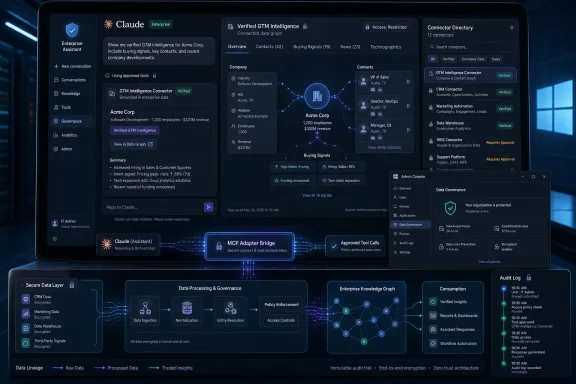
ZoomInfo’s pitch is that its GTM Context Graph can become the live substrate underneath those AI interactions. The company describes that graph as containing identity-resolved records on more than 100 million companies, 500 million contacts, and billions of buying signals. In plain English, ZoomInfo wants Claude to stop guessing who a buyer is and start querying a commercial intelligence layer that already knows.
That does not magically make every AI-generated recommendation correct. It does, however, shift the failure mode. A generic model may hallucinate a title, infer a decision-maker from outdated web text, or invent a buying trigger from thin context. A connected model can still misreason, but the raw material is at least coming from a governed data source with entitlement checks and a business model built around accuracy.
MCP Turns the Chat Window Into a Front End
The connector exists because of Model Context Protocol, the open standard Anthropic introduced to let AI systems connect to external tools, services, and data stores in a more consistent way. MCP has quickly become the connective tissue of the agentic AI boom: not the model itself, not the app itself, but the protocol that lets one talk to the other without every vendor writing a bespoke integration from scratch.
That is why the ZoomInfo-Claude news should be read as infrastructure news, not merely sales-tech news. Claude is the visible surface. GTM.AI is the plumbing. MCP is the adapter layer that lets the assistant call into ZoomInfo’s data and, in Claude Code, potentially become part of more automated workflows.
For business users, this means the prompt becomes less of a blank page and more of a command line for approved data. A salesperson could ask Claude to map stakeholders at a target account. A revenue operations user could ask for enriched contacts across a list of companies. A developer or GTM engineer working in Claude Code could assemble a workflow that researches accounts, enriches leads, scores targets, and pushes the results into a downstream process.
That is the commercial dream behind the word agentic. The assistant is no longer just generating prose. It is calling tools, retrieving structured records, and chaining steps together. In a best-case scenario, the model handles the ambiguity of human requests while the connected systems handle the facts.
The danger is that “connected” can become a euphemism for “over-permissioned.” Once an AI assistant can reach into external systems, retrieve sensitive business data, and invoke actions on behalf of a user, the security conversation changes. The question is no longer simply whether the model will hallucinate. The question is whether it can access data it should not, combine data in ways the company did not intend, or perform actions that look authorized but were triggered by a badly scoped prompt.
The Real Product Is the Governance Plane
ZoomInfo’s announcement leans heavily on governance: access control, permissioning, data lineage, AI policy, and audit logging across surfaces that consume GTM.AI. That language may sound like enterprise boilerplate, but it is the part of the release that IT leaders should read most carefully. If AI agents are going to be allowed anywhere near customer records, account plans, or prospecting workflows, governance is not an add-on. It is the product.
The old SaaS integration model was comparatively easy to reason about. Salesforce connected to Marketo. HubSpot synced with a data provider. A BI tool pulled from a warehouse. Administrators could inspect permissions, map data flows, and decide which systems were authoritative for which fields.
AI complicates that model because the user interface is natural language. A human does not click a button labeled “export contacts from segment X with fields Y and Z.” They ask, “Build me a list of senior security leaders at companies showing cloud migration intent.” That request may require multiple tool calls, data joins, ranking steps, and summarization. The result may be a conversational answer, a structured table, or the beginning of another automated workflow.
In that environment, the governance layer has to answer harder questions. Which user is asking? Which data are they entitled to see? Which fields can the connector expose? Which tool calls happened? Which model-generated conclusion came from which record? Can the company reconstruct the path from prompt to answer if a customer, regulator, or executive asks?
ZoomInfo is trying to position GTM.AI as the answer to those questions across many assistants, not just Claude. The release names integrations with Salesforce Agentforce, HubSpot Breeze, Microsoft Copilot, Gong, LeanData, Glean, ChatGPT, and Google. That list is strategic. ZoomInfo is not betting that one assistant wins everything; it is betting that every surface will need the same governed go-to-market context.
Sales Data Is the Perfect Test Case and the Worst-Case Demo
Go-to-market work is a natural fit for AI because it is full of semi-structured tasks that humans already describe in conversational language. Find similar accounts. Identify decision-makers. Summarize a company’s likely priorities. Draft outreach using recent signals. Prioritize a territory. Explain why one account is warmer than another.
It is also a messy domain where bad data spreads quickly. A wrong title wastes a rep’s time. A stale technology signal produces a tone-deaf pitch. A misidentified buying committee can distort pipeline coverage. A hallucinated trigger event can make a company look careless or creepy.
That is why ZoomInfo’s “verified data inside Claude” framing is more than marketing. For sales and marketing teams, the quality of the underlying contact and account intelligence is not a nice-to-have. It determines whether AI accelerates revenue work or simply automates spam at greater scale.
There is an uncomfortable truth here for the entire AI industry: many enterprise AI demos work because the data in the demo is clean, complete, and conveniently arranged. Real sales organizations are not like that. CRMs contain duplicate accounts, abandoned fields, incomplete territories, and notes written for humans rather than machines. If AI assistants are going to become useful in that environment, they need something more reliable than the average CRM record.
ZoomInfo’s bet is that the missing ingredient is an external, continuously refreshed context graph. That may be right, but it also creates a new dependency. If the assistant’s answer depends on ZoomInfo’s graph, then ZoomInfo’s accuracy, coverage, refresh cadence, and permission model become part of the customer’s AI risk profile.
Claude Code Makes This Bigger Than the Sales Desk
The Claude.ai connector is easy to understand: a user asks a question, Claude queries ZoomInfo, and the answer includes verified go-to-market intelligence. Claude Code is more interesting because it moves the same connector into a development and automation environment. That is where the announcement starts to touch IT operations, internal tooling, and the future of revenue engineering.
Claude Code began as a coding assistant, but tools like it are rapidly becoming general-purpose automation workbenches. If an organization can expose approved business data through MCP, a technical operator can build agents that perform repeatable workflows without waiting for a traditional SaaS vendor to ship a feature. That is appealing in revenue operations, where teams often stitch together brittle processes across CRM, enrichment tools, spreadsheets, sequencers, and analytics platforms.
The upside is speed. A GTM operator could prototype an account-scoring workflow, test different enrichment criteria, or generate territory research without building a full application. The connector gives the agent a sanctioned way to retrieve data rather than scraping, pasting, or improvising.
The downside is also speed. When agentic workflows become easy to assemble, organizations can accidentally create shadow automation with real business consequences. A bad account score may change rep behavior. A flawed enrichment rule may propagate into CRM. An overbroad contact list may create compliance exposure. A prompt that sounded harmless in a chat window can become operationally significant when wired into an agent.
That is why the Claude Code angle should make CIOs and CISOs pay attention. This is not only about sales teams chatting with a data provider. It is about business logic moving into AI-assisted workflows that may be created outside the traditional software development lifecycle.
Microsoft Shops Should See the Pattern, Not Just the Brand Names
For WindowsForum readers, the obvious question is why a ZoomInfo-Claude connector belongs in the same conversation as Microsoft Copilot, Windows endpoints, and enterprise administration. The answer is that the AI assistant wars are no longer just about models. They are about which assistants can reach which business systems under which governance model.
Microsoft has its own strategy here, centered on Copilot, Microsoft 365, Graph, Azure, Entra, and the broader security and compliance stack. Anthropic has been pushing Claude as a high-end reasoning and coding assistant with connectors and MCP as a way to reach enterprise data. OpenAI, Google, Salesforce, ServiceNow, and others are all building similar bridges between model interfaces and systems of record.
ZoomInfo’s move cuts across that landscape. The company says GTM.AI already plugs into Microsoft Copilot as well as Claude, ChatGPT, Salesforce Agentforce, HubSpot Breeze, and others. That is a pragmatic vendor strategy: customers will not standardize on one AI assistant overnight, and many will end up with several. The data layer wants to be present wherever the work happens.
That has practical consequences for Microsoft-centric IT teams. If a company allows Claude for certain teams, Copilot for others, and perhaps ChatGPT Enterprise for still others, the old question “Which AI tool are we buying?” becomes insufficient. The more important questions are about shared identity, logging, connector governance, data classification, and cross-surface policy enforcement.
In other words, the endpoint is no longer the perimeter, and neither is the application. The connector graph is becoming part of the control plane. Admins who spent years managing OAuth consent, app registrations, data loss prevention, and conditional access should recognize the shape of the problem. AI just gives it a faster user interface and a larger blast radius.
The Connector Directory Is Becoming the New App Store
Claude’s connector directory is beginning to look like an enterprise app store for AI context. That is not a perfect analogy, because connectors are not simply apps. They are permissioned bridges between a model and external systems. But from a user’s perspective, the directory serves the same function: discover a capability, connect an account, and bring a new service into the primary workspace.
This is a major shift in software distribution. In the SaaS era, vendors fought to become the destination application. In the AI-agent era, vendors may increasingly fight to become callable context. ZoomInfo does not need every user to live inside ZoomInfo’s own interface if its data becomes available inside Claude, Copilot, ChatGPT, Salesforce, and other tools where users already spend their day.
That is both smart and risky. It is smart because users do not want another tab. It is risky because the vendor’s brand may become less visible as the assistant becomes the front end. If Claude presents a polished answer grounded in ZoomInfo data, the user may credit Claude for the experience even though ZoomInfo supplied the commercial intelligence.
This is the same platform tension that has played out repeatedly in technology. Database vendors powered applications that got the user attention. Payment networks enabled marketplaces that owned the customer relationship. Cloud providers became the invisible substrate under consumer services. Now data vendors are deciding whether it is better to be the cockpit or the fuel.
ZoomInfo appears to be choosing fuel, but fuel with metering, governance, and policy hooks attached. That may be the right answer. In a world of many assistants, being the trusted data layer across them could be more durable than trying to make everyone use one more dashboard.
Verified Data Does Not Remove the Need for Judgment
The phrase “verified data” deserves scrutiny. In B2B intelligence, verification is not a binary state that lasts forever. People change jobs, companies reorganize, technologies are replaced, buying committees shift, and signals decay. A record can be verified and still become stale. A signal can be accurate and still be misinterpreted.
AI can amplify both the usefulness and the ambiguity of that data. If Claude retrieves a contact record and summarizes a likely buying committee, it may produce a more actionable view than a spreadsheet. But it may also smooth over uncertainty. The answer may sound more definitive than the underlying evidence deserves.
This is where product design matters. Enterprise AI systems need to show enough provenance for users to understand what they are acting on. If Claude says an account is showing buying intent, the user should know whether that conclusion comes from recent hiring, technology installation data, content engagement, funding news, web behavior, or some blend of signals. If a contact is recommended as a decision-maker, the user should know whether that is based on title, reporting structure, historical buying patterns, or inference.
ZoomInfo’s mention of data lineage is therefore important. The future of AI in business will not be won by assistants that merely sound confident. It will be won by systems that can explain enough of their work to be trusted, challenged, and corrected.
That is especially true in sales, where automation can quickly degrade into volume without relevance. A connected Claude could help a rep understand a target account more deeply. It could also help a careless team generate thousands of plausible but poorly grounded messages. The connector does not decide which culture a company has. It only makes that culture faster.
The MCP Boom Comes With Security Debt
MCP’s rapid rise has been one of the more important infrastructure stories in enterprise AI. Its appeal is obvious: standardize how AI applications connect to tools and data, and the ecosystem can move faster. Developers get a common pattern. Vendors get a distribution mechanism. Users get assistants that can actually do things.
But standardization also concentrates risk. A popular connector pattern becomes a popular target. A misconfigured tool can expose more than a single app. A vulnerable implementation can ripple across many clients and servers. Security researchers have already been probing MCP implementations and warning about the risks of tool invocation, local execution paths, prompt injection, and overbroad permissions.
That does not mean enterprises should avoid MCP. It means they should treat it as infrastructure, not a toy. The same scrutiny that applies to identity providers, API gateways, endpoint agents, and browser extensions should apply to AI connectors. What can the connector read? What can it write? Which user identity does it inherit? Are tool calls logged? Can administrators revoke access centrally? Are local and remote transports governed differently? What happens when a prompt tries to smuggle instructions through retrieved content?
These are not theoretical questions for companies connecting sales intelligence to AI assistants. Contact data, account strategy, buying signals, and customer context can be commercially sensitive. Even when the data is not regulated in the strictest sense, it can reveal market priorities, pipeline focus, partner relationships, and competitive strategy.
ZoomInfo’s governance language is meant to reassure buyers on precisely this point. The claim is that GTM.AI provides a consistent governance plane across the surfaces that consume it. Customers should test that claim in procurement, security review, and pilot deployments rather than accepting it as a slogan.
Revenue Teams Get a Shortcut; IT Gets Another Control Problem
The most immediate beneficiaries of the Claude connector are likely sales, marketing, customer success, and revenue operations teams that already pay for ZoomInfo. For them, the value proposition is straightforward: less tab-switching, less manual enrichment, and faster access to account intelligence inside an assistant they may already use.
The deeper organizational effect is less tidy. AI connectors blur the line between application access and data access. A user may not have direct access to every underlying system, but an assistant with the right connector might synthesize information from several of them. That synthesis is the point of the product, but it is also what makes governance harder.
IT departments will need to decide whether connectors are managed like SaaS integrations, browser extensions, API clients, or something new. In practice, they have characteristics of all three. They appear in user-facing directories. They authenticate through account entitlements. They call APIs. They can be invoked by natural language. In developer tools such as Claude Code, they may become building blocks for automation.
Procurement will also have to adapt. Buying an AI assistant is no longer just buying model access. Buying a data provider is no longer just buying a database. The value emerges from the combination: model, connector, context graph, policy layer, and workflow surface. That makes vendor evaluation more complicated, but also more important.
For organizations already wrestling with Copilot deployments, the lesson is familiar. The assistant’s quality depends heavily on the quality and permissions of the data it can reach. If your identity model is sloppy, your content permissions are chaotic, or your data owners are unclear, AI will expose those weaknesses. ZoomInfo’s connector may solve the specific problem of external GTM context, but it cannot solve an enterprise’s broader governance debt by itself.
The AI Sales Stack Is Consolidating Around Context
The older sales-tech stack was built around systems of record and systems of engagement. CRM stored the account. Sales engagement tools sent the emails. Marketing automation tracked campaigns. Data providers enriched records. Conversation intelligence captured calls. Analytics tools tried to explain what happened.
AI is pushing that stack toward systems of context. The user asks a question or assigns a task, and the assistant needs to assemble the relevant facts from across those layers. In that model, the winning product is not necessarily the one with the most screens. It is the one that supplies the most trusted context at the moment of action.
ZoomInfo understands this. The company’s GTM.AI positioning is not merely “we have data.” It is “our data can be called by agents, assistants, and workflows wherever go-to-market work occurs.” The Claude connector is one proof point in that strategy, but the broader goal is to make ZoomInfo part of the AI execution layer.
That is also why the announcement mentions both Claude.ai and Claude Code. One is for conversational access. The other is for workflow creation. Together, they sketch a future in which revenue teams do not just ask AI for advice; they ask it to operate against live data under policy constraints.
The open question is whether customers will embrace that future quickly or cautiously. Sales leaders will want speed. Legal and security teams will want boundaries. Administrators will want visibility. End users will want answers that are better than what they can get from a web search or CRM report. The connector succeeds only if it satisfies enough of those constituencies at once.
The Practical Test Will Happen in the Pilot, Not the Press Release
The announcement gives ZoomInfo a strong narrative: verified GTM intelligence, native Claude access, MCP-based extensibility, and consistent governance across AI surfaces. The real test will be what happens when customers connect it to messy operating environments.
A useful pilot should not measure only whether Claude can return a contact list. That is the easy part. It should measure whether the answers are more accurate than current workflows, whether users understand the source and freshness of the data, whether permissions behave as expected, and whether the workflow reduces manual work without creating new cleanup tasks elsewhere.
It should also test refusal and boundary cases. What happens when a user asks for data outside their entitlement? What happens when a prompt requests personal contact details in a region with stricter privacy requirements? What happens when a user asks Claude Code to enrich and score a list at scale? What happens when retrieved content contains instructions that conflict with company policy?
Those tests may sound adversarial, but they are the difference between an impressive demo and a deployable system. Enterprise AI is entering the phase where “it works” is not enough. It must work within the organization’s rules, and it must fail safely when those rules are reached.
ZoomInfo’s advantage is that it is not starting from scratch. The company already sells into environments that care about data quality, permissions, and revenue accountability. Its challenge is that AI raises the expectations. A data error inside a traditional interface is one thing. A data error amplified by an assistant and embedded into an automated workflow is another.
The Signal in ZoomInfo’s Claude Move
ZoomInfo’s Claude connector is not a consumer AI story, and that is exactly why it matters. It shows where enterprise AI is becoming useful: not in isolated chats, but in governed access to business context that already has value.
- ZoomInfo customers can now use a native Claude connector to bring company, contact, firmographic, technographic, and buying-signal data into Claude conversations.
- The same ZoomInfo connection is available in Claude Code, where it can support more technical and agentic go-to-market workflows.
- GTM.AI is the infrastructure layer behind the integration, exposing ZoomInfo data through API and Model Context Protocol.
- The practical value depends on governance as much as data quality, because AI assistants can retrieve, synthesize, and potentially operationalize sensitive business information.
- Microsoft-centric IT teams should read the announcement as part of a broader shift toward multi-assistant environments where Copilot, Claude, ChatGPT, and other tools may all consume the same governed data layers.
- The most important enterprise tests will be permissions, lineage, auditability, and safe failure modes, not whether the demo can produce a polished account summary.
ZoomInfo’s Claude integration is a small window into a larger platform fight: the models are becoming interchangeable at the edges, the assistants are becoming work surfaces, and the durable advantage is shifting toward trusted context that can move across them. For Windows administrators, security teams, and business-application owners, the message is blunt: the next wave of AI adoption will not arrive as a single app to deploy, but as a web of connectors to govern. The companies that get that governance right will make AI feel like leverage; the ones that do not will rediscover, at machine speed, every data-permission mistake they have spent the last decade trying to clean up.
References
- Claude Now Enabled by ZoomInfo's GTM Context Graph, Powered by GTM.AI The National Law Review · 2026-06-05T16:50:49.419413
- claude.com claude.com
- resources.anthropic.com resources.anthropic.com