That sounds, at first pass, like another logistics vendor grafting itself onto the AI news cycle. It is more interesting than that. CargoAi is betting that the next interface for freight operations will not be another dashboard, another portal, or another transport management system tab, but the conversational agent that already sits beside the operator’s inbox, spreadsheet, and customer thread.
CargoAi Is Moving the Marketplace Into the Agent Layer
CargoMART has always lived in a familiar digital-commerce frame: forwarders search for capacity, compare rates, book with airlines, and track shipments through a marketplace experience. The new move changes the frame. CargoAi is not merely adding a chatbot to CargoMART; it is exposing CargoMART’s data and transactional capabilities to AI assistants that sit outside CargoAi’s own product surface.
That distinction matters. A conventional chatbot is usually a front end for one vendor’s workflow. An MCP-connected service is closer to a socket: the AI assistant can discover approved capabilities, request live information, and execute defined actions without the user constantly switching applications.
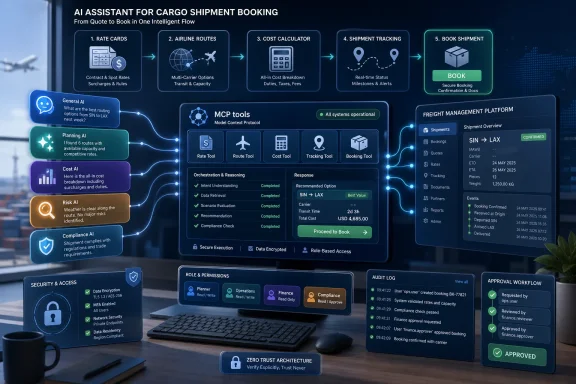
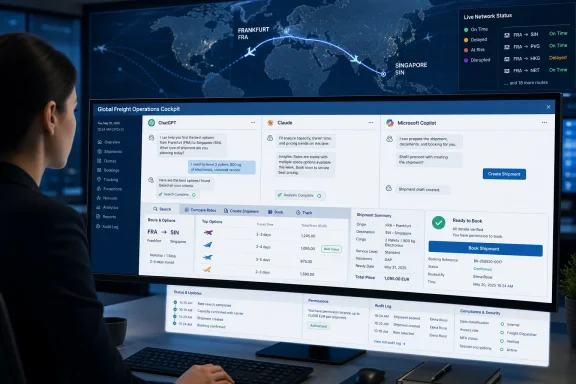
In CargoAi’s telling, a freight forwarder could ask an AI assistant to compare air cargo options, evaluate departure times, analyze all-in costs, create a shipment, book with one of more than 105 airlines, and then track the shipment across a network of more than 240 airlines. The promise is not that chat magically replaces air cargo expertise. The promise is that the operator’s command line becomes natural language.
That is why this announcement lands differently from the first wave of “AI in logistics” claims. Predictive ETAs, automated quotes, and rate intelligence have been circulating for years. The new question is whether operational systems become tools called by agents rather than destinations visited by humans.
MCP Gives Logistics Software a Common Doorway
The Model Context Protocol was introduced by Anthropic in late 2024 as a way to standardize how AI assistants connect to external data sources, applications, and tools. Since then, it has moved beyond Claude into a broader ecosystem that includes Microsoft, OpenAI-adjacent tooling, developer environments, and enterprise agent frameworks. The technical pitch is simple enough: instead of every AI platform building a custom connector to every business system, systems can expose capabilities through a shared protocol.
For IT pros, the analogy that keeps surfacing is “USB-C for AI.” That metaphor is imperfect but useful. USB-C does not make every device safe, fast, or well designed; it simply reduces the cost of getting devices to talk. MCP does something similar for AI assistants and business tools.
CargoAi’s adoption of MCP is therefore not just an air cargo story. It is a sign that vertical SaaS vendors are beginning to treat AI platforms as operating environments. ChatGPT, Claude, and Copilot are no longer just places where users draft emails or summarize documents; they are becoming orchestration layers for transactional work.
That is where Microsoft’s relevance becomes obvious for WindowsForum readers. Copilot is not merely a consumer assistant pinned to a taskbar or a productivity layer in Microsoft 365. In the enterprise, Microsoft wants Copilot Studio, connectors, identity, governance, and auditability to turn AI into a controlled interface for work. CargoAi is following the same gravitational pull from the other side: if the enterprise user is already living in Copilot or another approved assistant, the cargo platform needs to meet them there.
The Workflow Shift Is Bigger Than the Chat Window
Air cargo operations are a classic case of fragmented digital work. A team may move between a transport management system, carrier portals, rate sheets, email, WhatsApp, booking platforms, and tracking pages. The work is not just data retrieval; it is judgment under time pressure, with constraints around capacity, cut-off times, commodity type, route viability, customer price tolerance, and service reliability.
CargoAi’s announcement speaks directly to that mess. The company says users can search schedules, compare rates, review flight options, check departure times, analyze total costs, create shipments, book cargo, and track progress from everyday AI tools. In practice, that is an argument against the old idea that every operational workflow must be centered inside the system of record.
The system of record still matters. The booking still needs to be accurate. The shipment still needs structured data. The airline still needs valid instructions. The forwarder still needs a compliant audit trail. But the interaction layer can move.
That is the same shift that has been happening in software development, where engineers increasingly ask agentic tools to inspect repositories, open pull requests, run tests, and summarize issues. The IDE did not disappear, but its role changed. CargoAi is suggesting the same may happen to freight systems: the portal remains, but the operator increasingly works through an assistant that calls the portal’s capabilities on demand.
CargoAi’s Timing Catches an Industry Tired of Portals
The freight industry has spent years digitizing processes without always reducing the number of screens people must use. Marketplaces improved access to capacity. APIs connected airlines to partners. TMS integrations reduced duplicate data entry. Yet the operational reality often still includes a painful mix of structured platforms and unstructured communication.
That explains why the AI assistant pitch is attractive. It does not ask every forwarder to rip out its TMS, retrain staff on a new interface, or wait through a long integration project before seeing value. The user can begin with the AI environment already sanctioned by the business, provided the connector is approved and governed.
CargoAi is also careful to frame this as an extension of its existing strategy rather than a pivot. The company says it was founded in 2019 with AI at its core and has operated AI agents in production at scale for more than two years. It already markets AI-driven capabilities including rate intelligence, predictive tracking, automated quoting workflows, and CargoCOPILOT across CargoMART, email, and WhatsApp.
That continuity is important because logistics buyers are allergic to novelty for novelty’s sake. A forwarder does not need an AI demo that looks impressive on stage. It needs a system that knows when a quote is stale, when a departure is unrealistic, when a shipment needs special handling, and when a cheaper option will create a customer-service problem later.
The Agent Becomes Useful Only When It Can Act
The first generation of enterprise AI tools was mostly about text: summarize this, rewrite that, extract the action items. Those use cases are helpful, but they stay at the edge of operations. The agent becomes materially more valuable when it can do something in a live system.
CargoAi’s list of supported actions makes that ambition plain. Searching and comparing rates are informational tasks. Creating shipments and booking cargo are transactional tasks. Tracking shipments closes the loop after execution. Put those together, and the AI assistant becomes a workflow participant rather than a note-taker.
That is also where risk enters. A hallucinated paragraph is embarrassing; a mistaken booking can be expensive. A poorly scoped agent could select the wrong service, misread a customer constraint, or expose commercial rate data to the wrong user. In logistics, “move fast and break things” is not a culture; it is a liability.
The decisive question is not whether natural language can make air cargo easier. It can. The question is whether the permission model, validation steps, logging, and human approval gates are strong enough to let teams trust the assistant with operational work.
The Windows Angle Is Governance, Not Glamour
For Windows shops, the most important part of this story is not that CargoMART can connect to ChatGPT or Claude. It is that it can connect to Microsoft Copilot and other approved AI environments through a protocol that IT departments can evaluate, govern, and potentially standardize around.
Enterprise adoption of AI has been slowed less by user enthusiasm than by security and compliance. Users want assistants everywhere. IT wants identity controls, least-privilege access, data boundaries, audit logs, and revocation. MCP does not automatically solve those problems, but it gives vendors and enterprises a common integration pattern around which those controls can be built.
That is why the CargoAi move should be read as part of the same broader enterprise trend as Copilot Studio connectors, AI agents in productivity suites, and developer tools that call external systems. The assistant is becoming a broker between the user and the enterprise application stack. The broker must be managed.
A Windows administrator may not care about air cargo rates. But the pattern is familiar: a line-of-business application exposes capabilities, an AI assistant invokes them, and the organization has to decide who can do what, from where, under which policy, with what records retained. CargoAi’s use case is specialized; the governance problem is universal.
Natural Language Is a Feature, Not a Control Plane
The seductive part of this story is the user typing, “Find me the best option from Frankfurt to Singapore next Tuesday under this cost ceiling,” and getting a useful set of routings. That is the demo everyone understands. The harder engineering is everything that happens after the assistant parses the request.
The assistant must know which data it is allowed to access. It must distinguish a rough comparison from a booking instruction. It must handle missing shipment dimensions, commodity restrictions, customs-related fields, dangerous goods constraints, and airline-specific requirements. It must surface uncertainty rather than paper over it with a confident sentence.
Natural language is a powerful interface because it compresses intent. But compressed intent can be ambiguous. In a domain like air cargo, ambiguity has operational consequences.
That means the best implementations will not be frictionless in the naive sense. They will ask clarifying questions when the request is underspecified. They will show the basis of comparisons. They will require confirmation before committing a booking. They will make the final action legible to a human operator before it touches the live shipment record.
CargoMART’s Edge Is the Data Network Behind the Prompt
There is a temptation to view every AI workflow as a model competition: which assistant is smarter, faster, or more persuasive. In enterprise operations, the more durable advantage often sits behind the model. The assistant is only as useful as the systems it can safely reach.
CargoAi’s claimed network is the core asset here. If CargoMART users can access live marketplace data, airline capacity, rate comparisons, schedule options, booking functionality, and tracking coverage through an AI assistant, the model becomes a front end to a real commercial network. Without that network, the assistant is just guessing from stale general knowledge.
That is the practical difference between asking a generic chatbot for “air cargo options” and asking an authorized assistant connected to CargoMART. The former can explain concepts. The latter can potentially return live choices and execute a transaction.
This is also why vertical vendors have leverage in the AI era. Foundation-model companies own broad interfaces, but they do not automatically own domain-specific data rights, carrier relationships, workflow rules, and customer trust. CargoAi’s strategy is to let the big AI interfaces become doors into its marketplace rather than threats to it.
The TMS Is Not Dead, but Its Center of Gravity Is Moving
CargoAi says it has observed customers shifting attention from core TMS and CMS environments toward AI interfaces such as Copilot, Claude, and ChatGPT. That is plausible, but it should not be overstated. Systems of record do not vanish because an assistant becomes more convenient.
The better reading is that the TMS becomes less of a daily destination and more of an authoritative backend. Users may still rely on it for master data, compliance, accounting, shipment records, and integrations. But more routine interactions can be initiated from the assistant layer, especially when the assistant can call multiple systems in sequence.
That changes software power dynamics. If the user spends less time inside the TMS interface, vendors that control workflow surfaces lose some influence. If the assistant can coordinate CargoMART, email, customer data, and internal systems, the value shifts toward services that expose reliable, well-governed capabilities.
This is not unique to freight. CRM, ERP, ITSM, HR, and finance platforms are all facing the same question. If an employee can ask an approved agent to perform a task across systems, the application UI becomes less central. The API, permissions model, and semantic description of capabilities become more important.
Security Will Decide Whether This Becomes Infrastructure
The recent history of MCP has already shown that enthusiasm can outrun operational caution. Researchers and vendors have raised concerns around how MCP servers are implemented, how tools are described, how local processes are invoked, and how agents might be tricked into unsafe actions. The existence of a standard does not guarantee safe deployment.
For CargoAi customers, the security questions should be concrete. Which assistant is approved? Which CargoMART actions are exposed? Can the assistant book cargo, or only prepare a booking for human review? Are rate data and customer data restricted by role? Are prompts and responses retained? Can an administrator revoke access instantly? Are all tool calls logged in a way that supports dispute resolution?
These are not objections to CargoAi’s strategy. They are the conditions for its success. In regulated and operationally sensitive environments, adoption depends on making AI boring enough for administrators to trust.
The strongest version of CargoAi’s announcement is not “anyone can book cargo from a chatbot.” It is “authorized teams can bring air cargo intelligence into governed AI workflows.” That distinction is the line between a useful enterprise feature and a compliance incident waiting to happen.
The Real Contest Is Between Portals and Orchestration
CargoAi’s move also highlights a broader fight in logistics technology. For years, vendors have competed to become the portal that users open first. The next competition may be about which services are easiest for agents to orchestrate.
In that world, a user may not care whether a capability originated in a marketplace, a TMS, a carrier portal, or an internal database. The assistant presents a coherent workflow: compare options, validate constraints, generate a quote, confirm a booking, notify the customer, monitor exceptions. The underlying systems still matter, but the user’s mental model shifts from “open five tools” to “assign one task.”
This is exactly why MCP has momentum. It gives software providers a reason to expose capabilities in a machine-readable, assistant-friendly way. It also gives enterprise buyers a reason to pressure vendors for support. If one cargo marketplace can be called by Copilot or Claude, customers will begin asking why another cannot.
The risk for vendors is commoditization at the interface layer. If every service becomes an agent-callable tool, the assistant may flatten differences between platforms. The defense is depth: better data, better coverage, better execution, better reliability, and better governance.
CargoAi’s Announcement Is a Logistics Story With a Microsoft Subplot
Microsoft has spent years trying to make Copilot the front door for enterprise work. The CargoAi announcement is a small but telling example of how that ambition becomes real outside Microsoft’s own productivity stack. A freight operator does not need a philosophical argument about agentic AI; they need a way to move from a customer request to a viable shipment faster.
If Copilot can sit inside that workflow, Microsoft gains another proof point that its assistant can be more than a document helper. If CargoMART can be invoked from Copilot, CargoAi gains access to the environment many corporate users are already being trained to use. The relationship is symbiotic, but it is also strategic.
For WindowsForum readers, this is the practical edge of the AI platform war. The winning assistant will not be the one with the best poem or prettiest demo. It will be the one that can safely operate inside the messy, permissioned, high-stakes workflows where businesses actually spend money.
That is why niche announcements like this deserve attention. They show where AI adoption leaves the keynote stage and enters the operational floor.
The Cargo Desk Gets Its First Real Agent Playbook
CargoAi’s MCP rollout should be judged less by the novelty of the protocol and more by the operational behaviors it enables. If the implementation is governed well, the benefit is not “chat for cargo”; it is fewer context switches, faster comparisons, and a cleaner bridge between human judgment and live marketplace execution.
- CargoMART users can now connect marketplace data and actions to AI assistants that support the Model Context Protocol.
- The available workflow spans search, rate comparison, schedule review, shipment creation, booking, and tracking rather than stopping at informational queries.
- The announcement puts CargoAi inside the same enterprise AI trend that is pulling Microsoft Copilot, Claude, ChatGPT, and internal agents toward line-of-business systems.
- The practical value depends on live CargoMART data, airline connectivity, and permissions, not on generic chatbot intelligence.
- The main enterprise risk is not natural language itself, but poorly governed access to transactional actions such as booking and shipment creation.
- The broader implication is that vertical software vendors are beginning to compete on how well their capabilities can be orchestrated by approved AI agents.
The future CargoAi is sketching is not one where freight professionals disappear behind automation. It is one where the cargo desk becomes more like an operations cockpit, with AI handling retrieval, comparison, and routine execution while humans supervise exceptions, trade-offs, and customer commitments. If MCP becomes the connective tissue for that model, the most important enterprise software interface of the next few years may not be a new app at all, but the assistant already open on the user’s desktop.