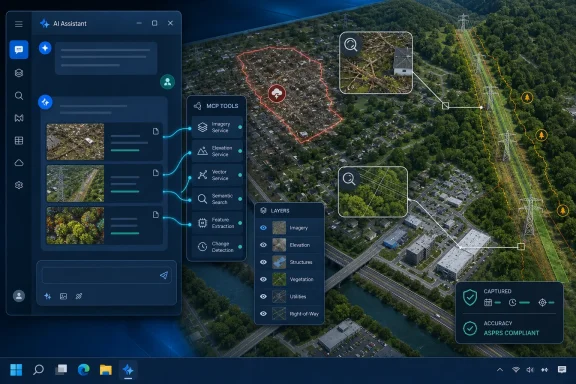
Vexcel announced on July 1, 2026, in Centennial, Colorado, that its new Vexcel Model Context Protocol will let licensed customers access its aerial imagery and geospatial intelligence from MCP-compatible AI platforms including ChatGPT, Claude, Microsoft Copilot, Gemini, and other assistants. The announcement is not just another connector in the fast-expanding AI middleware pile. It is a sign that the next phase of AI adoption will be fought over trusted context: not whether a model can talk fluently about the world, but whether it can inspect the world with data that someone is willing to stand behind.
For most users, the sales pitch around generative AI has been conversational: ask a question, get an answer, draft a memo, summarize a contract, write a script. Vexcel’s move pushes the interface into different territory. It turns the AI assistant into a front end for high-resolution aerial imagery, digital surface models, property attributes, roadway data, disaster imagery, and semantic geospatial search.
That matters because location is one of the places where language models are weakest and operational decisions are most expensive. A model can confidently describe a roof, a road, a substation, or a tornado path, but unless it has access to current, licensed, location-specific data, that confidence is mostly theater. Vexcel is trying to sell the antidote: let the model ask the imagery provider rather than improvise from stale training data or generic web fragments.
The company’s example is deliberately mundane: ask which properties have gardens or greenhouses, and the connected assistant checks the latest aerial imagery before answering. That sounds almost casual, but the same workflow scales into insurance underwriting, utility corridor inspection, infrastructure planning, municipal damage assessment, and commercial property analysis. The assistant becomes less like a chatbot and more like a geospatial analyst with a natural-language front door.
This is the part of the AI boom that gets less attention than benchmark scores. The practical enterprise question is not whether a model can reason in the abstract; it is whether it can pull the right tool, query the right dataset, preserve the right permissions, and produce an answer that can survive contact with a field crew, claims adjuster, planner, or regulator.
That sounds like plumbing, because it is. But plumbing has a way of deciding which buildings can be built. Once ChatGPT, Claude, Copilot, Gemini, developer IDEs, and enterprise agent frameworks all start speaking the same integration language, data vendors gain a new distribution channel: the assistant window.
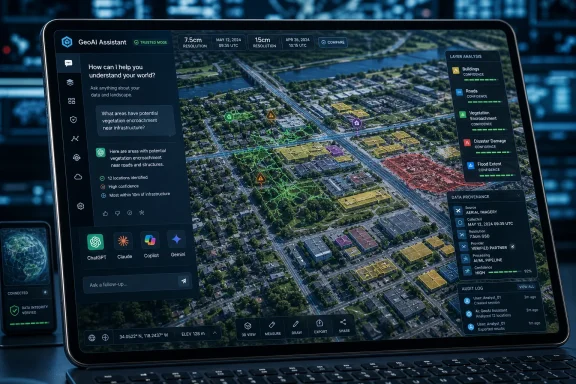
Vexcel is taking advantage of that opening. Its imagery has long been accessible through geospatial platforms, APIs, ArcGIS-oriented services, and industry workflows. MCP changes the buyer’s imagination. A claims team may not want another map portal; it may want to ask its existing AI assistant, “Which roofs in this ZIP code show visible deterioration after the storm?” A utility analyst may not want to load another GIS stack just to triage a corridor; they may want an agent to find encroaching vegetation and return measurements.
This is why the announcement name-drops ChatGPT, Claude, Microsoft Copilot, and Gemini. Vexcel is not claiming that those products all become geospatial systems by magic. It is saying that if an enterprise already has an MCP-compatible AI environment, Vexcel wants its data to be available inside that environment instead of trapped in a specialist application.
For WindowsForum readers, the Microsoft angle is especially important. Microsoft has been weaving MCP into Copilot Studio, developer tooling, and agent workflows, making the protocol part of its broader bet that Windows, Azure, Microsoft 365, and Copilot can become a programmable work surface for enterprise AI. Vexcel’s announcement fits that strategy: Copilot is more valuable if it can query real operational data, and operational data providers are more valuable if Copilot can reach them.
Vexcel says its aerial imagery is published at 7.5cm and 15cm resolution, aligned to ground control points, timestamped, compliant with ASPRS accuracy standards, and optimized for AI workflows. Those details are the difference between a general view and an operational asset. A claims workflow, for example, does not merely need to know that a roof exists; it needs a defensible basis for assessing condition, measuring features, comparing historical imagery, and routing a human review when the evidence is ambiguous.
Satellite imagery has improved dramatically, but aircraft-based imagery still has advantages in resolution, angle, and urban detail. Oblique imagery can show facades and side-facing structures that a straight-down satellite view may miss. Digital surface models can expose height and elevation relationships. Multispectral imagery can reveal vegetation and material signals that are invisible in ordinary RGB photos.
Vexcel’s pitch is that all of this becomes more useful when it can be queried semantically. “Find cooling towers,” “identify poor roof conditions,” “show vegetation encroachment,” and “summarize tornado damage” are not traditional GIS commands. They are business questions wrapped in spatial constraints. MCP lets the assistant translate those questions into calls against Vexcel’s imagery, attributes, embeddings, and spatial tools.
That translation layer is powerful, but it is also where risk enters. The more natural the interface becomes, the easier it is for users to forget that every answer reflects data freshness, coverage, permissions, model interpretation, and tool design. Vexcel can provide high-resolution context; it cannot eliminate the need to know what the assistant actually inspected.
After a tornado, hurricane, wildfire, flood, or severe hail event, organizations need to know which structures were hit, where access is blocked, which assets are threatened, and where to send people first. A natural-language interface that can ask for the latest imagery over a city, compare it with historical data, and summarize damage could be useful to insurers, emergency managers, utilities, and local governments.
The same capability also illustrates why provenance matters. In a disaster zone, a hallucinated answer is not merely embarrassing. A wrong assessment can send crews to the wrong place, delay aid, misprice claims, or produce a false sense of safety. That is why Vexcel keeps emphasizing trusted imagery, timestamps, and real-world grounding.
The practical workflow will still require controls. A disaster analyst will need to know when imagery was captured, which areas were covered, what confidence level applies to automated damage detection, and whether ground reports confirm the aerial view. The assistant should accelerate triage, not become an unquestioned authority.
This is where MCP integrations will be judged. The protocol can make data reachable, but reachability is not the same as reliability. Enterprises will need audit logs, permission boundaries, reproducible outputs, and clear separation between what the imagery shows and what the model infers.
But Vexcel MCP points toward a second interface for geospatial work: natural language as a query layer above specialized spatial systems. This is not a replacement for GIS so much as an access expansion. The person asking “Which parcels have likely roof damage?” may not know how to configure image services, build a spatial join, or run an object-detection pipeline. They may still know exactly what decision they need to make.
That expansion is likely to change who uses geospatial data. Insurance operations teams, municipal staff, facilities managers, infrastructure planners, and risk analysts may start asking location questions directly through AI assistants. The expert GIS team then becomes less of a map-making bottleneck and more of a governance, validation, and data engineering function.
There is a familiar pattern here. Spreadsheets did not eliminate accountants, but they changed who could manipulate numbers. Search engines did not eliminate librarians, but they changed who could find information. Natural-language geospatial interfaces will not eliminate GIS professionals, but they will change where spatial analysis begins.
The danger is that a sentence can conceal complexity. A prompt like “Find vegetation encroachment along this transmission corridor” sounds straightforward, but it depends on corridor geometry, vegetation classification, imagery date, clearance thresholds, seasonal conditions, and utility-specific risk rules. A good assistant should surface those assumptions rather than bury them under a confident answer.
Vexcel MCP is a clean example of the kind of third-party data source that could make Copilot more than a general-purpose assistant. A utility employee working in a Microsoft-centric environment could, in theory, ask Copilot to inspect Vexcel imagery for encroachment risks, summarize findings, generate a work order draft, and attach supporting imagery. A public-sector analyst could request a damage summary and then move the result into a briefing workflow.
For Microsoft, the strategic upside is obvious. If Copilot becomes the interface through which employees reach specialized data, Microsoft sits closer to the decision. For data vendors, the upside is equally obvious. If enterprise users spend their day in Copilot, Teams, Office, Windows, and browser-based agent environments, the data provider that shows up there has a better chance of becoming part of the daily workflow.
The uncomfortable part is dependency. If every specialized dataset becomes an assistant plug-in, enterprises must think carefully about where prompts, retrieved data, intermediate reasoning, and outputs travel. Vexcel’s customers will want assurances that licensed imagery and derived intelligence are accessed under the correct identity, not casually copied into uncontrolled AI sessions.
That is not a reason to dismiss the model. It is a reason to treat MCP as enterprise infrastructure rather than a novelty feature. The organizations that benefit most will be the ones that manage it like infrastructure: with access policies, logging, testing, and procurement scrutiny.
The strongest case is workflow compression. Instead of opening a map tool, locating an address, switching layers, checking imagery dates, running a search, exporting results, and writing a summary, a user can ask the assistant to do the first pass. That can turn geospatial work from a specialist request into a self-service query.
The weaker case is novelty. Plenty of AI integrations look impressive in a demo and then stall because the production workflow requires permissions, exception handling, metadata, cost controls, and human review. If the assistant cannot explain what imagery it used, when it was captured, how measurements were derived, and where confidence is low, users will fall back to the old tools.
Vexcel’s advantage is that it already has a serious data business behind the integration. The company operates a large aerial imagery program across more than 45 countries and territories, with collections in the United States, the United Kingdom, Canada, Mexico, Australia, New Zealand, Japan, India, and Western Europe. That gives the MCP announcement more weight than a startup connector wrapped around a thin dataset.
Still, coverage is not uniform magic. Resolution, recency, collection timing, weather, regulatory constraints, and local data availability will shape what users can actually ask. The best implementations will make those limits visible inside the assistant rather than forcing users to discover them after a bad answer.
That shift is subtle but profound. A city can search for building conditions. An insurer can search for roof materials. A utility can search for encroachment. An infrastructure team can search for equipment types. The AI system is no longer just retrieving a known location; it is discovering candidate locations that match a description.
Discovery creates value, but it also creates governance problems. If an assistant can identify properties with certain visible characteristics, organizations need rules for appropriate use. The same technical capability that helps assess storm damage could also be used for surveillance-adjacent analysis, discriminatory risk scoring, or opaque property decisions.
Vexcel’s announcement frames the technology around professional use cases: insurance, government, utilities, infrastructure, and geospatial analysis. Those are legitimate markets with real needs. They are also markets where automated interpretation of physical spaces can affect people’s premiums, services, inspections, and public resources.
The responsible path is not to pretend the technology is neutral. It is to require human review where decisions have consequences, preserve metadata, document confidence levels, and constrain use according to law, contract, and policy. AI that can see the physical world should not be allowed to hide how it looked.
A model connected to Vexcel data is less likely to invent the existence of a structure out of nothing. It may still misinterpret an object, overstate confidence, ignore capture dates, confuse a temporary condition with a permanent one, or apply the wrong business rule to the right image. In other words, it can be wrong in more operationally plausible ways.
That is why Vexcel’s emphasis on real-world data should be read as a necessary condition, not a complete solution. The imagery may be authoritative, but the interpretation is still a pipeline. The pipeline includes the user’s prompt, the MCP server’s available tools, the model’s tool-selection behavior, the retrieval method, the computer vision layer, and the final language summary.
This is not unique to Vexcel. It is the central challenge of agentic AI in enterprise settings. Once assistants can call tools, fetch data, and assemble answers, the failure mode shifts from “the model made something up” to “the system performed a plausible sequence of steps that produced a flawed result.”
For IT pros and administrators, that means evaluation has to move beyond demo prompts. Test the integration against known locations. Compare outputs with existing GIS workflows. Check whether the assistant reports imagery dates. Review access logs. Confirm that prompts cannot leak restricted datasets into unauthorized contexts. Treat the assistant as a new client application, not as a magical human coworker.
That mirrors what happened to other categories of enterprise data. Customer records moved from static databases into CRM APIs. Financial data moved into dashboards and automated reporting. Developer systems moved into CI/CD pipelines and code assistants. Geospatial intelligence is now moving into the same programmable fabric.
The move also reflects a shift in how value is captured. In the old model, a user might pay for access to a viewer or an imagery library. In the new model, the value may come from each AI-assisted decision: identify risk, prioritize inspection, estimate damage, detect change, route a crew, or generate a report. The interface fades; the dataset becomes part of the work.
This should worry incumbent software vendors more than it worries GIS professionals. If natural-language assistants become the place where users initiate spatial questions, then portals and dashboards must justify themselves with depth, visualization, governance, and expert control. A map viewer that only displays data may be less sticky than an agent that can act on it.
Vexcel appears to understand that risk. By exposing data through MCP, it is not waiting for every user to come to a Vexcel-branded interface. It is following users into the AI platforms they already use.
That licensing boundary is likely to be central to adoption. Enterprises will want to know which Vexcel products are exposed, which assistants are supported in practice, how authentication works, whether access is user-scoped, how rate limits and costs are handled, and how outputs can be retained or shared. They will also need to understand whether model providers can train on prompts or outputs, how data residency is handled, and whether sensitive locations require special controls.
Security teams will ask a different set of questions. MCP servers expand what an AI assistant can do, which means they expand the consequences of prompt injection, overbroad permissions, and poorly designed tool descriptions. If an assistant can query imagery, retrieve attributes, and summarize damage, an attacker may try to manipulate either the prompt or the workflow to extract information beyond the user’s intent.
None of this makes Vexcel MCP uniquely risky. It makes it typical of serious AI infrastructure. The more useful an integration becomes, the more it deserves the same scrutiny as any other system connected to business-critical data.
The vendors that win this phase will not be the ones that simply say “AI-ready.” They will be the ones that can show how their data behaves under identity, audit, policy, and error conditions. In enterprise AI, trust is not a vibe; it is an architecture.
The concrete points are straightforward:
 The AI Assistant Is Learning to Look Down
For most users, the sales pitch around generative AI has been conversational: ask a question, get an answer, draft a memo, summarize a contract, write a script. Vexcel’s move pushes the interface into different territory. It turns the AI assistant into a front end for high-resolution aerial imagery, digital surface models, property attributes, roadway data, disaster imagery, and semantic geospatial search.That matters because location is one of the places where language models are weakest and operational decisions are most expensive. A model can confidently describe a roof, a road, a substation, or a tornado path, but unless it has access to current, licensed, location-specific data, that confidence is mostly theater. Vexcel is trying to sell the antidote: let the model ask the imagery provider rather than improvise from stale training data or generic web fragments.
The company’s example is deliberately mundane: ask which properties have gardens or greenhouses, and the connected assistant checks the latest aerial imagery before answering. That sounds almost casual, but the same workflow scales into insurance underwriting, utility corridor inspection, infrastructure planning, municipal damage assessment, and commercial property analysis. The assistant becomes less like a chatbot and more like a geospatial analyst with a natural-language front door.
This is the part of the AI boom that gets less attention than benchmark scores. The practical enterprise question is not whether a model can reason in the abstract; it is whether it can pull the right tool, query the right dataset, preserve the right permissions, and produce an answer that can survive contact with a field crew, claims adjuster, planner, or regulator.
MCP Turns the Connector Problem Into a Platform War
The key acronym in Vexcel’s announcement is MCP, or Model Context Protocol. Introduced by Anthropic in late 2024 and quickly adopted across much of the AI tooling ecosystem, MCP was designed to standardize how AI systems connect to external tools and data sources. Instead of building a bespoke integration for every assistant and every database, a vendor can expose a server that MCP-compatible clients know how to use.That sounds like plumbing, because it is. But plumbing has a way of deciding which buildings can be built. Once ChatGPT, Claude, Copilot, Gemini, developer IDEs, and enterprise agent frameworks all start speaking the same integration language, data vendors gain a new distribution channel: the assistant window.
Vexcel is taking advantage of that opening. Its imagery has long been accessible through geospatial platforms, APIs, ArcGIS-oriented services, and industry workflows. MCP changes the buyer’s imagination. A claims team may not want another map portal; it may want to ask its existing AI assistant, “Which roofs in this ZIP code show visible deterioration after the storm?” A utility analyst may not want to load another GIS stack just to triage a corridor; they may want an agent to find encroaching vegetation and return measurements.
This is why the announcement name-drops ChatGPT, Claude, Microsoft Copilot, and Gemini. Vexcel is not claiming that those products all become geospatial systems by magic. It is saying that if an enterprise already has an MCP-compatible AI environment, Vexcel wants its data to be available inside that environment instead of trapped in a specialist application.
For WindowsForum readers, the Microsoft angle is especially important. Microsoft has been weaving MCP into Copilot Studio, developer tooling, and agent workflows, making the protocol part of its broader bet that Windows, Azure, Microsoft 365, and Copilot can become a programmable work surface for enterprise AI. Vexcel’s announcement fits that strategy: Copilot is more valuable if it can query real operational data, and operational data providers are more valuable if Copilot can reach them.
Vexcel Is Selling Ground Truth, Not Just Pretty Pictures
The company’s central argument is that AI systems need trusted context about the physical world. That is not marketing fluff. In geospatial work, the distinction between a visually persuasive image and a decision-grade dataset is enormous.Vexcel says its aerial imagery is published at 7.5cm and 15cm resolution, aligned to ground control points, timestamped, compliant with ASPRS accuracy standards, and optimized for AI workflows. Those details are the difference between a general view and an operational asset. A claims workflow, for example, does not merely need to know that a roof exists; it needs a defensible basis for assessing condition, measuring features, comparing historical imagery, and routing a human review when the evidence is ambiguous.
Satellite imagery has improved dramatically, but aircraft-based imagery still has advantages in resolution, angle, and urban detail. Oblique imagery can show facades and side-facing structures that a straight-down satellite view may miss. Digital surface models can expose height and elevation relationships. Multispectral imagery can reveal vegetation and material signals that are invisible in ordinary RGB photos.
Vexcel’s pitch is that all of this becomes more useful when it can be queried semantically. “Find cooling towers,” “identify poor roof conditions,” “show vegetation encroachment,” and “summarize tornado damage” are not traditional GIS commands. They are business questions wrapped in spatial constraints. MCP lets the assistant translate those questions into calls against Vexcel’s imagery, attributes, embeddings, and spatial tools.
That translation layer is powerful, but it is also where risk enters. The more natural the interface becomes, the easier it is for users to forget that every answer reflects data freshness, coverage, permissions, model interpretation, and tool design. Vexcel can provide high-resolution context; it cannot eliminate the need to know what the assistant actually inspected.
Disaster Response Is the Demo That Makes the Stakes Obvious
The most compelling use case in the announcement may be Vexcel’s Gray Sky disaster imagery and damage assessments. Normal AI productivity stories are about shaving minutes off office tasks. Disaster imagery is about compressing the time between an event and a usable operational picture.After a tornado, hurricane, wildfire, flood, or severe hail event, organizations need to know which structures were hit, where access is blocked, which assets are threatened, and where to send people first. A natural-language interface that can ask for the latest imagery over a city, compare it with historical data, and summarize damage could be useful to insurers, emergency managers, utilities, and local governments.
The same capability also illustrates why provenance matters. In a disaster zone, a hallucinated answer is not merely embarrassing. A wrong assessment can send crews to the wrong place, delay aid, misprice claims, or produce a false sense of safety. That is why Vexcel keeps emphasizing trusted imagery, timestamps, and real-world grounding.
The practical workflow will still require controls. A disaster analyst will need to know when imagery was captured, which areas were covered, what confidence level applies to automated damage detection, and whether ground reports confirm the aerial view. The assistant should accelerate triage, not become an unquestioned authority.
This is where MCP integrations will be judged. The protocol can make data reachable, but reachability is not the same as reliability. Enterprises will need audit logs, permission boundaries, reproducible outputs, and clear separation between what the imagery shows and what the model infers.
The New Map Interface Is a Sentence
Geospatial software has traditionally been built around layers, tools, coordinates, and expert workflows. That model is not going away. Professional GIS users will still need precision controls, projections, metadata, topology, QA processes, and visualization tools that do not fit neatly into a chat prompt.But Vexcel MCP points toward a second interface for geospatial work: natural language as a query layer above specialized spatial systems. This is not a replacement for GIS so much as an access expansion. The person asking “Which parcels have likely roof damage?” may not know how to configure image services, build a spatial join, or run an object-detection pipeline. They may still know exactly what decision they need to make.
That expansion is likely to change who uses geospatial data. Insurance operations teams, municipal staff, facilities managers, infrastructure planners, and risk analysts may start asking location questions directly through AI assistants. The expert GIS team then becomes less of a map-making bottleneck and more of a governance, validation, and data engineering function.
There is a familiar pattern here. Spreadsheets did not eliminate accountants, but they changed who could manipulate numbers. Search engines did not eliminate librarians, but they changed who could find information. Natural-language geospatial interfaces will not eliminate GIS professionals, but they will change where spatial analysis begins.
The danger is that a sentence can conceal complexity. A prompt like “Find vegetation encroachment along this transmission corridor” sounds straightforward, but it depends on corridor geometry, vegetation classification, imagery date, clearance thresholds, seasonal conditions, and utility-specific risk rules. A good assistant should surface those assumptions rather than bury them under a confident answer.
Microsoft’s Copilot Strategy Needs Data Like This
The announcement is not Windows-specific, but it lands squarely in the world Microsoft is trying to build. Copilot’s enterprise value depends less on its ability to chat and more on its ability to act inside approved business contexts. That means connectors, identity, permissions, governance, and access to systems of record.Vexcel MCP is a clean example of the kind of third-party data source that could make Copilot more than a general-purpose assistant. A utility employee working in a Microsoft-centric environment could, in theory, ask Copilot to inspect Vexcel imagery for encroachment risks, summarize findings, generate a work order draft, and attach supporting imagery. A public-sector analyst could request a damage summary and then move the result into a briefing workflow.
For Microsoft, the strategic upside is obvious. If Copilot becomes the interface through which employees reach specialized data, Microsoft sits closer to the decision. For data vendors, the upside is equally obvious. If enterprise users spend their day in Copilot, Teams, Office, Windows, and browser-based agent environments, the data provider that shows up there has a better chance of becoming part of the daily workflow.
The uncomfortable part is dependency. If every specialized dataset becomes an assistant plug-in, enterprises must think carefully about where prompts, retrieved data, intermediate reasoning, and outputs travel. Vexcel’s customers will want assurances that licensed imagery and derived intelligence are accessed under the correct identity, not casually copied into uncontrolled AI sessions.
That is not a reason to dismiss the model. It is a reason to treat MCP as enterprise infrastructure rather than a novelty feature. The organizations that benefit most will be the ones that manage it like infrastructure: with access policies, logging, testing, and procurement scrutiny.
The Real Competition Is the User’s Default Workflow
Vexcel is not merely competing with other imagery providers. It is competing with inertia. Many organizations already have established GIS platforms, custom portals, vendor dashboards, field inspection workflows, and data contracts. The question is whether an MCP layer makes Vexcel’s data meaningfully easier to use without weakening the controls that made the data trustworthy in the first place.The strongest case is workflow compression. Instead of opening a map tool, locating an address, switching layers, checking imagery dates, running a search, exporting results, and writing a summary, a user can ask the assistant to do the first pass. That can turn geospatial work from a specialist request into a self-service query.
The weaker case is novelty. Plenty of AI integrations look impressive in a demo and then stall because the production workflow requires permissions, exception handling, metadata, cost controls, and human review. If the assistant cannot explain what imagery it used, when it was captured, how measurements were derived, and where confidence is low, users will fall back to the old tools.
Vexcel’s advantage is that it already has a serious data business behind the integration. The company operates a large aerial imagery program across more than 45 countries and territories, with collections in the United States, the United Kingdom, Canada, Mexico, Australia, New Zealand, Japan, India, and Western Europe. That gives the MCP announcement more weight than a startup connector wrapped around a thin dataset.
Still, coverage is not uniform magic. Resolution, recency, collection timing, weather, regulatory constraints, and local data availability will shape what users can actually ask. The best implementations will make those limits visible inside the assistant rather than forcing users to discover them after a bad answer.
AI Search for the Physical World Will Reshape Risk
The phrase “semantic image search” may be the most consequential item in Vexcel’s data list. Traditional image access often starts with a place: show me this address, this parcel, this tile, this corridor. Semantic search starts with a concept: find objects, conditions, patterns, or visual similarities across an area.That shift is subtle but profound. A city can search for building conditions. An insurer can search for roof materials. A utility can search for encroachment. An infrastructure team can search for equipment types. The AI system is no longer just retrieving a known location; it is discovering candidate locations that match a description.
Discovery creates value, but it also creates governance problems. If an assistant can identify properties with certain visible characteristics, organizations need rules for appropriate use. The same technical capability that helps assess storm damage could also be used for surveillance-adjacent analysis, discriminatory risk scoring, or opaque property decisions.
Vexcel’s announcement frames the technology around professional use cases: insurance, government, utilities, infrastructure, and geospatial analysis. Those are legitimate markets with real needs. They are also markets where automated interpretation of physical spaces can affect people’s premiums, services, inspections, and public resources.
The responsible path is not to pretend the technology is neutral. It is to require human review where decisions have consequences, preserve metadata, document confidence levels, and constrain use according to law, contract, and policy. AI that can see the physical world should not be allowed to hide how it looked.
The Assistant Can Now Be Wrong With Better Evidence
There is a temptation to describe grounded AI as the cure for hallucination. That is too generous. Grounding reduces one class of failure, but it introduces others.A model connected to Vexcel data is less likely to invent the existence of a structure out of nothing. It may still misinterpret an object, overstate confidence, ignore capture dates, confuse a temporary condition with a permanent one, or apply the wrong business rule to the right image. In other words, it can be wrong in more operationally plausible ways.
That is why Vexcel’s emphasis on real-world data should be read as a necessary condition, not a complete solution. The imagery may be authoritative, but the interpretation is still a pipeline. The pipeline includes the user’s prompt, the MCP server’s available tools, the model’s tool-selection behavior, the retrieval method, the computer vision layer, and the final language summary.
This is not unique to Vexcel. It is the central challenge of agentic AI in enterprise settings. Once assistants can call tools, fetch data, and assemble answers, the failure mode shifts from “the model made something up” to “the system performed a plausible sequence of steps that produced a flawed result.”
For IT pros and administrators, that means evaluation has to move beyond demo prompts. Test the integration against known locations. Compare outputs with existing GIS workflows. Check whether the assistant reports imagery dates. Review access logs. Confirm that prompts cannot leak restricted datasets into unauthorized contexts. Treat the assistant as a new client application, not as a magical human coworker.
Vexcel’s Bet Is That the Map Becomes Infrastructure
The larger story behind Vexcel MCP is the infrastructure-ization of maps. High-resolution aerial imagery used to be something many organizations consumed through specialist departments or dedicated platforms. Now it is becoming a callable service inside AI workflows.That mirrors what happened to other categories of enterprise data. Customer records moved from static databases into CRM APIs. Financial data moved into dashboards and automated reporting. Developer systems moved into CI/CD pipelines and code assistants. Geospatial intelligence is now moving into the same programmable fabric.
The move also reflects a shift in how value is captured. In the old model, a user might pay for access to a viewer or an imagery library. In the new model, the value may come from each AI-assisted decision: identify risk, prioritize inspection, estimate damage, detect change, route a crew, or generate a report. The interface fades; the dataset becomes part of the work.
This should worry incumbent software vendors more than it worries GIS professionals. If natural-language assistants become the place where users initiate spatial questions, then portals and dashboards must justify themselves with depth, visualization, governance, and expert control. A map viewer that only displays data may be less sticky than an agent that can act on it.
Vexcel appears to understand that risk. By exposing data through MCP, it is not waiting for every user to come to a Vexcel-branded interface. It is following users into the AI platforms they already use.
The Fine Print Will Decide Whether This Is Enterprise-Ready
The announcement says Vexcel MCP is available now to customers licensed to Vexcel products. That phrase matters. This is not a consumer free-for-all where anyone can ask a chatbot to inspect high-resolution imagery. It is a licensed data integration aimed at organizations already entitled to use Vexcel’s products.That licensing boundary is likely to be central to adoption. Enterprises will want to know which Vexcel products are exposed, which assistants are supported in practice, how authentication works, whether access is user-scoped, how rate limits and costs are handled, and how outputs can be retained or shared. They will also need to understand whether model providers can train on prompts or outputs, how data residency is handled, and whether sensitive locations require special controls.
Security teams will ask a different set of questions. MCP servers expand what an AI assistant can do, which means they expand the consequences of prompt injection, overbroad permissions, and poorly designed tool descriptions. If an assistant can query imagery, retrieve attributes, and summarize damage, an attacker may try to manipulate either the prompt or the workflow to extract information beyond the user’s intent.
None of this makes Vexcel MCP uniquely risky. It makes it typical of serious AI infrastructure. The more useful an integration becomes, the more it deserves the same scrutiny as any other system connected to business-critical data.
The vendors that win this phase will not be the ones that simply say “AI-ready.” They will be the ones that can show how their data behaves under identity, audit, policy, and error conditions. In enterprise AI, trust is not a vibe; it is an architecture.
What Vexcel Has Really Put on the Table
Vexcel’s announcement is easy to summarize as “aerial imagery in chatbots,” but that understates the significance. The company is making a claim about where geospatial intelligence belongs in the AI era: not off to the side in a specialist application, but inside the assistant-driven workflows that enterprises are already building.The concrete points are straightforward:
- Vexcel MCP makes the company’s aerial imagery and geospatial data available inside MCP-compatible AI platforms for licensed customers.
- The integration is aimed at natural-language analysis of real-world locations, including properties, disaster areas, utility corridors, roads, buildings, and infrastructure.
- The available data includes ortho, oblique, and multispectral imagery, digital surface models, property and roadway attributes, Gray Sky disaster imagery, damage assessments, embeddings, and semantic image search.
- The strongest early use cases are likely to be insurance, government, utilities, infrastructure management, and geospatial analysis teams that already depend on current location intelligence.
- The practical value will depend on permissions, metadata, imagery recency, confidence reporting, auditability, and whether assistants clearly distinguish observation from inference.
- The broader implication is that MCP is becoming a serious distribution layer for specialized enterprise data, not merely a developer convenience.
References
- Primary source: Morningstar
Published: 2026-07-01T13:00:13.063597
Vexcel Brings Aerial Imagery and Geospatial Intelligence to AI Platforms
www.morningstar.com
- Related coverage: vexceldata.com
Orthomosaic Imagery | True Ortho Aerial Mapping | Vexcel
Find high resolution ortho imagery, TrueOrtho imagery & ortho photos for your city, county, state, and country. Use in GIS and mapping programs. Orthomosaic imagery from Vexcel: 7.5 to 15cm resolution, true ortho, mapping-grade accuracy, 45+ countries. Ready for ArcGIS, GIS, and digital twins.vexceldata.com - Related coverage: vexcel-imaging.com
Vexcel Data Program - Vexcel Imaging
The Vexcel Data Program is a cloud-based service providing detailed and accurate aerial imagery and geospatial data products for best location intelligence.www.vexcel-imaging.com - Related coverage: spatialsource.com.au
Vexcel to begin 7.5cm aerial imagery program - Spatial Source
The Vexcel aerial imagery program will cover the US first before moving on to Europe, boosting resolution from 15cm to 7.5cm.www.spatialsource.com.au - Related coverage: prnewswire.com
Vexcel Announces 2026 U.S. Aerial Imagery Collection Program
/PRNewswire/ -- Vexcel Data Program, the world's largest aerial imagery program, today announced its expanded 2026 collection plan for the United States,... www.prnewswire.com
- Related coverage: tomshardware.com
Anthropic's Model Context Protocol includes a critical remote code execution vulnerability — newly discovered exploit puts 200,000 AI servers at risk | Tom's Hardware
A design choice in the MCP SDKs allows remote code execution across the AI supply chain.www.tomshardware.com
- Related coverage: itpro.com
What is MCP? | IT Pro
MCP now underpins agentic AI systems – but how does it work and is it easy to use?www.itpro.com - Related coverage: windowscentral.com
New Windows 11 Insider build adds surprising features | Windows Central
Windows 11’s December Insider update adds new features — and some unexpected AI magicwww.windowscentral.com