

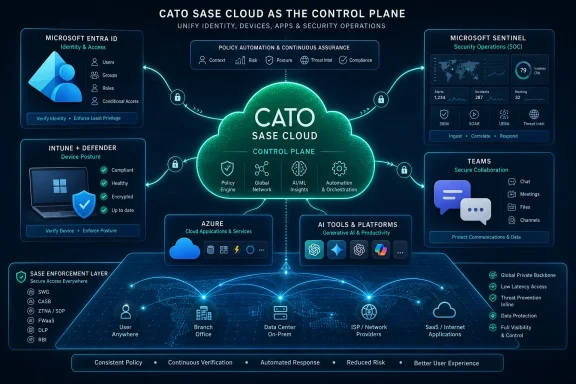
Cato Networks expanded the technology ecosystem around its Cato SASE Cloud platform in June 2026, adding integrations with Microsoft security and identity services, AI platforms, developer tools, cloud environments, and operations systems for enterprise customers. The move is not merely another partner-page update. It is a statement about where secure access service edge platforms are heading: away from closed “single pane of glass” promises and toward a more pragmatic role as the connective tissue between identity, endpoints, cloud apps, AI usage, and security operations. For WindowsForum readers, the Microsoft angle matters most, because Cato is positioning itself less as a replacement for Microsoft security investments and more as a control plane that can consume, enrich, and act on them.
The secure access service edge market has spent years arguing that consolidation is the cure for enterprise security sprawl. Cato Networks has been one of the louder advocates for that thesis, selling a cloud-native SASE platform that combines networking and security functions rather than stitching together legacy boxes, agents, tunnels, and dashboards. But this latest ecosystem expansion acknowledges an unavoidable truth: no serious enterprise is standardizing on one vendor for everything.
That is especially true in Microsoft-heavy shops. Entra ID, Intune, Microsoft Defender, Sentinel, Azure, Teams, and Microsoft 365 are already embedded into the daily operating model of many organizations. Cato’s integrations are therefore aimed at a practical problem: if identity, endpoint posture, user activity, network telemetry, AI usage, and incident response live in different systems, the SASE platform has to understand those systems or risk becoming just another silo.
The announcement frames the ecosystem as a way to improve policy enforcement, visibility, and automation. That language can sound familiar to the point of numbness, but the specific integration targets are telling. Cato is reaching into identity context through Entra ID, device posture through Intune and Microsoft Defender, security operations through Sentinel, productivity context through Microsoft 365 and Teams, and cloud workflows through Azure.
The deeper message is that SASE cannot win by pretending the rest of the stack does not exist. It has to ingest reality as it is deployed.
Cato’s expanded Microsoft integrations are intended to align access decisions with users and groups from Entra ID. In plain terms, that means network and application access rules can better follow the same organizational structure that admins already maintain in Microsoft’s identity platform. This is the kind of integration that does not look glamorous on a press release but can determine whether a product survives first contact with a real IT department.
Intune and Microsoft Defender add another layer: device trust. A user’s identity is no longer enough when unmanaged laptops, stale agents, risky endpoints, and bring-your-own-device scenarios can all sit behind the same username. Pulling device posture into Cato’s policy and visibility model gives security teams a cleaner way to distinguish between a known, compliant Windows endpoint and a device that should be treated with suspicion.
This does not mean Cato is replacing Microsoft’s conditional access model. It means Cato wants to extend those signals into the traffic path, where access to SaaS apps, private applications, cloud workloads, and internet resources can be governed with more context. That is the right architectural bet, because the old boundary between “identity security” and “network security” has become mostly administrative fiction.
For Windows administrators, Intune and Defender are natural sources of that context. They already know whether a machine is enrolled, compliant, patched, protected, or showing suspicious activity. A SASE platform that can factor in that state has a better chance of applying policy intelligently instead of treating every authenticated session as equal.
That matters because attackers increasingly do not need to “break in” through the network in the traditional sense. They abuse credentials, OAuth grants, unmanaged devices, browser sessions, and SaaS workflows. A policy engine that sees only IP addresses and ports is fighting the last war.
Cato’s pitch is that device posture and network enforcement should converge. The challenge will be whether customers experience that convergence as genuinely simplified operations or as another round of integration mapping, policy tuning, and alert routing.
At one level, this is about visibility. CISOs and IT leaders want to know which AI tools employees are using, what data may be flowing into them, and whether developers are leaning on coding assistants in ways that create compliance or intellectual property risk. Shadow IT has always been a problem, but generative AI compresses the timeline: a single pasted document, prompt, code fragment, or customer record can become a governance event.
At another level, it is about runtime control. Cato is positioning its platform to help govern interactions with SaaS AI assistants and protect custom AI applications and agents built on cloud AI platforms. That is a much more ambitious claim than simple app discovery. It implies policy enforcement around how AI tools are accessed and used, not just whether they appear in a log.
The inclusion of developer AI tools is particularly astute. Cursor and GitHub Copilot are not fringe experiments; they are increasingly part of the software development workflow. If security teams monitor ChatGPT but ignore code assistants, they will miss a large part of how enterprise AI adoption is actually happening.
That matters because AI security is still a messy category. Some vendors focus on data loss prevention for prompts. Others focus on model access, agent behavior, SaaS governance, or application-layer runtime protection. Cato appears to be pulling those concerns toward the network-and-access layer, arguing that the SASE platform is a natural enforcement point because it already sits between users, devices, cloud apps, and workloads.
There is logic in that argument. If an employee accesses ChatGPT from a managed Windows laptop, a developer calls an AI coding assistant, or an internal application connects to Azure OpenAI, those interactions can intersect with identity, endpoint, network, and cloud controls. A SASE platform with the right telemetry can, in theory, make AI governance less dependent on one-off point products.
The risk is equally obvious. AI security is evolving faster than procurement cycles, and the phrase “AI governance” can conceal everything from serious controls to glorified usage dashboards. Cato will need to prove that these integrations can do more than identify popular AI services after the fact.
That is why the Sentinel integration is strategically important. Microsoft Sentinel has become a common home for cloud-native security operations, especially in organizations already invested in Defender and Microsoft 365. Streaming Cato network, security, and identity telemetry into Sentinel lets teams correlate SASE events with other signals rather than forcing analysts to pivot manually.
Teams integration may sound less technical, but it reflects how incident response actually happens. Alerts, investigations, approvals, and escalations often flow through collaboration channels as much as formal case-management systems. Bringing SASE context into those workflows can shorten the distance between detection and action.
Azure integration, meanwhile, helps Cato stay relevant as enterprise networks extend into cloud-native infrastructure. The company already announced an Azure Virtual WAN integration in 2025, and this broader ecosystem push reinforces the idea that SASE cannot stop at branch offices and remote users. It must also understand cloud networks, SaaS traffic, private applications, and hybrid environments.
For administrators, the best version of this story is not “one dashboard to rule them all.” It is fewer blind spots between the dashboards they already use.
Early SASE messaging leaned heavily on consolidation because buyers were exhausted by appliance sprawl, VPN complexity, MPLS costs, inconsistent remote access, and fragmented security controls. But consolidation has limits. Enterprises still need best-of-breed identity, endpoint, SIEM, cloud, IT service management, SaaS, and developer tools.
The more realistic goal is not to eliminate the ecosystem. It is to make the ecosystem governable. Cato’s integration hub and technology partner program are ways to reassure customers that adopting Cato does not mean abandoning the rest of their stack.
That is especially important for channel partners and managed service providers. A platform that integrates with existing Microsoft and cloud tooling is easier to position than one requiring a disruptive rip-and-replace project. In a market where SASE deployments can involve networking teams, security teams, identity teams, endpoint teams, and cloud teams, interoperability is not a nice-to-have. It is how deals avoid dying in committee.
Cato has long argued that its platform is purpose-built rather than assembled through acquisitions. That remains part of its positioning. But as Cato itself acquires AI security capabilities and expands third-party integrations, the market’s real question becomes less theological: can the platform produce better outcomes with less operational drag?
Open integrations can help answer that. If Cato can take Microsoft identity and endpoint context, correlate with Defender and Sentinel, enforce policy across AI and SaaS usage, and surface meaningful incidents without multiplying noise, it will have a strong practical story. If the integrations require brittle configuration or create duplicate alerts, customers will see another vendor adding complexity while promising to reduce it.
The distinction matters because SASE buyers are often trying to unwind years of accumulated architecture debt. They do not want philosophical purity. They want branch connectivity that works, remote access that does not punish users, policy that follows identity, and visibility that survives the move from office networks to cloud apps and AI tools.
Generative AI changes that balance in subtle ways. AI adoption creates new data flows, new destinations, new application patterns, and new risks that do not always fit neatly into endpoint or identity controls alone. Users interact with AI assistants through browsers and apps. Developers connect coding tools to repositories and cloud services. Internal applications call model APIs. Agents may execute actions across systems.
In that environment, traffic visibility and access control regain importance. Not as a return to the old firewall perimeter, but as a distributed enforcement fabric. A SASE platform that can see who is connecting, from what device, to which AI service, under what policy, and with what risk signals has a meaningful role.
Cato is trying to occupy that role before AI governance settles into a different category controlled by cloud providers, endpoint vendors, or SaaS security brokers. The ecosystem expansion is therefore defensive as well as offensive. It keeps Cato in the conversation as enterprises decide where AI policy should live.
If Entra ID remains the identity source, Intune remains the device compliance system, Defender remains the endpoint detection layer, Sentinel remains the SIEM, and Teams remains the collaboration hub, then Cato is not asking to become the center of everything. It is asking to become the security and networking layer that can act on those signals across traffic paths Microsoft does not fully control.
That distinction matters in hybrid and multi-cloud environments. Microsoft has strong coverage inside its own ecosystem, but enterprises rarely live entirely inside one vendor’s world. They use non-Microsoft SaaS apps, unmanaged partner access, developer tools, third-party clouds, private applications, branch networks, and legacy systems. A SASE platform earns its keep when it applies consistent policy across that messy estate.
The strongest use case is not a perfectly modern company with every workload in Azure and every endpoint managed identically. It is the imperfect enterprise: some Windows devices, some Macs, some contractors, some legacy apps, some Azure, some AWS, some SaaS, some AI experimentation, and a security team trying to make sense of it all.
This is where vendor demos often drift away from operational reality. In a clean demo, Entra groups map neatly to access policies, Intune posture flows into device context, Defender alerts enrich investigations, Sentinel correlates incidents, and Teams delivers notifications to the right people. In production, group hygiene is imperfect, device states lag, exceptions accumulate, and alert fatigue is real.
That does not invalidate the strategy. It simply means buyers should test the boring parts. How quickly does group membership update? What happens when an endpoint is temporarily noncompliant? Can Sentinel distinguish high-value Cato events from routine traffic noise? Are Teams notifications actionable or merely chat spam? Can AI usage policies be explained to legal, compliance, and development teams?
The answers will matter more than the logo grid.
The timing is favorable. Enterprises are under pressure to adopt AI tools quickly while proving they can manage risk. Developers are bringing AI assistants into workflows faster than governance teams can write policies. Microsoft 365 Copilot, ChatGPT Enterprise-style deployments, Claude, Azure OpenAI, and cloud AI platforms are spreading through organizations in overlapping ways.
Security teams do not want to block all of that usage. They want visibility, guardrails, and incident response. If Cato can deliver those controls without forcing customers to abandon existing Microsoft and cloud investments, it has a credible pitch.
But the market will be unforgiving. AI security claims are proliferating, and buyers are learning to separate marketing from enforcement. The winners will be the platforms that can show concrete risk reduction: fewer unmanaged AI interactions, better data controls, faster investigations, cleaner access policy, and less time spent reconciling logs across systems.
Still, integrations are not outcomes. A connector that exists on a marketplace page is not the same as a tested operational pattern. A dashboard showing AI app usage is not the same as enforceable governance. A SIEM feed is not the same as a usable detection pipeline.
The serious evaluation should focus on workflow change. Can a security team identify risky AI usage and act before sensitive data leaves the organization? Can access policies adapt based on Entra groups and Intune posture without manual duplication? Can Defender and Cato telemetry combine into a clearer incident story rather than two parallel alert streams? Can network teams and security teams use the same context without fighting over ownership?
Those are the questions that determine whether this is a platform expansion or a partner-marketing exercise.
 Cato Is Selling the Platform, but the Message Is Interoperability
The secure access service edge market has spent years arguing that consolidation is the cure for enterprise security sprawl. Cato Networks has been one of the louder advocates for that thesis, selling a cloud-native SASE platform that combines networking and security functions rather than stitching together legacy boxes, agents, tunnels, and dashboards. But this latest ecosystem expansion acknowledges an unavoidable truth: no serious enterprise is standardizing on one vendor for everything.That is especially true in Microsoft-heavy shops. Entra ID, Intune, Microsoft Defender, Sentinel, Azure, Teams, and Microsoft 365 are already embedded into the daily operating model of many organizations. Cato’s integrations are therefore aimed at a practical problem: if identity, endpoint posture, user activity, network telemetry, AI usage, and incident response live in different systems, the SASE platform has to understand those systems or risk becoming just another silo.
The announcement frames the ecosystem as a way to improve policy enforcement, visibility, and automation. That language can sound familiar to the point of numbness, but the specific integration targets are telling. Cato is reaching into identity context through Entra ID, device posture through Intune and Microsoft Defender, security operations through Sentinel, productivity context through Microsoft 365 and Teams, and cloud workflows through Azure.
The deeper message is that SASE cannot win by pretending the rest of the stack does not exist. It has to ingest reality as it is deployed.
Microsoft Shops Get a More Direct Path from Identity to Enforcement
The Entra ID integration is the most important piece for many Windows-centric environments because modern access policy starts with identity. Groups, roles, conditional access signals, and user attributes are not merely directory data; they are the vocabulary of enterprise permissioning. If a SASE platform cannot map that context cleanly, administrators end up translating policy between systems by hand.Cato’s expanded Microsoft integrations are intended to align access decisions with users and groups from Entra ID. In plain terms, that means network and application access rules can better follow the same organizational structure that admins already maintain in Microsoft’s identity platform. This is the kind of integration that does not look glamorous on a press release but can determine whether a product survives first contact with a real IT department.
Intune and Microsoft Defender add another layer: device trust. A user’s identity is no longer enough when unmanaged laptops, stale agents, risky endpoints, and bring-your-own-device scenarios can all sit behind the same username. Pulling device posture into Cato’s policy and visibility model gives security teams a cleaner way to distinguish between a known, compliant Windows endpoint and a device that should be treated with suspicion.
This does not mean Cato is replacing Microsoft’s conditional access model. It means Cato wants to extend those signals into the traffic path, where access to SaaS apps, private applications, cloud workloads, and internet resources can be governed with more context. That is the right architectural bet, because the old boundary between “identity security” and “network security” has become mostly administrative fiction.
Endpoint Posture Becomes the New Network Perimeter
The endpoint integration story is also a reminder that SASE is not just SD-WAN with a security subscription. The old perimeter assumed a trusted office network and untrusted outside world. The new perimeter is assembled dynamically from identity, device health, location, application sensitivity, user behavior, and session risk.For Windows administrators, Intune and Defender are natural sources of that context. They already know whether a machine is enrolled, compliant, patched, protected, or showing suspicious activity. A SASE platform that can factor in that state has a better chance of applying policy intelligently instead of treating every authenticated session as equal.
That matters because attackers increasingly do not need to “break in” through the network in the traditional sense. They abuse credentials, OAuth grants, unmanaged devices, browser sessions, and SaaS workflows. A policy engine that sees only IP addresses and ports is fighting the last war.
Cato’s pitch is that device posture and network enforcement should converge. The challenge will be whether customers experience that convergence as genuinely simplified operations or as another round of integration mapping, policy tuning, and alert routing.
AI Governance Is Becoming a SASE Feature, Whether Buyers Asked for It or Not
The most interesting part of Cato’s ecosystem expansion is not Microsoft by itself. It is the explicit inclusion of AI platforms and developer tools: OpenAI ChatGPT, Anthropic Claude, Microsoft 365 Copilot, Amazon Bedrock, Google AI Studio, Microsoft Foundry and Azure OpenAI, the OpenAI Platform, Cursor, and GitHub Copilot. That list captures a shift now visible across enterprise security: AI usage is no longer a side conversation for innovation teams. It is becoming a policy surface.At one level, this is about visibility. CISOs and IT leaders want to know which AI tools employees are using, what data may be flowing into them, and whether developers are leaning on coding assistants in ways that create compliance or intellectual property risk. Shadow IT has always been a problem, but generative AI compresses the timeline: a single pasted document, prompt, code fragment, or customer record can become a governance event.
At another level, it is about runtime control. Cato is positioning its platform to help govern interactions with SaaS AI assistants and protect custom AI applications and agents built on cloud AI platforms. That is a much more ambitious claim than simple app discovery. It implies policy enforcement around how AI tools are accessed and used, not just whether they appear in a log.
The inclusion of developer AI tools is particularly astute. Cursor and GitHub Copilot are not fringe experiments; they are increasingly part of the software development workflow. If security teams monitor ChatGPT but ignore code assistants, they will miss a large part of how enterprise AI adoption is actually happening.
The Aim Security Acquisition Now Looks Like a Platform Move
Cato’s 2025 acquisition of Aim Security makes more sense in light of this ecosystem announcement. At the time, the deal was framed around securing AI adoption and bringing AI security capabilities into the SASE platform. The new integrations suggest that Cato is moving from acquisition rationale to product surface.That matters because AI security is still a messy category. Some vendors focus on data loss prevention for prompts. Others focus on model access, agent behavior, SaaS governance, or application-layer runtime protection. Cato appears to be pulling those concerns toward the network-and-access layer, arguing that the SASE platform is a natural enforcement point because it already sits between users, devices, cloud apps, and workloads.
There is logic in that argument. If an employee accesses ChatGPT from a managed Windows laptop, a developer calls an AI coding assistant, or an internal application connects to Azure OpenAI, those interactions can intersect with identity, endpoint, network, and cloud controls. A SASE platform with the right telemetry can, in theory, make AI governance less dependent on one-off point products.
The risk is equally obvious. AI security is evolving faster than procurement cycles, and the phrase “AI governance” can conceal everything from serious controls to glorified usage dashboards. Cato will need to prove that these integrations can do more than identify popular AI services after the fact.
Sentinel, Teams, and Azure Put Cato Closer to the SOC Workflow
Security products often fail not because they lack detection capabilities but because they do not fit the operational workflow. Analysts live in SIEMs, ticketing systems, collaboration tools, endpoint consoles, and identity portals. If a SASE platform produces useful telemetry but keeps it trapped in its own interface, its value is capped.That is why the Sentinel integration is strategically important. Microsoft Sentinel has become a common home for cloud-native security operations, especially in organizations already invested in Defender and Microsoft 365. Streaming Cato network, security, and identity telemetry into Sentinel lets teams correlate SASE events with other signals rather than forcing analysts to pivot manually.
Teams integration may sound less technical, but it reflects how incident response actually happens. Alerts, investigations, approvals, and escalations often flow through collaboration channels as much as formal case-management systems. Bringing SASE context into those workflows can shorten the distance between detection and action.
Azure integration, meanwhile, helps Cato stay relevant as enterprise networks extend into cloud-native infrastructure. The company already announced an Azure Virtual WAN integration in 2025, and this broader ecosystem push reinforces the idea that SASE cannot stop at branch offices and remote users. It must also understand cloud networks, SaaS traffic, private applications, and hybrid environments.
For administrators, the best version of this story is not “one dashboard to rule them all.” It is fewer blind spots between the dashboards they already use.
The Ecosystem Strategy Is a Quiet Rebuttal to Pure Consolidation
There is a tension at the heart of Cato’s announcement. The company sells a converged platform, yet it is celebrating integrations with a growing cast of outside vendors. That might look contradictory, but it is better understood as the maturation of the SASE market.Early SASE messaging leaned heavily on consolidation because buyers were exhausted by appliance sprawl, VPN complexity, MPLS costs, inconsistent remote access, and fragmented security controls. But consolidation has limits. Enterprises still need best-of-breed identity, endpoint, SIEM, cloud, IT service management, SaaS, and developer tools.
The more realistic goal is not to eliminate the ecosystem. It is to make the ecosystem governable. Cato’s integration hub and technology partner program are ways to reassure customers that adopting Cato does not mean abandoning the rest of their stack.
That is especially important for channel partners and managed service providers. A platform that integrates with existing Microsoft and cloud tooling is easier to position than one requiring a disruptive rip-and-replace project. In a market where SASE deployments can involve networking teams, security teams, identity teams, endpoint teams, and cloud teams, interoperability is not a nice-to-have. It is how deals avoid dying in committee.
Open Platforms Are Now a Competitive Weapon
Cato’s announcement should also be read against the broader competitive field. Palo Alto Networks, Zscaler, Netskope, Fortinet, Cisco, Cloudflare, and others are all pushing versions of platform consolidation, cloud security, zero trust access, and AI-era protection. The feature checklists increasingly overlap. The differentiator becomes architecture, operational simplicity, ecosystem fit, and trust.Cato has long argued that its platform is purpose-built rather than assembled through acquisitions. That remains part of its positioning. But as Cato itself acquires AI security capabilities and expands third-party integrations, the market’s real question becomes less theological: can the platform produce better outcomes with less operational drag?
Open integrations can help answer that. If Cato can take Microsoft identity and endpoint context, correlate with Defender and Sentinel, enforce policy across AI and SaaS usage, and surface meaningful incidents without multiplying noise, it will have a strong practical story. If the integrations require brittle configuration or create duplicate alerts, customers will see another vendor adding complexity while promising to reduce it.
The distinction matters because SASE buyers are often trying to unwind years of accumulated architecture debt. They do not want philosophical purity. They want branch connectivity that works, remote access that does not punish users, policy that follows identity, and visibility that survives the move from office networks to cloud apps and AI tools.
AI Makes Network Telemetry Valuable Again
For years, network security vendors had to defend their relevance as workloads moved to SaaS and users moved off-premises. Endpoint and identity vendors gained influence because they sat closer to the user and device. Cloud security vendors gained influence because workloads migrated away from private data centers. The network layer looked less central than it once did.Generative AI changes that balance in subtle ways. AI adoption creates new data flows, new destinations, new application patterns, and new risks that do not always fit neatly into endpoint or identity controls alone. Users interact with AI assistants through browsers and apps. Developers connect coding tools to repositories and cloud services. Internal applications call model APIs. Agents may execute actions across systems.
In that environment, traffic visibility and access control regain importance. Not as a return to the old firewall perimeter, but as a distributed enforcement fabric. A SASE platform that can see who is connecting, from what device, to which AI service, under what policy, and with what risk signals has a meaningful role.
Cato is trying to occupy that role before AI governance settles into a different category controlled by cloud providers, endpoint vendors, or SaaS security brokers. The ecosystem expansion is therefore defensive as well as offensive. It keeps Cato in the conversation as enterprises decide where AI policy should live.
Windows Administrators Should Read This as a Microsoft Stack Extension
For WindowsForum’s core audience, the temptation is to evaluate Cato’s announcement as a vendor ecosystem story. That is fair, but too narrow. The more useful lens is how it changes the day-to-day model for organizations already using Microsoft as the spine of identity, endpoint management, productivity, and security operations.If Entra ID remains the identity source, Intune remains the device compliance system, Defender remains the endpoint detection layer, Sentinel remains the SIEM, and Teams remains the collaboration hub, then Cato is not asking to become the center of everything. It is asking to become the security and networking layer that can act on those signals across traffic paths Microsoft does not fully control.
That distinction matters in hybrid and multi-cloud environments. Microsoft has strong coverage inside its own ecosystem, but enterprises rarely live entirely inside one vendor’s world. They use non-Microsoft SaaS apps, unmanaged partner access, developer tools, third-party clouds, private applications, branch networks, and legacy systems. A SASE platform earns its keep when it applies consistent policy across that messy estate.
The strongest use case is not a perfectly modern company with every workload in Azure and every endpoint managed identically. It is the imperfect enterprise: some Windows devices, some Macs, some contractors, some legacy apps, some Azure, some AWS, some SaaS, some AI experimentation, and a security team trying to make sense of it all.
The Admin Burden Will Be the Real Test
The announcement promises reduced complexity, but every integration creates a new administrative surface. Someone has to configure permissions, map groups, validate data flows, tune policies, monitor failures, and decide which system is authoritative when signals conflict. The value of Cato’s ecosystem will depend on whether those tasks are easier than the fragmented workflows they replace.This is where vendor demos often drift away from operational reality. In a clean demo, Entra groups map neatly to access policies, Intune posture flows into device context, Defender alerts enrich investigations, Sentinel correlates incidents, and Teams delivers notifications to the right people. In production, group hygiene is imperfect, device states lag, exceptions accumulate, and alert fatigue is real.
That does not invalidate the strategy. It simply means buyers should test the boring parts. How quickly does group membership update? What happens when an endpoint is temporarily noncompliant? Can Sentinel distinguish high-value Cato events from routine traffic noise? Are Teams notifications actionable or merely chat spam? Can AI usage policies be explained to legal, compliance, and development teams?
The answers will matter more than the logo grid.
Cato’s Bet Is That SASE Becomes the AI-Era Control Plane
The broader strategic play is clear: Cato wants SASE to be seen not just as a network modernization project, but as an operating layer for enterprise security in the AI era. That is a bigger ambition than replacing VPNs or consolidating branch firewalls. It is an attempt to make the SASE platform the place where identity, endpoint posture, application access, cloud traffic, AI usage, and security telemetry meet.The timing is favorable. Enterprises are under pressure to adopt AI tools quickly while proving they can manage risk. Developers are bringing AI assistants into workflows faster than governance teams can write policies. Microsoft 365 Copilot, ChatGPT Enterprise-style deployments, Claude, Azure OpenAI, and cloud AI platforms are spreading through organizations in overlapping ways.
Security teams do not want to block all of that usage. They want visibility, guardrails, and incident response. If Cato can deliver those controls without forcing customers to abandon existing Microsoft and cloud investments, it has a credible pitch.
But the market will be unforgiving. AI security claims are proliferating, and buyers are learning to separate marketing from enforcement. The winners will be the platforms that can show concrete risk reduction: fewer unmanaged AI interactions, better data controls, faster investigations, cleaner access policy, and less time spent reconciling logs across systems.
The Integration List Is Only Impressive If It Changes Operations
Cato’s expanded ecosystem gives IT leaders a familiar set of promises: stronger policy enforcement, better visibility, faster investigation, more automation, and simpler operations. The difference is that the integration targets line up with real enterprise pain. Microsoft identity and endpoint data, Sentinel workflows, SaaS visibility, cloud environments, and AI tooling are exactly where many organizations are struggling to impose coherent control.Still, integrations are not outcomes. A connector that exists on a marketplace page is not the same as a tested operational pattern. A dashboard showing AI app usage is not the same as enforceable governance. A SIEM feed is not the same as a usable detection pipeline.
The serious evaluation should focus on workflow change. Can a security team identify risky AI usage and act before sensitive data leaves the organization? Can access policies adapt based on Entra groups and Intune posture without manual duplication? Can Defender and Cato telemetry combine into a clearer incident story rather than two parallel alert streams? Can network teams and security teams use the same context without fighting over ownership?
Those are the questions that determine whether this is a platform expansion or a partner-marketing exercise.
The Cato Expansion Gives Buyers a Shorter Checklist and a Harder Test
The practical implications are concrete enough for enterprises and partners to start pressure-testing the announcement rather than merely applauding it. Cato is adding the right categories of integration, but the burden now shifts to proving depth, reliability, and operational value.- Organizations standardized on Entra ID should evaluate whether Cato can use existing user and group context without forcing duplicate policy structures.
- Teams using Intune and Microsoft Defender should test how device posture and endpoint detections affect real access decisions, not just reporting.
- Security operations teams should validate whether Sentinel integration improves correlation or simply increases log volume.
- Enterprises adopting ChatGPT, Claude, Microsoft 365 Copilot, GitHub Copilot, Cursor, Azure OpenAI, and similar tools should treat AI visibility as a governance requirement, not an optional dashboard.
- Channel partners should read the ecosystem expansion as a sign that SASE sales are moving from network replacement conversations to broader platform integration projects.
- Buyers should ask Cato to demonstrate failure modes, exception handling, and policy synchronization, because those are where integration promises usually meet reality.
References
- Primary source: Redmond Channel Partner
Published: 2026-06-12T21:12:10.959217
Cato Networks Expands Technology Ecosystem for Cato SASE Cloud Platform -- Redmond Channel Partner
New integrations aim to help enterprises connect networking and security operations across a broader range of third-party technologies.rcpmag.com - Related coverage: catonetworks.com
- Related coverage: sase.cloud
- Related coverage: prnewswire.com

Cato Networks Introduces the Industry's First GPU-Powered SASE Platform with Native AI Security
/PRNewswire/ -- Cato Networks, the SASE leader, today unveiled two major innovations for the Cato SASE Platform to secure enterprise AI adoption at scale. Cato...
www.prnewswire.com
- Related coverage: networkworld.com
Cato Networks lets enterprises pick their SASE starting point | Network World
The SASE vendor’s modular adoption model lets organizations deploy AI Security, SD-WAN, SSE, or Universal ZTNA independently, while still getting a converged platform underneath.www.networkworld.com
- Related coverage: itpro.com
Cato Networks opens new London hub in regional R&D drive | IT Pro
The new R&D site aims to capitalize on the UK’s tech ecosystem to drive AI and security innovationwww.itpro.com
- Related coverage: wire.expertini.com
Cato Networks Empowers Service Providers to Deliver True SASE Services with Cato Private PoP — Expertini Wire
Cato Networks Empowers Service Providers to Deliver True SASE Services with Cato Private PoP. Read the full press release on Expertini Wire.wire.expertini.com - Related coverage: sase.viadex.com
- Related coverage: frost.com
- Related coverage: aitranslatewpml.versa-networks.com
