

Check Point Software and UK MSSP SEP2 said on June 24, 2026, that demand for specialist managed security providers is rising as healthcare, public-sector and regulated organisations seek deeper operational expertise for hybrid, cloud, SASE, email and AI-era cyber-resilience programmes. The announcement is vendor-shaped, naturally, but the market signal underneath it is harder to dismiss. Security buyers are not merely outsourcing alerts anymore; they are shopping for accountable expertise, platform discipline, and someone who can stay in the room when a hospital firewall anomaly becomes a board-level incident.
That is the more interesting story than the familiar “MSSPs are growing” headline. The classic managed security model promised scale: more analysts, more dashboards, more coverage for less internal effort. The specialist MSSP pitch is different. It argues that in a world of fragmented estates and escalating compliance pressure, breadth without depth can become another form of risk.
For years, managed security services were sold as a capacity answer. Organisations lacked enough people to watch logs, tune alerts, run vulnerability scans, respond to tickets, and satisfy auditors, so they paid a provider to absorb the operational burden. That model still exists, and for many customers it remains useful. But it is no longer sufficient for the environments that now carry the most operational consequence.
Hybrid infrastructure has changed the job. A modern security team may be defending on-premises firewalls, cloud workloads, SaaS collaboration suites, identity services, remote access, endpoint fleets, and compliance programmes at the same time. The seams between those systems are where many operational failures begin.
This is why SEP2’s “go deep, not wide” framing matters. The company says it has deliberately built around a limited set of best-of-breed technologies rather than trying to support dozens of overlapping platforms. That may sound like a partner marketing line, but it reflects a genuine pressure inside enterprise security: too many tools, not enough mastery.
The industry has spent a decade preaching consolidation, yet many buyers still live inside estates assembled through incident response, acquisition, budget cycles, and executive preference. The result is not simply tool sprawl. It is knowledge sprawl, where the organisation owns security capabilities that only a handful of people truly understand.
That is the vendor thesis: fewer disconnected products, more integrated prevention, and a platform architecture that spans network, cloud, users, access, email, and collaboration. It is a compelling argument for buyers exhausted by point tools, but it is also a familiar one. Every major security vendor now claims some version of platform consolidation, AI-assisted defence, and operational simplification.
SEP2’s value proposition is more grounded. Founded in 2016, the UK-headquartered company operates a 24/7/365 UK-based security operations centre and supports customers from SMEs to large enterprises across public and private sectors. Its Wingman service portfolio includes secure access, email and collaboration security, governance, exposure management, and managed services built around Check Point technologies such as Maestro Hyperscale Firewall, SASE, Email Security, and ThreatCloud AI capabilities.
The difference is that SEP2 is not merely reselling the platform. It is betting that customers will pay for a provider that knows the platform deeply enough to operate as an extension of the internal team. In regulated sectors, that distinction is not cosmetic. When downtime affects patients, citizens, financial operations, or critical infrastructure, “we opened a vendor ticket” is not an operational strategy.
The important detail is not simply that the issue was resolved. It is that the customer apparently gained enough confidence from the engagement to sign a new five-year platform agreement. In other words, the crisis became proof of the support model.
That is exactly where broad managed services can struggle. A generalist provider may have enough expertise to monitor alerts and follow runbooks, but not enough to diagnose complex behaviour across hyperscale firewall architecture, network topology, application dependencies, and vendor internals. In healthcare, that gap is not an inconvenience. It can delay change windows, prolong outages, and weaken trust in the entire security programme.
Hospitals are also a brutal test for security architecture because they combine legacy systems, high uptime requirements, sensitive data, constrained budgets, and operational urgency. They cannot simply pause care delivery while a platform dispute is adjudicated between supplier tiers. A specialist partner that can bring engineers, labs, vendor relationships, and escalation paths into the same operational motion has a real advantage.
But AI does not eliminate the need for specialist providers. It changes what specialist providers must be good at. The value shifts from merely noticing events to understanding whether automated conclusions make sense in a particular customer environment.
That is a harder job than it sounds. An AI-powered security platform may identify malicious infrastructure, suspicious access, anomalous email behaviour, or exploit patterns at scale. But the operational decision still depends on business context. Is this traffic expected? Is this SaaS integration sanctioned? Is this remote access pattern consistent with a clinician, contractor, developer, or attacker?
This is where prevention-first architectures can become politically delicate. Blocking an attack early is the ideal outcome. Blocking a legitimate workflow inside a hospital, council, bank, or manufacturer is a different kind of incident. Specialist MSSPs are increasingly being asked to tune that boundary between security effectiveness and operational continuity.
Security talent is not evenly distributed. Many organisations can hire generalists, but fewer can retain engineers with deep experience in niche enterprise platforms. Even when they can, those engineers may not see enough variety in one internal environment to stay sharp across edge cases.
A specialist MSSP can offer a different career bargain. Engineers get repeated exposure to complex deployments, escalations, migrations, and failures across multiple customers. The provider then turns that accumulated pattern recognition into a commercial advantage.
That is the optimistic version. The less flattering version is that enterprises are outsourcing expertise because the market has made it too expensive, too scarce, or too difficult to grow internally. Either way, the result is the same: the MSSP relationship becomes less like a help desk contract and more like a retained engineering partnership.
That alignment can be a strength. It gives the MSSP tighter escalation paths, better platform knowledge, more mature deployment patterns, and the confidence to handle incidents that would overwhelm a thinner partner. But it can also narrow the customer’s choices over time.
A provider that is very good at one ecosystem may naturally recommend more of that ecosystem. That does not make the recommendation wrong, but it does mean the buyer must distinguish between architectural fit and partner preference. Platform consolidation is valuable when it reduces operational risk. It is dangerous when it merely replaces tool sprawl with vendor dependency.
The smarter customers will ask harder questions. Can the provider explain where the platform is strong and where it is not? Can it integrate with third-party controls without turning every exception into a sales opportunity? Can it document exit paths, migration assumptions, and operational dependencies before the five-year agreement is signed?
Fragmentation failed many customers because it created gaps between products, teams, and responsibilities. Security leaders bought email security here, firewalling there, endpoint protection elsewhere, and cloud posture management from another vendor. Each tool produced data, but few produced clarity.
Platform-based security is the industry’s answer to that mess. The promise is consistent policy, shared intelligence, fewer consoles, integrated response, and better coverage across hybrid estates. In theory, this is exactly what overburdened teams need.
In practice, consolidation only works when the platform is well operated. A badly governed platform can become a single large blind spot. A well-run platform can reduce alert fatigue, shrink response times, and give security teams a more coherent view of risk. The difference is not the logo on the dashboard. It is the operational discipline behind it.
Many organisations running Microsoft 365, Entra ID, Windows endpoints, Azure workloads, legacy Active Directory, and third-party firewalls already know the pain of split responsibility. The endpoint team owns one layer, the network team another, the cloud team another, and the SOC tries to infer intent from whatever telemetry arrives. Incidents do not respect that chart.
A specialist MSSP can help if it understands those operational boundaries. It can hurt if it adds another abstraction layer without owning outcomes. The deciding factor is whether the provider can work across identity, network, cloud, and endpoint teams without reducing everything to a ticket queue.
This is particularly relevant as SASE architectures mature. Secure access is no longer just VPN replacement; it touches identity policy, device posture, application segmentation, data protection, and user experience. A partner that understands only firewall rules is too narrow. A partner that understands everything superficially is not enough either.
Still, they fit the broader direction of travel. Customers are increasingly willing to pay for managed services that promise not just monitoring, but engineering competence. Retention and multi-year relationships matter because security outsourcing is painful to unwind once a provider becomes embedded in daily operations.
The 98 percent internal resolution figure is especially revealing. If accurate, it suggests the provider is not simply a pass-through layer between customer and vendor. That is an important distinction in a market where some managed service relationships degrade into ticket brokerage.
But growth also creates tension. The very specialisation that differentiates a provider can be diluted if hiring, training, and service delivery cannot scale at the same pace as customer acquisition. SEP2’s lab investment and certification emphasis are therefore not side details. They are the infrastructure needed to keep a specialist business from becoming a generalist one by accident.
Healthcare, financial services, public sector, and critical infrastructure organisations need evidence that controls work under pressure. They need to know who will respond, how fast they can escalate, whether the provider understands the estate, and what happens when a security control becomes part of an availability problem.
That is why the NHS deployment anecdote matters more than the product names. The customer did not need a theoretical platform benefit. It needed engineers who could investigate a live anomaly, coordinate with vendor R&D, and restore confidence in the architecture.
The resilience conversation also changes how MSSPs are judged. Service-level agreements are still important, but they are blunt instruments. A two-hour response commitment does not prove that the person responding understands Maestro, SASE policy, email security, hybrid routing, or the operational politics of a hospital network.
The challenge is that prevention-first security must operate in messy environments. False positives carry business cost. Policy changes require testing. Threat intelligence has to be timely, but also trusted. AI engines may improve coverage, but they also introduce new questions about explainability and governance.
This is where specialist MSSPs can either strengthen or weaken the model. A skilled provider can tune prevention so it is assertive without being reckless. It can stage changes, test in labs, document exceptions, and translate threat intelligence into customer-specific policy. A weak provider can turn prevention into either noise or disruption.
The same logic applies to exposure management and governance programmes. Identifying risk is useful. Prioritising it against real operational constraints is where expertise appears. Every security team has a backlog; the question is whether the MSSP can help decide what matters this week.
That evaluation is difficult because many providers use similar language. Everyone claims expertise, partnership, resilience, and AI-powered service delivery. The difference often appears only during incidents, migrations, and awkward change windows.
Customers should therefore treat reference calls and technical workshops as seriously as price negotiations. Ask the provider to walk through a recent escalation. Ask how many engineers have hands-on experience with the exact products in scope. Ask what happens when the platform behaves unexpectedly and the vendor’s first-line support is not enough.
The point is not to distrust the MSSP. It is to recognise that managed security has become operationally intimate. The provider may end up influencing firewall policy, remote access design, email security posture, identity integrations, vulnerability prioritisation, and compliance evidence. That is not a commodity relationship.
That shift favours providers that can combine product expertise with service design. SEP2’s Wingman branding is one expression of that. The underlying idea is that customers want a partner beside them, not simply a supplier behind a portal.
It also favours vendors that can build strong partner ecosystems around complex platforms. Check Point benefits when a specialist MSSP can make its architecture usable, trusted, and sticky inside demanding environments. The partner benefits when the vendor’s portfolio is broad enough to support a consolidated service model.
The danger for both is complacency. Specialist status has to be maintained. AI-powered prevention has to keep proving itself. Platform consolidation has to reduce complexity rather than merely centralising it. Customers will tolerate vendor alignment when it produces resilience; they will punish it when it feels like lock-in without operational benefit.
That is the more interesting story than the familiar “MSSPs are growing” headline. The classic managed security model promised scale: more analysts, more dashboards, more coverage for less internal effort. The specialist MSSP pitch is different. It argues that in a world of fragmented estates and escalating compliance pressure, breadth without depth can become another form of risk.
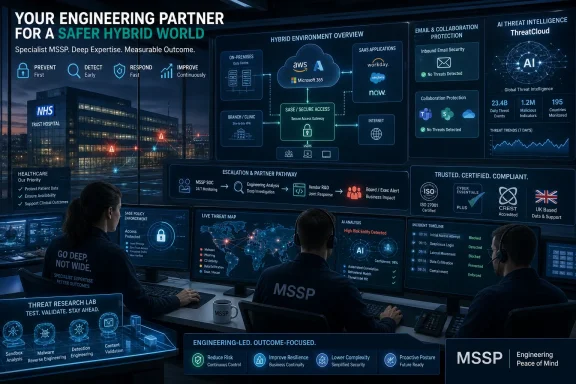 The MSSP Market Is Splitting Between Coverage and Competence
For years, managed security services were sold as a capacity answer. Organisations lacked enough people to watch logs, tune alerts, run vulnerability scans, respond to tickets, and satisfy auditors, so they paid a provider to absorb the operational burden. That model still exists, and for many customers it remains useful. But it is no longer sufficient for the environments that now carry the most operational consequence.Hybrid infrastructure has changed the job. A modern security team may be defending on-premises firewalls, cloud workloads, SaaS collaboration suites, identity services, remote access, endpoint fleets, and compliance programmes at the same time. The seams between those systems are where many operational failures begin.
This is why SEP2’s “go deep, not wide” framing matters. The company says it has deliberately built around a limited set of best-of-breed technologies rather than trying to support dozens of overlapping platforms. That may sound like a partner marketing line, but it reflects a genuine pressure inside enterprise security: too many tools, not enough mastery.
The industry has spent a decade preaching consolidation, yet many buyers still live inside estates assembled through incident response, acquisition, budget cycles, and executive preference. The result is not simply tool sprawl. It is knowledge sprawl, where the organisation owns security capabilities that only a handful of people truly understand.
Check Point Sells Prevention, but SEP2 Sells Confidence
Check Point’s role in the story is straightforward. The company is positioning its platform around prevention-first security, AI-driven threat intelligence, and consistent protection across hybrid environments. ThreatCloud AI sits at the centre of that message, feeding Check Point’s broader portfolio with intelligence intended to stop malware, phishing, zero-day activity, and suspicious behaviour before those events become response problems.That is the vendor thesis: fewer disconnected products, more integrated prevention, and a platform architecture that spans network, cloud, users, access, email, and collaboration. It is a compelling argument for buyers exhausted by point tools, but it is also a familiar one. Every major security vendor now claims some version of platform consolidation, AI-assisted defence, and operational simplification.
SEP2’s value proposition is more grounded. Founded in 2016, the UK-headquartered company operates a 24/7/365 UK-based security operations centre and supports customers from SMEs to large enterprises across public and private sectors. Its Wingman service portfolio includes secure access, email and collaboration security, governance, exposure management, and managed services built around Check Point technologies such as Maestro Hyperscale Firewall, SASE, Email Security, and ThreatCloud AI capabilities.
The difference is that SEP2 is not merely reselling the platform. It is betting that customers will pay for a provider that knows the platform deeply enough to operate as an extension of the internal team. In regulated sectors, that distinction is not cosmetic. When downtime affects patients, citizens, financial operations, or critical infrastructure, “we opened a vendor ticket” is not an operational strategy.
Hospitals Expose the Weakness of Shallow Outsourcing
The NHS hospital example in the announcement is a useful case study because it shows where specialist MSSPs earn their margin. SEP2 and Check Point were involved in a major hospital deployment of Check Point Maestro Hyperscale Firewall. After a network anomaly was initially attributed to the firewall, engineers from both companies worked collaboratively on-site to investigate and resolve the issue, with direct support from Check Point R&D.The important detail is not simply that the issue was resolved. It is that the customer apparently gained enough confidence from the engagement to sign a new five-year platform agreement. In other words, the crisis became proof of the support model.
That is exactly where broad managed services can struggle. A generalist provider may have enough expertise to monitor alerts and follow runbooks, but not enough to diagnose complex behaviour across hyperscale firewall architecture, network topology, application dependencies, and vendor internals. In healthcare, that gap is not an inconvenience. It can delay change windows, prolong outages, and weaken trust in the entire security programme.
Hospitals are also a brutal test for security architecture because they combine legacy systems, high uptime requirements, sensitive data, constrained budgets, and operational urgency. They cannot simply pause care delivery while a platform dispute is adjudicated between supplier tiers. A specialist partner that can bring engineers, labs, vendor relationships, and escalation paths into the same operational motion has a real advantage.
AI Makes the Expertise Gap More Visible, Not Less
The security industry has been quick to present AI as an answer to the skills shortage. There is truth in that. AI-assisted triage, automated enrichment, threat intelligence correlation, phishing detection, and policy recommendation can reduce noise and accelerate decisions. Check Point’s own positioning around ThreatCloud AI fits this wider movement toward machine-assisted prevention.But AI does not eliminate the need for specialist providers. It changes what specialist providers must be good at. The value shifts from merely noticing events to understanding whether automated conclusions make sense in a particular customer environment.
That is a harder job than it sounds. An AI-powered security platform may identify malicious infrastructure, suspicious access, anomalous email behaviour, or exploit patterns at scale. But the operational decision still depends on business context. Is this traffic expected? Is this SaaS integration sanctioned? Is this remote access pattern consistent with a clinician, contractor, developer, or attacker?
This is where prevention-first architectures can become politically delicate. Blocking an attack early is the ideal outcome. Blocking a legitimate workflow inside a hospital, council, bank, or manufacturer is a different kind of incident. Specialist MSSPs are increasingly being asked to tune that boundary between security effectiveness and operational continuity.
Certification Is Becoming a Labour-Market Weapon
SEP2 says around 70 percent of its Wingman Secure Access team holds elite-level Check Point certifications, including CCSM and CCSM Elite accreditations. It also maintains dedicated lab environments where engineers can test deployments and build capability using live Check Point technologies, including Maestro and VSX environments. That detail may look like partner-program trivia, but it points to a broader labour-market reality.Security talent is not evenly distributed. Many organisations can hire generalists, but fewer can retain engineers with deep experience in niche enterprise platforms. Even when they can, those engineers may not see enough variety in one internal environment to stay sharp across edge cases.
A specialist MSSP can offer a different career bargain. Engineers get repeated exposure to complex deployments, escalations, migrations, and failures across multiple customers. The provider then turns that accumulated pattern recognition into a commercial advantage.
That is the optimistic version. The less flattering version is that enterprises are outsourcing expertise because the market has made it too expensive, too scarce, or too difficult to grow internally. Either way, the result is the same: the MSSP relationship becomes less like a help desk contract and more like a retained engineering partnership.
The Platform Story Has a Lock-In Shadow
There is a risk in the specialist model that buyers should not ignore. Deep expertise often travels with deep vendor alignment. SEP2’s network and access security strategy has centred on Check Point since the company was founded, and the company describes Check Point as a cornerstone of its business.That alignment can be a strength. It gives the MSSP tighter escalation paths, better platform knowledge, more mature deployment patterns, and the confidence to handle incidents that would overwhelm a thinner partner. But it can also narrow the customer’s choices over time.
A provider that is very good at one ecosystem may naturally recommend more of that ecosystem. That does not make the recommendation wrong, but it does mean the buyer must distinguish between architectural fit and partner preference. Platform consolidation is valuable when it reduces operational risk. It is dangerous when it merely replaces tool sprawl with vendor dependency.
The smarter customers will ask harder questions. Can the provider explain where the platform is strong and where it is not? Can it integrate with third-party controls without turning every exception into a sales opportunity? Can it document exit paths, migration assumptions, and operational dependencies before the five-year agreement is signed?
Fragmentation Failed, but Consolidation Is Not Magic
Check Point’s UK and Ireland regional director, Mark Weir, framed the trend around organisations balancing security effectiveness with operational simplicity. That line captures the central tension of modern enterprise security. Every new tool promises visibility; every new console imposes work.Fragmentation failed many customers because it created gaps between products, teams, and responsibilities. Security leaders bought email security here, firewalling there, endpoint protection elsewhere, and cloud posture management from another vendor. Each tool produced data, but few produced clarity.
Platform-based security is the industry’s answer to that mess. The promise is consistent policy, shared intelligence, fewer consoles, integrated response, and better coverage across hybrid estates. In theory, this is exactly what overburdened teams need.
In practice, consolidation only works when the platform is well operated. A badly governed platform can become a single large blind spot. A well-run platform can reduce alert fatigue, shrink response times, and give security teams a more coherent view of risk. The difference is not the logo on the dashboard. It is the operational discipline behind it.
Windows Shops Should Read This as an Operations Story
For WindowsForum readers, the SEP2 and Check Point announcement is not just a channel story. It intersects with the daily reality of Windows-heavy environments, where identity, endpoint, email, collaboration, VPN replacement, remote access, and cloud workloads increasingly collapse into one security conversation.Many organisations running Microsoft 365, Entra ID, Windows endpoints, Azure workloads, legacy Active Directory, and third-party firewalls already know the pain of split responsibility. The endpoint team owns one layer, the network team another, the cloud team another, and the SOC tries to infer intent from whatever telemetry arrives. Incidents do not respect that chart.
A specialist MSSP can help if it understands those operational boundaries. It can hurt if it adds another abstraction layer without owning outcomes. The deciding factor is whether the provider can work across identity, network, cloud, and endpoint teams without reducing everything to a ticket queue.
This is particularly relevant as SASE architectures mature. Secure access is no longer just VPN replacement; it touches identity policy, device posture, application segmentation, data protection, and user experience. A partner that understands only firewall rules is too narrow. A partner that understands everything superficially is not enough either.
The Numbers Tell a Growth Story, but Not the Whole One
SEP2 reports year-on-year growth of approximately 35 to 40 percent and says it onboarded 88 new customers in 2025, compared with 54 the previous year. It also says its technical teams resolve roughly 98 percent of support tickets internally without escalation. Those figures are impressive, though they should be read as company-reported metrics rather than independently audited market data.Still, they fit the broader direction of travel. Customers are increasingly willing to pay for managed services that promise not just monitoring, but engineering competence. Retention and multi-year relationships matter because security outsourcing is painful to unwind once a provider becomes embedded in daily operations.
The 98 percent internal resolution figure is especially revealing. If accurate, it suggests the provider is not simply a pass-through layer between customer and vendor. That is an important distinction in a market where some managed service relationships degrade into ticket brokerage.
But growth also creates tension. The very specialisation that differentiates a provider can be diluted if hiring, training, and service delivery cannot scale at the same pace as customer acquisition. SEP2’s lab investment and certification emphasis are therefore not side details. They are the infrastructure needed to keep a specialist business from becoming a generalist one by accident.
Resilience Is Replacing Compliance as the Buying Language
Regulated sectors have always cared about compliance, but the language of the market is shifting toward resilience. That does not mean audits have gone away. It means boards increasingly understand that passing an audit is not the same as surviving an incident.Healthcare, financial services, public sector, and critical infrastructure organisations need evidence that controls work under pressure. They need to know who will respond, how fast they can escalate, whether the provider understands the estate, and what happens when a security control becomes part of an availability problem.
That is why the NHS deployment anecdote matters more than the product names. The customer did not need a theoretical platform benefit. It needed engineers who could investigate a live anomaly, coordinate with vendor R&D, and restore confidence in the architecture.
The resilience conversation also changes how MSSPs are judged. Service-level agreements are still important, but they are blunt instruments. A two-hour response commitment does not prove that the person responding understands Maestro, SASE policy, email security, hybrid routing, or the operational politics of a hospital network.
The “Prevention-First” Pitch Will Be Tested by Reality
Check Point has long emphasised prevention-first security, and the concept is appealing. If a threat can be blocked before execution, before lateral movement, before credential theft, or before data exfiltration, everyone wins. Detection and response remain necessary, but they are expensive ways to learn that prevention failed.The challenge is that prevention-first security must operate in messy environments. False positives carry business cost. Policy changes require testing. Threat intelligence has to be timely, but also trusted. AI engines may improve coverage, but they also introduce new questions about explainability and governance.
This is where specialist MSSPs can either strengthen or weaken the model. A skilled provider can tune prevention so it is assertive without being reckless. It can stage changes, test in labs, document exceptions, and translate threat intelligence into customer-specific policy. A weak provider can turn prevention into either noise or disruption.
The same logic applies to exposure management and governance programmes. Identifying risk is useful. Prioritising it against real operational constraints is where expertise appears. Every security team has a backlog; the question is whether the MSSP can help decide what matters this week.
The MSSP Buyer’s Job Is Getting Harder
The rise of specialist MSSPs does not make procurement easier. It makes it more consequential. Buyers now have to evaluate not only coverage hours and price, but also engineering depth, vendor alignment, escalation rights, lab capability, certification quality, and cultural fit with internal teams.That evaluation is difficult because many providers use similar language. Everyone claims expertise, partnership, resilience, and AI-powered service delivery. The difference often appears only during incidents, migrations, and awkward change windows.
Customers should therefore treat reference calls and technical workshops as seriously as price negotiations. Ask the provider to walk through a recent escalation. Ask how many engineers have hands-on experience with the exact products in scope. Ask what happens when the platform behaves unexpectedly and the vendor’s first-line support is not enough.
The point is not to distrust the MSSP. It is to recognise that managed security has become operationally intimate. The provider may end up influencing firewall policy, remote access design, email security posture, identity integrations, vulnerability prioritisation, and compliance evidence. That is not a commodity relationship.
SEP2’s Bet Shows Where the Channel Is Going
SEP2 is not alone in seeing the opportunity, but its Check Point partnership is a clear example of where the security channel is moving. The old channel model rewarded resale, implementation, and support. The new one rewards continuous operational ownership.That shift favours providers that can combine product expertise with service design. SEP2’s Wingman branding is one expression of that. The underlying idea is that customers want a partner beside them, not simply a supplier behind a portal.
It also favours vendors that can build strong partner ecosystems around complex platforms. Check Point benefits when a specialist MSSP can make its architecture usable, trusted, and sticky inside demanding environments. The partner benefits when the vendor’s portfolio is broad enough to support a consolidated service model.
The danger for both is complacency. Specialist status has to be maintained. AI-powered prevention has to keep proving itself. Platform consolidation has to reduce complexity rather than merely centralising it. Customers will tolerate vendor alignment when it produces resilience; they will punish it when it feels like lock-in without operational benefit.
The Real Signal in SEP2’s Check Point Growth Is Operational Depth
The practical lesson is not that every organisation should choose a specialist MSSP or standardise on one platform. It is that security outsourcing is moving up the stack, from alert handling to architectural stewardship. That raises the bar for providers and buyers alike.- Organisations in regulated sectors are increasingly looking for MSSPs that can act as operational partners, not just remote monitoring centres.
- SEP2’s Check Point-focused strategy shows how deep platform expertise can become a commercial differentiator when customers face complex hybrid estates.
- The NHS hospital example illustrates why high-stakes environments value escalation paths, vendor R&D access, and engineers who can troubleshoot under pressure.
- AI-powered prevention can reduce security workload, but it increases the need for people who understand business context, policy impact, and false-positive risk.
- Buyers should evaluate specialist MSSPs on technical depth, lab capability, escalation maturity, and willingness to explain where their preferred platform is not the right answer.
References
- Primary source: Intelligent CISO
Published: 2026-06-24T09:00:46.138311
- Related coverage: isystems.cloud
- Related coverage: cybermatch.tech
Check Point Endpoint Security - Cybermatch
Check Point Endpoint Security is a consolidated endpoint protection solution delivering EPP, EDR and XDR capabilities in a single client and management console. Built to protect laptops, desktops, servers, VDI... cybermatch.tech
- Related coverage: cdw.com
- Related coverage: wearecws.com
Check Point — CWS Technology Partner
CWS delivers Check Point security services across the Infinity architecture. From Quantum firewall deployment and CloudGuard posture management to Harmony endpowearecws.com - Related coverage: sep2.security
Cyber Summit 2026 - SEP2
SEP2 and our esteemed sponsors, including headline sponsors Wiz, and Gold sponsors Google and Check Point, invite you to the third Cyber Summit, a day of www.sep2.security

