

CData’s new push to wire enterprise systems directly into Microsoft’s agent ecosystem marks a consequential step for production AI: the company’s Connect AI managed Model Context Protocol (MCP) platform now exposes semantic, real‑time access to hundreds of business systems for agents built in Microsoft Copilot Studio and the Microsoft Agent 365 runtime, promising faster agent development, richer reasoning, and tightly inherited security controls — but it also amplifies operational and security responsibilities for IT teams.
That upside, however, is accompanied by concentrated operational responsibilities. Centralized MCP servers, consent flows, agent templates, and writeback capabilities all elevate the importance of governance, observability, and rigorous pilot validation. Security research and Microsoft’s own advisories show that misconfiguration and social engineering remain effective attack vectors against agent ecosystems, and vendor promises about semantics, coverage, and cost savings are meaningful only when validated in production scenarios.
Enterprises should approach the new MCP-enabled world with a two-track strategy: accelerate pilots to capture early productivity gains, but pair every pilot with enforced governance, end‑to‑end security testing, and contractual assurances about deployment topology and SLAs. Done well, MCP plus managed semantic connectors like Connect AI can move AI agents from experimental assistants to reliable, governed workers inside Microsoft Copilot and agent runtimes; done carelessly, they amplify the same risks enterprises have spent years mitigating in cloud and SaaS ecosystems.
Source: ADVFN https://br.advfn.com/noticias/PRNUS/2025/artigo/97266090/
 Background and overview
What CData announced — the short version
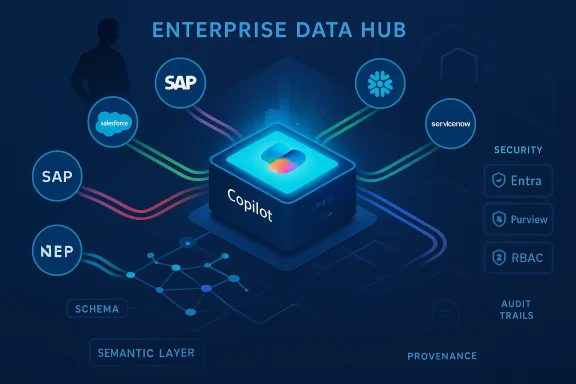
CData says its Connect AI platform is available as an MCP endpoint for Microsoft’s agent surfaces, enabling Copilot Studio–authored agents and Microsoft Agent 365 runtimes to discover and call CData’s MCP servers to read, write, and act on live data across 300–350+ enterprise systems, including Salesforce, Snowflake, NetSuite, SAP and ServiceNow. The company frames Connect AI as a managed MCP layer that preserves system semantics, relationships, and source-level access controls, allowing agents to reason about business data without expensive ingestion or fragile prompt engineering.Why this matters now
The Model Context Protocol (MCP) has moved quickly from a niche developer standard to a cross-vendor connector for agentic applications. Microsoft elevated MCP support within Copilot Studio and agent tooling as part of its agent roadmap, explicitly calling out MCP as a mechanism to let agents access tool manifests and live enterprise data, and other platform vendors have begun shipping MCP servers and connectors. That ecosystem momentum turns MCP from an experimental convenience into an enterprise integration architecture that IT organizations must evaluate seriously.What Connect AI actually delivers
Core capabilities (as described by CData)
- Universal MCP connectivity to hundreds of systems via prebuilt connectors — CData markets 300–350+ sources depending on the announcement.
- Semantic data models that surface schema, metadata, entity relationships and business logic so agents can reason across systems rather than treating each result as an opaque blob.
- Real‑time, in‑place access that preserves source permissions and authentication (passthrough RBAC), avoiding wholesale copying of corporate data into AI indexes.
- Action support (read/write) plus curated workspaces, toolsets and dataset scoping for optimized agent performance and governance.
- Query pushdown and optimized execution to reduce token costs and latency by having the MCP layer handle heavy retrieval and aggregation work before returning compact results to the model.
How it maps to Microsoft’s agent stack
Microsoft’s Copilot Studio and associated runtimes (including the Agent Framework and Azure AI Foundry) have adopted MCP as a first‑class mechanism for tool integration: agents author in Copilot Studio and can call MCP servers to discover actions, inputs and outputs, with Microsoft’s governance surfaces (Entra identities, Purview classification, Copilot Credits observability) wrapping the runtime. CData’s Connect AI appears as a managed MCP server that can be registered inside that ecosystem so Copilot agents find it as a discoverable toolset.Technical anatomy — how the pieces fit
MCP servers and manifests
MCP uses a client–server, JSON‑RPC style contract: servers advertise available tools, input/output schemas and authentication flows; agents (or the host model client) call those tools with structured parameters and consume structured results. Connect AI runs connector instances (MCP servers) that expose a source’s operations and metadata so an agent can introspect available actions and data without bespoke adapter code. This manifest-first approach reduces the need for brittle prompt engineering and custom scraping, replacing it with deterministic tool calls.Semantic models and schema intelligence
A crucial distinction CData emphasizes is semantic preservation: the connector exposes source schemas, relationships (foreign keys, joins, entity maps) and metadata so an agent doesn’t just get rows of data but understands what those rows mean in business terms. That enables cross‑system joins and multi‑source reasoning inside the agent’s plan, not in ad‑hoc prompt concatenation. This is the technical argument for better accuracy and fewer hallucinations when agents synthesize information across CRM, ERP, and data warehouses.Security and identity flow
CData promotes a passthrough model: authentication remains with the source — OAuth or SSO — and the MCP server enforces source-side RBAC for each agent call. The platform also supports audit trails, action-level downscoping, and least-privilege writeback controls. In Microsoft’s world, these capabilities are expected to integrate with Entra identity and Microsoft Purview for classification and policy enforcement. Those controls are essential because MCP centralizes tool invocation and therefore becomes part of the trust boundary.Performance and cost mechanics
By pushing retrieval, aggregation, and schema resolution into the MCP server, CData claims agents pay fewer tokens (and incur less inference cost) because the LLM receives distilled, semantically-labeled context instead of verbose raw dumps. Connect AI also promises endpoint-level optimizations (pagination strategies, API version handling, query plans) to support reliable, low-latency agent responses. Those are vendor-provided performance claims that enterprises should validate in pilots.Strengths and potential enterprise benefits
1) Faster path from prototype to production
Prebuilt connectors and a managed MCP surface reduce the engineering overhead of building and maintaining dozens of custom agent connectors. For enterprises juggling 10s–100s of SaaS systems, a universal connector offering reduces integration timelines and technical debt. This is particularly appealing to teams using Copilot Studio to author agents quickly.2) Better reasoning through semantics
Semantic exposure of schema and relationships lets agents perform multi‑source joins and apply business rules coherently, decreasing reliance on brittle RAG hacks and lowering hallucination risk when answering complex cross‑system queries. This is a meaningful step toward agents that can “think” across business domains.3) Governance-friendly architecture (when configured correctly)
Keeping access and permissions enforced at the source — and instrumenting every tool call — creates an auditable chain of custody for agent actions. For regulated industries, the ability to inherit RBAC, produce per-action audit logs, and require human approvals for sensitive writebacks is a necessary capability for production adoption.4) Reduced operational complexity for connectors
CData’s managed offering shifts maintenance, API updates, and connector edge cases to an ISV that claims to handle every API version and endpoint. That promise reduces the in-house burden of adapting agents to API churn. For organizations without large integration teams, this is a pragmatic tradeoff.Risks, implementation caveats, and security posture
1) Trust and third‑party hosting risk
MCP centralizes a critical control plane. If the MCP server or its host is misconfigured, compromised, or located outside the enterprise boundary, sensitive queries might leave the tenant’s legal protections or trigger data residency issues. Enterprises must verify contractual, security and operational SLAs and insist on private or on‑prem deployment options where regulatory constraints require it. Public vendor claims about “preserving permissions” don’t remove the need for legal review and network/topology validation.2) Token theft and agent‑level phishing (CoPhish)
Recent security research shows attackers are actively targeting agent authoring platforms and OAuth flows to capture tokens. Misconfigured agents or malicious agent templates in collaborative studios can trick users into granting excessive permissions. Microsoft and security vendors have already warned about token‑theft techniques targeting Copilot Studio workflows; enterprises must harden consent models, audit third‑party templates, and limit agent privileges. An MCP server is only as secure as its authentication flows and the consent model used to authorize agents.3) Prompt‑injection and downstream data leakage
MCP exposes structured tool interfaces, which reduces some classes of prompt injection, but attackers can still leverage returned structured data or tool manifests to nudge agents into leaking sensitive snippets or performing unintended actions. Defense-in-depth — manifest validation, strict schema whitelists, runtime content filtering, and human approval gates for high‑risk actions — is necessary.4) Operational and cost complexity
While MCP may reduce token consumption for reasoning, agent usage introduces new consumption models (e.g., Copilot Credits, agent runtime metering, connector invocation costs). Tracking, chargeback, and cost governance are typically more complex for agent fleets than for traditional API calls. Organizations must define observability, budget controls, and finance-ready metering before widescale rollout.5) Vendor claims vs. verification
Marketing materials frequently report “350+ connectors”, “semantic intelligence”, and token‑cost savings. These are meaningful differentiators but are vendor claims — enterprises should validate through measured pilots and acceptance criteria tied to latency, accuracy, security controls, and auditability. One vendor’s 350‑connector count may overlap with another’s 300‑connector claim; what matters is connector coverage for your critical systems.Practical adoption checklist for IT and security teams
- Inventory critical systems and map them to the vendor’s connector list; confirm exact API coverage and supported endpoints for your versions.
- Insist on a security data sheet: deployment topologies (SaaS vs. private), encryption in transit and at rest, data minimization, and provenance/export controls.
- Test identity flows end‑to‑end: OAuth consent screens, short‑lived tokens, Entra integration, and the ability to revoke access immediately.
- Pilot with a narrowly scoped, read‑only agent before enabling any writeback. Validate provenance, traceability, and the audit trail export format.
- Define Copilot/agent consumption governance: budgets, consumption alerts, and per‑agent rate limits tied to business KPIs.
- Red team the agent and MCP surface: simulate token-theft, rogue agent templates, and prompt-injection attempts against the MCP returns.
- Operationalize logging into your SIEM and tracing systems (OpenTelemetry) to make agent behavior visible and auditable.
Realistic enterprise use cases
Finance and ERP automation
Agents can query ERP ledgers, propose reconciliations, and surface exceptions for human review. When connected via MCP with proper constraints, agents can drastically reduce manual triage time for month‑end processes — but only when master‑data hygiene and reconciliation rules are maintained.Customer support synthesis
An agent that can join CRM data (Salesforce), incident logs (ServiceNow), and communication records (Outlook/Teams) and then draft accurate, evidence‑linked responses can shorten resolution times and improve SLA compliance. Semantic connectors help ensure the agent reasons about the same customer entity across systems.Audit and compliance workflows
Agents that can prepare audit workpapers by querying multiple systems and compiling provenance trails are attractive to audit teams; KPMG and others are exploring MCP-based automation where agents prepare evidence packages for human auditors. Immutable audit trails and human approvals are prerequisites.How to evaluate vendor claims and what to measure in pilots
- Coverage: Does the connector support the exact API versions and endpoints you use? Test edge cases like pagination, attachments, and custom fields.
- Semantics: Can the connector expose business relationships and metadata your models require (e.g., multi‑table joins, lineage fields)?
- Latency and reliability: Measure P95/P99 latencies for typical agent queries under load.
- Security: Validate token lifetimes, revocation behavior, and ability to run private MCP servers under your tenancy.
- Cost: Model Copilot Credits, inference cost, and connector invocation charges against expected agent volume.
- Explainability: Confirm that every agent response can be traced to the underlying tool calls and source records used.
The broader ecosystem and where this fits
Microsoft’s rapid adoption of MCP inside Copilot Studio and the Agent Framework, along with marketplace plays from Databricks and other cloud vendors, is turning MCP into the de‑facto interoperability layer for agents. CData’s managed Connect AI offering is emblematic of a new ISV class: connector‑as‑a‑service for agentic workflows. For enterprises, this means faster time to capability but also a need to make architectural choices about where the control plane sits — Microsoft tenancy, vendor-managed SaaS, or on‑prem/private deployment. The best choice depends on regulation, data residency, and the organization’s tolerance for third‑party tooling in the loop.Conclusion — measured optimism with operational rigor
CData’s integration with Microsoft’s agent ecosystem via the Model Context Protocol is important: it converts a common enterprise pain point — connecting dozens of data systems to agent workflows — into a repeatable platform pattern. For organizations ready to embrace agentic automation, Connect AI and similar MCP managed offerings materially lower engineering barriers and improve semantic reasoning across systems.That upside, however, is accompanied by concentrated operational responsibilities. Centralized MCP servers, consent flows, agent templates, and writeback capabilities all elevate the importance of governance, observability, and rigorous pilot validation. Security research and Microsoft’s own advisories show that misconfiguration and social engineering remain effective attack vectors against agent ecosystems, and vendor promises about semantics, coverage, and cost savings are meaningful only when validated in production scenarios.
Enterprises should approach the new MCP-enabled world with a two-track strategy: accelerate pilots to capture early productivity gains, but pair every pilot with enforced governance, end‑to‑end security testing, and contractual assurances about deployment topology and SLAs. Done well, MCP plus managed semantic connectors like Connect AI can move AI agents from experimental assistants to reliable, governed workers inside Microsoft Copilot and agent runtimes; done carelessly, they amplify the same risks enterprises have spent years mitigating in cloud and SaaS ecosystems.
Source: ADVFN https://br.advfn.com/noticias/PRNUS/2025/artigo/97266090/
