

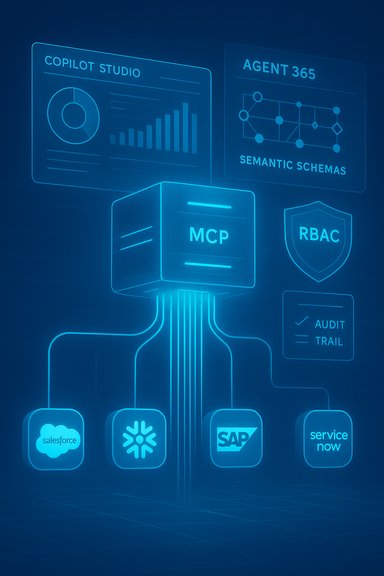
CData’s Connect AI is now available inside Microsoft Copilot Studio and Agent 365, promising a managed Model Context Protocol (MCP) bridge that gives agents real‑time, semantic access to hundreds of enterprise data sources — a capability that, if delivered as advertised, could materially shorten time‑to‑production for agentic automation while forcing IT teams to think harder about governance, data egress, and operational risk.
Background / Overview
CData announced that its Connect AI platform exposes MCP connectivity directly to Microsoft Copilot Studio and Microsoft Agent 365, enabling Copilot‑built agents to discover, read, write, and act on live data from what the vendor describes as 350+ enterprise systems including Salesforce, Snowflake, NetSuite, SAP, and ServiceNow. The timing matters. The Model Context Protocol (MCP) — an open protocol introduced by Anthropic in November 2024 to standardize how LLMs and agents access external tools and datasets — has quickly become an industry integration layer supported by multiple platforms and SDKs. Anthropic published the MCP specification and reference implementations, and broader coverage has highlighted MCP’s role as a “universal connector” for agents. Microsoft, in turn, has baked MCP into its agent roadmap: Copilot Studio and the newly announced Agent 365 control plane surface MCP‑compatible servers and tracing so enterprises can register third‑party MCP tool providers and govern agent access centrally. Agent 365 is presented as the enterprise control plane for agent discovery, access control, visualization, interoperability, and security. CData’s pitch combines three enterprise promises: universal connectivity (many prebuilt connectors), semantic context (models of schema, relationships and business logic), and enterprise control (RBAC passthrough, audit trails, and scoping). The company frames this as the answer to the three classic production barriers for agents: connectivity, context, and control.What CData says Connect AI brings to Microsoft Copilot Studio and Agent 365
Universal MCP connectivity
- One managed MCP endpoint that exposes a library of prebuilt, maintained connectors to hundreds of systems. CData’s announcement and marketing materials list a 350+ connector footprint in some places and “300+” in others; the company’s press releases and marketplace listings emphasize breadth as a core differentiator.
- Connectors claim to cover every API endpoint and supported API version for each source, handling pagination, protocol differences, and edge cases so agents do not need bespoke adapters.
Semantic context and source modeling
- Connect AI advertises source‑level semantic models: schemas, entity relationships, metadata, and business logic are made available to agents so LLMs can reason with business entities (orders, invoices, cases) instead of raw rows of JSON or CSV. This semantic layer is positioned to reduce reliance on brittle RAG (retrieval‑augmented generation) hacks and to lower hallucination risk.
- Unstructured file handling: agents can read, edit, and track revisions for files alongside structured records without heavy external RAG pipelines, according to product docs.
Enterprise control and governance
- Identity‑first security: CData says it supports passthrough RBAC so source system permissions flow through with OAuth/SSO, plus AI‑specific downscoping for CRUD operations and detailed audit trails. Integration with Microsoft Agent 365 is meant to give IT centralized visibility and enforcement.
- Tooling for curated workspaces: admins can create curated multi‑source datasets and custom tools per use case to optimize performance and security, shrinking token footprints and keeping reasoning focused.
Verifying the key claims — what independent evidence shows
- Model Context Protocol origin and ecosystem support
Anthropic published the Model Context Protocol and SDKs on Nov 25, 2024; the organization provides docs and reference implementations and positioned MCP as a universal protocol for tool/data integration. Independent reporting (major tech outlets) tracked the initial release and early adopters. This confirms MCP’s provenance and developer ecosystem. - Microsoft’s MCP adoption and Agent 365 governance surface
Microsoft’s Ignite and product documentation describe MCP as supported within Copilot Studio and list Agent 365 as the control plane for agents, including registry, access control, visualization, interoperability, and security features. Microsoft also publicly describes the ability to trace MCP tool invocations in Copilot Studio. - CData’s connector breadth and managed MCP offering
CData’s press release, product pages, and Databricks Marketplace listing consistently advertise a managed MCP platform (Connect AI / Connect Cloud rebranded) with 300–350+ connectors. The company also publishes MCP access docs and an MCP endpoint for customers. Those vendor publications verify the claim that CData offers a broad connector catalog and an MCP endpoint, though exact counts vary by page. - Security caveats and protocol risks
Independent analysis of MCP‑style integrations has flagged risks such as prompt injection, unintended data exposure, and operational misconfiguration. Industry commentary and technical guides urge enterprises to treat third‑party MCP servers as egress surfaces and to validate enforcement semantics and logging. Those warnings appear in trade reporting and protocol analysis.
Why this matters for enterprises and Windows‑centric organizations
- Rapid agent development: having a managed MCP provider with many connectors reduces the N×M integration problem (many models × many tools). For teams using Microsoft Copilot Studio, the ability to register an MCP server and immediately see discoverable tools simplifies prototyping and reduces the engineering backlog required to surface enterprise data to agents.
- Semantic grounding improves reasoning: exposing schema, relationships, and business logic gives agents structured inputs that are easier to verify and audit than ad‑hoc prompt concatenation, which reduces hallucinations and improves reproducibility of agent actions.
- Governance integration: Agent 365 gives a central place for inventory, access control, monitoring, and policy — if an MCP provider faithfully enforces source RBAC and logs actions, IT gains observability into agent actions across systems. That alignment is essential for regulated industries.
- Windows/Office productivity uplift: for many organizations the most immediate ROI will be agents that can combine SharePoint, Dynamics, Excel, and third‑party SaaS data to automate workflows without manual exports — a natural fit for Windows and Microsoft 365 environments.
Strengths: where Connect AI + Microsoft look convincing
- Speed to pilot: Managed connectors and a hosted MCP endpoint let business teams iterate quickly without long connector build cycles. This is valuable in organizations that face frequent API changes and SaaS version churn.
- Reduced token and latency cost: server‑side query pushdown and aggregated, semantic responses reduce the token footprint the LLM must process, lowering inference cost and response latency relative to naive RAG approaches.
- Better traceability of agent actions: MCP manifests, structured calls, and Copilot Studio tracing make it easier to trace which tool, connector, or query produced a result — a practical auditability gain.
- Ecosystem fit and portability: MCP is an open protocol with SDKs and multiple server/client implementations, which reduces the risk of a single‑vendor lock‑in for the basic protocol layer. However, semantic models and curated toolsets remain vendor artifacts.
Risks, caveats and operational realities
- Data egress and third‑party trust: a managed MCP provider that executes queries and returns enriched context becomes a data egress surface. For highly regulated or sensitive systems, hosting the MCP server inside tenant boundaries or using tenant‑owned MCP instances is safer than sending queries to an external managed platform. Microsoft documentation and industry analysts explicitly call this out.
- Prompt injection and tool manifest integrity: MCP exposes structured tools that models call deterministically, but a compromised tool manifest or malicious third‑party MCP server could return poisoned structured outputs that drive incorrect agent behavior. Runtime validation, allow‑lists, and human‑in‑the‑loop approvals for writebacks are essential mitigations.
- Vendor claims vs. real coverage: marketing counts (300+, 350+) are useful as signals, but true production readiness depends on per‑source depth: read vs. write support, API version coverage, multi‑tenant nuances, custom fields, and edge cases. Buyers must validate connector depth, not just breadth. Independent marketplace listings and CData pages display minor variations in connector counts that buyers should clarify.
- Operational complexity and cost: agent activity can rapidly consume Copilot credits, model inference credits, and MCP provider API billable units. Cost governance and consumption monitoring are critical, and token‑efficiency claims should be validated under realistic workloads.
- Migration and portability: while MCP is portable as a protocol, semantic models and curated workspaces produced by a vendor may not be trivially exportable. Plan migration strategies if the long‑term architecture will move from managed to self‑hosted MCP.
Practical pilot and production checklist (recommended)
- Inventory and classify target data sources by sensitivity and necessity.
- Verify connector parity for each critical source: confirm read/write support, API version coverage, pagination, custom fields, and test query performance.
- Start with read‑only, low‑sensitivity pilots: limit agent workspaces to predefined datasets and single‑purpose agents.
- Validate RBAC passthrough semantics end‑to‑end: confirm that Entra identities, OAuth tokens, and source permissions are enforced and logged.
- Test for prompt injection and unexpected tool outputs: include validation layers that check structured responses before applying business logic.
- Monitor telemetry and cost: track Copilot credits, model usage, MCP call volume, and end‑to‑end latency under expected load.
- Define human‑in‑the‑loop gates for all writebacks and high‑impact actions, and require approvals during scale phases.
- Contractual protections: require SLAs, incident response procedures, data‑handling commitments, and a data‑residency/export policy from any managed MCP provider.
- Plan exit and migration: insist on exportable manifests and semantic models, or document the re‑build cost to self‑host equivalent connectors.
- Iterate and harden: move to more sensitive workloads only after stable enforcement and auditing are proven.
Technical deep dive: how MCP + Connect AI actually changes agent design
- Manifest‑first tool discovery: MCP servers expose tool manifests with structured inputs/outputs, enabling agents to discover capabilities and call tools deterministically rather than rely on natural‑language prompt parsing.
- Server‑side query pushdown: heavy retrieval, joins, aggregation, and schema translation occur in the MCP connector layer so the model receives concise, semantically labeled context, reducing token use and improving accuracy.
- Semantic models: by exposing schema metadata (tables, fields, relationships), connectors allow agents to reason across systems using entity semantics rather than tokenized raw data.
- Actionability: when connectors support write operations, agents can propose changes that are executed with enforced downscoped permissions and logged for audit, making automation executable and auditable.
Final assessment — practical value and realistic expectations
CData’s integration with Microsoft Copilot Studio and Agent 365 via a managed MCP endpoint represents a pragmatic solution to a real and urgent enterprise problem: how to give agentic AI secure, semantically meaningful access to the dozens or hundreds of SaaS and on‑prem systems that drive business work. The combination of a broad connector library, semantic modeling, query pushdown, and Agent 365 governance creates a credible path from prototype to controlled production for many scenarios. That said, the offering is not a panacea. The hard work shifts from building connectors to operationalizing governance, validating enforcement semantics, and managing data egress and vendor relationships. Security teams must treat any managed MCP server as a critical egress surface and validate contractual and technical protections. Buyers should confirm connector depth for their priority systems and run conservative pilots that emphasize read‑only scenarios, telemetry, and human approvals before enabling writebacks. Enterprises that pair disciplined AgentOps, identity governance, and data‑centric security with MCP‑enabled connectivity stand to accelerate agent productivity substantially. The next 12–18 months will reveal whether managed MCP providers and platform vendors can operationalize the promise at scale — and whether enterprises can tame the new attack surface that agentic AI introduces.Recommended next steps for IT leaders
- Run a targeted pilot (4–8 weeks) exposing a small set (2–5) of low‑sensitivity sources via Connect AI + Copilot Studio, validating RBAC, auditing, and cost.
- Require a vendor‑provided export of any semantic manifests and tool definitions used in pilots.
- Engage security and compliance early: simulate incident and egress scenarios and verify contractual breach remedies.
- Measure token efficiency and latency against baseline RAG approaches to validate claimed cost savings.
- Keep a parallel plan to self‑host MCP servers for the most sensitive workloads if regulatory or contractual constraints demand it.
Source: citybiz CData Partners with Microsoft to Bring Real-Time, Semantic Access to Hundreds of Enterprise Data Sources via Model Context Protocol
