

CData’s announcement that its Connect AI managed Model Context Protocol (MCP) platform is now available inside Microsoft Copilot Studio and listed as a launch partner in tthe Databricks Marketplace marks a decisive moment in the maturing MCP ecosystem—one that promises faster agent development, richer cross‑system reasoning and a single integration surface for hundreds of enterprise systems, while also concentrating operational, security and contractual responsibilities in new ways.
The last year has seen the Model Context Protocol evolve from an open developer standard into a practical integration fabric for production AI agents. MCP standardizes how models and agents discover, describe and call external tools, datasets and services using manifest‑first, structured inputs and outputs. Microsoft has embedded MCP into Copilot Studio and Agent 365, making it a first‑class tool registration and governance surface; Anthropic’s early stewardship of MCP and recent moves to place reallyated agent standards have accelerated ecosystem adoption. CData’s Connect AI (also described in marketing as Connect Cloud or Connect AI depending on the announcement) presents itself as a managed MCP server that exposes a catalog of prebuilt connectors and semantic models—allowing agents built in Copilot Studio or Databricks Agent Bricks to read, write, and act on live data business systems without the traditional bespoke adapter work. The vendor consistently cites a footprint in the 300–350+ connector range and emphasizes semantic preservation (schemas, relationships, entity maps) and passthrough identity/RBAC as distinguishing features.
However, technical and operational details determine whether the promise translates into real value: connector depth and fidelity (do threads, extensions, or on‑prem variants?, PASSTHROUGH semantics (are audit trails preserved and auditable to tenant standards?, latency under heavy load, and exportability/portability if an enterprise later decides to move off a managed provider. Practical deployments require verifying these properties early in a proof‑of‑concept.
Thatits depend on non‑glamorous engineering and operational work: validating connector fidelity, ensuring master‑data hygiene, contracting for audit and portability, and hardening identity and DLP controls. Enterprises that treat a managed MCP provider as an extension of their security boundary—and that run rigorous POCs before broad rollout—will capture the upside while limiting the concentrated risks a managed MCP endpoint introduces.
For Windows‑centric IT organizations and data teams, the pragmatic path is straightforward: pilot aggressively on low‑risk workflows, verify connector behavior and security assumptions, integrate Agent 365 governance from day one, and contract for portability and audits. If those prerequisites are met, MCP plus managed connectors can be a fast, effective route to bringing agentic automation into everyday enterprise systems.
Source: ERP Today CData, Databricks, and the Expanding MCP Ecosystem
 Background / Overview
The last year has seen the Model Context Protocol evolve from an open developer standard into a practical integration fabric for production AI agents. MCP standardizes how models and agents discover, describe and call external tools, datasets and services using manifest‑first, structured inputs and outputs. Microsoft has embedded MCP into Copilot Studio and Agent 365, making it a first‑class tool registration and governance surface; Anthropic’s early stewardship of MCP and recent moves to place reallyated agent standards have accelerated ecosystem adoption. CData’s Connect AI (also described in marketing as Connect Cloud or Connect AI depending on the announcement) presents itself as a managed MCP server that exposes a catalog of prebuilt connectors and semantic models—allowing agents built in Copilot Studio or Databricks Agent Bricks to read, write, and act on live data business systems without the traditional bespoke adapter work. The vendor consistently cites a footprint in the 300–350+ connector range and emphasizes semantic preservation (schemas, relationships, entity maps) and passthrough identity/RBAC as distinguishing features. Why this matters now
MCP shifts how enterprises think about agent integration in three concrete ways:- Protocol-first interoperability: Agents can discover tools and data programmatic little prompt engineering and ad‑hoc API maintenance. Microsoft’s Copilot Studio surfaces MCP tools directly, so third‑party MCP servers become discoverable building blocks for makers.
- **Semantic context instead of raw blob schemas and relationships as typed metadata lets agents reason with business entities (orders, invoices, tickets) rather than opaque JSON extracts. This directly addresses hallucination risk and improves traceability of agent outputs.
- Governance at the tool boundary: With Agent 365 as the control plane, tenants can register MCP servers, assign scoped permissions, and trace tool invocations—moving much of the access control and auditability up to a known surface. That makes third‑party MCP providers attractive, but also transforms them into high‑value egress and trust points that IT must vet.
What Connect AI actually delivers (vendor claning)
Core vendor claims
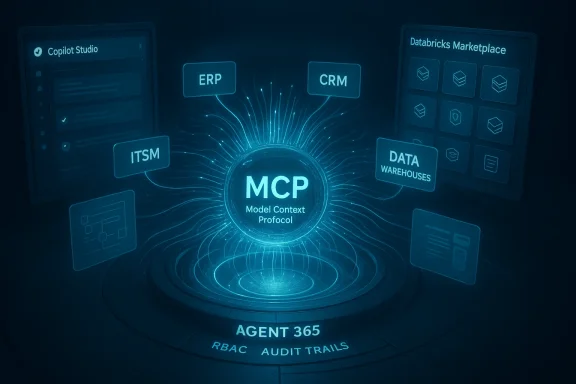
CData’s public materials emphasize a consistent feature set:- One MCP endpoint exposing 300–350+ prebuilt connectors to CRM, ERP, data warehouses, ITSM and file stores.
- Semantic models that surface schemas, relationships and business logic so agents operate on typed entities.
- Real‑time, in‑place access that preserves source authentication (passthrough RBAC/OAuth/SSO) and avoids wholesale data ingestion.
- Action support (read/write) plus curated workspaces and dataset scoping for governance.
- Query pushdown / optimization to reduce LLM token consumption and latency by performing heavy retrieval server‑side.
- Managed hosting and a free trial tier, with he Databricks Marketplace to support Agent Bricks.
Practical interpretation and enterprise value
Taken together, these capabilities promise to shorten the path from pilot to production for agentic workflows that require multi‑system context—collections of tasks like AP reconciliation (ERP + bank feeds), salesperson activity summaries (CRM + email + ERP), or incident triage (ITSM + monitoring + CMDB). Server‑side pushes and semantic models can significantly redprove determinism, because far more of the data aggregation and authoritative computation happens in the connector runtime rather than inside the model prompt.However, technical and operational details determine whether the promise translates into real value: connector depth and fidelity (do threads, extensions, or on‑prem variants?, PASSTHROUGH semantics (are audit trails preserved and auditable to tenant standards?, latency under heavy load, and exportability/portability if an enterprise later decides to move off a managed provider. Practical deployments require verifying these properties early in a proof‑of‑concept.
How the integration fits Microsoft and Databricks’ stacks
Microsoft Copilot Studio + Agent 365
Microsoft has integrated MCP support into Copilot Studio and Agent 365 to let makers discover tools and to let IT register and control them. That means a registered MCP server appears in Copilot Studio as a discoverable tool manifest: tools, typed inputs/outputs and descriptions are visible to agent authors and can be traced by Agent 365’s governance surfaces. This is the mechanism by which Connect AI becomes a first‑class provider inside Microsoft’s ecosystem. ([microsoft.com](What’s new in Copilot Studio: March 2025 | Microsoft Copilot Blog 365’s role as a central registry and policy engine is a guardrail: admins can allow or block MCP servers, assign scopes, and trace calls for compliance. That integration is essential because it gives enterprises a controllable on‑ramp for third‑party MCP tooling—if they use it correctly.Databricks Agent Bricks
Databricks positions Agent Bricks as an analytic and automation surface; CData’s Databricks Marketplace listing makes Connect AI available as a launch bricks can combine analytics-derived signals with live operational data from 350+ systems. For analytics teams, that combination extends historically-backed insight (data lake and ML) into action—letting agents not only reason about patterns but also take governed actions in the operational systems that reflect those insights.Technical anatomy: how MCP, connectors and semantics interplay
MCP manifest-first model
MCP servers publish manifests that enumerate available tools, inputs/outputs and auth flows. Agents discover these manifests and make structured anifest-first approach replaces brittle prompt engineering with deterministic tool calls, and it’s the basic interoperability pattern Connect AI uses to expose each connector’s operations to Copilot agents.Semantic modeling
CData eeservation—exposing foreign keys, business relationships, field semantics and business logic alongside raw rows. For agents, that means the context is more than a payload; it’s type can rely on to form plans and avoid making decisions based on misinterpreted fields. In practice, semantic models depend on quality of mapping and master data hygiene; poor master data will undermine these benefits.Query pushdown and optimized execution
Rather than returning megabytes of raw rows to the model, an MCP server can execute filters, joins and aggregations close to the source and return condensed, semantically labeled summaries. This reduces token consumption and latency and makes outputs more auditable, because numerics and aggregations originate from source systems rather than being computed in‑prompt.Strengths and near‑term benefits
- Speed to pilot: Prebuilt connectors and Copilot Studio’s MCP onboarding accelerate proof‑of‑concepts that historically required bespoke engineering. Early pilots can be stood u instead of months.
- Improved multi‑system reasoning: Semantic models and typed manifests let agents perform cross‑system joins and audits more reliably than ad‑hoc RAG pipelines. This matters for finance, supply chain, and customer service scenarios.
- **Centralistering an MCP server with Agent 365 centralizes policy, tracing and approval workflows—giving IT a place to observe and restrict agent actions.
- Ecosystem leverage: Databricks and Microsoft platform support for MCP reduces lock‑in at the protocol level while enabling commercial providers to monetize connector mainl features.
Risks, limits and caveats — what IT and security teams must evaluate
While the architecture is compelling, deploying managed MCP providers creates concentrated trust and operational dependencies. Key concerns:- Connector coverage vs. claims: CData’s materials vary between 250+, 300+, and 350+ connectors across pages and marketplaces. Connector count is a headline metric; connector depth (support for custom fields, extensions, API versions, ers more. Enterprises should verify support for their exact systems and customizations before relying on the managed service.
- Egress and contractual risk: A managed provider that executes queries against live systems is an egress surface. Contracts muy, encryption, breach obligations, audit rights, and SLAs. Treat the provider as an extension of your attack surface.
- Operational dependency and vendor lock‑in: Semantic modeling and curated workspaces are often proprietary. Migrating to another provider or to an in‑house MCP runtime can require considerable rework unless explicit portability guarantees exist. Evaluate export formats and code/manifest portability in procurement.
- Agent attack surface: Agents calling external services are vulnerable to injection or malicious manifests that attempt to exfiltrate or misdirect. Validate manifests, require strict identity flows, and enforce manual approvals for sensitive writebacks. Independent commentary on MCP-style integrations highlights these risks.
- Master data and semantic accuracy: Agents acting at scale amplify master‑data errors; robust data governance and reconciliation pipelines are prerequisites. Pilot outcomes often depend more on master data quality than on model sophistication.
- Regulatory compliance: For regulated industries, audit trails, retention, encryption, and datatiable. Verify that Agent 365 tracing plus provider logging meet your regulatory posture and that you retain adequate forensic access.
Practical rollout recommendations for Microsoft and Windows environments
A phased, risk‑aware approach will maximize value while limiting exposure:- Inventory and classify: map exact systems, API versions, custom fields and sensitivity levels. Know what you will expose before onboarding any MCP server.
- Start small: pilot with a read‑heavy, low‑risk workflow spanning no more than two or three systems (for example, a sales summary or procurement status dashboard).
- Validate connector fidelity: perform tests that exercise pagination, filters, rates, and any custom fields or extensions your tenant uses.
- Integrate governance early: register the MCP server through Agent 365’s onboarding, enable tracing and route logs into your SIEM and data classification tools.
- Harden writebacks: require explicit human approvals for any agent-initiated writes, particularly in finance or HR workflows; use least‑privilege CRUD scoping.
- Measure and iterate: quantify token savings, latency improvements, error rates, human intervention frequency and business KPIs.
- Contract for auditability and portability: require SLA, data handling and right‑to‑audit clauses; insist on exportable manifests and semantic mappings where possible.
Vendor comparison and alternatives
Managed MCP providers like CData bring connector breadth and operational convenience; alternatives include:- Building an internal MCP server that wraps your systems (higher upfront engineering but more control over data, semantics and portability).
- Using cloud‑vendor native MCP offerings where available (Microsoft’s own Dynamics and Dataverse MCP servers for ERP are one example and embed tenant security more tightly).
- Hybrid models that host connector runtimes inside customer VNets or on‑prem gateways to reduce egress risk.
Databricks partnership — what it adds and why it matters
CData’s role as a Databricks Marketplace launch partner for Agent Bricks is noteworthy because it ties live operational context to analytics pipelines. Agent Bricks already enable agents to operationalize model outputs; adding Connect AI extends those agents’ reach into transactional systems so agents can not just recommend but act on insights—subject, of course, to governance. For data teams, this convergence simplifies the previously difficult handoff between analytic insight and operational execution.Short checklist for procurement and security teams
- Confirm exact connector cal system, including customizations.
- Ask for a manifest export and semantic mapping for critical entities.
- Require on‑prem or VNet deployment options if egress/sovereignty is a concern.
- Validate passthrough RBAC semantics and audit log fidelity end‑to‑end.
- Insist on breach/incident response SLAs and right‑to‑audit clauses.
- Test scale and latency with representative query workloads, including batch and streaming patterns.
Verdict: promising architecture, but execution and governance determine success
CData’s Connect AI entering Microsoft Copilot Studio and Databricks Marketplace is not merely a marketing moment; it reflects a broader architectural inflection where MCP becomes the practical glue for agentic systems. When connectors actually deliver faithful semantic models, and when governance surfaces like Agent 365 are correctly configured, enterprises can meaningfully reduce agent development friction and improve multi‑system reasoning.Thatits depend on non‑glamorous engineering and operational work: validating connector fidelity, ensuring master‑data hygiene, contracting for audit and portability, and hardening identity and DLP controls. Enterprises that treat a managed MCP provider as an extension of their security boundary—and that run rigorous POCs before broad rollout—will capture the upside while limiting the concentrated risks a managed MCP endpoint introduces.
Conclusion
The expanding MCP ecosystem—accelerated by Microsoft’s Copilot Studio and Agent 365, Anthropic’s protocol work, and platform integrations like Databricks—creates a new, practical pattern for getting agents into production. CData’s Connect AI is a clear, commercially minded articulation of that pattern: broad connector coverage, semantic models and managed hosting designed to make agents useful faster. The integration’s promise is real, but so too are the new operational responsibilities it concentrates.For Windows‑centric IT organizations and data teams, the pragmatic path is straightforward: pilot aggressively on low‑risk workflows, verify connector behavior and security assumptions, integrate Agent 365 governance from day one, and contract for portability and audits. If those prerequisites are met, MCP plus managed connectors can be a fast, effective route to bringing agentic automation into everyday enterprise systems.
Source: ERP Today CData, Databricks, and the Expanding MCP Ecosystem
