

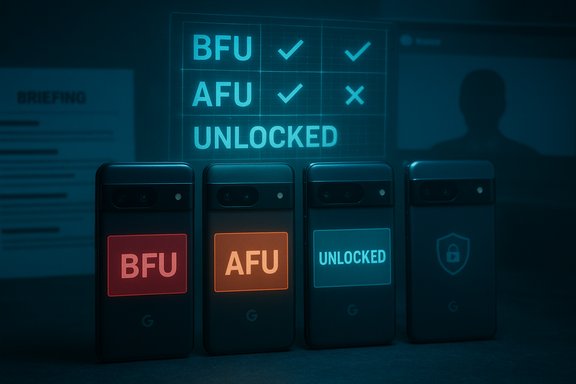
A recently leaked Microsoft Teams briefing has pulled back the curtain on how commercial phone-unlocking vendors describe their capabilities against modern Google Pixel devices — and the slide deck circulating in security communities suggests the reality is both more capable and more limited than many users expect. Screenshots from the meeting, shared on public forums and reported by multiple outlets, show a Cellebrite “support matrix” that lists which Pixel models and software builds the company’s tools can and cannot extract data from, including explicit notes about before first unlock (BFU), after first unlock (AFU), and fully unlocked states. The leak has immediate technical and policy implications: it highlights the evolving arms race between device makers, privacy-oriented OS projects like GrapheneOS, and forensic vendors; it reveals operational blind spots (notably around eSIM extraction and certain Pixel builds); and it raises fresh questions about how vendors brief law enforcement and prospective customers on sensitive exploitation capabilities. Reporting so far is based on screenshots and forum posts rather than full internal documents, so several specifics remain provisional and should be treated cautiously.
Background
Who is Cellebrite and why this matters
Cellebrite is a well-known provider of forensic tools and services that law enforcement agencies and private contractors use to extract and analyze data from mobile devices. For years the company has operated in a grey zone of public attention: rare, targeted disclosures of capability (and limitation) have periodically surfaced through leaks and reporting, and those disclosures shape public debate about lawful access, privacy, and vendor responsibility. Recent prior leaks showed which iPhone and Android models the firm could or could not handle, and those documents have been used by journalists and researchers to track capability changes over time. The Teams-call leak reported this week is notable because it appears to be a live sales or presales briefing that an outsider joined, rather than a static PDF accidentally published. That format offers a different danger: real-time briefing sessions can disclose not only what a product does, but operational caveats and internal reasoning that vendors might prefer to keep off the public record. Forum posts attributed to the attendee “rogueFed” say the screenshots include a Cellebrite Android support matrix focused on Pixel phones, and the images were circulated on privacy and security forums shortly after the call.What the leaked material appears to show
BFU, AFU and unlocked: why the distinctions matter
The leaked slide compares Cellebrite’s success across Pixel generations and Android versions using three key states:- Before First Unlock (BFU): the device has not yet been unlocked since a power cycle — full-disk encryption protections are strongest in this state.
- After First Unlock (AFU): the device has been unlocked at least once since boot; certain keys are resident in memory and some extraction methods become feasible.
- Unlocked: the device is unlocked and available for live inspection by a human operator, which is the simplest forensic case.
GrapheneOS and patched Pixels: meaningful resistance
One of the most consequential takeaways from the leak — and a recurrent theme in earlier Cellebrite leaks — is that GrapheneOS builds running on Pixel hardware show markedly reduced exploitability in Cellebrite’s matrix. According to the screenshots shared and community analysis, Pixels running GrapheneOS were flagged as inaccessible for many extraction scenarios, particularly for BFU and recent security-patch-level builds. That finding aligns with public claims from GrapheneOS developers that their USB and kernel hardening, along with conservative default behavior for USB modes while locked, materially raise the bar for USB-based extraction tools. However, the leaked slide suggests older GrapheneOS builds from around 2022 or earlier may still be partially vulnerable, underscoring that security is an ongoing maintenance task.eSIM extraction: still out of reach
Multiple community posts tied to the leaked screenshots emphasize one practical limitation shown in the slide: eSIM extraction from Pixel devices remains unsupported. Cellebrite’s matrix reportedly lists eSIM copying as a capability gap, a notable operational constraint given that modern Pixel devices increasingly use eSIM-only configurations. That limitation matters for investigations that need carrier or SIM metadata and illustrates how hardware design choices (removal of physical SIM slots, eSIM adoption) change the forensic attack surface. Treat this claim as likely accurate for the tools referenced in the slides, while noting the possibility that workarounds or newer vendor releases could address it in later product versions.Technical analysis: how real are the limits?
USB-based extraction is brittle and evolving
Most commercial forensic tools rely on a combination of low-level hardware interfaces, USB-based protocols, memory corruption exploits, and sometimes cooperative OS-level actions to extract data. GrapheneOS’s approach — hardening allocator behavior, restricting USB functions while locked, and supporting aggressive automatic reboot policies — specifically reduces the feasibility of widely used USB-based exploit chains. The leaked matrix demonstrates that operating system hardening and security patch levels materially affect vendor claims. This aligns with earlier leaked support matrices that showed similar trends for iOS and stock Android: new protections and patched CVEs can quickly obsolete a vendor’s capability where exploits rely on specific vulnerabilities.Cold-boot and hardware protections
Another technical factor the matrix reflects is the role of cold-boot protections and hardware-backed secure elements (for example, Titan M-series security modules on Pixel devices). When devices are powered off (or have not been unlocked since power on), critical keys remain sealed behind hardware-enforced boot-time checks; many exploit chains require keys to be resident or accessible in AFU or unlocked states. The leaked slide’s pattern for Pixel 6–8 limitations when powered down matches prior analyses that identified cold-boot and hardware-backed protections as major impediments to brute-force and memory-exfiltration methods.But proprietary tools still have reach — and ambiguity
Two counterpoints temper the “GrapheneOS is invulnerable” reading. First, the leaked slide—like all screenshots—may omit context about test conditions, accessory cables, firmware revisions, and operator workflows that determine success rates. Second, vendors have commercial incentives to overstate or understate capabilities in different venues: sales briefings aimed at law enforcement customers emphasize strengths while minimizing caveats; public statements emphasize restraint for liability reasons. The result is a shifting, partially opaque record where a slide in a Teams briefing is suggestive but not definitive. Reporters and analysts have therefore been careful to describe the material as leaked, corroborated, and cross-checked, rather than as an exhaustive or final truth.Why a Teams meeting leak is a unique vector
Live briefings expose operational nuance
A static PDF or a published datasheet is one thing; a presales or technical briefing can reveal candid operational notes, “this works half the time,” and detailed limitations that would not be published formally. The attendee who leaked these screenshots reportedly joined a scheduled Teams briefing and captured slides and a participant image — a modus operandi that underscores how collaboration tools themselves can enable sensitive disclosures. That dynamic is part social engineering and part operational hygiene: vendors must vet external participants, and buyers must understand that such calls can leak technical intelligence.The platform paradox: trusted channels as risk vectors
Microsoft Teams and similar collaboration platforms are now primary sales and support channels. Their familiarity lowers the guard for attendees, which is precisely why sensitive capabilities are sometimes discussed there. This leak is a reminder that the same tools that streamline vendor engagement also present a platform-level risk for operational secrecy. The security community has been warning about these platform risks (including device code phishing schemes and malicious tenant-led demos) for some time; the Teams-call leak adds a concrete example where sensitive forensic capability details escaped via a routine briefing.Policy and ethical dimensions
Transparency vs. abuse
Cellebrite and similar vendors face a difficult policy trade-off: publicizing full extraction capabilities makes it easier for malicious actors to defend against or replicate those techniques; withholding details raises oversight concerns about lawful access and potential misuse. Earlier leaks prompted Cellebrite to argue that detailed public documentation would “provide potential criminals or malicious actors with an unintended advantage,” while journalists and civil liberties advocates countered that public scrutiny is essential for accountability. The Teams slide leak sits squarely inside that debate: the content informs the public about who can access data and when, but it also risks feeding exploit-development cycles if misused.Law enforcement practice and vendor controls
Law enforcement has long relied on third-party vendors to supply specialized tools. The leaked briefing highlights that procurement and operational policy need to consider vendor disclosures, training access, and the supply chain of exploit knowledge. Agencies should ensure that procurement processes include vetted briefings, NDAs with strict access controls, and internal oversight to prevent sensitive capability exposure during public or semi-public demonstrations. At the same time, privacy advocates argue that stricter export controls, licensing, or usage auditing for powerful forensic capabilities should be on the table. The leak is likely to accelerate those policy conversations.Practical takeaways for users and administrators
For privacy-minded users (and defenders)
- Use updated OS builds and hardening-focused alternatives: The leaked matrix underscores that timely patching and hardened OS choices (e.g., GrapheneOS on Pixel hardware) materially reduce exploit surface. Keep security patches current and prefer options that limit USB functionality while the device is locked.
- Control physical access: Many extraction workflows require physical possession. If a device is seized, the BFU state (rebooted and not yet unlocked) remains the strongest protective posture.
- Consider device features and configuration: Settings like automatic reboot windows, restricted USB modes when locked, and duress PINs (where available) are practical mitigations that make automated extraction harder.
For enterprise and law enforcement buyers
- Treat briefings as sensitive events: Tighten attendee vetting, require non-disclosure agreements, and archive session artifacts under secure controls.
- Audit vendor claims: Independent testing and red-team assessments are necessary to validate vendor matrices in your own operational conditions.
- Update policy to reflect capability limits: eSIM-only architectures and ever-tighter OS protections alter what tools can do; policies should adapt accordingly.
For policymakers and oversight bodies
- Mandate reporting and oversight: Where vendors sell powerful forensic tools to public agencies, transparency measures (redacted capability summaries, audited use logs) would help balance investigatory needs with civil liberties.
- Consider export and licensing controls: The international nature of these tools creates risk vectors; targeted controls could reduce misuse while preserving legitimate investigative access.
What remains unverified — and what to watch for
- The leaked Teams screenshots are credible to many researchers but do not represent the entire Cellebrite product portfolio or roadmap. Some details — particularly about success rates, accessory dependencies, and any bespoke operator procedures — are not visible in screenshots. Treat any single leaked image as an incomplete data point.
- Vendors update tools frequently. A matrix captured during a single briefing may already be out of date; this is why independent verification and continual monitoring of security patching trends matter.
- The absence of Pixel 10 coverage in the leaked slide could mean the product simply wasn’t addressed in that briefing, not that the vendor lacks capability. Always assume a partial view unless a complete support matrix is obtained and verified.
Final analysis: strengths, risks and the path forward
The Teams meeting leak is a consequential reminder that the tension between privacy, law enforcement capability, and vendor disclosure lives in the open today, not behind closed doors. The leaked material confirms several important dynamics:- Strengths for defenders: Active OS hardening (as in GrapheneOS) and conservative hardware/USB modes deliver real, measurable resistance to commodity forensic workflows. Device manufacturers and third-party OS projects can change the operational calculus for forensic vendors via timely patches and secure defaults.
- Strengths for vendors and investigators: Commercial tools remain capable in many real-world cases, especially when devices are unlocked or have not been protected with the latest mitigations. For lawful investigations, these tools provide time-saving, high-value access to evidence that would otherwise be difficult or impossible to obtain.
- Risks and blind spots: Live briefings and platform-mediated demos are a fragile channel for sensitive capability discussion. Unauthorized attendees or inadequate vetting can create intelligence leaks. Additionally, the rapid cadence of patches and hardware changes means vendor claims can become stale fast, complicating procurement and policy decisions.
The leaked Teams slide is not an endpoint; it’s an accelerant in an ongoing dialogue between defenders, investigators, and policymakers. It proves once again that security is not a static property of a device or product — it is an emergent property of design choices, operational practices, and the social systems that surround technology. Recognizing that interdependence is the first step toward thoughtful, durable answers.
Source: Moneycontrol https://www.moneycontrol.com/techno...ogle-pixel-devices-article-13644430.html/amp/
