

Cendyn unveiled Wayfinder on June 15, 2026, in Austin, Texas, as a generative-engine optimization and AI monitoring platform for hotels that tracks how properties appear across ChatGPT, Gemini, Perplexity and other AI-led discovery systems. The launch is less about one vendor adding another dashboard than about hospitality’s uncomfortable new reality: travelers may soon ask an AI assistant where to stay before they ever see a Google results page. For hotels, that turns accuracy, structured content, and machine-readable authority into revenue infrastructure. The old fight for search rankings is becoming a fight over who gets to be treated as truth.
Wayfinder arrives with a blunt premise: hotels are already being described, ranked, compared, and sometimes misrepresented by AI systems, whether their marketing teams are watching or not. Cendyn’s pitch is that hoteliers need an instrument panel for this new layer of discovery, much as they once needed SEO dashboards, rate-shopping tools, and reputation-management platforms.
The product is built around generative engine optimization, or GEO, the increasingly popular term for influencing visibility inside AI-generated answers rather than traditional search result pages. That distinction matters. A hotel may rank well on Google, maintain polished OTA listings, and still be invisible or inaccurately summarized when a traveler asks an AI assistant for “a quiet boutique hotel near the convention center with parking and late checkout.”
Wayfinder is designed to run simulated traveler prompts across multiple AI platforms and evaluate how a hotel appears in the results. It looks for gaps in discoverability, incorrect facts, weak content signals, and competitive disadvantages. In plain English, it tells a hotel whether the machines have understood the property correctly.
That sounds narrow until you consider the booking funnel. If an AI assistant gives a traveler three options and a hotel is not among them, the traveler may never reach the hotel’s site, its paid-search ad, or its booking engine. In that world, visibility is no longer just a marketing concern. It becomes a distribution problem.
That is precisely why hotels should be nervous. Traditional search at least gave brands several chances to intercept demand: organic results, paid ads, metasearch placements, map packs, OTA listings, and retargeting. AI-led discovery compresses those chances. A system that returns a synthesized answer may favor sources it can parse cleanly and trust confidently.
The hospitality industry has lived this story before. OTAs became powerful not merely because they offered inventory, but because they organized complexity better than individual hotel sites did. They made comparison easier, buying simpler, and discovery more predictable. AI assistants threaten to repeat that platform shift, except this time the interface is not a website with filters. It is a conversation.
Cendyn’s language around avoiding “OTA 2.0” is marketing, but it lands because the fear is credible. If AI assistants learn to rely disproportionately on intermediary platforms for rates, availability, descriptions, policies, and review summaries, hotels could again find themselves paying for access to demand they helped create.
Hotel websites are often messier than brand teams admit. Amenities pages lag renovations. Parking policies change. Restaurant hours drift. Pet rules differ between a booking engine, an FAQ, and an OTA description. A human traveler may call to clarify. An AI model may simply synthesize the inconsistency into a confident answer.
Wayfinder’s fact-checking concept addresses that weakness by comparing AI-generated answers against the hotel’s own source content. When a model diverges from what the hotel says on its site, the platform flags the issue and points teams toward the content that may need repair. This is less glamorous than “dominating AI search,” but it is probably where the real work lives.
The platform also includes prompt testing, competitive comparisons, and AI-readable directives hosted on a hotel’s own domain. Those directives are meant to guide crawlers and language models toward brand-approved information, constraints, and source material. The standards for this are still evolving, and no vendor can guarantee that frontier AI models will obey every signal. Still, the direction of travel is obvious: hotel websites are being asked to serve human guests, search crawlers, booking engines, and now AI agents.
For IT teams, this is where the story becomes more than a marketing release. Structured data, content governance, schema hygiene, crawlability, domain authority, and API-fed availability are no longer background chores. They are part of whether the property exists in the machine-mediated booking journey.
In practice, hotels have often failed to capitalize on that advantage. OTAs tend to be better at standardizing information, maintaining structured inventory, and presenting comparison-ready data at scale. Many hotel websites, especially for independent properties and smaller groups, remain visually polished but semantically thin. They are built to persuade a person, not to be interpreted reliably by a machine.
That gap is what GEO vendors are now rushing to monetize. They are not simply selling visibility; they are selling a remedy for years of fragmented content operations. If a hotel cannot state its facts consistently across its CMS, booking engine, rate feeds, FAQs, local listings, and distribution partners, AI systems will not magically infer the correct version.
The direct-booking dream therefore depends on something less romantic than brand storytelling. It depends on disciplined data stewardship. The hotel that wants AI assistants to recommend it must make itself legible, current, and verifiable.
But the OTA framing can also obscure the deeper shift. The larger issue is that the interface to demand is changing. The winning intermediary may not be Booking.com, Expedia, Google, or a hotel brand site in isolation. It may be the AI assistant that chooses which sources to consult, which answers to present, and which booking path to complete.
That is why Cendyn’s earlier AI Connect launch matters in the background. AI Connect was designed to push hotel availability, rates, and inventory into AI search environments through a Model Context Protocol-style approach. Wayfinder sits higher in the funnel, monitoring and shaping what AI systems say before a booking decision is made. Together, the two products sketch a broader strategy: first make the hotel visible to AI, then make its bookable data available when intent hardens.
That is a logical roadmap, but it also exposes the uncertainty. The AI travel stack is not settled. Standards may shift. Model behavior may change. Platforms may restrict crawling, favor partners, or build their own commerce layers. Hotels investing now are not buying certainty; they are buying preparedness.
A search results page can be inspected, ranked, localized, and tracked. AI answers are more fluid. They may vary by prompt wording, user history, geography, model version, retrieval sources, and tool access. A hotel might appear in one answer and vanish in another that differs by only a few words.
That makes Wayfinder’s simulated prompt library useful but not magical. Synthetic prompts can reveal patterns, but they cannot perfectly reproduce every real traveler interaction. The platform can show whether a property is being understood, whether competitors appear more often, and whether factual errors recur. It cannot guarantee that every AI assistant will recommend the hotel at the moment that matters.
Still, imperfect measurement is better than no measurement. The early days of any channel are messy. Paid search, social advertising, metasearch, and mobile attribution all matured through dashboards that were initially incomplete and sometimes misleading. The companies that learned fastest gained an advantage, even when the tools were crude.
For hotel marketers, the practical question is not whether GEO is fully mature. It is whether they can afford to ignore a channel where travelers are already experimenting.
Travel is a natural proving ground because it is high-intent, data-rich, and frustratingly fragmented. A good hotel recommendation requires location, dates, budget, amenities, availability, reputation, loyalty preferences, cancellation rules, and subjective taste. That is exactly the sort of multi-variable task AI companies want to own.
The risk for hotels is that AI platforms become the new gatekeepers without looking like gatekeepers. A traveler may not think they are using an OTA at all. They may think they are simply asking an assistant for help. But behind the answer sits a chain of data sources, partnerships, crawlers, APIs, ranking heuristics, and commercial incentives.
Wayfinder’s value depends on shining light into that chain. Even if it cannot fully explain every model’s reasoning, it can help hotels see the outputs that matter: whether they appear, how they are described, what facts are wrong, and which competitors are winning the answer.
Wayfinder sits at the intersection of all four. If the tool flags an incorrect parking policy, that is not just a copywriting issue. Someone must verify the operational truth, update the CMS, ensure structured data reflects the change, check OTA feeds, and monitor whether AI responses improve. The workflow matters as much as the dashboard.
This is where hotels that treat AI visibility as a campaign will struggle. GEO is not a one-time optimization sprint. It is closer to reputation management fused with technical SEO and distribution operations. The hotel must keep teaching machines what is true as the property changes.
For larger brands, the challenge becomes scale. A chain with hundreds or thousands of properties cannot manually babysit every AI answer. It needs templated content governance, property-level exception handling, and reporting that separates a minor wording issue from a revenue-threatening visibility gap. Cendyn is clearly aiming at that operational layer.
They should also ask what happens when AI platforms change their access patterns. If a model stops exposing certain behavior, changes retrieval methods, or prioritizes paid partnerships, monitoring tools may need to adapt quickly. The history of digital marketing is full of analytics products that looked precise until the platform underneath them changed.
Yet dismissing Wayfinder as hype would be a mistake. The specific product may evolve, competitors may appear, and the category name may change. The underlying problem is durable: hotels need to know how AI systems represent them. A wrong answer about pet fees, resort charges, accessibility, parking, shuttle service, or room configuration can create real guest friction and lost bookings.
The near-term ROI may come less from grand claims about “dominating AI search” and more from reducing misinformation. If Wayfinder helps a hotel catch and correct inaccurate AI answers before guests rely on them, that alone has operational value.
This is not a call to write websites for robots instead of guests. It is a recognition that robots are increasingly mediating what guests see. The AI assistant may be the one summarizing the hotel’s value proposition, comparing it to competitors, and deciding whether the official site is a trustworthy source.
That shift should push hotels to audit their digital foundations. Are policies consistent? Are amenities described in structured form? Is local content specific enough to answer natural-language queries? Does the booking engine expose accurate availability and rates? Are changes in operations reflected quickly online?
Wayfinder gives Cendyn a product story around those questions. More importantly, it gives hotels a reason to treat content accuracy as infrastructure rather than decoration.
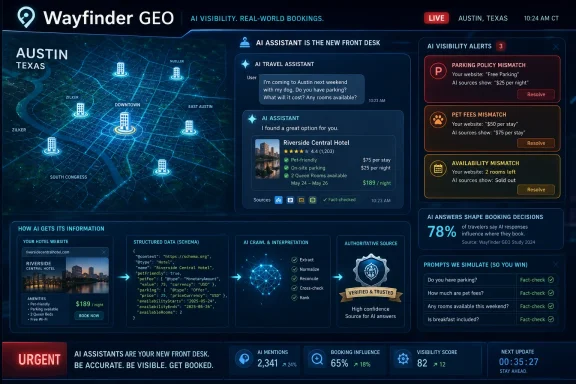 Cendyn Is Selling Hotels a Radar for a Foggy New Booking Channel
Wayfinder arrives with a blunt premise: hotels are already being described, ranked, compared, and sometimes misrepresented by AI systems, whether their marketing teams are watching or not. Cendyn’s pitch is that hoteliers need an instrument panel for this new layer of discovery, much as they once needed SEO dashboards, rate-shopping tools, and reputation-management platforms.The product is built around generative engine optimization, or GEO, the increasingly popular term for influencing visibility inside AI-generated answers rather than traditional search result pages. That distinction matters. A hotel may rank well on Google, maintain polished OTA listings, and still be invisible or inaccurately summarized when a traveler asks an AI assistant for “a quiet boutique hotel near the convention center with parking and late checkout.”
Wayfinder is designed to run simulated traveler prompts across multiple AI platforms and evaluate how a hotel appears in the results. It looks for gaps in discoverability, incorrect facts, weak content signals, and competitive disadvantages. In plain English, it tells a hotel whether the machines have understood the property correctly.
That sounds narrow until you consider the booking funnel. If an AI assistant gives a traveler three options and a hotel is not among them, the traveler may never reach the hotel’s site, its paid-search ad, or its booking engine. In that world, visibility is no longer just a marketing concern. It becomes a distribution problem.
The AI Assistant Is Becoming the New Front Desk Before the Front Desk
Travel search has always been conversational in intent, even when it was typed into a box. Travelers do not really want ten blue links or a grid of sponsored listings; they want an answer that fits a messy set of constraints. AI assistants are unusually well suited to that behavior because they can accept natural-language preferences and collapse research, comparison, and recommendation into a single exchange.That is precisely why hotels should be nervous. Traditional search at least gave brands several chances to intercept demand: organic results, paid ads, metasearch placements, map packs, OTA listings, and retargeting. AI-led discovery compresses those chances. A system that returns a synthesized answer may favor sources it can parse cleanly and trust confidently.
The hospitality industry has lived this story before. OTAs became powerful not merely because they offered inventory, but because they organized complexity better than individual hotel sites did. They made comparison easier, buying simpler, and discovery more predictable. AI assistants threaten to repeat that platform shift, except this time the interface is not a website with filters. It is a conversation.
Cendyn’s language around avoiding “OTA 2.0” is marketing, but it lands because the fear is credible. If AI assistants learn to rely disproportionately on intermediary platforms for rates, availability, descriptions, policies, and review summaries, hotels could again find themselves paying for access to demand they helped create.
Wayfinder Turns Hotel Content Into Operational Plumbing
The most interesting part of Wayfinder is not that it watches ChatGPT, Gemini, and Perplexity. Plenty of vendors will claim some version of AI visibility monitoring. The more consequential idea is that hotel content must become operationally reliable enough for machines to treat it as authoritative.Hotel websites are often messier than brand teams admit. Amenities pages lag renovations. Parking policies change. Restaurant hours drift. Pet rules differ between a booking engine, an FAQ, and an OTA description. A human traveler may call to clarify. An AI model may simply synthesize the inconsistency into a confident answer.
Wayfinder’s fact-checking concept addresses that weakness by comparing AI-generated answers against the hotel’s own source content. When a model diverges from what the hotel says on its site, the platform flags the issue and points teams toward the content that may need repair. This is less glamorous than “dominating AI search,” but it is probably where the real work lives.
The platform also includes prompt testing, competitive comparisons, and AI-readable directives hosted on a hotel’s own domain. Those directives are meant to guide crawlers and language models toward brand-approved information, constraints, and source material. The standards for this are still evolving, and no vendor can guarantee that frontier AI models will obey every signal. Still, the direction of travel is obvious: hotel websites are being asked to serve human guests, search crawlers, booking engines, and now AI agents.
For IT teams, this is where the story becomes more than a marketing release. Structured data, content governance, schema hygiene, crawlability, domain authority, and API-fed availability are no longer background chores. They are part of whether the property exists in the machine-mediated booking journey.
Hotels Have an Authority Advantage, but They Keep Wasting It
Cendyn’s optimistic argument is that hotels should have a natural advantage in AI discovery because the hotel’s own website is the primary source of truth. No OTA should know the renovated room categories, brand voice, local packages, accessibility details, or current policies better than the property itself. In theory, that makes the direct channel the cleanest source for AI systems.In practice, hotels have often failed to capitalize on that advantage. OTAs tend to be better at standardizing information, maintaining structured inventory, and presenting comparison-ready data at scale. Many hotel websites, especially for independent properties and smaller groups, remain visually polished but semantically thin. They are built to persuade a person, not to be interpreted reliably by a machine.
That gap is what GEO vendors are now rushing to monetize. They are not simply selling visibility; they are selling a remedy for years of fragmented content operations. If a hotel cannot state its facts consistently across its CMS, booking engine, rate feeds, FAQs, local listings, and distribution partners, AI systems will not magically infer the correct version.
The direct-booking dream therefore depends on something less romantic than brand storytelling. It depends on disciplined data stewardship. The hotel that wants AI assistants to recommend it must make itself legible, current, and verifiable.
The OTA Threat Is Real, but It Is Not the Whole Story
It is tempting to frame Wayfinder as another weapon in the long war between hotels and online travel agencies. That is partly correct. Hotels have spent years trying to reduce commission costs, protect guest relationships, and move more bookings through direct channels. AI search could either help that effort or make the dependency worse.But the OTA framing can also obscure the deeper shift. The larger issue is that the interface to demand is changing. The winning intermediary may not be Booking.com, Expedia, Google, or a hotel brand site in isolation. It may be the AI assistant that chooses which sources to consult, which answers to present, and which booking path to complete.
That is why Cendyn’s earlier AI Connect launch matters in the background. AI Connect was designed to push hotel availability, rates, and inventory into AI search environments through a Model Context Protocol-style approach. Wayfinder sits higher in the funnel, monitoring and shaping what AI systems say before a booking decision is made. Together, the two products sketch a broader strategy: first make the hotel visible to AI, then make its bookable data available when intent hardens.
That is a logical roadmap, but it also exposes the uncertainty. The AI travel stack is not settled. Standards may shift. Model behavior may change. Platforms may restrict crawling, favor partners, or build their own commerce layers. Hotels investing now are not buying certainty; they are buying preparedness.
GEO Is SEO With Fewer Guarantees and Higher Stakes
Search-engine optimization was always an uneasy bargain. Publishers and businesses tried to understand ranking signals; Google changed the rules; everyone adjusted. GEO inherits that instability but removes some of the observability that made SEO manageable.A search results page can be inspected, ranked, localized, and tracked. AI answers are more fluid. They may vary by prompt wording, user history, geography, model version, retrieval sources, and tool access. A hotel might appear in one answer and vanish in another that differs by only a few words.
That makes Wayfinder’s simulated prompt library useful but not magical. Synthetic prompts can reveal patterns, but they cannot perfectly reproduce every real traveler interaction. The platform can show whether a property is being understood, whether competitors appear more often, and whether factual errors recur. It cannot guarantee that every AI assistant will recommend the hotel at the moment that matters.
Still, imperfect measurement is better than no measurement. The early days of any channel are messy. Paid search, social advertising, metasearch, and mobile attribution all matured through dashboards that were initially incomplete and sometimes misleading. The companies that learned fastest gained an advantage, even when the tools were crude.
For hotel marketers, the practical question is not whether GEO is fully mature. It is whether they can afford to ignore a channel where travelers are already experimenting.
Microsoft, Google, OpenAI, and Perplexity Are Quietly Rewriting Travel Discovery
WindowsForum readers will recognize this pattern from the broader platform wars. Once a new interface layer becomes habitual, businesses downstream must adapt to its rules. Microsoft’s Copilot ambitions, Google’s Gemini integration, OpenAI’s ChatGPT ecosystem, and Perplexity’s answer-engine model all point toward a future in which users expect software to summarize options and take action.Travel is a natural proving ground because it is high-intent, data-rich, and frustratingly fragmented. A good hotel recommendation requires location, dates, budget, amenities, availability, reputation, loyalty preferences, cancellation rules, and subjective taste. That is exactly the sort of multi-variable task AI companies want to own.
The risk for hotels is that AI platforms become the new gatekeepers without looking like gatekeepers. A traveler may not think they are using an OTA at all. They may think they are simply asking an assistant for help. But behind the answer sits a chain of data sources, partnerships, crawlers, APIs, ranking heuristics, and commercial incentives.
Wayfinder’s value depends on shining light into that chain. Even if it cannot fully explain every model’s reasoning, it can help hotels see the outputs that matter: whether they appear, how they are described, what facts are wrong, and which competitors are winning the answer.
The Real Work Will Fall on Marketing, IT, and Revenue Teams Together
One reason AI search visibility is difficult for hotels is that no single department owns it cleanly. Marketing owns the website and brand content. Revenue teams own rate strategy and channel mix. IT or digital teams own integrations, CMS configuration, schema, analytics, and data flows. Operations owns the facts that guests actually experience.Wayfinder sits at the intersection of all four. If the tool flags an incorrect parking policy, that is not just a copywriting issue. Someone must verify the operational truth, update the CMS, ensure structured data reflects the change, check OTA feeds, and monitor whether AI responses improve. The workflow matters as much as the dashboard.
This is where hotels that treat AI visibility as a campaign will struggle. GEO is not a one-time optimization sprint. It is closer to reputation management fused with technical SEO and distribution operations. The hotel must keep teaching machines what is true as the property changes.
For larger brands, the challenge becomes scale. A chain with hundreds or thousands of properties cannot manually babysit every AI answer. It needs templated content governance, property-level exception handling, and reporting that separates a minor wording issue from a revenue-threatening visibility gap. Cendyn is clearly aiming at that operational layer.
The Product Is Early, but the Problem Is Not
Skepticism is warranted. AI visibility tools are arriving in a market full of hype, loose terminology, and metrics that may harden only after vendors have already sold annual contracts. “GEO health” sounds useful, but buyers should ask how it is calculated, how often models are checked, which prompts are tested, and how results correlate with traffic or bookings.They should also ask what happens when AI platforms change their access patterns. If a model stops exposing certain behavior, changes retrieval methods, or prioritizes paid partnerships, monitoring tools may need to adapt quickly. The history of digital marketing is full of analytics products that looked precise until the platform underneath them changed.
Yet dismissing Wayfinder as hype would be a mistake. The specific product may evolve, competitors may appear, and the category name may change. The underlying problem is durable: hotels need to know how AI systems represent them. A wrong answer about pet fees, resort charges, accessibility, parking, shuttle service, or room configuration can create real guest friction and lost bookings.
The near-term ROI may come less from grand claims about “dominating AI search” and more from reducing misinformation. If Wayfinder helps a hotel catch and correct inaccurate AI answers before guests rely on them, that alone has operational value.
The Machine-Readable Hotel Becomes the Bookable Hotel
The next phase of hotel marketing will reward properties that can express themselves in formats AI systems can use. Beautiful photography and polished prose will still matter, but they will sit alongside schema, structured amenities, authoritative FAQs, clean rate feeds, and machine-readable directives.This is not a call to write websites for robots instead of guests. It is a recognition that robots are increasingly mediating what guests see. The AI assistant may be the one summarizing the hotel’s value proposition, comparing it to competitors, and deciding whether the official site is a trustworthy source.
That shift should push hotels to audit their digital foundations. Are policies consistent? Are amenities described in structured form? Is local content specific enough to answer natural-language queries? Does the booking engine expose accurate availability and rates? Are changes in operations reflected quickly online?
Wayfinder gives Cendyn a product story around those questions. More importantly, it gives hotels a reason to treat content accuracy as infrastructure rather than decoration.
The Hotels That Win AI Search Will Be the Ones That Clean Their Own House
The immediate lesson from Wayfinder is not that every hotel must buy Cendyn’s platform tomorrow. It is that the hospitality industry’s discovery layer is moving faster than many property websites are prepared for. Hotels that want direct demand in an AI-first environment must become more authoritative, more structured, and more vigilant.- Hotels should assume that AI assistants are already describing their properties to travelers, even if those interactions do not yet show up cleanly in traditional analytics.
- Hotels should treat inaccurate or inconsistent website content as a revenue risk, not merely a branding defect.
- Hotels should evaluate AI visibility tools by their methodology, model coverage, prompt design, correction workflow, and connection to measurable business outcomes.
- Hotels should not expect GEO to replace SEO, metasearch, paid media, or OTA strategy; it will sit beside them as another contested discovery layer.
- Hotels should prepare for AI booking channels by aligning marketing content, structured data, availability feeds, revenue strategy, and operational truth.
- Hotels should remember that AI platforms may become intermediaries in their own right, which makes direct authority valuable but not automatically decisive.
References
- Primary source: Travel And Tour World
Published: 2026-06-15T22:03:22.697672
Cendyn Unveils Wayfinder to Help Hotels Beat ChatGPT, Gemini and Perplexity and Dominate AI Search Visibility - Travel And Tour World
Cendyn unveils Wayfinder and changes hotel marketing forever. Hotels can now track ChatGPT, Gemini and Perplexity visibility, stop AI misinformation and protect direct bookings before OTAs take over traveller discovery in an AI-first world.www.travelandtourworld.com - Related coverage: cendyn.com
- Related coverage: hospitalitynet.org
Cendyn Wayfinder — See, shape, and protect how your hotel appears in AI-led discovery | Hospitality Net
See, shape, and protect how your hotel appears in AI-led discovery www.hospitalitynet.org
- Related coverage: phocuswire.com
Cendyn launches Wayfinder to help hotels avoid "OTA 2.0"
Wayfinder will help hotels gain, measure and boost visibility across AI platforms such as Gemini, ChatGPT and Perplexity. www.phocuswire.com
- Related coverage: hotelbusiness.com
Cendyn launches AI Connect - hotelbusiness.com
Partners with DirectBooker on distribution channel Cendyn launches AI Connecthotelbusiness.com - Related coverage: prnewswire.co.uk
Cendyn unveils AI-native infrastructure tackling hotels' invisibility cliff
/PRNewswire/ -- Cendyn, the leading hospitality marketing software and services platform, has unveiled Wayfinder, a GEO analytics and LLM monitoring platform... www.prnewswire.co.uk
- Related coverage: altexsoft.com
Cendyn Adds Wayfinder as Hotels Chase AI Search Visibility
Cendyn launched Wayfinder to help hotels understand how they appear in AI-powered travel search.www.altexsoft.com - Related coverage: hospitality.today
Cendyn brings hotel direct rates into AI search… • Hospitality.today
 www.hospitality.today
