

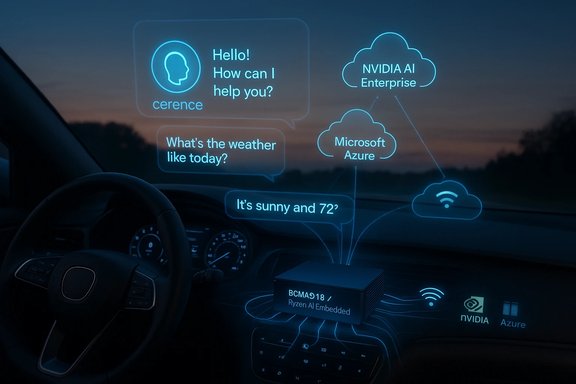
Cerence, NVIDIA, and Microsoft have taken a decisive step to put large language models and cloud-accelerated AI at the center of the next-generation in-car experience, with Cerence’s hybrid agentic platform, Cerence xUI, now optimized to run on NVIDIA AI Enterprise and deployed on Microsoft Azure — a combination vendors say will appear in production vehicles beginning in 2026. This week’s flurry of announcements at the intersection of automotive systems and AI infrastructure — from Cerence’s OEM traction to Broadcom’s new BCM4918 APU and AMD’s edge-embedded AI processors — underscores a larger industry inflection: automakers and chip vendors are converging on cloud + edge hybrid models to deliver low-latency, LLM-powered driving assistants and cockpit experiences. The implications are substantial for in-vehicle latency, data governance, supply-chain dependencies, and the race to standardize secure, production-grade AI in millions of vehicles.
Automotive UX has moved rapidly from rule-based voice commands and fixed “skills” to adaptive, conversational agents capable of multi-turn dialog, context awareness, and proactive recommendations. Vendors are now packaging those capabilities as end-to-end stacks combining: (a) automotive-grade LLMs and small, on-device models; (b) cloud-hosted training and inference pipelines; and (c) edge accelerators or zonal compute platforms to deliver real-time responsiveness.
Cerence, a company with a long history in vehicle voice assistants and conversational AI, has positioned xUI as a hybrid, agentic platform. The company’s recent announcement that multiple premium automakers have selected xUI running on NVIDIA AI Enterprise and hosted on Microsoft Azure for in-production vehicles starting in 2026 is the most visible example of how OEMs are partnering with cloud and silicon providers to speed productization of generative AI in cars.
At the same time, silicon and connectivity vendors are releasing hardware optimized for the AI era. Broadcom’s new BCM4918 APU and dual-band Wi‑Fi 8 radios aim to fuse networking, compute, and on-device AI acceleration for consumer gateways and edge nodes. AMD’s recently announced Ryzen AI Embedded P100/X100 series and collaborations with Autolink point to a parallel push: high-performance, power-efficient AI at the vehicle edge and within zonal compute architectures.
The upside is substantial: rich, conversational, multi-modal in-car assistants; embedded personalization; and seamless AI-driven services that improve safety and convenience. The downside is equally real: vendor lock-in, integration complexity, regulatory and security risk, and the practical difficulties of shipping massively complex software/hardware stacks into products that will be on the road for years.
For automakers, tier-ones, and infrastructure vendors, the next 12–24 months will be a test of execution. Success will come to those who can combine pragmatic engineering (deterministic fallbacks, robust ML ops), clear privacy and safety guardrails, and supply-chain commitments that match the extended lifecycle of the automotive industry. The promise of AI-powered driving experiences is now within reach — the industry’s challenge is to make those experiences predictable, safe, and maintainable at scale.
Source: simplywall.st This Week In AI Chips - AI Powers Shift In-Car Experience Through Strategic Partnerships - Simply Wall St News
 Background
Automotive UX has moved rapidly from rule-based voice commands and fixed “skills” to adaptive, conversational agents capable of multi-turn dialog, context awareness, and proactive recommendations. Vendors are now packaging those capabilities as end-to-end stacks combining: (a) automotive-grade LLMs and small, on-device models; (b) cloud-hosted training and inference pipelines; and (c) edge accelerators or zonal compute platforms to deliver real-time responsiveness.Cerence, a company with a long history in vehicle voice assistants and conversational AI, has positioned xUI as a hybrid, agentic platform. The company’s recent announcement that multiple premium automakers have selected xUI running on NVIDIA AI Enterprise and hosted on Microsoft Azure for in-production vehicles starting in 2026 is the most visible example of how OEMs are partnering with cloud and silicon providers to speed productization of generative AI in cars.
At the same time, silicon and connectivity vendors are releasing hardware optimized for the AI era. Broadcom’s new BCM4918 APU and dual-band Wi‑Fi 8 radios aim to fuse networking, compute, and on-device AI acceleration for consumer gateways and edge nodes. AMD’s recently announced Ryzen AI Embedded P100/X100 series and collaborations with Autolink point to a parallel push: high-performance, power-efficient AI at the vehicle edge and within zonal compute architectures.
What was announced this week
Cerence xUI on NVIDIA AI Enterprise — a production push
- Cerence publicly confirmed that Cerence xUI — its hybrid, agentic conversational platform powered by the CaLLM family of automotive-grade LLMs — is being optimized on NVIDIA AI Enterprise and deployed on Microsoft Azure for automaker programs.
- The company stated that multiple premium global automakers have selected xUI for production vehicles launching in 2026, and that xUI uses NVIDIA software components such as NeMo and NIM microservices to improve inference throughput and operational efficiency.
- Cerence’s broader collaboration with NVIDIA (expanded in 2025) and partnerships across edge silicon vendors reflect a strategy to split work between cloud supercomputing for training/fine-tuning and a mixture of cloud-hosted and embedded inference for real-time use.
NVIDIA NIM microservices — the inference “easy button”
- NVIDIA’s NIM (NVIDIA Inference Microservices) framework is being adopted within these automotive stacks to deliver standardized, containerized inference endpoints that claim to maximize throughput and minimize latency for LLMs in production.
- Vendor benchmarks show significant token-per-second throughput gains when NIM is used in tandem with optimized runtimes and accelerators; NIM’s selling point is that the same microservice packaging can be deployed on cloud Kubernetes clusters or on-prem accelerated infrastructure.
Broadcom: BCM4918 APU and Wi‑Fi 8 hardware
- Broadcom announced the BCM4918 APU, a unified compute + networking + neural engine platform targeted at consumer and operator gateway devices and designed to support on-device AI inference alongside tri-band Wi‑Fi 8 connectivity.
- Two complementary dual-band Wi‑Fi 8 radios — the BCM6714 and BCM6719 — were introduced to complete a unified Wi‑Fi 8 platform that emphasizes reliability, low latency, and on-edge AI optimizations. Broadcom framed the platform as enabling “real-time agentic applications” for homes and edge devices.
AMD, Autolink and Ryzen AI Embedded processors
- AMD showcased new Ryzen AI Embedded processors (P100 and X100 series) intended to carry AI inferencing workloads at the edge — including automotive digital cockpits and zonal controllers.
- Autolink unveiled its “Deep Fusion EEA” (Electronic/Electrical Architecture) and announced collaborations with AMD to integrate versatile SoCs (including AMD Versal Gen2 adaptive devices) into next-gen zonal/central compute platforms for intelligent vehicles.
Why the cloud + edge hybrid model matters for cars
Automotive AI faces unique constraints that drive hybrid architectures:- Safety and latency: Real-time safety functions and immediate user interactions (e.g., voice-based navigation changes while driving) require millisecond-level response times. Purely cloud-based LLM inference risks unacceptable latency and connectivity dependency during trips.
- Data residency and privacy: Personalization, driver profiling, and continuous audio capture are sensitive. Automakers and regulators demand strong data governance and control over where data is stored and processed.
- Update cycles and reproducibility: Vehicles have long-lived lifecycles. Vendors must ensure models running in cars can be patched, retrained, and rolled back safely over years.
- Hardware constraints: Cars operate in thermally constrained environments; power budgets and automotive-grade reliability place limits on on-device compute.
- Faster development and scaling via cloud-foundry training using HPC GPUs.
- Deployable, containerized inference endpoints (NIM microservices) for predictable latency and autoscaling in edge cloud or OEM-controlled clouds.
- Ability to offload less-latency-sensitive tasks to cloud while keeping safety- or latency-critical tasks on device.
Technical specifics and verified claims
This section extracts and verifies the technical claims made by vendors and outlines what’s vendor-provided benchmark versus independent measurement.Cerence and CaLLM
- Cerence’s CaLLM family includes a cloud-based Automotive LLM and an on-device SLM variant (CaLLM Edge). The vendor states the model family is trained on automotive-relevant datasets and optimized for vehicle contexts.
- Cerence’s press materials and subsequent industry coverage indicate that xUI will be hosted on Azure and use NVIDIA AI Enterprise software components for model optimization. Vendor statements specify that multiple premium automakers have selected xUI for vehicles slated to ship in 2026. The automaker identities and program volumes were not disclosed in the announcements; that detail remains unverified in the public domain.
NVIDIA NIM microservices
- NVIDIA presents NIM as a microservice layer that exposes standard APIs for inference and supports optimized runtimes (TensorRT-LLM, vLLM, etc.. Vendor-provided benchmarks show substantive throughput improvements for LLMs (for example, doubling throughput on a sample Llama model configuration when NIM is enabled).
- These numbers are vendor benchmarks — useful for comparative purposes but best treated as illustrative. Real-world performance in an automotive SaaS/edge hybrid depends on model size, quantization (FP8/INT8), concurrency, and end-to-end network conditions.
Broadcom BCM4918 and Wi‑Fi 8 radios
- Broadcom’s BCM4918 is described as an APU that integrates a high-performance CPU complex, a Broadcom Neural Engine (BNE), advanced networking offloads, and crypto acceleration — specifically positioned to serve as a unified compute + connectivity platform.
- The Wi‑Fi 8 radios (BCM6714 and BCM6719) are pitched for multi-band, multi-stream deployments and early sampling to OEMs and operators. The Wi‑Fi 8 ecosystem remains in draft standardization phases; early products will rely on drafts and vendor-specific features until standards finalize.
AMD Ryzen AI Embedded and Autolink
- AMD’s Ryzen AI Embedded P100/X100 families are positioned for constrained, real-time edge AI workloads. AMD also highlighted Versal AI Edge Gen2 adaptive SoCs in Autolink collaborations for zonal and central compute functions.
- Autolink’s Deep Fusion EEA is a system-level architecture combining centralized computing, zonal controllers, and high-bandwidth optical backbones — intended to enable millisecond-scale coordination across perception, decision, and cockpit subsystems.
Critical analysis — strengths and immediate benefits
- Faster route to production for automakers
- By partnering with established AI and cloud stacks (NVIDIA AI Enterprise + Azure), Cerence shortens the path from prototype LLM to production-grade in-car assistants. Vendor tooling like NeMo and NIM accelerates tuning and inference standardization, reducing the engineering burden on OEMs.
- For automakers, this is a pragmatic shift: instead of building everything in-house, they can adopt a validated stack that’s optimized for automotive workloads and supported by enterprise SLAs.
- Better performance and operational efficiency (if vendor claims hold)
- Containerized inference microservices and optimized runtimes promise predictable scaling and lower latency for cloud-hosted components. For LLM-assisted features that can tolerate asynchronous responses, this enables richer, more capable assistants without burdening vehicle hardware.
- On-device + cloud co-design reduces risk
- The hybrid model preserves critical, latency-sensitive features on-device (e.g., driver intent detection, safety-critical prompts) while leveraging the cloud for heavier reasoning, personalization, and long-context memory management. This reduces both latency exposure and cloud cost when designed correctly.
- Ecosystem coherence across compute and connectivity
- Broadcom’s unified APU and the broader Wi‑Fi 8 initiative, together with AMD’s edge processors, indicate the industry is aligning compute, networking, and security stacks — a necessary step to support multimodal, low-latency experiences across the vehicle and its surrounding environment.
Risks, blind spots, and areas to watch
- Vendor lock-in and integration complexity
- Heavy reliance on a combined stack (Cerence + NVIDIA + Microsoft) risks vendor lock-in. OEMs must weigh the engineering and procurement trade-offs between a vertically integrated vendor stack and modular, multi-vendor architectures.
- Integrating cloud-hosted LLM behaviors with embedded SLMs and vehicle control systems remains a non-trivial engineering challenge. Edge cases, fallbacks during connectivity loss, and rigorous validation for safety-critical interactions must be exhaustively tested.
- Unspecified OEM commitments and deployment scope
- Public announcements reference “multiple premium global automakers” but omit OEM identities, program volumes, and exact feature sets. Without concrete program details, it’s difficult to evaluate market impact or timeline certainty for broad fleet rollouts.
- Historically, automaker proofs-of-concept often take longer to translate into mass-market production at scale; mid-2026 program deliveries may well be limited to selected models or trim levels.
- Safety, regulation, and testing gaps for multimodal LLM agents
- LLMs introduce non-determinism into user interactions. Guardrails (e.g., NeMo Guardrails-style systems) are a start, but automakers and regulators will demand deterministic behaviors for any interaction that could affect driver attention or vehicle control. Certification frameworks for agentic systems in vehicles are nascent or absent in many jurisdictions.
- Privacy and telemetry concerns
- Running personalized assistants that learn from driver data requires careful telemetry governance, consent models, and secure update mechanisms. OEMs must provide transparent, auditable controls for data residency and model updates. Cloud-hosted personalization is powerful but amplifies regulatory risk if mishandled.
- Early Wi‑Fi 8 adoption risk
- Broadcom and media companies are shipping Wi‑Fi 8 silicon ahead of final standard ratification. While early hardware can speed innovation, firmware and interoperability updates may be required as the standard matures. Early adopters could face compatibility or performance surprises in multi-vendor environments.
- Supply chain and silicon availability
- Mass production of vehicles requires validated hardware supply and long-term availability commitments. With APU and SoC lead times historically measured in quarters to years, automakers must lock supply and plan for product life cycles across multi-year vehicle programs.
How OEMs and tier-one suppliers should think about adopting these stacks
- Define clear functional allocation: which tasks must live on-device vs. cloud-hosted? Prioritize safety-critical and latency-sensitive functions for on-device inference; reserve cloud LLMs for contextual memory, personalization, and compute-heavy reasoning.
- Adopt modular integration interfaces: use standardized APIs, containerization, and microservice patterns (as exemplified by NIM) to enable swapping runtimes, quantization strategies, and even cloud vendors.
- Insist on reproducible telemetry and explainability: require vendors to provide interpretable logs and model versioning to support audits, recall scenarios, and over-the-air (OTA) rollback.
- Plan for lifecycle management and ML ops at scale: vehicle fleets require hardened pipelines for model updates, A/B testing, and staged rollouts that prioritize safety and rollback speed.
- Treat connectivity as a distributed compute asset: with Wi‑Fi 8, 5G, and vehicle-to-cloud links, connectivity becomes an extension of the compute stack. OEMs should architect for graceful degradation and asynchronous synchronization.
Use cases to expect in 2026 vehicles (practical examples)
- Natural language trip planning with multi-modal context: driver asks for a route optimization that considers calendar events, EV charging windows, and passenger preferences. The LLM synthesizes context from local device and cloud data, returning an updated route and in-cabin suggestions.
- Agentic multi-step tasks: “Book the restaurant, add it to my calendar, and text the group we’re leaving in 30 minutes.” An agentic flow spans cloud-based booking services and on-device confirmation prompts, with clear consent flows.
- Real-time multimodal cockpit assistance: voice + camera + sensor input to detect when the driver glances at an unfamiliar control and offer context-aware help or warnings without distracting the driver.
- Edge-based personalization: local SLM stores frequent commands and profile items, enabling fast local responses when connectivity is poor or latency-sensitive reactions are required.
The security and compliance perimeter
Every integration point introduces new attack surfaces: OTA update channels, cloud inference endpoints, radio stacks (Wi‑Fi 8), and zonal Ethernet/optical backbones in advanced E/E architectures. Security strategy must include:- End-to-end encryption and authenticated microservices.
- Hardware-rooted trust (secure boot, TPM/certificates) in APUs and central compute.
- Least-privilege model for telemetry and data sharing between cloud and vehicle.
- Robust incident response and chain-of-trust validation for OTA model or software rollbacks.
Market and competitive implications
- NVIDIA’s software ecosystem (NeMo, TensorRT-LLM, NIM) and Azure’s broad cloud presence create a powerful on-ramp for enterprise-grade LLM deployments in regulated industries like automotive. For competitors, this raises the bar: to play at scale they must match NVIDIA’s inference optimizations and Microsoft’s cloud security/compliance posture.
- Broadcom’s move to integrate on-device AI acceleration into Wi‑Fi APUs signals a blurring boundary between connectivity and compute. Gateway and home ecosystems will become increasingly important as vehicles become nodes in a broader mobility/IoT fabric.
- AMD’s push into embedded AI with Ryzen AI Embedded and Versal Gen2 shows the competitive imperative for heterogeneous compute — CPUs, NPUs, programmable logic — to address the diverse workload mix inside vehicles.
What to watch next (short- and mid-term signals)
- OEM program disclosures — look for announced vehicle models and the specific features being marketed as “xUI” or LLM-driven. Program scale and trim-level availability will determine real market reach.
- Interoperability tests and standards developments for in-car LLMs — regulatory guidance or industry consortia efforts will be a key determinant of how quickly these systems can be standardized.
- Real-world latency and telemetry reports from pilot fleets — independent benchmarks or independent third-party evaluations will be critical to validate vendor performance claims.
- Adoption of Wi‑Fi 8 and the pace at which operators and consumer device vendors embrace early silicon — interoperability and firmware update cadence will reveal the true cost of early adoption.
- Security audits and penetration testing reports — any serious vulnerabilities that surface in integrated stacks could materially slow OEM deployments.
Conclusion
This week’s announcements — Cerence’s xUI optimized on NVIDIA AI Enterprise and hosted on Microsoft Azure, Broadcom’s BCM4918 APU and Wi‑Fi 8 radios, and AMD’s edge-focused Ryzen AI Embedded processors and Autolink collaborations — map a clear industry trajectory: automotive systems will be built as clouds of distributed intelligence where edge and cloud are co-engineered to balance latency, safety, and personalization.The upside is substantial: rich, conversational, multi-modal in-car assistants; embedded personalization; and seamless AI-driven services that improve safety and convenience. The downside is equally real: vendor lock-in, integration complexity, regulatory and security risk, and the practical difficulties of shipping massively complex software/hardware stacks into products that will be on the road for years.
For automakers, tier-ones, and infrastructure vendors, the next 12–24 months will be a test of execution. Success will come to those who can combine pragmatic engineering (deterministic fallbacks, robust ML ops), clear privacy and safety guardrails, and supply-chain commitments that match the extended lifecycle of the automotive industry. The promise of AI-powered driving experiences is now within reach — the industry’s challenge is to make those experiences predictable, safe, and maintainable at scale.
Source: simplywall.st This Week In AI Chips - AI Powers Shift In-Car Experience Through Strategic Partnerships - Simply Wall St News
