

CES is back in Las Vegas and, if the pre-show leaks and vendor previews are any guide, CES 2026 will be dominated by three converging storylines: AI-as-infrastructure, a sprint to ship RGB / Micro‑RGB display technology into mainstream screen sizes, and a smarter, more automated home driven by robotics and appliance AI.
CES 2026 runs January 6–9 in Las Vegas, and organizers have framed the event as a showcase for devices that make AI, displays, and home automation tangible to consumers and enterprises alike. The dominant narrative this cycle isn’t an isolated feature on a single product category; it’s a systems-level push where chipmakers, display houses, and appliance brands are aligning hardware, firmware, and cloud services to deliver on-device intelligence, new visual standards, and cleaner, more autonomous homes.
Several preview stories, manufacturer press statements, and industry briefings paint a consistent picture: expect RGB‑backlit Mini‑LEDs and Micro‑RGB implementations to headline TV and monitor booths, Dolby Vision 2 to be the newest HDR standard pushing tone‑mapping and scene intelligence, robot vacuums to show real progress on mopping and autonomy, and AMD/Intel/Qualcomm to outline concrete AI PC roadmaps for on‑device LLM inferencing and efficiency.
Expect demos and announcements that emphasize:
That said, the most important takeaways for readers and buyers will be verification and patience. Measured lab results, shipping availability, firmware update policies, and clear privacy practices will determine whether these advances are meaningful improvements or premium marketing. The CES floor will deliver spectacle; the reviews and first‑wave shipping units will deliver answers.
Expect our WindowsForum coverage to dig into hands‑on impressions, benchmarked display metrics, and practical tests of AI features and robot vacuum automation during and immediately after CES — because this year the subtleties of implementation will decide whether “AI everywhere” is genuinely useful, or just louder marketing.
Source: channelnews.com.au CES 2026: What to Expect at Tech’s Biggest Show – channelnews
 Background / Overview
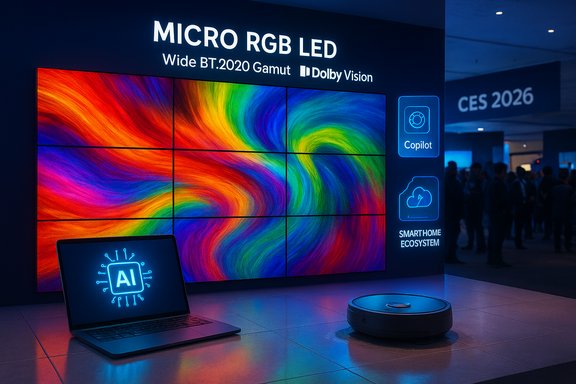
CES 2026 runs January 6–9 in Las Vegas, and organizers have framed the event as a showcase for devices that make AI, displays, and home automation tangible to consumers and enterprises alike. The dominant narrative this cycle isn’t an isolated feature on a single product category; it’s a systems-level push where chipmakers, display houses, and appliance brands are aligning hardware, firmware, and cloud services to deliver on-device intelligence, new visual standards, and cleaner, more autonomous homes.Several preview stories, manufacturer press statements, and industry briefings paint a consistent picture: expect RGB‑backlit Mini‑LEDs and Micro‑RGB implementations to headline TV and monitor booths, Dolby Vision 2 to be the newest HDR standard pushing tone‑mapping and scene intelligence, robot vacuums to show real progress on mopping and autonomy, and AMD/Intel/Qualcomm to outline concrete AI PC roadmaps for on‑device LLM inferencing and efficiency.
Display Technology: RGB, Micro‑RGB and the next wave of “picture quality”
Why RGB / Micro‑RGB matters now
For a decade the race in premium displays has been about two things: more precise local dimming (Mini‑LED) and better color rendition. The next technical leap is replacing white or blue backlights plus color filters with direct RGB backlighting at extremely small scales — what the industry calls RGB Mini‑LED or Micro‑RGB. That change lets manufacturers tune color and brightness per sub-zone rather than relying primarily on LCD filters, which yields higher peak brightness, wider gamut, and markedly improved local contrast control. Early vendor previews confirm multiple manufacturers will push these systems at CES.- Samsung and LG have both publicly announced Micro‑RGB sets that extend to more realistic living‑room sizes (55–115 inches for Samsung’s 2026 range).
- LG’s Micro RGB evo and Samsung’s Micro RGB line both claim improved color gamut coverage and thousands of dimming zones controlled by dedicated AI image engines.
Dolby Vision 2: HDR’s next chapter
Dolby announced Dolby Vision 2 as a successor to Dolby Vision, positioning it as a content‑aware picture engine that adds Content Intelligence (Precision Black, Light Sense, bi‑directional tone mapping and creative‑driven motion control). Dolby’s press release names Hisense as an early partner, and coverage from outlets confirms Dolby Vision 2 will be presented in two tiers: a mainstream Dolby Vision 2 and a Dolby Vision 2 Max for top‑flight displays. What this means practically:- Precision Black aims to correct “images that look too dark” by smarter tone‑mapping rather than simply boosting brightness.
- Light Sense blends ambient lighting data with content metadata to adapt the presentation to room conditions.
- Dolby Vision 2 Max is intended to exploit higher peak‑brightness displays (including Micro‑RGB) without compromising creative intent.
What to watch at CES: head‑to‑head picture demos and practical metrics
At CES you’ll want to separate PR from measured performance. Look for:- Measured color‑space coverage (BT.2020, DCI‑P3, Adobe RGB) and independent third‑party verification.
- Real‑world local dimming demos (halo control, black level under bright highlights).
- HDR tone‑mapping behavior across different scenes (dark interiors, sports, night shots).
- Native support for Dolby Vision 2 vs. vendor alternatives (HDR10+, proprietary tone mapping).
Reports and hands‑on previews from The Verge, TechRadar and Forbes already show early Micro‑RGB demos — but independent lab measurements will be the meaningful yardstick at CES.
AI as infrastructure: TVs, appliances and “Copilot everywhere”
From feature to platform
AI no longer shows up as a single gimmick on product pages — vendors are positioning it as the glue that makes displays, fridges, vacuums and PCs smarter and interoperable. Samsung’s “Vision AI” and LG’s AI ecosystems, combined with Microsoft’s Copilot ambitions in the living room, exemplify the trend: the television becomes a shared conversational surface and a hub for contextual assistance.Expect demos and announcements that emphasize:
- On‑device upscaling and frame‑by‑frame image optimization driven by dedicated NPU/image engines.
- Contextual audio tuning (room‑aware sound profiles).
- Appliance intelligence — refrigerators that recognize contents and suggest recipes, HVAC units that optimize energy use, and washer/dryer combos that predict cycles.
AI PCs: on‑device inference is now productized
CES 2026 will be a major checkpoint for the “AI PC” thesis. Across the industry:- Qualcomm has publicly positioned second‑generation Snapdragon X‑class chips (X2 Elite / X2 Elite Extreme) with large NPUs (reports cite up to ~80 TOPS) to enable aggressive on‑device AI. OEMs are lining up designs for early 2026.
- Intel’s Panther Lake / Core Ultra roadmap centers on integrating a 5th‑gen NPU and Xe3 GPU improvements, promising platform TOPS and NPU features purpose‑built for local LLM inference and Copilot+ scenarios. Some reporting places Panther Lake launches in the CES timeframe or just before.
- AMD continues to push Ryzen AI and server‑grade Instinct lineups for workstation and datacenter inference; its Ryzen AI series and partnership products (OEM Copilot+ laptops) broaden the AI PC ecosystem.
Robotics and smarter homes: robot vacuums take a practical leap
Robotic cleaning gets pragmatic
Robotic vacuum vendors have spent years iterating around navigation and suction; the 2025–2026 cycle is about practical mopping systems and automation docks. Highlights to watch:- Roller‑based mopping systems: Dreame’s Aqua10 and variants use roller mops that wash and dry themselves, improving pickup on grout and textured floors versus spinning pads. These models have already been named CES Innovation honorees.
- Advanced docks: fully automated cleaning docks that empty, refill, wash and dry mop pads at high temperatures are moving from high‑end concept to shipping products. Dreame’s docked stations and Dreame/X50 family show this approach.
- Robotic arms / object handling: Roborock and Dreame demonstrated robotic‑arm prototypes that can pick small objects and move them out of the way — promising but still nascent; expect more refined demos and commercialization timelines.
Practical implications
- For consumers: better mopping means fewer manual interventions; for multi‑pet households and tile owners, roller mops + smart docks are meaningful upgrades.
- For privacy/security: robots with richer sensor suites (RGB cameras, lidar, on‑device vision) increase the attack surface for personal data; vendors must provide transparent controls and local processing fallbacks.
PC and silicon — what the chipmakers will likely say at CES
Qualcomm: full court press on on‑device AI
Qualcomm’s Snapdragon X2 family is positioned to be a central talking point at CES 2026. The company has published technical claims about multi‑core CPU improvements, significant NPU gains (up to ~80 TOPS in some public materials), and aggressive power efficiency improvements — all intended to enable Windows on ARM designs that are both performant and battery friendly. OEM partners are expected to show Snapdragon X2‑powered machines in the first half of 2026.Intel: Panther Lake and the 18A narrative
Intel’s push — often framed as a “return to leadership” — centers on Panther Lake/Core Ultra platforms and a renewed focus on NPU integration and Xe3 graphics. Early coverage suggests Intel will highlight platform TOPS, energy‑efficient sustained performance, and an NPU roadmap to make Copilot+ and local models practical on Windows laptops.AMD: Ryzen AI and compute for creators
AMD is doubling down on both client and server AI capability. Ryzen AI 300/400 series parts and AMD Instinct GPUs target creators and data centers, respectively — AMD’s narrative will emphasize openness, efficiencies for AI workloads, and partnerships across OEMs building Copilot+ devices. Cross‑checking these vendor claims against independent benchmarks is essential: platform TOPS and vendor silicon charts are helpful, but real‑world sustained performance, thermal constraints in thin laptops, and application optimization will determine everyday user impact.Smartphones, wearables and concept devices: why CES still matters
CES is no longer the primary smartphone launch stage, but it remains a showcase for concepts and bridging experiences. Expect:- Flexible and tri‑fold prototypes, XR headsets, and continuity demos showing how phones, TVs and PCs hand off Copilot contexts.
- Lenovo Tech World (concurrent events) could host smartphone and foldable reveals by Lenovo or Motorola — rumors exist that Lenovo‑affiliated brands may preview premium foldables meant to compete with Samsung/Google. Treat those as rumors until OEMs confirm product and launch dates.
Risks, fragmentation and consumer advice
Key risks to watch
- HDR / format fragmentation: Dolby Vision 2’s arrival will be important for premium color, but competing standards (HDR10+, vendor‑specific tuning) and uneven adoption risk confusing buyers and complicating content pipelines. Verify format support on the specific model you buy.
- Pricing and yield constraints: Micro‑RGB and RGB Mini‑LED will likely be premium at launch. Samsung’s first 115‑inch Micro‑RGB commanded premium pricing; bringing those modules to 55–75‑inch sizes will help cost, but expect flagship pricing initially.
- Privacy and data handling: as more devices become “always aware,” vendors must be evaluated for local processing options, data deletion controls, and firmware update commitments. AI features that rely on cloud agents should clearly document what leaves the home and what stays local.
- Hype vs. shipping reality: prototypes (robotic arms, tri‑fold phones) often stroll the CES show floor; not all make it to market. Treat demos as directional, not contractual.
Practical buying checklist (for the cautious early adopter)
- Confirm support for Dolby Vision 2 (or HDR10+ Advanced support) if HDR fidelity is a priority.
- Ask for independent color and local dimming measurements (third‑party labs or reputable review outlets).
- For robot vacuums: evaluate dock automation (wash/dry/refill) and replacement part costs; mopping pads and solution refills can add long‑term costs.
- For AI PCs: check NPU TOPS and sustained performance under real workloads — vendor TOPS are useful but incomplete.
What to monitor during CES 2026 week
- Live demos and hands‑on reviews of Micro‑RGB TVs at Samsung, LG, Hisense, TCL and Sony booths; independent measurement labs posting objective data will be decisive.
- Dolby Vision 2 content demonstrations and announcements of streaming partners or studio support beyond early partners.
- AMD/Intel/Qualcomm developer briefings and OEM system previews that reveal sustained NPU performance and concrete Copilot+ integrations.
- Robot vacuum wins in the CES Innovation Awards circle and available shipping dates for roller‑mop + automated dock combos; that indicates which concepts will reach consumers soonest.
Conclusion — why CES 2026 could matter beyond trade‑show buzz
CES 2026 looks set to be a watershed moment not because a single product will change the world, but because three ecosystem shifts are converging: display hardware that can finally match creative intent (Micro‑RGB + Dolby Vision 2), on‑device AI becoming practical across PCs and appliances, and robotics moving from experiments to useful, automated household helpers. Taken together, these trends could reshape what “living room tech” delivers by the end of 2026: better images, less fiddly cleaning, and devices that act more like assistants than passive appliances.That said, the most important takeaways for readers and buyers will be verification and patience. Measured lab results, shipping availability, firmware update policies, and clear privacy practices will determine whether these advances are meaningful improvements or premium marketing. The CES floor will deliver spectacle; the reviews and first‑wave shipping units will deliver answers.
Expect our WindowsForum coverage to dig into hands‑on impressions, benchmarked display metrics, and practical tests of AI features and robot vacuum automation during and immediately after CES — because this year the subtleties of implementation will decide whether “AI everywhere” is genuinely useful, or just louder marketing.
Source: channelnews.com.au CES 2026: What to Expect at Tech’s Biggest Show – channelnews
