

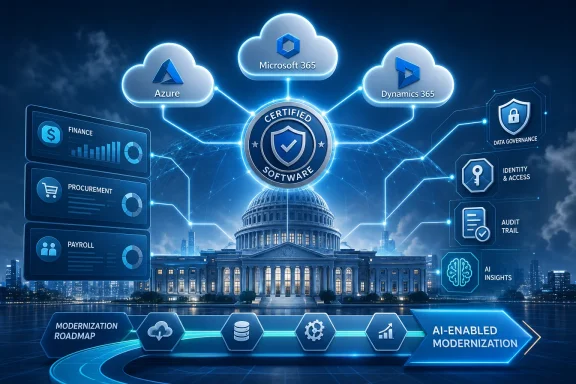
CGI announced on June 30, 2026, that its CGI Advantage government ERP platform earned Microsoft’s Solutions Partner with certified software designation under the Microsoft AI Cloud Partner Program for compatibility across Azure, Microsoft 365, and Dynamics 365. The news is not a consumer Windows story, but it is very much a Microsoft ecosystem story: another large public-sector software vendor is making Azure, Microsoft 365, Dynamics, and AI governance part of the procurement pitch. For state and local agencies, the designation is less a trophy than a signal about where modernization dollars are expected to flow. For Microsoft, it is another small but telling win in the long campaign to turn partner certification into a routing layer for cloud-era government software.
Microsoft partner designations used to be easy to dismiss as channel theater. The old Gold and Silver labels told buyers that a vendor was aligned with Microsoft, but not always much about how a particular product performed, integrated, or showed up in a marketplace-led procurement workflow. The newer Solutions Partner with certified software designation is designed to be more specific: it attaches to a software solution, not merely to a consultancy’s general Microsoft résumé.
That distinction matters in government ERP because public-sector buyers are not just choosing an application. They are choosing a platform posture: identity, hosting, productivity integration, data governance, procurement channel, support model, and compliance assumptions that may last a decade or more. A certification that says a product has met Microsoft’s technical criteria and is interoperable with Microsoft Cloud does not eliminate due diligence, but it reduces ambiguity at the top of the funnel.
CGI Advantage sits squarely in the kind of market where such ambiguity is expensive. Government ERP projects involve finance, procurement, budgeting, payroll, human resources, reporting, and a thicket of state and local rules. These are not apps that a county swaps out after a bad quarter. They become institutional plumbing, and the platform choices around them harden into operational reality.
That is why this announcement deserves more than a shrug. CGI is not saying merely that Advantage can run near Microsoft technologies. It is saying Microsoft has recognized the software under a partner framework built to help buyers and Microsoft sellers identify certified, cloud-compatible solutions. In procurement language, that can become a faster route to shortlists, co-sell motions, marketplace visibility, and executive confidence.
A commercial ERP project can fail painfully. A government ERP project can fail publicly, politically, and operationally. Payroll delays, budget reporting problems, procurement bottlenecks, and compliance gaps do not remain inside IT. They reach employees, vendors, auditors, constituents, and elected officials.
The Microsoft designation lands at a moment when CGI is pushing the language of AI-enabled modernization hard. The company says Advantage uses AI capabilities for predictive insight and real-time decision-making, and it ties the platform to Azure and other Microsoft technologies to support cloud governance and operational efficiency. That wording is familiar, but in this market the subtext is sharper: agencies want modernization without another grand IT trauma.
“Modernization without disruption” is the kind of phrase vendors use because the alternative has happened too many times. State and local governments are full of aging systems that still work because dedicated staff know the quirks, shadow processes, and exception paths. Replacing them requires not just new software, but a credible migration narrative that procurement officials and CIOs can defend.
By putting Microsoft certification around Advantage, CGI is trying to make that narrative less abstract. Azure provides the cloud foundation, Microsoft 365 provides the productivity and collaboration surface, Dynamics 365 provides a familiar business applications orbit, and the Microsoft AI Cloud Partner Program provides the badge that says the pieces belong in the same conversation. The result is a modernization pitch tuned for governments that want cloud capability but fear cloud chaos.
ERP is an especially sensitive place to introduce AI. The data is financial, operational, personnel-related, and often legally constrained. Predictive insights can help identify budget pressures, procurement delays, staffing issues, or service delivery gaps. But the same systems can also encode bad assumptions, expose sensitive data, or produce recommendations that users treat as authoritative because they appear inside a trusted enterprise platform.
That makes Microsoft’s ecosystem useful to vendors like CGI. Azure is not just compute in this story; it is a governance vocabulary. Microsoft 365 is not just email and documents; it is identity, access, records, collaboration, and administrative control. Dynamics is not just CRM and business apps; it is part of the business-process layer that many Microsoft-aligned organizations already understand.
None of that means an AI-enabled ERP rollout becomes safe by default. Certification does not answer whether an agency has clean data, disciplined role-based access, strong retention policies, or a mature AI review process. But it does give vendors and buyers a shared control plane to discuss those questions, and that is often where government IT succeeds or fails.
The danger is that “AI-enabled” becomes a procurement incantation rather than a deployment discipline. CGI’s claims about predictive insights and real-time decision-making are plausible in the abstract, but the hard work will be in implementation: deciding which workflows deserve automation, which decisions require human review, and which data should never be fed into a model-driven pipeline without strict controls.
For independent software vendors, the message is plain: if you want Microsoft’s field organization and marketplace machinery to help sell your product, you need to fit the program. That means proving technical compatibility, demonstrating customer success, and aligning your offer with Microsoft’s cloud story. In return, a certified solution can gain visibility and a degree of buyer confidence that is hard to manufacture alone.
For agencies, this has two sides. On the positive side, a designation can reduce the noise in a crowded vendor market. Government IT leaders can see which solutions Microsoft has placed into a more structured certification path and which ones are simply claiming integration in a slide deck.
On the other side, it tightens the gravitational pull of the Microsoft cloud. If a government already depends on Microsoft 365, Entra identity, Azure services, Power Platform, or Dynamics integrations, a certified software designation may make a Microsoft-aligned ERP choice feel lower risk than a more independent architecture. That may be rational, but it is still a strategic lock-in decision dressed in procurement clothing.
This is the Microsoft partner model doing exactly what it is supposed to do. It gives vendors a way to differentiate. It gives Microsoft a way to channel demand toward its cloud. It gives buyers a shorthand for compatibility. The question for CIOs is whether the shorthand helps them ask better questions or tempts them to ask fewer.
At first glance, that might look like a split strategy: Microsoft for CGI Advantage, AWS for federal AI modernization. In practice, it is closer to how large integrators actually operate. Government IT is not a single-cloud fantasy. It is a messy blend of Azure, AWS, Google Cloud, SaaS platforms, on-premises systems, custom code, identity layers, and procurement vehicles accumulated over years.
CGI’s job is not to swear lifelong loyalty to one hyperscaler. Its job is to position itself wherever public-sector modernization budgets are moving. For ERP in state and local government, Microsoft alignment is powerful because many agencies already live in Microsoft productivity, identity, and business-app ecosystems. For code analysis and legacy modernization, AWS partnerships can be equally attractive, especially in federal environments where AWS has a deep public-sector footprint.
This multi-cloud posture also gives CGI a useful message: it can modernize across environments while still certifying specific products for specific ecosystems. That is a subtle but important distinction. A vendor can be cloud-agnostic at the consulting layer and deeply cloud-aligned at the product layer.
For WindowsForum readers, this is the enterprise version of a familiar pattern. The operating system is no longer the whole Microsoft story; the identity, productivity, security, management, and cloud layers are. When a government ERP platform earns a Microsoft software designation, the story is not about Windows clients. It is about the Microsoft stack becoming the administrative substrate behind public services.
That is why state and local governments often modernize cautiously. They need better analytics, self-service workflows, mobile access, automation, and cloud resilience. They also need continuity, auditability, legislative compliance, and a support model that does not collapse when one veteran employee retires.
CGI Advantage’s public-sector focus is meant to answer that tension. A built-for-government ERP suite can offer templates, controls, reporting structures, and domain assumptions that generic enterprise software may require customers to customize heavily. In theory, that reduces implementation risk. In practice, the risk shifts from “Can the software model government?” to “Can the agency change itself enough to use the software well?”
Microsoft certification helps CGI in the first half of that equation. It can reassure buyers that the software fits into a mainstream cloud ecosystem and has passed a defined partner process. It cannot fix data migration, change management, process redesign, training, or politics.
Those caveats are not nitpicks. They are the difference between a modernization program and a procurement event. Too many ERP projects are sold as technology transformations and then fail because the organization did not have the governance muscle to make hard process decisions. A certified platform may be a better starting point, but it is not an escape hatch from institutional complexity.
Predictive insights in ERP can be useful when they surface problems early. A finance team might identify spending patterns before a department blows through a budget. Procurement staff might see vendor or contract bottlenecks before they delay service delivery. HR leaders might detect staffing pressure that affects operations.
But these systems must earn trust slowly. Public-sector users will not simply hand decisions to an algorithm because a vendor put AI in the release notes. They will compare model-driven suggestions against policy, experience, and audit expectations. They will ask whether the recommendation can be explained, reproduced, challenged, and documented.
That is where Microsoft’s broader governance stack could become meaningful. If AI features are embedded into workflows that also respect identity, access control, logging, retention, and compliance policies, they have a better chance of becoming operational tools rather than risky experiments. If they sit beside those controls as opaque add-ons, they will become another source of anxiety.
The future of AI in government ERP will not be decided by demos. It will be decided by whether agencies can prove that AI-assisted workflows are more accurate, more transparent, and more accountable than the processes they replace. That is a much higher bar than “the model found a pattern.”
This matters because procurement language has a way of hardening into assumption. Once a product is “Microsoft certified,” stakeholders may treat the risk analysis as partly complete. That is exactly when IT leaders should slow down and separate product eligibility from project readiness.
Agencies still need to ask the hard questions. How is identity federated? Where does data reside? Which administrative roles exist by default? How are AI features logged and reviewed? What happens during an outage? How are integrations tested? What is the exit strategy if the platform relationship changes? How does the vendor handle state-specific legislative changes?
The Microsoft designation may make those questions easier to frame because the product is already mapped into the Microsoft ecosystem. But it should not make them disappear. A certified solution can still be configured badly, governed weakly, or implemented in a way that reproduces old dysfunction on newer infrastructure.
That is especially true for AI. Certification around cloud compatibility and partner readiness should not be confused with a public-sector AI assurance regime. If an agency uses predictive analytics to influence budgeting, staffing, procurement, or service prioritization, it must define accountability beyond the vendor’s brochure.
Government agencies that standardized on Windows and Office years ago often find themselves living inside Microsoft 365 today. From there, Azure, Entra, Purview, Defender, Power Platform, Teams, and Dynamics become natural adjacent choices. A government ERP vendor seeking Microsoft certification is responding to that installed reality.
That does not mean every public agency wants an all-Microsoft stack. Many do not, and many cannot. Federal, state, and local environments contain decades of accumulated systems, vendors, statutes, and budget constraints. But Microsoft’s advantage is rarely the purity of a greenfield architecture. It is the convenience of extending what is already there.
CGI Advantage’s designation reflects that convenience. If an agency’s users authenticate through Microsoft identity services, collaborate in Microsoft 365, analyze data in Microsoft tools, and operate cloud workloads in Azure, then an ERP platform certified within that ecosystem has an easier path to credibility. The purchasing decision still may be competitive, but the integration story begins with a home-field advantage.
That is why WindowsForum readers should care. The Windows client may be only one surface now, but the Microsoft estate remains a powerful organizing principle for enterprise and public-sector IT. The CGI announcement is another example of Microsoft turning installed-base familiarity into cloud-era leverage.
ERP is especially valuable because it anchors core administrative data. Once a platform becomes the system of record for finance, procurement, HR, payroll, and budgeting, it influences integrations across the rest of government. That gives the vendor a durable strategic position.
Microsoft’s partner program helps it compete without needing to own every application outright. If a third-party ERP like CGI Advantage becomes more attractive because it works cleanly with Azure, Microsoft 365, and Dynamics, Microsoft still benefits. The cloud consumption, identity relationships, marketplace motions, security tooling, and partner co-sell activity all reinforce Microsoft’s position.
CGI benefits by borrowing Microsoft’s trust signal while retaining its own public-sector domain story. That is the bargain. Microsoft supplies ecosystem gravity; CGI supplies government ERP specialization.
The buyer, meanwhile, must decide whether this alignment creates value or narrows options. In many cases, it may do both. A Microsoft-aligned ERP strategy can reduce integration friction and simplify governance, but it can also deepen dependence on Microsoft’s roadmap, licensing, and cloud economics. That trade-off is not inherently bad, but it should be made consciously.
That is a stronger story than “we integrate with Azure.” It says the product belongs in Microsoft’s partner architecture, can be discovered and evaluated through Microsoft’s ecosystem, and has cleared a certification process designed for software offers. In a market where procurement confidence is scarce, that can matter.
Still, agencies should not mistake ecosystem alignment for implementation certainty. Public-sector ERP programs fail for reasons that badges cannot solve: unclear ownership, unrealistic timelines, dirty data, underfunded training, political churn, and process exceptions that no one wants to standardize. The Microsoft designation may reduce some technical and commercial uncertainty, but it does not repeal the laws of enterprise change.
CGI’s recent AWS activity reinforces the point. The company is not betting on one cloud so much as betting on the modernization wave itself. Microsoft certification for Advantage is one plank in that strategy, and AWS-powered AI modernization is another. The common thread is the same: governments want to move legacy operations into modern cloud and AI environments without losing control.
 Microsoft’s Badge Is Really a Procurement Shortcut
Microsoft partner designations used to be easy to dismiss as channel theater. The old Gold and Silver labels told buyers that a vendor was aligned with Microsoft, but not always much about how a particular product performed, integrated, or showed up in a marketplace-led procurement workflow. The newer Solutions Partner with certified software designation is designed to be more specific: it attaches to a software solution, not merely to a consultancy’s general Microsoft résumé.That distinction matters in government ERP because public-sector buyers are not just choosing an application. They are choosing a platform posture: identity, hosting, productivity integration, data governance, procurement channel, support model, and compliance assumptions that may last a decade or more. A certification that says a product has met Microsoft’s technical criteria and is interoperable with Microsoft Cloud does not eliminate due diligence, but it reduces ambiguity at the top of the funnel.
CGI Advantage sits squarely in the kind of market where such ambiguity is expensive. Government ERP projects involve finance, procurement, budgeting, payroll, human resources, reporting, and a thicket of state and local rules. These are not apps that a county swaps out after a bad quarter. They become institutional plumbing, and the platform choices around them harden into operational reality.
That is why this announcement deserves more than a shrug. CGI is not saying merely that Advantage can run near Microsoft technologies. It is saying Microsoft has recognized the software under a partner framework built to help buyers and Microsoft sellers identify certified, cloud-compatible solutions. In procurement language, that can become a faster route to shortlists, co-sell motions, marketplace visibility, and executive confidence.
CGI Advantage Is Being Recast for the AI-and-Cloud Budget Cycle
CGI Advantage has long been pitched as a built-for-government ERP platform, not a private-sector ERP suite with public-sector stickers applied after the fact. CGI describes it as serving state and local administrative requirements across finance, procurement, budgeting, performance budgeting, reporting, payroll, and human resources. That positioning is important because public-sector ERP is less forgiving than ordinary back-office modernization.A commercial ERP project can fail painfully. A government ERP project can fail publicly, politically, and operationally. Payroll delays, budget reporting problems, procurement bottlenecks, and compliance gaps do not remain inside IT. They reach employees, vendors, auditors, constituents, and elected officials.
The Microsoft designation lands at a moment when CGI is pushing the language of AI-enabled modernization hard. The company says Advantage uses AI capabilities for predictive insight and real-time decision-making, and it ties the platform to Azure and other Microsoft technologies to support cloud governance and operational efficiency. That wording is familiar, but in this market the subtext is sharper: agencies want modernization without another grand IT trauma.
“Modernization without disruption” is the kind of phrase vendors use because the alternative has happened too many times. State and local governments are full of aging systems that still work because dedicated staff know the quirks, shadow processes, and exception paths. Replacing them requires not just new software, but a credible migration narrative that procurement officials and CIOs can defend.
By putting Microsoft certification around Advantage, CGI is trying to make that narrative less abstract. Azure provides the cloud foundation, Microsoft 365 provides the productivity and collaboration surface, Dynamics 365 provides a familiar business applications orbit, and the Microsoft AI Cloud Partner Program provides the badge that says the pieces belong in the same conversation. The result is a modernization pitch tuned for governments that want cloud capability but fear cloud chaos.
The Public Sector Wants AI, But It Wants a Grown-Up in the Room
The most interesting part of the announcement is not the compatibility claim. It is the way CGI connects ERP modernization, AI, and cloud governance in a single package. That combination reflects the current mood in government IT: agencies are under pressure to use AI, but they are also under pressure not to become tomorrow’s cautionary headline.ERP is an especially sensitive place to introduce AI. The data is financial, operational, personnel-related, and often legally constrained. Predictive insights can help identify budget pressures, procurement delays, staffing issues, or service delivery gaps. But the same systems can also encode bad assumptions, expose sensitive data, or produce recommendations that users treat as authoritative because they appear inside a trusted enterprise platform.
That makes Microsoft’s ecosystem useful to vendors like CGI. Azure is not just compute in this story; it is a governance vocabulary. Microsoft 365 is not just email and documents; it is identity, access, records, collaboration, and administrative control. Dynamics is not just CRM and business apps; it is part of the business-process layer that many Microsoft-aligned organizations already understand.
None of that means an AI-enabled ERP rollout becomes safe by default. Certification does not answer whether an agency has clean data, disciplined role-based access, strong retention policies, or a mature AI review process. But it does give vendors and buyers a shared control plane to discuss those questions, and that is often where government IT succeeds or fails.
The danger is that “AI-enabled” becomes a procurement incantation rather than a deployment discipline. CGI’s claims about predictive insights and real-time decision-making are plausible in the abstract, but the hard work will be in implementation: deciding which workflows deserve automation, which decisions require human review, and which data should never be fed into a model-driven pipeline without strict controls.
Microsoft’s Partner Program Has Become a Marketplace Machine
Microsoft’s Solutions Partner with certified software designation is part of a larger shift in how Microsoft organizes its ecosystem. The company has been moving away from broad partner labels and toward designations tied to solution areas, industry AI categories, marketplace readiness, customer success, and technical criteria. That matters because Microsoft’s commercial marketplace and co-sell programs increasingly influence how enterprise and government buyers discover software.For independent software vendors, the message is plain: if you want Microsoft’s field organization and marketplace machinery to help sell your product, you need to fit the program. That means proving technical compatibility, demonstrating customer success, and aligning your offer with Microsoft’s cloud story. In return, a certified solution can gain visibility and a degree of buyer confidence that is hard to manufacture alone.
For agencies, this has two sides. On the positive side, a designation can reduce the noise in a crowded vendor market. Government IT leaders can see which solutions Microsoft has placed into a more structured certification path and which ones are simply claiming integration in a slide deck.
On the other side, it tightens the gravitational pull of the Microsoft cloud. If a government already depends on Microsoft 365, Entra identity, Azure services, Power Platform, or Dynamics integrations, a certified software designation may make a Microsoft-aligned ERP choice feel lower risk than a more independent architecture. That may be rational, but it is still a strategic lock-in decision dressed in procurement clothing.
This is the Microsoft partner model doing exactly what it is supposed to do. It gives vendors a way to differentiate. It gives Microsoft a way to channel demand toward its cloud. It gives buyers a shorthand for compatibility. The question for CIOs is whether the shorthand helps them ask better questions or tempts them to ask fewer.
CGI Is Playing Both Hyperscaler Sides, and That Is the Point
The Microsoft announcement also arrives after CGI’s April strategic collaboration with Amazon Web Services to accelerate AI and digital transformation across the U.S. public sector. In June, CGI Federal introduced an AI-powered IT modernization offering enabled by its Yukon digital workforce platform and powered by AWS. That product is aimed at helping agencies analyze legacy systems, generate modernization roadmaps, identify risks, and understand codebases that may have outlived their documentation.At first glance, that might look like a split strategy: Microsoft for CGI Advantage, AWS for federal AI modernization. In practice, it is closer to how large integrators actually operate. Government IT is not a single-cloud fantasy. It is a messy blend of Azure, AWS, Google Cloud, SaaS platforms, on-premises systems, custom code, identity layers, and procurement vehicles accumulated over years.
CGI’s job is not to swear lifelong loyalty to one hyperscaler. Its job is to position itself wherever public-sector modernization budgets are moving. For ERP in state and local government, Microsoft alignment is powerful because many agencies already live in Microsoft productivity, identity, and business-app ecosystems. For code analysis and legacy modernization, AWS partnerships can be equally attractive, especially in federal environments where AWS has a deep public-sector footprint.
This multi-cloud posture also gives CGI a useful message: it can modernize across environments while still certifying specific products for specific ecosystems. That is a subtle but important distinction. A vendor can be cloud-agnostic at the consulting layer and deeply cloud-aligned at the product layer.
For WindowsForum readers, this is the enterprise version of a familiar pattern. The operating system is no longer the whole Microsoft story; the identity, productivity, security, management, and cloud layers are. When a government ERP platform earns a Microsoft software designation, the story is not about Windows clients. It is about the Microsoft stack becoming the administrative substrate behind public services.
State and Local ERP Is Where Cloud Strategy Meets Political Reality
The hardest audience for any modernization story is not the CIO who wants cloud. It is the finance officer, HR director, procurement manager, auditor, county executive, and union representative who need the system to work on Monday morning. ERP touches too many daily functions to be treated like a pure technology refresh.That is why state and local governments often modernize cautiously. They need better analytics, self-service workflows, mobile access, automation, and cloud resilience. They also need continuity, auditability, legislative compliance, and a support model that does not collapse when one veteran employee retires.
CGI Advantage’s public-sector focus is meant to answer that tension. A built-for-government ERP suite can offer templates, controls, reporting structures, and domain assumptions that generic enterprise software may require customers to customize heavily. In theory, that reduces implementation risk. In practice, the risk shifts from “Can the software model government?” to “Can the agency change itself enough to use the software well?”
Microsoft certification helps CGI in the first half of that equation. It can reassure buyers that the software fits into a mainstream cloud ecosystem and has passed a defined partner process. It cannot fix data migration, change management, process redesign, training, or politics.
Those caveats are not nitpicks. They are the difference between a modernization program and a procurement event. Too many ERP projects are sold as technology transformations and then fail because the organization did not have the governance muscle to make hard process decisions. A certified platform may be a better starting point, but it is not an escape hatch from institutional complexity.
The AI Pitch Will Be Judged by Boring Outcomes
The phrase “real-time decision-making” sounds exciting until it reaches a government office, where the most valuable outcomes are often boring: fewer manual reconciliations, faster purchase approvals, cleaner budget visibility, more accurate payroll, better audit trails, and fewer spreadsheet workarounds. If CGI Advantage’s AI capabilities help deliver those results, agencies will not need much hype to notice.Predictive insights in ERP can be useful when they surface problems early. A finance team might identify spending patterns before a department blows through a budget. Procurement staff might see vendor or contract bottlenecks before they delay service delivery. HR leaders might detect staffing pressure that affects operations.
But these systems must earn trust slowly. Public-sector users will not simply hand decisions to an algorithm because a vendor put AI in the release notes. They will compare model-driven suggestions against policy, experience, and audit expectations. They will ask whether the recommendation can be explained, reproduced, challenged, and documented.
That is where Microsoft’s broader governance stack could become meaningful. If AI features are embedded into workflows that also respect identity, access control, logging, retention, and compliance policies, they have a better chance of becoming operational tools rather than risky experiments. If they sit beside those controls as opaque add-ons, they will become another source of anxiety.
The future of AI in government ERP will not be decided by demos. It will be decided by whether agencies can prove that AI-assisted workflows are more accurate, more transparent, and more accountable than the processes they replace. That is a much higher bar than “the model found a pattern.”
The Certification Does Not Mean Microsoft Has Endorsed Every Implementation
A designation is a signal, not a warranty. That distinction should be printed on every government modernization briefing. Microsoft’s certified software framework indicates that a solution has met defined criteria around interoperability, marketplace readiness, technical requirements, and customer success. It does not mean every deployment will be secure, compliant, well-governed, or worth the money.This matters because procurement language has a way of hardening into assumption. Once a product is “Microsoft certified,” stakeholders may treat the risk analysis as partly complete. That is exactly when IT leaders should slow down and separate product eligibility from project readiness.
Agencies still need to ask the hard questions. How is identity federated? Where does data reside? Which administrative roles exist by default? How are AI features logged and reviewed? What happens during an outage? How are integrations tested? What is the exit strategy if the platform relationship changes? How does the vendor handle state-specific legislative changes?
The Microsoft designation may make those questions easier to frame because the product is already mapped into the Microsoft ecosystem. But it should not make them disappear. A certified solution can still be configured badly, governed weakly, or implemented in a way that reproduces old dysfunction on newer infrastructure.
That is especially true for AI. Certification around cloud compatibility and partner readiness should not be confused with a public-sector AI assurance regime. If an agency uses predictive analytics to influence budgeting, staffing, procurement, or service prioritization, it must define accountability beyond the vendor’s brochure.
Windows Is Now the Front Door, Not the Whole House
For longtime Windows watchers, stories like this can feel distant from the old center of gravity. There is no new Start menu, no kernel change, no client deployment drama. Yet this is one of the ways Microsoft’s Windows-era dominance has been translated into the cloud era: the desktop estate became the productivity estate, the productivity estate became the identity estate, and the identity estate became the cloud procurement advantage.Government agencies that standardized on Windows and Office years ago often find themselves living inside Microsoft 365 today. From there, Azure, Entra, Purview, Defender, Power Platform, Teams, and Dynamics become natural adjacent choices. A government ERP vendor seeking Microsoft certification is responding to that installed reality.
That does not mean every public agency wants an all-Microsoft stack. Many do not, and many cannot. Federal, state, and local environments contain decades of accumulated systems, vendors, statutes, and budget constraints. But Microsoft’s advantage is rarely the purity of a greenfield architecture. It is the convenience of extending what is already there.
CGI Advantage’s designation reflects that convenience. If an agency’s users authenticate through Microsoft identity services, collaborate in Microsoft 365, analyze data in Microsoft tools, and operate cloud workloads in Azure, then an ERP platform certified within that ecosystem has an easier path to credibility. The purchasing decision still may be competitive, but the integration story begins with a home-field advantage.
That is why WindowsForum readers should care. The Windows client may be only one surface now, but the Microsoft estate remains a powerful organizing principle for enterprise and public-sector IT. The CGI announcement is another example of Microsoft turning installed-base familiarity into cloud-era leverage.
The Real Contest Is Over Who Owns Government Modernization
CGI’s Microsoft designation should also be read against a broader competitive landscape. Oracle, Workday, SAP, Tyler Technologies, OpenGov, Salesforce, ServiceNow, and a long list of system integrators all want pieces of government modernization. Hyperscalers want the infrastructure layer. SaaS vendors want the workflow layer. Consultancies want the transformation layer. AI providers want to become embedded in all of it.ERP is especially valuable because it anchors core administrative data. Once a platform becomes the system of record for finance, procurement, HR, payroll, and budgeting, it influences integrations across the rest of government. That gives the vendor a durable strategic position.
Microsoft’s partner program helps it compete without needing to own every application outright. If a third-party ERP like CGI Advantage becomes more attractive because it works cleanly with Azure, Microsoft 365, and Dynamics, Microsoft still benefits. The cloud consumption, identity relationships, marketplace motions, security tooling, and partner co-sell activity all reinforce Microsoft’s position.
CGI benefits by borrowing Microsoft’s trust signal while retaining its own public-sector domain story. That is the bargain. Microsoft supplies ecosystem gravity; CGI supplies government ERP specialization.
The buyer, meanwhile, must decide whether this alignment creates value or narrows options. In many cases, it may do both. A Microsoft-aligned ERP strategy can reduce integration friction and simplify governance, but it can also deepen dependence on Microsoft’s roadmap, licensing, and cloud economics. That trade-off is not inherently bad, but it should be made consciously.
The Badge Gives CGI a Stronger Story, Not a Free Pass
The most concrete reading of the announcement is straightforward: CGI Advantage has earned a Microsoft certified software designation, and CGI can now use that status to strengthen its government ERP sales motion. But the more useful reading is strategic. CGI is positioning Advantage as a cloud-and-AI modernization platform for agencies that already see Microsoft as part of their operating environment.That is a stronger story than “we integrate with Azure.” It says the product belongs in Microsoft’s partner architecture, can be discovered and evaluated through Microsoft’s ecosystem, and has cleared a certification process designed for software offers. In a market where procurement confidence is scarce, that can matter.
Still, agencies should not mistake ecosystem alignment for implementation certainty. Public-sector ERP programs fail for reasons that badges cannot solve: unclear ownership, unrealistic timelines, dirty data, underfunded training, political churn, and process exceptions that no one wants to standardize. The Microsoft designation may reduce some technical and commercial uncertainty, but it does not repeal the laws of enterprise change.
CGI’s recent AWS activity reinforces the point. The company is not betting on one cloud so much as betting on the modernization wave itself. Microsoft certification for Advantage is one plank in that strategy, and AWS-powered AI modernization is another. The common thread is the same: governments want to move legacy operations into modern cloud and AI environments without losing control.
The Practical Reading for Agencies Already Living in Microsoft’s Cloud
For agencies evaluating ERP modernization, this announcement should prompt a sober but useful set of conclusions. It is neither a revolution nor a press-release nothingburger. It is a procurement signal wrapped around a real platform strategy.- CGI Advantage now carries a Microsoft certified software designation that can help government buyers evaluate its fit with Azure, Microsoft 365, and Dynamics 365 environments.
- The designation should be treated as evidence of ecosystem compatibility, not proof that a specific implementation will meet an agency’s security, compliance, or operational requirements.
- The AI claims around predictive insight and real-time decision-making will matter only if agencies can govern the data, explain the outputs, and keep humans accountable for consequential decisions.
- Microsoft benefits because certified third-party software makes Azure and Microsoft 365 more central to government modernization without requiring Microsoft to own every application.
- CGI benefits because it can pair a public-sector ERP story with Microsoft’s partner validation while continuing to pursue AWS-backed modernization work in other parts of government.
- State and local CIOs should use the designation to sharpen due diligence, not shorten it.
References
- Primary source: ExecutiveBiz
Published: Thu, 02 Jul 2026 14:46:28 GMT
CGI Advantage Earns Microsoft Certified Software Designation
CGI Advantage features AI capabilities that deliver predictive insights and real-time decision support. www.executivebiz.com
- Official source: partner.microsoft.com
Differentiate your capabilities with Solutions Partner designations
Attain a Solutions Partner designation and drive success with badging and benefits that help you stand out to customers.partner.microsoft.com
- Official source: learn.microsoft.com
Introduction to Solutions Partner with certified software designations - Partner Center | Microsoft Learn
Learn about Solutions Partner with certified software designations.learn.microsoft.com - Official source: microsoft.com
Your request has been blocked. This could be due to several reasons.
www.microsoft.com
- Official source: blogs.microsoft.com
From vision to reality: Microsoft's partners embrace AI to deliver customer value - The Official Microsoft Blog
Artificial intelligence is a defining technology of our time. Over the past year we’ve begun to see how it can unlock profound possibilities for individuals, organizations and society — and it’s clear that we have only scratched the surface. For Microsoft and our partners across industries, AI...blogs.microsoft.com - Related coverage: epcgroup.net
Microsoft Solutions Partner with Core Designations: What...
Microsoft Solutions Partner designations explained 2026: what the core designations mean, how partners earn them, and what they signal for enterprise.www.epcgroup.net
- Related coverage: newswire.ca

CGI obtient la désignation de partenaire de solutions avec logiciel certifié dans le cadre du programme Microsoft AI Cloud Partner
/CNW/ - CGI (TSX : GIB.A) (NYSE : GIB), l'une des plus importantes firmes indépendantes de services en technologie et en management au monde, a annoncé...
www.newswire.ca
- Related coverage: itpro.com
Triple Microsoft designation defines serious, competitive, high-performing modern MSPs | ChannelPro
Triple Microsoft designation signals serious MSP capability through rigorous, performance-based accreditation standardswww.itpro.com - Official source: download.microsoft.com
- Related coverage: experteach.eu
- Related coverage: cgi.com
CGI Advantage® Enterprise Resource Planning
CGI Advantage cloud-based ERP system supports business management for state and local governments with embedded analytics and mobile-first design. Learn more.www.cgi.com - Official source: marketplace.microsoft.com
CGI Advantage
A proven, built-for-government ERP solution backed by 50 years of industry experiencemarketplace.microsoft.com
