

CGI said on May 4, 2026, in Montréal that it has earned Microsoft’s Copilot specialization in Modern Work within the Microsoft AI Cloud Partner Program, a designation meant to validate its ability to deliver Microsoft 365 Copilot, Copilot Studio, Copilot Chat, and agent-based workplace solutions. The news is not merely another badge in a partner directory. It is a sign that Microsoft’s AI strategy is becoming less about selling a chatbot and more about deputizing large services firms to make AI survivable inside real organizations. For CGI, the specialization is a credential; for Microsoft, it is distribution; for customers, it is a reminder that Copilot’s hardest problems now live well beyond the ribbon in Word.
Microsoft has spent the last several years turning Copilot from a product name into a platform thesis. What began as a generative assistant embedded in Microsoft 365 has expanded into Copilot Studio, agent workflows, governance tooling, security integrations, and partner incentives. That sprawl has created an obvious enterprise problem: the product is everywhere, but coherent implementation is not.
That is where CGI’s announcement matters. A Microsoft specialization does not mean CGI suddenly discovered AI this week, nor does it mean every Copilot deployment it touches will succeed. It means Microsoft is publicly sorting partners into those it believes can move customers from AI demo to AI operating model.
That distinction is important. In 2023 and 2024, many organizations bought into the Copilot story through executive optimism and proof-of-concept theater. By 2026, the conversation has shifted toward adoption, measurable productivity, data hygiene, compliance, and whether agents can be trusted with business processes. The partner badge is Microsoft’s way of saying: the sale is no longer the hard part; the rollout is.
CGI is a natural candidate for that role. The company’s business is not built on a single software product but on consulting, systems integration, managed services, and long-term outsourcing relationships. Those are precisely the categories that become more valuable when customers discover that AI adoption is less like installing an app and more like rewiring a company’s nervous system.
The Modern Work angle matters because Microsoft 365 Copilot sits at the messy intersection of identity, documents, email, meetings, Teams, SharePoint, compliance policies, and user behavior. It is not a neatly isolated AI service. It depends on the accumulated state of an organization’s Microsoft tenant, and that state is often more archaeological than architectural.
A company that turns on Copilot without cleaning permissions may discover that the assistant is very good at surfacing documents people forgot were broadly accessible. A company that deploys it without training may discover that users treat it like a novelty rather than a workflow tool. A company that builds agents without governance may discover that automation has multiplied its risk surface.
That is the unglamorous value of a specialization. It does not guarantee wisdom, but it suggests that Microsoft wants customers to find partners capable of doing the unsexy work: readiness assessments, tenant governance, change management, security review, workflow redesign, and post-deployment measurement. Those are the things that determine whether Copilot becomes infrastructure or shelfware.
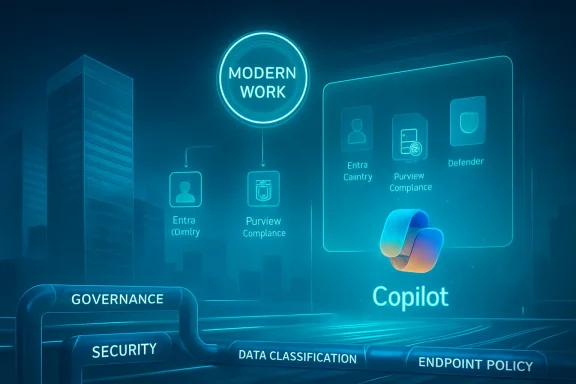
For WindowsForum readers, the important point is that Copilot’s workplace story is not confined to Microsoft 365 apps. It increasingly touches endpoint management, identity, data classification, Teams collaboration, Power Platform, custom agents, and the broader Azure stack. A Copilot rollout is therefore a Windows, Microsoft 365, Entra, Purview, Defender, SharePoint, and Teams story all at once.
CGI’s role is to translate that pile of services into something a CIO can defend and a sysadmin can maintain. That is a different sales motion from “here is a license; enjoy the future.” It is closer to the way enterprises adopted cloud: first through enthusiasm, then through chaos, then through landing zones, governance, cost controls, and specialized partners who made the abstraction behave.
The phrase agent-based solutions is doing a lot of work here. Microsoft has been pushing the idea that Copilot is not just an assistant that answers questions but a framework for task-specific agents that act across business systems. That is more powerful than chat, and it is also more dangerous. The moment an AI system can initiate actions, consult enterprise data, and operate inside business workflows, implementation quality stops being optional.
Partners help Microsoft square that contradiction. They turn product ambition into customer-specific execution. They also provide political cover inside enterprises, where AI rollouts often require alignment among IT, legal, HR, security, finance, records management, and business unit leaders who may not agree on what “productivity” means.
This is why the Microsoft AI Cloud Partner Program has become strategically important. It is not just a loyalty scheme for resellers. It is a way to organize Microsoft’s ecosystem around the workloads it cares about most: AI, cloud, security, data, modern work, business applications, and developer productivity.
The economics are straightforward. Microsoft sells the platform and captures recurring software revenue. Partners sell assessment, migration, customization, governance, adoption, and managed services. Customers get someone to blame, which in enterprise technology is not a minor feature.
CGI’s specialization slots neatly into that model. It gives the company a stronger Microsoft-facing credential while giving Microsoft another large services partner it can point to when customers ask who can make Copilot work beyond a pilot group.
There is logic to that view. Consulting firms with credible AI practices may benefit as enterprises move from experimentation to implementation. AI has the potential to pull forward advisory work, data modernization, security remediation, workflow redesign, and managed services. If customers are serious about Copilot, they will need help, and CGI is in the business of selling precisely that help.
But investors should be careful not to confuse a partner specialization with a revenue event. The designation improves positioning; it does not automatically create bookings. A services firm still has to win projects, staff them profitably, avoid margin compression, and prove that AI work can scale beyond bespoke consulting engagements.
The better reading is that CGI has strengthened its seat at a table Microsoft is expanding. That table is attractive, but it is crowded. Accenture, Avanade, Capgemini, Cognizant, Deloitte, Kyndryl, PwC, and the broader Microsoft partner universe are all chasing the same enterprise AI transformation spend. CGI’s badge is meaningful because the market is real, not because the badge makes the market exclusive.
Microsoft has an advantage because Copilot is embedded in tools workers already use. That same advantage creates risk. If an AI assistant is sitting inside Outlook, Teams, Word, Excel, SharePoint, and business applications, mistakes are not abstract. They occur in the same environment where employees negotiate contracts, review financials, handle personnel matters, and collaborate on confidential plans.
This is where CGI’s pitch around compliance and cybersecurity becomes more than brochure language. Organizations need to know who can access what, which data sources are grounded, how prompts and outputs are handled, how retention rules apply, how agents are monitored, and what happens when the model produces something plausible but wrong. The old enterprise maxim still applies: bad governance at scale is not innovation.
For sysadmins and IT pros, the Copilot era may feel less like science fiction and more like another round of permission audits. That is not a failure of AI; it is the reality of enterprise computing. AI amplifies whatever state your environment is already in. Clean identity, disciplined access control, mature data lifecycle practices, and sensible endpoint management become competitive advantages.
A lawyer drafting a memo, a project manager summarizing meetings, a service desk triaging tickets, and a finance analyst reconciling data do not need the same AI experience. They also do not carry the same risk. The enterprise opportunity is not a universal assistant but a portfolio of role-aware, policy-aware workflows that reduce friction without reducing accountability.
This is where services firms have an opening. They can work with business units to identify repeatable processes, define success metrics, and decide whether Copilot should assist, summarize, draft, search, trigger a workflow, or stay out of the way. That last option matters more than vendors like to admit.
Microsoft’s own product direction points toward this more granular world. Copilot Studio and agent frameworks are meant to let organizations build AI experiences that reflect specific business needs. But tools that make agents easier to build also make governance more urgent. The enterprise will not suffer from a shortage of agents; it will suffer from a shortage of disciplined agent management.
That means the sysadmin’s role changes again. The job is not simply to deploy software or keep devices patched. It is to define the boundaries within which AI can safely operate. That includes permissions, device compliance, conditional access, sensitivity labels, data loss prevention policies, audit logging, and the lifecycle of both human and non-human actors.
The rise of agents makes this more acute. If an agent can access a mailbox, search SharePoint, update a ticket, draft a response, or call another system, it needs identity and policy. In practice, AI agents may become a new class of managed workload, sitting somewhere between user accounts, service principals, automation scripts, and outsourced labor.
That is why partners with Microsoft specializations will be judged less by their slide decks than by their runbooks. Can they help customers build a support model? Can they document agent behavior? Can they hand over governance processes that internal IT can actually operate? Can they prevent the AI project from becoming yet another fragile consulting artifact?
CGI’s traditional strengths line up with that world. Government, financial services, healthcare, utilities, manufacturing, and large commercial enterprises do not buy technology the way startups do. They need procurement discipline, security review, auditability, localization, data residency planning, and long-running support. They also tend to have decades of accumulated systems that will not be replaced simply because an AI vendor has a clean demo.
Copilot’s promise in these environments is not that it makes legacy complexity disappear. It may make some of that complexity easier to navigate, but only after the underlying information architecture is made intelligible. In many companies, the Copilot readiness project will reveal more about SharePoint sprawl and access control debt than about model quality.
That is not a bad thing. If AI enthusiasm forces enterprises to fix permissions, classify data, retire abandoned workspaces, rationalize collaboration patterns, and document workflows, then Copilot may deliver value even before the assistant writes a single useful paragraph. The cleanup is part of the transformation.
The requirements and benefits around the Microsoft AI Cloud Partner Program also show how Microsoft is reshaping partner behavior. It has expanded Copilot-related benefits, added AI and security entitlements, updated Modern Work criteria, and continued to fold AI readiness into partner designations. The message is clear: the partner ecosystem is being trained to sell and support AI-first Microsoft environments.
That has a self-reinforcing effect. Partners invest in Microsoft certifications, practices, and delivery playbooks because that is where customer demand and vendor incentives are moving. Microsoft then uses those partners to accelerate adoption, which creates more demand for specialized implementation work. The flywheel is not subtle, but it is effective.
The risk is that customers mistake partner status for independent advice. A Microsoft-specialized partner is, by definition, aligned with Microsoft’s ecosystem. That can be exactly what a Microsoft-centric enterprise wants. It can also narrow the conversation if organizations need a more heterogeneous AI strategy spanning Google, AWS, OpenAI direct offerings, Anthropic, open models, or industry-specific platforms.
That is a harder message to sell than “AI will transform everything.” It is also more durable. Enterprises have already seen enough generative AI magic tricks. What they need now is a path from experimentation to repeatable operations.
CGI can plausibly argue that its size and services model fit that need. It has the global footprint to support multinational customers and the consulting depth to connect technology programs with business outcomes. The Microsoft specialization gives it another proof point in that conversation, especially for customers already standardized on Microsoft 365.
Still, execution will matter. The consulting industry has a long history of turning hot technology trends into expensive transformation programs with uneven results. Copilot will not be immune to that. The winners will be the firms that can show measurable improvements without burying customers in jargon, dependency, and endless change orders.
AI services revenue is not the same as software revenue. It can be labor-intensive, margin-sensitive, and dependent on utilization rates. If demand spikes faster than firms can train or hire qualified staff, quality can suffer. If customers cut budgets or delay AI programs after weak early results, pipeline enthusiasm can turn quickly.
There is also the uncomfortable question of productivity cannibalization. Consulting firms are selling AI to make clients more efficient, but AI may also make parts of consulting delivery more efficient. That can improve margins if managed well, or pressure billable-hour models if customers expect lower costs. The services industry is not merely advising on AI disruption; it is exposed to it.
For CGI, the best outcome is not just more Copilot projects. It is reusable methodology, managed services, governance frameworks, accelerators, and industry-specific solutions that turn AI implementation from bespoke labor into repeatable practice. The specialization helps open the door, but the business model has to walk through it.
That scrutiny is healthy. It forces Microsoft and partners to move beyond generic claims. It also exposes a central truth of workplace AI: value is uneven. Some roles will see immediate gains from summarization, drafting, search, and meeting assistance. Others will need custom agents, better data, or deeper process integration before the benefits are obvious.
This is why the partner ecosystem matters so much. Microsoft can build the platform, but it cannot individually redesign every procurement process, claims workflow, engineering review, HR case flow, or municipal service desk. Partners like CGI are supposed to translate the platform into local value.
The danger is that the channel overpromises. If every PowerPoint deck says Copilot will unlock productivity, customers will eventually ask where the unlocked productivity went. The next year will likely separate partners who can produce credible before-and-after evidence from those who merely attach AI language to old consulting offers.
That matters because Microsoft’s enterprise strength has always been ecosystem gravity. Windows became more than an operating system because developers, OEMs, administrators, trainers, consultants, and enterprises organized around it. Microsoft 365 became more than Office because identity, compliance, collaboration, and device management accumulated around it. Copilot is now being given the same ecosystem treatment.
This does not guarantee success. AI tools still hallucinate, frustrate users, raise governance concerns, and produce uneven returns. But Microsoft is not betting only on model quality. It is betting on distribution, integration, admin familiarity, compliance posture, and a partner army that can make the technology feel inevitable.
CGI’s specialization is therefore less about CGI alone than about the shape of the market. AI in the workplace is leaving the keynote stage and entering procurement, security review, tenant administration, and managed services. That is where technology trends either become infrastructure or die slowly in unused licenses.
Source: GuruFocus https://www.gurufocus.com/news/8839...t-copilot-specialization-in-ai-cloud-program/
 Microsoft’s Copilot Bet Now Runs Through the Consulting Channel
Microsoft has spent the last several years turning Copilot from a product name into a platform thesis. What began as a generative assistant embedded in Microsoft 365 has expanded into Copilot Studio, agent workflows, governance tooling, security integrations, and partner incentives. That sprawl has created an obvious enterprise problem: the product is everywhere, but coherent implementation is not.That is where CGI’s announcement matters. A Microsoft specialization does not mean CGI suddenly discovered AI this week, nor does it mean every Copilot deployment it touches will succeed. It means Microsoft is publicly sorting partners into those it believes can move customers from AI demo to AI operating model.
That distinction is important. In 2023 and 2024, many organizations bought into the Copilot story through executive optimism and proof-of-concept theater. By 2026, the conversation has shifted toward adoption, measurable productivity, data hygiene, compliance, and whether agents can be trusted with business processes. The partner badge is Microsoft’s way of saying: the sale is no longer the hard part; the rollout is.
CGI is a natural candidate for that role. The company’s business is not built on a single software product but on consulting, systems integration, managed services, and long-term outsourcing relationships. Those are precisely the categories that become more valuable when customers discover that AI adoption is less like installing an app and more like rewiring a company’s nervous system.
The Badge Is Small, but the Signal Is Large
Specializations inside the Microsoft AI Cloud Partner Program are easy to dismiss as corporate taxonomy. Microsoft has never been shy about partner tiers, competencies, solution designations, and program names that require a laminated decoder ring. But in this case, the label maps to something real: Microsoft is narrowing the gap between Copilot licensing and Copilot outcomes.The Modern Work angle matters because Microsoft 365 Copilot sits at the messy intersection of identity, documents, email, meetings, Teams, SharePoint, compliance policies, and user behavior. It is not a neatly isolated AI service. It depends on the accumulated state of an organization’s Microsoft tenant, and that state is often more archaeological than architectural.
A company that turns on Copilot without cleaning permissions may discover that the assistant is very good at surfacing documents people forgot were broadly accessible. A company that deploys it without training may discover that users treat it like a novelty rather than a workflow tool. A company that builds agents without governance may discover that automation has multiplied its risk surface.
That is the unglamorous value of a specialization. It does not guarantee wisdom, but it suggests that Microsoft wants customers to find partners capable of doing the unsexy work: readiness assessments, tenant governance, change management, security review, workflow redesign, and post-deployment measurement. Those are the things that determine whether Copilot becomes infrastructure or shelfware.
CGI Is Selling Operational AI, Not AI Magic
CGI’s announcement leans on familiar enterprise language: secure AI, scaling across the enterprise, navigating complexity, compliance, and cybersecurity. That phrasing will not win poetry awards, but it accurately describes where AI budgets are moving. The novelty phase is fading; the operational phase is here.For WindowsForum readers, the important point is that Copilot’s workplace story is not confined to Microsoft 365 apps. It increasingly touches endpoint management, identity, data classification, Teams collaboration, Power Platform, custom agents, and the broader Azure stack. A Copilot rollout is therefore a Windows, Microsoft 365, Entra, Purview, Defender, SharePoint, and Teams story all at once.
CGI’s role is to translate that pile of services into something a CIO can defend and a sysadmin can maintain. That is a different sales motion from “here is a license; enjoy the future.” It is closer to the way enterprises adopted cloud: first through enthusiasm, then through chaos, then through landing zones, governance, cost controls, and specialized partners who made the abstraction behave.
The phrase agent-based solutions is doing a lot of work here. Microsoft has been pushing the idea that Copilot is not just an assistant that answers questions but a framework for task-specific agents that act across business systems. That is more powerful than chat, and it is also more dangerous. The moment an AI system can initiate actions, consult enterprise data, and operate inside business workflows, implementation quality stops being optional.
Microsoft Needs Partners Because Copilot Is Too Big to Implement Alone
Microsoft’s Copilot strategy contains a contradiction. The company wants Copilot to feel simple to users, but the stack beneath it is increasingly complex. That complexity is not a bug; it is the inevitable result of trying to bring generative AI into regulated, permissioned, multilingual, multi-tenant enterprise environments.Partners help Microsoft square that contradiction. They turn product ambition into customer-specific execution. They also provide political cover inside enterprises, where AI rollouts often require alignment among IT, legal, HR, security, finance, records management, and business unit leaders who may not agree on what “productivity” means.
This is why the Microsoft AI Cloud Partner Program has become strategically important. It is not just a loyalty scheme for resellers. It is a way to organize Microsoft’s ecosystem around the workloads it cares about most: AI, cloud, security, data, modern work, business applications, and developer productivity.
The economics are straightforward. Microsoft sells the platform and captures recurring software revenue. Partners sell assessment, migration, customization, governance, adoption, and managed services. Customers get someone to blame, which in enterprise technology is not a minor feature.
CGI’s specialization slots neatly into that model. It gives the company a stronger Microsoft-facing credential while giving Microsoft another large services partner it can point to when customers ask who can make Copilot work beyond a pilot group.
The Financial Story Is Tempting, but It Is Not the Whole Story
GuruFocus framed the announcement partly through the lens of CGI’s stock. It noted a market capitalization around $13.84 billion, a GF Score of 84 out of 100, and a price-to-earnings ratio of 11.82, close to the company’s 10-year low by its data. That makes for an appealing investor narrative: established IT services firm, AI credential, reasonable valuation, strong profitability and growth scores.There is logic to that view. Consulting firms with credible AI practices may benefit as enterprises move from experimentation to implementation. AI has the potential to pull forward advisory work, data modernization, security remediation, workflow redesign, and managed services. If customers are serious about Copilot, they will need help, and CGI is in the business of selling precisely that help.
But investors should be careful not to confuse a partner specialization with a revenue event. The designation improves positioning; it does not automatically create bookings. A services firm still has to win projects, staff them profitably, avoid margin compression, and prove that AI work can scale beyond bespoke consulting engagements.
The better reading is that CGI has strengthened its seat at a table Microsoft is expanding. That table is attractive, but it is crowded. Accenture, Avanade, Capgemini, Cognizant, Deloitte, Kyndryl, PwC, and the broader Microsoft partner universe are all chasing the same enterprise AI transformation spend. CGI’s badge is meaningful because the market is real, not because the badge makes the market exclusive.
The Real Competition Is Trust, Not Features
Enterprise AI buyers are already drowning in feature claims. Every vendor says it can automate work, unlock knowledge, improve productivity, and accelerate decisions. The more interesting question is which providers can earn trust when the deployment touches sensitive data and business-critical processes.Microsoft has an advantage because Copilot is embedded in tools workers already use. That same advantage creates risk. If an AI assistant is sitting inside Outlook, Teams, Word, Excel, SharePoint, and business applications, mistakes are not abstract. They occur in the same environment where employees negotiate contracts, review financials, handle personnel matters, and collaborate on confidential plans.
This is where CGI’s pitch around compliance and cybersecurity becomes more than brochure language. Organizations need to know who can access what, which data sources are grounded, how prompts and outputs are handled, how retention rules apply, how agents are monitored, and what happens when the model produces something plausible but wrong. The old enterprise maxim still applies: bad governance at scale is not innovation.
For sysadmins and IT pros, the Copilot era may feel less like science fiction and more like another round of permission audits. That is not a failure of AI; it is the reality of enterprise computing. AI amplifies whatever state your environment is already in. Clean identity, disciplined access control, mature data lifecycle practices, and sensible endpoint management become competitive advantages.
Copilot’s Value Depends on the Workflows Around It
The most exaggerated version of the Copilot story imagines that productivity appears automatically when a license is assigned. The more realistic version says Copilot creates value when organizations redesign work around it. That requires domain knowledge, process mapping, training, incentives, and a willingness to stop measuring AI adoption by seat count alone.A lawyer drafting a memo, a project manager summarizing meetings, a service desk triaging tickets, and a finance analyst reconciling data do not need the same AI experience. They also do not carry the same risk. The enterprise opportunity is not a universal assistant but a portfolio of role-aware, policy-aware workflows that reduce friction without reducing accountability.
This is where services firms have an opening. They can work with business units to identify repeatable processes, define success metrics, and decide whether Copilot should assist, summarize, draft, search, trigger a workflow, or stay out of the way. That last option matters more than vendors like to admit.
Microsoft’s own product direction points toward this more granular world. Copilot Studio and agent frameworks are meant to let organizations build AI experiences that reflect specific business needs. But tools that make agents easier to build also make governance more urgent. The enterprise will not suffer from a shortage of agents; it will suffer from a shortage of disciplined agent management.
Windows Shops Will Feel This Through Identity, Data, and Endpoint Policy
For the Windows ecosystem, the CGI announcement is another reminder that Microsoft’s AI push is not happening off to the side. It is becoming part of the administrative surface area that IT teams already manage. Copilot adoption will increasingly intersect with Microsoft 365 administration, Entra identity, Purview compliance, Defender security posture, Intune policies, Teams governance, and Windows endpoint strategy.That means the sysadmin’s role changes again. The job is not simply to deploy software or keep devices patched. It is to define the boundaries within which AI can safely operate. That includes permissions, device compliance, conditional access, sensitivity labels, data loss prevention policies, audit logging, and the lifecycle of both human and non-human actors.
The rise of agents makes this more acute. If an agent can access a mailbox, search SharePoint, update a ticket, draft a response, or call another system, it needs identity and policy. In practice, AI agents may become a new class of managed workload, sitting somewhere between user accounts, service principals, automation scripts, and outsourced labor.
That is why partners with Microsoft specializations will be judged less by their slide decks than by their runbooks. Can they help customers build a support model? Can they document agent behavior? Can they hand over governance processes that internal IT can actually operate? Can they prevent the AI project from becoming yet another fragile consulting artifact?
The AI Services Market Is Moving From Pilots to Plumbing
The first wave of enterprise generative AI was about possibility. The second wave is about plumbing. That shift favors companies that understand systems integration, because the value of AI increasingly depends on the systems it can safely reach.CGI’s traditional strengths line up with that world. Government, financial services, healthcare, utilities, manufacturing, and large commercial enterprises do not buy technology the way startups do. They need procurement discipline, security review, auditability, localization, data residency planning, and long-running support. They also tend to have decades of accumulated systems that will not be replaced simply because an AI vendor has a clean demo.
Copilot’s promise in these environments is not that it makes legacy complexity disappear. It may make some of that complexity easier to navigate, but only after the underlying information architecture is made intelligible. In many companies, the Copilot readiness project will reveal more about SharePoint sprawl and access control debt than about model quality.
That is not a bad thing. If AI enthusiasm forces enterprises to fix permissions, classify data, retire abandoned workspaces, rationalize collaboration patterns, and document workflows, then Copilot may deliver value even before the assistant writes a single useful paragraph. The cleanup is part of the transformation.
Microsoft’s Partner Program Is Becoming an AI Governance Filter
Microsoft’s partner designations and specializations have always served a marketing purpose, but in the AI era they also function as a governance filter. Customers need a way to distinguish between firms that can talk about AI and firms that have demonstrated at least some capacity to deploy it within Microsoft’s framework. The specialization is a shorthand, imperfect but useful.The requirements and benefits around the Microsoft AI Cloud Partner Program also show how Microsoft is reshaping partner behavior. It has expanded Copilot-related benefits, added AI and security entitlements, updated Modern Work criteria, and continued to fold AI readiness into partner designations. The message is clear: the partner ecosystem is being trained to sell and support AI-first Microsoft environments.
That has a self-reinforcing effect. Partners invest in Microsoft certifications, practices, and delivery playbooks because that is where customer demand and vendor incentives are moving. Microsoft then uses those partners to accelerate adoption, which creates more demand for specialized implementation work. The flywheel is not subtle, but it is effective.
The risk is that customers mistake partner status for independent advice. A Microsoft-specialized partner is, by definition, aligned with Microsoft’s ecosystem. That can be exactly what a Microsoft-centric enterprise wants. It can also narrow the conversation if organizations need a more heterogeneous AI strategy spanning Google, AWS, OpenAI direct offerings, Anthropic, open models, or industry-specific platforms.
CGI’s Opportunity Is to Be Boring in the Right Ways
The most useful AI consultants in 2026 may not be the ones with the flashiest demos. They may be the ones willing to be boring: to document permissions, map business processes, measure adoption honestly, write governance policies, and tell executives that some workflows are not ready for agents. CGI’s opportunity is to make Copilot implementation feel less like a leap of faith and more like a managed technology program.That is a harder message to sell than “AI will transform everything.” It is also more durable. Enterprises have already seen enough generative AI magic tricks. What they need now is a path from experimentation to repeatable operations.
CGI can plausibly argue that its size and services model fit that need. It has the global footprint to support multinational customers and the consulting depth to connect technology programs with business outcomes. The Microsoft specialization gives it another proof point in that conversation, especially for customers already standardized on Microsoft 365.
Still, execution will matter. The consulting industry has a long history of turning hot technology trends into expensive transformation programs with uneven results. Copilot will not be immune to that. The winners will be the firms that can show measurable improvements without burying customers in jargon, dependency, and endless change orders.
The Valuation Angle Should Not Eclipse the Deployment Reality
The GuruFocus analysis understandably highlights CGI’s valuation metrics. A low historical P/E ratio, strong profitability score, and solid growth profile make the stock screen well. But a WindowsForum audience should keep one eye on the operational reality behind the market framing.AI services revenue is not the same as software revenue. It can be labor-intensive, margin-sensitive, and dependent on utilization rates. If demand spikes faster than firms can train or hire qualified staff, quality can suffer. If customers cut budgets or delay AI programs after weak early results, pipeline enthusiasm can turn quickly.
There is also the uncomfortable question of productivity cannibalization. Consulting firms are selling AI to make clients more efficient, but AI may also make parts of consulting delivery more efficient. That can improve margins if managed well, or pressure billable-hour models if customers expect lower costs. The services industry is not merely advising on AI disruption; it is exposed to it.
For CGI, the best outcome is not just more Copilot projects. It is reusable methodology, managed services, governance frameworks, accelerators, and industry-specific solutions that turn AI implementation from bespoke labor into repeatable practice. The specialization helps open the door, but the business model has to walk through it.
The Copilot Channel Now Has Its Own Reality Check
The broader Copilot market is entering a more demanding phase. Microsoft has touted large enterprise adoption and continued to expand the Copilot family, but customers are asking harder questions about return on investment. They want to know which workers benefit, which workflows improve, which risks increase, and how much administrative overhead comes with the promised productivity.That scrutiny is healthy. It forces Microsoft and partners to move beyond generic claims. It also exposes a central truth of workplace AI: value is uneven. Some roles will see immediate gains from summarization, drafting, search, and meeting assistance. Others will need custom agents, better data, or deeper process integration before the benefits are obvious.
This is why the partner ecosystem matters so much. Microsoft can build the platform, but it cannot individually redesign every procurement process, claims workflow, engineering review, HR case flow, or municipal service desk. Partners like CGI are supposed to translate the platform into local value.
The danger is that the channel overpromises. If every PowerPoint deck says Copilot will unlock productivity, customers will eventually ask where the unlocked productivity went. The next year will likely separate partners who can produce credible before-and-after evidence from those who merely attach AI language to old consulting offers.
The Small Print Is Where the Strategy Lives
The most concrete read on CGI’s announcement is simple: Microsoft’s AI ambitions are becoming institutionalized. The company is embedding Copilot into partner requirements, benefits, specializations, and sales motions. CGI’s recognition is one data point in a larger campaign to make AI adoption feel like the default next phase of Microsoft cloud modernization.That matters because Microsoft’s enterprise strength has always been ecosystem gravity. Windows became more than an operating system because developers, OEMs, administrators, trainers, consultants, and enterprises organized around it. Microsoft 365 became more than Office because identity, compliance, collaboration, and device management accumulated around it. Copilot is now being given the same ecosystem treatment.
This does not guarantee success. AI tools still hallucinate, frustrate users, raise governance concerns, and produce uneven returns. But Microsoft is not betting only on model quality. It is betting on distribution, integration, admin familiarity, compliance posture, and a partner army that can make the technology feel inevitable.
CGI’s specialization is therefore less about CGI alone than about the shape of the market. AI in the workplace is leaving the keynote stage and entering procurement, security review, tenant administration, and managed services. That is where technology trends either become infrastructure or die slowly in unused licenses.
The Practical Read for WindowsForum’s Crowd
For IT pros, the CGI-Microsoft announcement is worth reading as an operational signal rather than a stock-market headline. The Copilot wave is moving toward implementation discipline, and that means the surrounding Microsoft estate matters more, not less.- Organizations planning Copilot deployments should audit permissions, data classification, retention, and sharing practices before treating licenses as the starting line.
- Microsoft partners with Copilot specializations will become more visible in enterprise buying cycles, but customers should still demand evidence, methodology, and post-deployment support commitments.
- Agent-based workflows will raise the stakes for identity, monitoring, and governance because AI systems that take action need boundaries as much as human users do.
- CGI’s recognition strengthens its Microsoft AI services pitch, but the designation itself is a positioning advantage rather than proof of future revenue.
- The strongest Copilot business cases will come from specific workflows with measurable outcomes, not broad claims that every knowledge worker becomes instantly more productive.
- Windows and Microsoft 365 administrators should expect AI readiness to become part of routine tenant hygiene, security posture management, and endpoint governance.
Source: GuruFocus https://www.gurufocus.com/news/8839...t-copilot-specialization-in-ai-cloud-program/
