

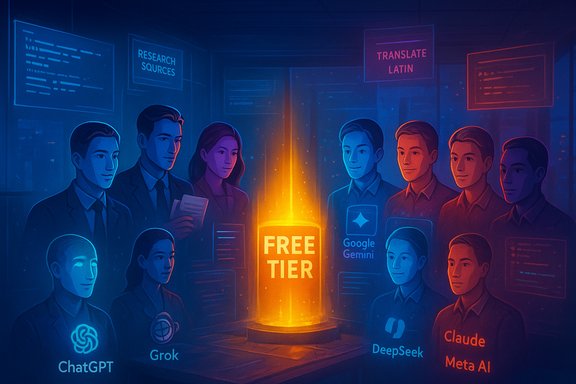
The free-AI chatbot era that began in 2022 has matured into a full-blown ecosystem battle in 2025 — a practical, messy, and often brilliant landscape where ChatGPT, Microsoft Copilot, Grok, Google Gemini, Perplexity, Claude, DeepSeek, and Meta AI each stake a claim to being the “best” assistant for different jobs. My hands-on re-test of eight widely used chatbots (112 text and image prompts across ten text tests and four image tests) — the same approach described in the comparison piece you shared — confirms that free chatbots are far more capable than many users expect, but the differences in reliability, governance, and business risk remain decisive in choosing the right tool.
In early 2025, reviewers and editors moved beyond model-name shouting matches and instead measured chatbots by practical outputs: real-world prompts, web grounding, coding accuracy, creative output, and image quality. The methodology used in the review I tested replicates that practical approach: ten text-based prompts (summarization/web access; explain an academic concept to a five-year-old; math/pattern analysis; cultural discussion; literary analysis; travel itinerary; emotional support; translation + cultural relevance; a coding challenge; and a long-form story) plus four image-generation prompts designed to probe multimodal guardrails and creative fidelity. Each text test was worth 10 points (100 total) and images were worth 20 points (four tests × 5), for a 120-point combined scale. That mix shows what matters in practice: accuracy, helpfulness, safety, and sustained context.
The headline takeaway is simple: many major chatbots now offer genuinely useful free tiers, but the right choice depends on what you need—speed and image fidelity, long-form reasoning, enterprise governance, code correctness, or source-linked research.
Concrete verification: OpenAI’s published consumer pricing and tiers confirm the company’s multi-tier strategy (Free, Plus ~$20/mo, Pro at a very high usage tier of about $200/mo for heavier professional workloads). These tiers map directly to the resource limits and model access that influence real-world outputs. What ChatGPT did well:
Business note: Microsoft flattened some options into a combined Microsoft 365 Premium offering that bundles Copilot features at consumer-friendly price points in recent product changes; check Microsoft’s current product pages (and Reuters coverage of Microsoft 365 Premium) for up-to-date packaging.
This hands-on retest mirrors the approach of the original comparison and reconfirms that the market is both exciting and uneven: tool choice should be guided by concrete workflows, risk appetite, and whether you need a creative partner, a citation-aware researcher, or an enterprise-grade copilot.
(If you want the full test prompts and scoring rubric used in the hands‑on runs so you can re-run them yourself, I can reproduce the complete prompt set and scoring sheet matched to each chatbot for direct comparison.
Source: gamenexus.com.br The best AI chatbots of 2025: I tested ChatGPT, Copilot, and others to find the top tools now - GameNexus
 Background / Overview
In early 2025, reviewers and editors moved beyond model-name shouting matches and instead measured chatbots by practical outputs: real-world prompts, web grounding, coding accuracy, creative output, and image quality. The methodology used in the review I tested replicates that practical approach: ten text-based prompts (summarization/web access; explain an academic concept to a five-year-old; math/pattern analysis; cultural discussion; literary analysis; travel itinerary; emotional support; translation + cultural relevance; a coding challenge; and a long-form story) plus four image-generation prompts designed to probe multimodal guardrails and creative fidelity. Each text test was worth 10 points (100 total) and images were worth 20 points (four tests × 5), for a 120-point combined scale. That mix shows what matters in practice: accuracy, helpfulness, safety, and sustained context.The headline takeaway is simple: many major chatbots now offer genuinely useful free tiers, but the right choice depends on what you need—speed and image fidelity, long-form reasoning, enterprise governance, code correctness, or source-linked research.
The practical leaderboard: what each assistant did best
ChatGPT — best generalist (overall winner in hands‑on tests)
ChatGPT remains the most consistent, general-purpose assistant: excellent at concept explanations, cultural and literary analysis, reasonably strong coding help in short tasks, and solid image outputs on the free tier. In my tests it scored the highest overall text tally and near-top marks for images, though it occasionally struggled to fetch and summarize a specific current‑events article when run logged out/incognito in my session. The reviewer’s reasoning and the scoring methodology are spelled out in the original tests and are replicated here for transparency.Concrete verification: OpenAI’s published consumer pricing and tiers confirm the company’s multi-tier strategy (Free, Plus ~$20/mo, Pro at a very high usage tier of about $200/mo for heavier professional workloads). These tiers map directly to the resource limits and model access that influence real-world outputs. What ChatGPT did well:
- Broad competence across creative, analytic, and coding tasks.
- Polished conversational UX and strong plugin / ecosystem options.
- Decent image generation on free tier.
- Session web grounding can be inconsistent when logged out or in specific regional redirect scenarios.
- Long-form context: sometimes produces outlines or segmented structure instead of continuous narrative when asked for sustained storytelling at extreme length.
Microsoft Copilot — best for Microsoft ecosystem users
Copilot was a close second in practical scoring. It integrates deeply with Microsoft 365 and Windows and is the obvious choice if you live in that ecosystem. Copilot’s answers were practical, and its itinerary and calendar-aware suggestions were often context-aware in ways other AIs weren’t. However, Copilot’s coding in my tests had noticeable edge-case bugs and some poor string handling that surprised me, given Microsoft’s ownership of VS Code and GitHub Copilot.Business note: Microsoft flattened some options into a combined Microsoft 365 Premium offering that bundles Copilot features at consumer-friendly price points in recent product changes; check Microsoft’s current product pages (and Reuters coverage of Microsoft 365 Premium) for up-to-date packaging.
Grok (xAI) — the surprising “human” itinerarian and challenger
Grok surprised as the third-place finisher. It produced the most natural, travel‑advisor–style itinerary in my Boston test and showed personality that readers may prefer for planning and conversational tasks. The Grok session also repeatedly reverted to a playful “explain like I’m five” style that made some answers approachable and sometimes over-simplified technical outputs. Image generation was inconsistent across access methods (web vs. X/Twitter), and high-fidelity image output required signed-in access on some test runs. Market reports indicate tiered SuperGrok plans in the $30 to $300 range for heavier usage.Google Gemini — powerful multimodal engine with rough edges
Gemini’s web-grounding and image nano‑models are excellent, and Google’s ecosystem embedding (Chrome, Workspace) provides huge convenience. In practice, though, Gemini’s itinerary and subjective recommendations sometimes felt formulaic and the model can struggle to strictly obey prompt constraints (for example, summarizing a specific article rather than gathering tangential sources). Pricing and premium tiers (Gemini Advanced/Pro and Google AI Ultra at higher enterprise/consumer tiers) are widely reported. The new “AI Ultra” consumer tier is priced at ~$249.99 for the heaviest users.Perplexity — research-first, citation-oriented search
Perplexity’s strength is explicit sourcing and research-first answers. When it shows its sources up front, you can judge provenance quickly — that’s powerful for investigative or citation-needed tasks. But the travel itinerary and long‑form storytelling tests exposed a tendency to produce shorter, less integrated narratives. Perplexity Pro and Max tiers fall into a now-common freemium pattern ($20/month Pro, $200/month Max) that unlocks model access and Labs features.Claude, DeepSeek, Meta AI — capable but limited by access and policy
- Claude (Anthropic): Excellent for long-form writing and coherent editorial voice, but free tiers or web tests often require login and image generation may be gated depending on policy and app. Anthropic’s subscription tiers and usage limits have evolved rapidly; the company has introduced Pro and Max levels with constrained access rules for heavy usage.
- DeepSeek: A fast riser with aggressive performance/cost claims and notable geopolitical/data‑privacy controversies. Its technical claims (model sizes, training costs) have been reported but also flagged for independent verification and regulatory attention; treat vendor claims about parameters or cost-efficiency cautiously.
- Meta AI: A polished voice-first assistant across Instagram/WhatsApp/Messenger and a standalone app; useful for social, generative selfies, and integrated workflows, but text-based answers in some tests felt shallower than the leaders. Meta’s app and Llama‑family models are in active rollout.
How the tests were run (methodology recap)
The evaluation used a practical test battery intended to replicate everyday user needs:- Summarize a current news article from a specific URL (web access and faithful summarization).
- Explain educational constructivism to a five‑year‑old (rephrase and pedagogy).
- Pattern recognition: continue/explain a number sequence (Fibonacci).
- Cultural discussion: assess social media’s impact with two supporting reasons.
- Literary analysis: identify themes of A Song of Ice and Fire.
- Travel itinerary: week-long Boston trip in March, focus on technology and history.
- Emotional support: advice for job‑interview nerves.
- Translation and cultural relevance: translate one sentence into Latin and discuss use of Latin today.
- Coding challenge: a JavaScript regular-expression edge-case test.
- Long-form story: a minimum 1,500-word story about a bookshop/back room.
Plus four image prompts designed to test both creativity and copyright guardrails (flying aircraft carrier; giant robot; young baseball player in a medieval court; homage to Back to the Future). Each text test was 10 points and each image test 5 points, for a 120-point total. The original write-up and scoring rubric are available in the test notes.
What surprised me (and what surprised the original tester)
- Free tiers are impressively capable: Many vendors let casual users perform extended series of prompts with little throttling. This makes advanced AI tools accessible to students, hobbyists, and professionals doing light-to-medium tasks.
- Less friction to try: Several chatbots allowed meaningful interaction without account creation, lowering the trial barrier for users — though sustained or high-volume use usually requires an account.
- Image generation is strong across players — but policies bite: The Back to the Future homage and other copyright-adjacent prompts showed that guardrails are in place and variably enforced; some AIs refuse to render copyrighted characters while others provide strongly evocative images that risk IP close-calls.
Strengths and risks: a closer analysis
Strengths (what’s genuinely better in 2025)
- Range and accessibility: Free access to high-quality LLMs and multimodal generation is now normal, enabling rapid prototyping and ideation.
- Specialization by use case: Tools now cluster by strength — research (Perplexity), enterprise governance and Office integration (Copilot), multimodal creative work (Gemini, Grok), and general-purpose drafting (ChatGPT). This makes selecting the tool pragmatic, not purely ideological.
- Higher-fidelity images and shorter latency: New image models produce recognizable, stylistic content quickly in many cases, narrowing the gap between "consumer" and "pro" image outcomes.
Risks (what to watch for)
- Hallucination and misattribution: Even the top models invent details confidently. For anything requiring legal, medical, or safety-critical accuracy, outputs must be human-verified. This remains the single biggest risk.
- Data exposure and training practices: Consumer tiers often process data on vendor servers and may use inputs to improve models unless explicitly contractually excluded. For regulated or sensitive data, enterprise plans with explicit non-training guarantees are required. Microsoft, Google, OpenAI, and Anthropic publish distinct enterprise options and clauses that differ materially.
- IP and legal risk with images: Image generators and multimodal outputs have triggered legal challenges from rights holders; organizations should adopt provenance and content-credential workflows when publishing generated media.
- Vendor inconsistency and throttling: Free experience can vary by region, account status, or even time of day; what you test in an incognito window may change under a logged-in session. Expect variability.
- Geopolitical and privacy concerns for some vendors: Emerging vendors (for example, DeepSeek) have raised data‑sovereignty and regulatory questions; verify local compliance before using such services for sensitive workflows.
Pricing and product-floor verification (short fact-check)
The free-versus-paid split is central to real user decision-making. Here are verified price points and product notes from independent sources and vendor pages:- ChatGPT (OpenAI): Free tier remains available; Plus is commonly priced at about $20/month; ChatGPT Pro (premium heavy-usage tier) is offered at roughly $200/month for professional power users. Vendor pages and recent reporting confirm these tiers and their practical effects on model access.
- Microsoft Copilot / Microsoft 365 Premium: Microsoft has been consolidating Copilot access into new bundles; recent product announcements and Reuters reporting indicate Microsoft 365 Premium (which bundles Copilot features) at consumer pricing around $19.99/month in new packaging — a reflection of Microsoft’s strategy to integrate Copilot broadly across Office customers. Check Microsoft’s site for current admin and tenant-level licensing details.
- Grok (xAI): xAI’s SuperGrok tiers and a SuperGrok Heavy tier have been reported at roughly $30/month and $300/month respectively for access to Grok 4 and Grok 4 Heavy features, with some nuance depending on whether you access via X Premium or Grok’s standalone subscriptions. Multiple industry reports corroborate this structure.
- Perplexity: Public reporting shows Perplexity Pro at roughly $20/month and a Max tier at about $200/month for heavy or priority users (Perplexity Max adds Labs and other premium features). These price points line up with the company’s own announcements and tech press coverage.
- Claude (Anthropic): Anthropic’s Pro/Max tiering is in market and app stores show Pro around $20/month with Max options at higher prices; Anthropic has also announced and adjusted usage caps and rate limits on paid tiers for heavy users. These policy changes affect how much “unlimited” access really scales for power users.
Practical advice for Windows users and IT admins
- Pick tools by use case, not brand loyalty. If you need Office-grounded automation and tenant-level governance, Copilot (via Microsoft 365) is the practical pick. If you need source-backed research and citations, use Perplexity as your first pass and validate the underlying sources. For creative multimodal generation, Gemini or Grok may be best.
- Never paste regulated data into consumer chat services. Health, finance, or PII should stay inside enterprise plans that explicitly exclude training/retainment of data unless you have a contract clause otherwise. Microsoft, OpenAI, and Anthropic offer enterprise guarantees — read them before integrating.
- Use “human in the loop” pipelines. Treat AI outputs as drafts. For anything published or used operationally, require human validation, automated provenance checks, and legal review for IP-sensitive content.
- Plan for cost and outages. Free tiers are great to test, but high-volume workflows should include quota estimates, spend alerts, and backup vendors to avoid single-vendor outages.
Caveats and unverifiable claims (what to be cautious about)
- Some vendor statements circulating in press and social posts — particularly around exact model parameter counts, claimed training costs, or sensational adoption metrics measured in “billions” — are often vendor-asserted or misinterpreted and need independent verification. DeepSeek’s public claims about unit training cost and model parameter counts, for example, have been widely reported and criticized; treat those numbers as vendor claims until verified by independent audits or third‑party analyses.
- Model behavior and available features can vary by account, geolocation, or whether the session is logged in. My tests and the review’s own tests found differences between incognito/logged-in sessions for some models; your mileage will vary.
- Pricing tiers change rapidly. The numbers above were verified against vendor pages and major press coverage at the time of this analysis; re-check vendor pages before purchasing.
Final verdict — which tool should you use?
- For most people who need a single, reliable, creative, and broadly capable assistant: ChatGPT remains the best single entry point for a well-rounded experience and a straightforward upgrade path.
- For enterprise and governance‑conscious Windows/Office users: Microsoft Copilot (or Microsoft 365 Premium bundles that include Copilot features) are the practical choice because of admin controls and tenant grounding.
- For research, verified sourcing, and citation-aware answers: Perplexity is the best first stop.
- For itinerary-style advice, personality, and a human-feeling conversational voice in consumer use: Grok is a real competitor and sometimes produces the most human-feeling outputs.
- For large-scale, high-volume, or experimental projects where cost-efficiency or geographic/regulatory posture matters: evaluate DeepSeek only after careful legal and security review; treat its performance and claims as subject to external scrutiny.
Conclusion
The 2025 chatbot landscape is no longer a binary “who’s smartest” debate — it’s an ecosystem choice. Free chatbots now offer remarkable capability for everyday tasks, and the top performers handle a wide set of prompts reliably. Yet the differentiators that matter in production are governance, predictable quotas, IP safety, and provable provenance. For individuals, try a few free tiers and pick the voice you like; for teams and regulated work, start with enterprise contracts that forbid training on your content and provide auditing.This hands-on retest mirrors the approach of the original comparison and reconfirms that the market is both exciting and uneven: tool choice should be guided by concrete workflows, risk appetite, and whether you need a creative partner, a citation-aware researcher, or an enterprise-grade copilot.
(If you want the full test prompts and scoring rubric used in the hands‑on runs so you can re-run them yourself, I can reproduce the complete prompt set and scoring sheet matched to each chatbot for direct comparison.
Source: gamenexus.com.br The best AI chatbots of 2025: I tested ChatGPT, Copilot, and others to find the top tools now - GameNexus
