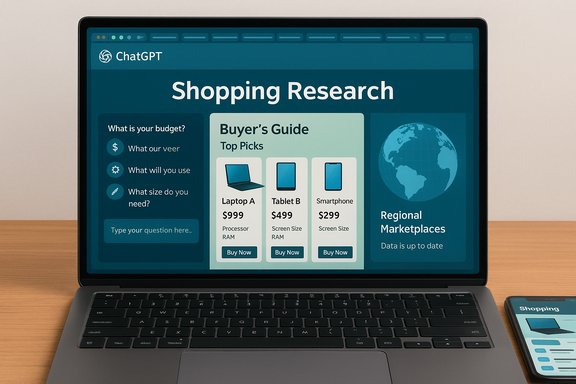
OpenAI’s ChatGPT has been extended with a conversational shopping-research capability that transforms a simple product query into an interactive buying guide: users describe what they want, ChatGPT asks follow-ups about budget and preferences, then scans the publicly available web to return prioritized product picks, side‑by‑side comparisons, purchase links, and practical buying advice. The roll‑out promises a more personalized, time‑saving way to explore options before purchase, but real‑world testing in South Korea shows the feature already running into a predictable set of limitations—most notably gaps in local marketplace coverage that can materially change outcomes for consumers in markets dominated by proprietary platforms.
Conversational agents have steadily moved beyond chat and creative tasks into practical, transactional workflows. The new shopping‑research feature positions ChatGPT as both a discovery engine and a decision support tool: rather than returning a static list of products, it behaves like a knowledgeable clerk asking clarifying questions, refining results, and compiling a buyer’s guide tailored to the user’s constraints.
This approach combines two mature ideas: (1) retrieval‑augmented generation (RAG)—where a language model pulls in up‑to‑date information from the web before answering—and (2) an interactive question‑and‑answer funnel that helps narrow down large product catalogs into actionable recommendations. By producing direct purchase links and inventory‑aware suggestions, the feature attempts to make the conversational experience immediately useful for real purchases.
However, the user experience and the quality of recommendations depend heavily on which retail sources the model can access and how it reconciles differing information from those sources. Tests comparing ChatGPT’s results to Microsoft Copilot and Google’s Gemini show meaningful variation in focus, depth, and localization—differences that directly affect which products users actually discover.
Asking follow‑ups helps the model:
That said, privacy guarantees deserve scrutiny in practice—an area explored later in this article.
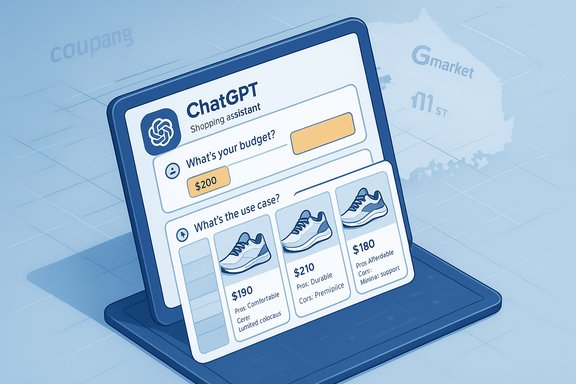
When the user clarified budget (below 150,000 won) and use case (light snow), ChatGPT returned three prioritized choices with reasons and “best if” labels. The recommendations included pros and cons and practical tips—precisely the kind of incremental value that conversational guidance promises.
Comparative tests with Microsoft Copilot and Google’s Gemini produced different outcomes:
This omission is consequential in Korea because Naver Shopping functions not only as a marketplace but also as a discovery and community endorsement mechanism: the platform’s large user review base, domestic vendor ecosystem, and localized ranking signals make it the dominant source of product popularity and social proof. When a conversational assistant omits Naver‑based signals, it can systematically underrepresent items that Korean shoppers prefer.
What “no personal data shared” typically implies:
The South Korean example makes this point plainly. ChatGPT’s ability to surface current inventory from platforms that permit retrieval is useful, but the lack of integration with a critical local marketplace leaves a sizable blind spot. That blind spot can change outcomes for consumers and skew which merchants benefit from the new discovery channel.
As conversational shopping becomes more common, the industry will need clearer standards for transparency, stronger local partnerships to ensure fair coverage, and robust privacy practices that protect users without sacrificing the practical value of integrated purchasing workflows. When those conditions are met, conversational assistants can speed decisions, reduce cognitive load, and help shoppers find better fits faster. Until then, users should treat assistant results as an informed first draft—valuable, but incomplete—of the shopping research process.
Source: The Korea Times ChatGPT launches conversational shopping-research tool - The Korea Times
 Background / Overview
Conversational agents have steadily moved beyond chat and creative tasks into practical, transactional workflows. The new shopping‑research feature positions ChatGPT as both a discovery engine and a decision support tool: rather than returning a static list of products, it behaves like a knowledgeable clerk asking clarifying questions, refining results, and compiling a buyer’s guide tailored to the user’s constraints.This approach combines two mature ideas: (1) retrieval‑augmented generation (RAG)—where a language model pulls in up‑to‑date information from the web before answering—and (2) an interactive question‑and‑answer funnel that helps narrow down large product catalogs into actionable recommendations. By producing direct purchase links and inventory‑aware suggestions, the feature attempts to make the conversational experience immediately useful for real purchases.
However, the user experience and the quality of recommendations depend heavily on which retail sources the model can access and how it reconciles differing information from those sources. Tests comparing ChatGPT’s results to Microsoft Copilot and Google’s Gemini show meaningful variation in focus, depth, and localization—differences that directly affect which products users actually discover.
How the conversational shopping feature works
Conversational inputs and follow-ups
The flow begins with a plain language user prompt—e.g., “I need a sneaker‑style winter shoe.” Instead of generating a broad answer, ChatGPT asks follow‑up questions to reduce ambiguity: What’s your budget? Is the winter dry or snowy? Do you prefer insulation or style? These clarifying steps are crucial because product suitability is inherently conditional on context.Asking follow‑ups helps the model:
- Narrow the universe of relevant SKUs.
- Surface trade‑offs (warmth vs. breathability, water resistance vs. flexibility).
- Match products to use cases (commuting, light snow, heavy trekking).
Retrieval and synthesis
After gathering constraints, the model performs a web scan across publicly accessible retail platforms to find current product listings, prices, review snippets, and product images. Results are synthesized into a structured buyer’s guide that typically includes:- Top picks with short rationales.
- “Best if” notes that map each pick to a user persona or need.
- Side‑by‑side comparisons of core attributes.
- Direct purchase links where available.
Privacy and data handling claims
OpenAI states that this feature respects user privacy by not sharing personal data with merchants and by generating results only from publicly accessible sources. From a high level, the claim indicates the model does not transmit personally identifiable information (PII) to third‑party sellers as part of the search process.That said, privacy guarantees deserve scrutiny in practice—an area explored later in this article.
Real‑world test: the Korean context and what it reveals
A test case searching for “good sneaker‑type shoes for winter” illustrates both the strengths and the limitations of ChatGPT’s shopping feature.When the user clarified budget (below 150,000 won) and use case (light snow), ChatGPT returned three prioritized choices with reasons and “best if” labels. The recommendations included pros and cons and practical tips—precisely the kind of incremental value that conversational guidance promises.
Comparative tests with Microsoft Copilot and Google’s Gemini produced different outcomes:
- Copilot returned broadly similar product lists but with less refinement—short descriptions, links, and a few budget alternatives.
- Gemini produced the least tailored output: a basic list of major brand options categorized by three winter features and vague price ranges, but lacking purchase links and deeper detail.
This omission is consequential in Korea because Naver Shopping functions not only as a marketplace but also as a discovery and community endorsement mechanism: the platform’s large user review base, domestic vendor ecosystem, and localized ranking signals make it the dominant source of product popularity and social proof. When a conversational assistant omits Naver‑based signals, it can systematically underrepresent items that Korean shoppers prefer.
Technical architecture and likely backend mechanics
Although productized details were not published in full, the feature’s behavior is consistent with a hybrid RAG architecture that mixes an LLM with real‑time retrieval tools:- A conversational front end collects user constraints.
- A retrieval component queries indexed web sources or performs live scraping/APIs to collect product listings, prices, reviews, and images.
- The LLM synthesizes findings into a prose buyer’s guide and comparison table.
- External links and metadata are returned for the user to verify or follow through.
- Data freshness: connecting to APIs or running frequent crawls to reflect inventory and price changes.
- Rate limits and anti‑scraping protections: dealing with platforms that throttle or block bots.
- Normalization: reconciling different naming conventions, SKUs, and currencies across sellers.
- Localization: handling language differences, local regulations, and market norms.
Strengths: what the feature does well
- Conversational disambiguation: The follow‑up question flow reduces guesswork and surfaces trade‑offs quickly.
- Actionable output: By including purchase links and “best if” annotations, the guide accelerates decision‑making.
- Comparative framing: Side‑by‑side pros/cons and tips help users weigh attributes beyond price.
- Inventory awareness (where available): By surfacing items that are actually in stock on major platforms, recommendations can lead directly to purchase decisions without dead links.
- Time savings for complex purchases: For multi‑attribute items—shoes, laptops, appliances—the guided narrowing can save hours of manual research.
Weaknesses and risks
Coverage and localization gaps
The omission of Naver Shopping in Korea is an illustrative example of a broader problem: global models often lack access to closed or proprietary marketplaces, regional review databases, and localized social signals. This yields:- Skewed discoverability toward platforms that expose their catalogs.
- Underrepresentation of domestic brands or community‑endorsed items.
- Potential cultural misalignment in taste, sizing, or terminology.
Data quality and freshness
- Price and inventory are volatile; scraping or infrequent indexing can produce stale recommendations.
- Misaligned SKUs or discrepancies between product titles and attributes may lead to inaccurate comparisons.
Transparency and trust
- Users must be able to verify how recommendations were generated and whether any partnerships or affiliate relationships influenced ranking.
- When results mix editorial judgment with commercial links, disclosure practices matter.
Legal and compliance risks
- Scraping and republishing structured product data can raise copyright or platform‑usage issues where permission is required.
- Privacy regulations (GDPR, Korea’s Personal Information Protection Act) impose constraints on how user data is collected, retained, and shared—especially if the feature links purchases to user accounts.
Monetization and conflict of interest
- If the assistant begins to surface affiliate links, merchants that pay more could gain preferential placement unless clearly disclosed, undermining the perceived impartiality of recommendations.
Privacy: claims versus practical concerns
OpenAI’s stated approach—no personal data shared with merchants and reliance on publicly accessible sources—is meaningful, but warrants careful parsing.What “no personal data shared” typically implies:
- The model does not include PII (name, email, address) in outbound queries to merchants.
- Backend retrieval uses aggregated queries rather than user identifiers.
- Click‑throughs to merchants are often instrumented; if the assistant inserts affiliate or tracking parameters, merchants (or partner networks) can tie purchase behavior to tracking IDs.
- If the user completes a purchase via a link opened from the assistant, the merchant will receive PII at checkout—even if the initial search did not transmit it.
- The assistant’s logs and telemetry could retain user inputs (e.g., “I need shoes for my small feet”); retention policies and access controls determine risk.
- Cross‑product profile correlation (linking shopping queries with a user’s registered account) could enable micro‑targeted offers unless explicitly prohibited.
Marketplace and competitive implications
The arrival of conversational shopping tools from major AI providers reshapes where and how consumers discover products:- Traffic diversion: If assistants surface direct purchase links, platforms could lose organic search traffic—especially if links go to large marketplaces that are already integrated with the assistant.
- Power concentration: Marketplaces that grant access to their catalogs and APIs will benefit from greater visibility; closed systems may be excluded, disadvantaging local competitors.
- Merchant strategy changes: Sellers will need to optimize product metadata, images, and review visibility to surface in assistant results—an extension of SEO into “assistant optimization.”
- Regulatory scrutiny: Authorities will watch for anticompetitive behavior if assistant rankings systematically favor certain platforms or advertisers.
How users should treat assistant shopping guidance
- Use the assistant to narrow options and gain comparative insight.
- Treat recommendations as a starting point, not a binding source—especially for price‑sensitive purchases.
- Cross‑check key facts (price, availability, warranty terms) on the merchant’s website before buying.
- In markets with dominant local platforms, verify that the assistant covered those sources; if not, query the local marketplace directly.
- Be mindful of privacy: avoid pasting payment details or sensitive PII into the chat.
Recommendations for merchants, platforms, and policymakers
For merchants and platforms
- Provide robust, well‑structured product feeds (accurate SKUs, localized titles, clear images) to improve discoverability in assistant searches.
- Consider controlled API access to conversational platforms to ensure accurate representation and to protect brand integrity.
- Monitor the assistant’s referral traffic and be prepared to sign partnership agreements that balance visibility and independence.
For platform operators and AI companies
- Publish clear documentation on what sources are queried and how ranking decisions are made.
- Disclose any monetization mechanisms (affiliate fees, sponsored placements) prominently.
- Build localization partnerships with dominant local marketplaces in key markets rather than relying on web crawling alone.
For regulators
- Evaluate disclosure requirements for AI shopping assistants to prevent misleading or biased recommendations.
- Monitor whether assistant behavior creates unfair advantages for certain marketplaces and whether competition is being suppressed.
- Ensure privacy protections are enforced: transparent logging policies, user consent for data use, and meaningful opt‑outs.
Strengths and potential benefits at scale
When implemented responsibly, conversational shopping assistants could deliver major benefits:- Faster, less frictional discovery for complex purchases.
- Better match between user needs and product features through interactive clarification.
- Democratization of shopping expertise—helping less experienced buyers make informed choices.
- Potential for local language support and inclusive design that helps users with accessibility needs.
Persistent limitations and how they might be addressed
- Coverage gaps: Establish formal partnerships or paid access models with closed marketplaces to include local favorites.
- Data quality: Use validated APIs and merchant partnerships rather than relying solely on scraping.
- Transparency: Provide audit logs or summaries showing which sources informed each recommendation and why items were ranked as they were.
- Bias and monetization: Separate sponsored placements clearly from organic recommendations, and provide a filter to view only non‑sponsored results.
Conclusion
OpenAI’s conversational shopping‑research feature is a natural and potentially transformative next step for retail discovery: it combines clarifying conversation with synthesized, actionable buying advice and live availability. In practice, the difference between a useful assistant and a misleading one depends less on language model cleverness and more on the breadth and reliability of the data it can access.The South Korean example makes this point plainly. ChatGPT’s ability to surface current inventory from platforms that permit retrieval is useful, but the lack of integration with a critical local marketplace leaves a sizable blind spot. That blind spot can change outcomes for consumers and skew which merchants benefit from the new discovery channel.
As conversational shopping becomes more common, the industry will need clearer standards for transparency, stronger local partnerships to ensure fair coverage, and robust privacy practices that protect users without sacrificing the practical value of integrated purchasing workflows. When those conditions are met, conversational assistants can speed decisions, reduce cognitive load, and help shoppers find better fits faster. Until then, users should treat assistant results as an informed first draft—valuable, but incomplete—of the shopping research process.
Source: The Korea Times ChatGPT launches conversational shopping-research tool - The Korea Times