

As of May 2026, ChatGPT led standalone AI chatbot traffic with 79.05 percent global share, while Google still controlled 90.39 percent of the global search-engine market, making the AI search war a split contest rather than a clean handoff from one winner to another. The scoreboard says OpenAI owns the new habit, but Google still owns the old gateway. That distinction matters because the future of search is not just about who answers a question. It is about who gets to decide whether the web receives a click at all.
ChatGPT’s advantage is not that it has replaced Google Search. It is that it has trained a huge audience to treat search as a conversation instead of a hunt. Users no longer need to assemble keywords, scan ten blue links, open five tabs, dodge cookie banners, and synthesize the answer themselves. They ask, refine, challenge, and move on.
That is a profound behavioral shift. Google’s classic search interface was built around retrieval: here are the places where the answer may live. ChatGPT’s interface is built around resolution: here is the answer, shaped to your intent, with the option to keep going. The first model sends attention outward. The second keeps attention inside the product.
This is why the 79.05 percent figure matters, even if it does not mean ChatGPT is bigger than Google. In the standalone AI chatbot category, ChatGPT is not merely ahead; it is the default verb. Perplexity, Gemini, Copilot, Claude, and others may have strong products, but most ordinary users still reach for ChatGPT when they mean “ask AI.”
The irony is that Google spent decades trying to make search more answer-like. Featured snippets, knowledge panels, direct answers, weather boxes, sports scores, shopping modules, and local packs all taught users that Google could be more than an index. ChatGPT simply completed the move with a cleaner interaction model and a stronger illusion of finality.
That distribution moat is why Google can look threatened and dominant at the same time. A user may experiment with ChatGPT for research, but still use Google dozens of times a day for navigation, commerce, local queries, breaking news, images, maps, troubleshooting, and quick verification. The search box remains one of the most valuable pieces of real estate in computing.
Google also benefits from ambiguity. Many “searches” are not really requests for knowledge. They are attempts to reach a site, buy a product, find a nearby business, check a known source, compare prices, or confirm something current. These tasks still play to Google’s strengths, especially when freshness, location, inventory, and commercial intent are involved.
ChatGPT’s weakness is the mirror image of its appeal. A conversational answer can be elegant, but elegance is not the same as authority. For high-stakes, fast-changing, or transactional searches, users often still want the messy web: multiple sources, visible provenance, recent posts, reviews, forum threads, documentation, and the confidence that comes from checking more than one place.
That is why publishers, retailers, software vendors, and community sites should pay close attention. The old bargain was imperfect but legible: websites created content, search engines crawled it, search results pointed users back, and advertising or subscriptions paid some of the bill. AI answers complicate that bargain by letting the platform extract utility from the page while reducing the need to open it.
Google is especially conflicted here. It has every incentive to defend the web ecosystem because that ecosystem supplies the content, commerce, and advertising surface that made Google rich. It also has every incentive to answer more questions directly because users like convenience and competitors are forcing the shift. The company is trying to preserve the link economy while teaching users that links are increasingly optional.
OpenAI has a different problem. ChatGPT can feel magical because it is not burdened by the legacy layout of search results. But if users begin treating it as a primary search engine, expectations change. They will demand fresher information, better citations, clearer source handling, fewer hallucinations, and a better relationship with the sites whose work supplies the answers.
But that defense creates an uncomfortable tension. The more complete the AI answer becomes, the less necessary the click may feel. A user who receives a compact, synthesized answer at the top of Google results may never scroll to the publishers, forums, documentation pages, and product sites that supplied the raw material. Google can say it is improving search, and from the user’s perspective that may be true. From the publisher’s perspective, improvement can look a lot like traffic extraction.
This is not entirely new. Google has been answering queries directly for years. What is new is the breadth of answerable queries and the human-like presentation of synthesis. A featured snippet usually extracted a small block. A generative answer can merge multiple sources, flatten disagreement, and present a polished response that feels less like a pointer and more like a destination.
That change places enormous pressure on attribution. In the link era, ranking first was the prize. In the AI answer era, being cited may be the prize, but the value of that citation is unsettled. A citation that no one clicks is branding, not traffic. For many sites, branding does not pay the hosting bill.
That fragmentation matters because AI habits may not consolidate the way classic search did. Users can keep Google as their default search engine, ChatGPT as their general assistant, Perplexity for source-heavy research, Claude for long writing or coding, and Copilot inside corporate Microsoft environments. The winner may not be a single box. It may be the assistant that happens to be closest to the task.
This is where Google has an underrated advantage. Gemini does not need to beat ChatGPT as a standalone chatbot to reshape search. It only needs to be good enough inside Android, Chrome, Gmail, Docs, YouTube, Maps, and Search. Google can distribute AI through products people already use, while OpenAI must keep persuading users to come directly to ChatGPT or encounter it through partners.
OpenAI, however, has the advantage of clarity. ChatGPT is not perceived as a search results page with AI features. It is perceived as the AI. That brand simplicity is powerful. Google must convince users that its AI layer is not just another search widget, while also avoiding the risk of making classic Google results feel obsolete.
Copilot does not need to become the world’s favorite chatbot to be strategically important. If it is embedded in the tools employees use to write documents, analyze spreadsheets, summarize meetings, manage email, and administer systems, it can mediate a different kind of search: internal knowledge retrieval. That is not the public web, but it may be where a large share of economically valuable queries move.
The enterprise version of AI search is less about “best pizza near me” and more about “which customer contract allows this,” “what changed in this codebase,” “why did this server fail,” or “summarize our policy across these documents.” Google and OpenAI both want that territory, but Microsoft already has deep roots in the software where those questions arise.
This is also where the Windows platform becomes relevant again. If AI becomes a system-level interface rather than a website, operating-system integration matters. Search used to be something you did in a browser. Increasingly, it may be something invoked from the desktop, document editor, terminal, inbox, or meeting transcript. That is Microsoft’s opening.
The new fight is often described as generative engine optimization, though the label is still slippery. The practical goal is straightforward: become the kind of source AI systems trust, summarize, and cite. That means clear authorship, factual density, original reporting, structured information, clean pages, consistent entity signals, and content that answers real questions without burying the answer under affiliate clutter.
Yet there is a dangerous fantasy forming around AI SEO. Some marketers talk as if citations can be engineered with the same mechanical certainty that keyword pages once targeted Google rankings. That is unlikely. AI systems synthesize from multiple signals, change rapidly, and may not cite the same source consistently across users, prompts, locations, or sessions.
The better lesson is harsher: mediocre content has less room to hide. In a link list, ten similar pages could all collect some traffic. In an AI answer, the model may compress those ten pages into one paragraph and cite only two of them, if any. When the interface collapses the results page, it also collapses the long tail of marginal content.
On the other hand, that value is easy to summarize. A forum thread that once attracted a desperate user from Google may become a hidden ingredient in an AI answer. The user gets the fix; the community gets no new member, no page view, no reply, and no chance to update the thread with whether the solution still works.
This is one reason citations are not a cosmetic issue. Community knowledge is iterative. A Windows bug workaround from March may be unsafe after a June cumulative update. A driver fix may apply to one GPU branch but not another. A registry edit may be useful in a lab and reckless on a production machine. If AI systems flatten that context, they can turn community wisdom into brittle advice.
The opportunity is to make community content harder to ignore and easier to credit. Threads with clear accepted answers, version numbers, dates, hardware details, and follow-up confirmations are more useful to humans and machines alike. The messiness of forums is their authenticity, but structure is what lets that authenticity survive summarization.
This is the uncomfortable truth publishers must face: AI search is not winning only because platforms are powerful. It is winning because much of the web trained users to prefer not visiting websites. If a chatbot can provide a useful answer without forcing the user through a maze of monetization, many users will accept that bargain.
But trust remains the limiting factor. ChatGPT and Google’s AI answers can still make mistakes, omit context, overstate certainty, or cite sources that do not fully support the claim. For casual queries, that may be tolerable. For medical, legal, financial, security, and system-administration advice, the cost of a confident wrong answer is much higher.
That is where Google’s legacy habits still matter. Users know how to triangulate on Google, even if imperfectly. They can compare sources, check dates, prefer official documentation, scan forums, and look for recent reports. AI search must make that verification path just as natural, or it risks becoming a beautifully written rumor engine.
This shift will punish sites built purely to intercept low-value informational searches. If the query is “what is X,” “how many Y,” or “summarize Z,” AI can often satisfy it without a visit. The more generic the content, the more vulnerable it is to answer engines.
By contrast, sites with original data, expert communities, tools, downloads, calculators, interactive comparisons, strong personalities, or timely reporting have more durable reasons to be visited. AI can summarize a benchmark, but it cannot replace the full dataset for a serious buyer. It can describe a Windows issue, but it cannot fully replace a living thread where users test fixes across configurations.
The click, in other words, becomes a vote of depth. Users will still click when they need proof, nuance, authority, transaction, or community. The web’s challenge is to produce more of those reasons and less filler designed for a search engine that is rapidly learning to eat filler for breakfast.
OpenAI faces a different version of the same problem. It does not have Google’s search monopoly, but it has enormous influence over how users encounter information inside ChatGPT. If ChatGPT becomes a major answer gateway, its source choices, ranking behavior, partnerships, and citation practices will matter. A platform does not need classic search share to become a discovery gatekeeper.
Publishers may push harder for licensing, opt-outs, revenue sharing, or technical standards for AI crawling and attribution. Some already see AI companies as building products on top of content they did not pay enough to use. Others fear that blocking AI crawlers could make them invisible in the next discovery layer. That is the prisoner’s dilemma at the heart of the AI web.
Users are unlikely to care about these mechanics until something breaks. But the economics behind the interface will shape the information supply. If answer engines reduce traffic to the sites that produce useful work, fewer sites will produce useful work. The long-term risk is not merely that AI search kills SEO. It is that it weakens the web it depends on.
If search continues to mean “find me places on the web,” Google remains extraordinarily hard to dislodge. Its index, ad marketplace, default placements, local data, shopping infrastructure, and user habit are unmatched. Even a better chatbot does not automatically replace that machinery.
If search increasingly means “give me the answer and help me act on it,” ChatGPT’s position looks more dangerous to Google. The interface is simpler, the brand is stronger in AI, and the user expectation is different. People do not go to ChatGPT to browse results. They go there to complete a thought.
The most likely outcome is not a single winner but a redraw of the map. Google keeps much of navigational, commercial, local, and default search. ChatGPT captures a growing share of exploratory, creative, educational, coding, and synthesis-heavy queries. Microsoft, Perplexity, Claude, and others take slices based on context, trust, and workflow integration.
That means the practical work changes. Dates need to be visible. Authors need to be credible. Product claims need evidence. Technical fixes need version numbers. Comparisons need methodology. Forum answers need confirmation. Pages need to distinguish first-hand reporting from recycled summaries.
This does not mean every site should chase AI bots at the expense of human readers. That would repeat the worst mistakes of SEO. The better approach is to make pages genuinely useful in ways that machines can recognize and humans can verify. The same structure that helps an AI cite a page often helps a reader trust it.
The sites that survive this transition will not be the ones that declare SEO dead and pivot to buzzwords. They will be the ones that understand the new funnel: visibility may happen inside an answer, trust may depend on a citation, and the click must be earned by offering something the answer cannot fully contain.
Google’s advertising empire was built on that insight. A search query is a signal of intent, and intent is monetizable. ChatGPT’s challenge is to turn conversational intent into a business without making the product feel like a sponsored concierge. Google’s challenge is to add AI without destroying the ad-supported link economy that funds its dominance.
This is why the “answers versus links” framing is too narrow. The future interface will not stop at answering. It will book, buy, configure, summarize, draft, compare, execute code, open apps, change settings, and hand off tasks to agents. At that point, the search war becomes an operating-system war, a browser war, a cloud war, and a commerce war all at once.
For Windows users and administrators, this could become very concrete. The assistant that can diagnose an update failure, check known issues, inspect logs, recommend a fix, and apply a safe remediation path is more valuable than a page of results. But it is also more dangerous if it is wrong. The more action AI takes, the more accountability matters.
Near term, users will keep both. They will Google for what feels current, commercial, local, or source-sensitive. They will ask ChatGPT for what feels complex, messy, personal, or synthesis-heavy. Over time, the boundary will move as AI answers become more current and Google’s results become more conversational.
The companies know this. Google is pushing AI deeper into results because it cannot allow answer-seeking to leave its ecosystem. OpenAI is pushing ChatGPT toward search because a chatbot that cannot reliably use the web leaves too much intent on the table. Both are trying to own the same moment: the instant a user turns uncertainty into action.
For publishers and communities, waiting for a final winner is the wrong strategy. The web is already being re-priced around citations, summaries, and fewer casual clicks. The next advantage belongs to sites that are authoritative enough to be used, clear enough to be cited, and valuable enough to be visited anyway.
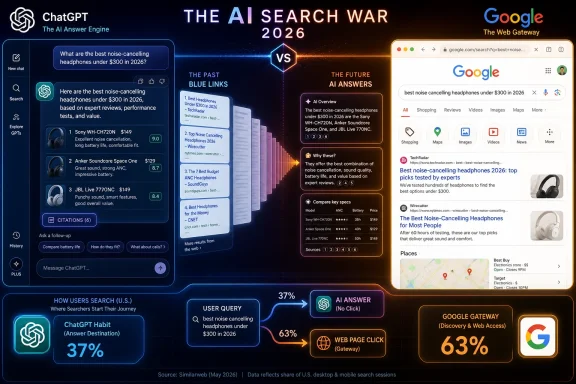 ChatGPT Owns the Habit Google Wishes It Had
ChatGPT’s advantage is not that it has replaced Google Search. It is that it has trained a huge audience to treat search as a conversation instead of a hunt. Users no longer need to assemble keywords, scan ten blue links, open five tabs, dodge cookie banners, and synthesize the answer themselves. They ask, refine, challenge, and move on.That is a profound behavioral shift. Google’s classic search interface was built around retrieval: here are the places where the answer may live. ChatGPT’s interface is built around resolution: here is the answer, shaped to your intent, with the option to keep going. The first model sends attention outward. The second keeps attention inside the product.
This is why the 79.05 percent figure matters, even if it does not mean ChatGPT is bigger than Google. In the standalone AI chatbot category, ChatGPT is not merely ahead; it is the default verb. Perplexity, Gemini, Copilot, Claude, and others may have strong products, but most ordinary users still reach for ChatGPT when they mean “ask AI.”
The irony is that Google spent decades trying to make search more answer-like. Featured snippets, knowledge panels, direct answers, weather boxes, sports scores, shopping modules, and local packs all taught users that Google could be more than an index. ChatGPT simply completed the move with a cleaner interaction model and a stronger illusion of finality.
Google Still Owns the Road to the Web
Google’s 90.39 percent global search-engine share is the counterweight to every premature obituary. Search is not just a destination; it is infrastructure. It is built into browsers, phones, address bars, Android defaults, Chrome muscle memory, Safari deals, enterprise habits, advertising systems, and millions of websites optimized around Google’s interpretation of relevance.That distribution moat is why Google can look threatened and dominant at the same time. A user may experiment with ChatGPT for research, but still use Google dozens of times a day for navigation, commerce, local queries, breaking news, images, maps, troubleshooting, and quick verification. The search box remains one of the most valuable pieces of real estate in computing.
Google also benefits from ambiguity. Many “searches” are not really requests for knowledge. They are attempts to reach a site, buy a product, find a nearby business, check a known source, compare prices, or confirm something current. These tasks still play to Google’s strengths, especially when freshness, location, inventory, and commercial intent are involved.
ChatGPT’s weakness is the mirror image of its appeal. A conversational answer can be elegant, but elegance is not the same as authority. For high-stakes, fast-changing, or transactional searches, users often still want the messy web: multiple sources, visible provenance, recent posts, reviews, forum threads, documentation, and the confidence that comes from checking more than one place.
The War Is Moving From Links to Citations
The phrase “AI search” undersells what is happening. This is not just search with a chatbot bolted on. It is a change in the economics of discovery. Traditional SEO rewarded the page that could rank, attract a click, and monetize the visit. AI search rewards the source that can be summarized, cited, or absorbed into an answer — sometimes without receiving the visit that used to justify the work.That is why publishers, retailers, software vendors, and community sites should pay close attention. The old bargain was imperfect but legible: websites created content, search engines crawled it, search results pointed users back, and advertising or subscriptions paid some of the bill. AI answers complicate that bargain by letting the platform extract utility from the page while reducing the need to open it.
Google is especially conflicted here. It has every incentive to defend the web ecosystem because that ecosystem supplies the content, commerce, and advertising surface that made Google rich. It also has every incentive to answer more questions directly because users like convenience and competitors are forcing the shift. The company is trying to preserve the link economy while teaching users that links are increasingly optional.
OpenAI has a different problem. ChatGPT can feel magical because it is not burdened by the legacy layout of search results. But if users begin treating it as a primary search engine, expectations change. They will demand fresher information, better citations, clearer source handling, fewer hallucinations, and a better relationship with the sites whose work supplies the answers.
AI Overviews Are Google’s Defensive Weapon and Its Self-Inflicted Wound
Google’s AI push inside search is best understood as a defensive maneuver. If users are going to ask conversational questions, Google would rather answer them inside Google than watch that behavior migrate to ChatGPT, Perplexity, or Copilot. AI Overviews and related answer features are therefore not side projects. They are Google’s attempt to keep the front door intact.But that defense creates an uncomfortable tension. The more complete the AI answer becomes, the less necessary the click may feel. A user who receives a compact, synthesized answer at the top of Google results may never scroll to the publishers, forums, documentation pages, and product sites that supplied the raw material. Google can say it is improving search, and from the user’s perspective that may be true. From the publisher’s perspective, improvement can look a lot like traffic extraction.
This is not entirely new. Google has been answering queries directly for years. What is new is the breadth of answerable queries and the human-like presentation of synthesis. A featured snippet usually extracted a small block. A generative answer can merge multiple sources, flatten disagreement, and present a polished response that feels less like a pointer and more like a destination.
That change places enormous pressure on attribution. In the link era, ranking first was the prize. In the AI answer era, being cited may be the prize, but the value of that citation is unsettled. A citation that no one clicks is branding, not traffic. For many sites, branding does not pay the hosting bill.
ChatGPT’s Lead Is Real, but It Is Not Yet a Search Monopoly
OpenAI’s position in AI chatbots looks commanding, but the category itself is young and fluid. The same StatCounter-style measurements that show ChatGPT far ahead also show competitors carving out meaningful niches. Gemini benefits from Google’s ecosystem. Copilot benefits from Windows, Edge, Microsoft 365, and enterprise procurement. Claude has mindshare among developers, writers, and technical users. Perplexity has made citation-forward AI search its identity.That fragmentation matters because AI habits may not consolidate the way classic search did. Users can keep Google as their default search engine, ChatGPT as their general assistant, Perplexity for source-heavy research, Claude for long writing or coding, and Copilot inside corporate Microsoft environments. The winner may not be a single box. It may be the assistant that happens to be closest to the task.
This is where Google has an underrated advantage. Gemini does not need to beat ChatGPT as a standalone chatbot to reshape search. It only needs to be good enough inside Android, Chrome, Gmail, Docs, YouTube, Maps, and Search. Google can distribute AI through products people already use, while OpenAI must keep persuading users to come directly to ChatGPT or encounter it through partners.
OpenAI, however, has the advantage of clarity. ChatGPT is not perceived as a search results page with AI features. It is perceived as the AI. That brand simplicity is powerful. Google must convince users that its AI layer is not just another search widget, while also avoiding the risk of making classic Google results feel obsolete.
Microsoft Is the Quiet Complication in a Two-Company Story
It is tempting to frame the search war as OpenAI versus Google, but Microsoft complicates the map. The company has integrated AI into Bing, Edge, Windows, GitHub, and Microsoft 365, and it has an unusually direct path into the workday. For WindowsForum readers, that matters more than consumer market share alone suggests.Copilot does not need to become the world’s favorite chatbot to be strategically important. If it is embedded in the tools employees use to write documents, analyze spreadsheets, summarize meetings, manage email, and administer systems, it can mediate a different kind of search: internal knowledge retrieval. That is not the public web, but it may be where a large share of economically valuable queries move.
The enterprise version of AI search is less about “best pizza near me” and more about “which customer contract allows this,” “what changed in this codebase,” “why did this server fail,” or “summarize our policy across these documents.” Google and OpenAI both want that territory, but Microsoft already has deep roots in the software where those questions arise.
This is also where the Windows platform becomes relevant again. If AI becomes a system-level interface rather than a website, operating-system integration matters. Search used to be something you did in a browser. Increasingly, it may be something invoked from the desktop, document editor, terminal, inbox, or meeting transcript. That is Microsoft’s opening.
The SEO Industry Is Being Rewritten in Real Time
The old SEO playbook was never static, but at least its center of gravity was clear. Crawlability, backlinks, topical authority, technical performance, structured data, freshness, and user intent all mattered because they influenced ranking. AI search does not erase those signals, but it changes the reward function.The new fight is often described as generative engine optimization, though the label is still slippery. The practical goal is straightforward: become the kind of source AI systems trust, summarize, and cite. That means clear authorship, factual density, original reporting, structured information, clean pages, consistent entity signals, and content that answers real questions without burying the answer under affiliate clutter.
Yet there is a dangerous fantasy forming around AI SEO. Some marketers talk as if citations can be engineered with the same mechanical certainty that keyword pages once targeted Google rankings. That is unlikely. AI systems synthesize from multiple signals, change rapidly, and may not cite the same source consistently across users, prompts, locations, or sessions.
The better lesson is harsher: mediocre content has less room to hide. In a link list, ten similar pages could all collect some traffic. In an AI answer, the model may compress those ten pages into one paragraph and cite only two of them, if any. When the interface collapses the results page, it also collapses the long tail of marginal content.
Forums and Communities Have New Leverage — and New Exposure
For a community publication like WindowsForum.com, the AI search shift cuts both ways. On one hand, forums contain exactly the kind of lived, specific, troubleshooting-rich material that generic AI answers need. Real users describe real errors, hardware combinations, driver conflicts, failed updates, registry fixes, and weird edge cases that official documentation often misses.On the other hand, that value is easy to summarize. A forum thread that once attracted a desperate user from Google may become a hidden ingredient in an AI answer. The user gets the fix; the community gets no new member, no page view, no reply, and no chance to update the thread with whether the solution still works.
This is one reason citations are not a cosmetic issue. Community knowledge is iterative. A Windows bug workaround from March may be unsafe after a June cumulative update. A driver fix may apply to one GPU branch but not another. A registry edit may be useful in a lab and reckless on a production machine. If AI systems flatten that context, they can turn community wisdom into brittle advice.
The opportunity is to make community content harder to ignore and easier to credit. Threads with clear accepted answers, version numbers, dates, hardware details, and follow-up confirmations are more useful to humans and machines alike. The messiness of forums is their authenticity, but structure is what lets that authenticity survive summarization.
Users Will Choose Convenience Until Trust Breaks
For ordinary users, the appeal of AI search is obvious. It is faster, more conversational, and often less annoying than navigating the modern web. Nobody misses autoplay videos, intrusive pop-ups, ad-choked recipe pages, SEO filler, and articles that spend 900 words delaying the answer.This is the uncomfortable truth publishers must face: AI search is not winning only because platforms are powerful. It is winning because much of the web trained users to prefer not visiting websites. If a chatbot can provide a useful answer without forcing the user through a maze of monetization, many users will accept that bargain.
But trust remains the limiting factor. ChatGPT and Google’s AI answers can still make mistakes, omit context, overstate certainty, or cite sources that do not fully support the claim. For casual queries, that may be tolerable. For medical, legal, financial, security, and system-administration advice, the cost of a confident wrong answer is much higher.
That is where Google’s legacy habits still matter. Users know how to triangulate on Google, even if imperfectly. They can compare sources, check dates, prefer official documentation, scan forums, and look for recent reports. AI search must make that verification path just as natural, or it risks becoming a beautifully written rumor engine.
The Click Is Becoming a Premium Event
The click is not dead, but it is becoming more selective. In the classic search model, users clicked because the result page was a directory. In the AI model, users click when the answer is insufficient, the stakes are high, the source is compelling, or the task requires action. That makes traffic less abundant but potentially more intentional.This shift will punish sites built purely to intercept low-value informational searches. If the query is “what is X,” “how many Y,” or “summarize Z,” AI can often satisfy it without a visit. The more generic the content, the more vulnerable it is to answer engines.
By contrast, sites with original data, expert communities, tools, downloads, calculators, interactive comparisons, strong personalities, or timely reporting have more durable reasons to be visited. AI can summarize a benchmark, but it cannot replace the full dataset for a serious buyer. It can describe a Windows issue, but it cannot fully replace a living thread where users test fixes across configurations.
The click, in other words, becomes a vote of depth. Users will still click when they need proof, nuance, authority, transaction, or community. The web’s challenge is to produce more of those reasons and less filler designed for a search engine that is rapidly learning to eat filler for breakfast.
Regulators Will Notice the New Gatekeepers
The AI search war also has an antitrust shadow. Google’s search dominance has already drawn regulatory scrutiny in multiple markets, and adding AI answers to the top of results will intensify questions about self-preferencing, publisher dependence, and control over discovery. If Google both summarizes the web and controls the main path to it, regulators will ask whether the bargain remains fair.OpenAI faces a different version of the same problem. It does not have Google’s search monopoly, but it has enormous influence over how users encounter information inside ChatGPT. If ChatGPT becomes a major answer gateway, its source choices, ranking behavior, partnerships, and citation practices will matter. A platform does not need classic search share to become a discovery gatekeeper.
Publishers may push harder for licensing, opt-outs, revenue sharing, or technical standards for AI crawling and attribution. Some already see AI companies as building products on top of content they did not pay enough to use. Others fear that blocking AI crawlers could make them invisible in the next discovery layer. That is the prisoner’s dilemma at the heart of the AI web.
Users are unlikely to care about these mechanics until something breaks. But the economics behind the interface will shape the information supply. If answer engines reduce traffic to the sites that produce useful work, fewer sites will produce useful work. The long-term risk is not merely that AI search kills SEO. It is that it weakens the web it depends on.
The 2026 Scoreboard Rewards Two Different Kinds of Power
The clean answer to “who wins” is unsatisfying because ChatGPT and Google are winning different contests. ChatGPT is winning the standalone AI assistant habit. Google is winning the search distribution war. The strategic question is which contest becomes more important over the next few years.If search continues to mean “find me places on the web,” Google remains extraordinarily hard to dislodge. Its index, ad marketplace, default placements, local data, shopping infrastructure, and user habit are unmatched. Even a better chatbot does not automatically replace that machinery.
If search increasingly means “give me the answer and help me act on it,” ChatGPT’s position looks more dangerous to Google. The interface is simpler, the brand is stronger in AI, and the user expectation is different. People do not go to ChatGPT to browse results. They go there to complete a thought.
The most likely outcome is not a single winner but a redraw of the map. Google keeps much of navigational, commercial, local, and default search. ChatGPT captures a growing share of exploratory, creative, educational, coding, and synthesis-heavy queries. Microsoft, Perplexity, Claude, and others take slices based on context, trust, and workflow integration.
The Web Learns That Being Indexed Is No Longer Enough
For site owners, the strategic adjustment is blunt. Being indexable used to be the baseline. Now, being understandable, attributable, and worth visiting matters more. AI systems are less impressed by content that merely exists and more dependent on content that can be parsed into reliable claims.That means the practical work changes. Dates need to be visible. Authors need to be credible. Product claims need evidence. Technical fixes need version numbers. Comparisons need methodology. Forum answers need confirmation. Pages need to distinguish first-hand reporting from recycled summaries.
This does not mean every site should chase AI bots at the expense of human readers. That would repeat the worst mistakes of SEO. The better approach is to make pages genuinely useful in ways that machines can recognize and humans can verify. The same structure that helps an AI cite a page often helps a reader trust it.
The sites that survive this transition will not be the ones that declare SEO dead and pivot to buzzwords. They will be the ones that understand the new funnel: visibility may happen inside an answer, trust may depend on a citation, and the click must be earned by offering something the answer cannot fully contain.
The New Search Winner Is the One That Controls the Next Action
The real prize is not the answer. It is the next action. Search has always been valuable because it sits between intent and outcome. A user wants to buy, fix, learn, travel, install, compare, diagnose, or decide. Whoever mediates that moment can shape where money, attention, and trust flow.Google’s advertising empire was built on that insight. A search query is a signal of intent, and intent is monetizable. ChatGPT’s challenge is to turn conversational intent into a business without making the product feel like a sponsored concierge. Google’s challenge is to add AI without destroying the ad-supported link economy that funds its dominance.
This is why the “answers versus links” framing is too narrow. The future interface will not stop at answering. It will book, buy, configure, summarize, draft, compare, execute code, open apps, change settings, and hand off tasks to agents. At that point, the search war becomes an operating-system war, a browser war, a cloud war, and a commerce war all at once.
For Windows users and administrators, this could become very concrete. The assistant that can diagnose an update failure, check known issues, inspect logs, recommend a fix, and apply a safe remediation path is more valuable than a page of results. But it is also more dangerous if it is wrong. The more action AI takes, the more accountability matters.
The Numbers Say Split Decision; the Product Roadmaps Say Collision Course
The May 2026 numbers make one thing clear: ChatGPT has not dethroned Google Search, and Google has not neutralized ChatGPT. One dominates the emerging AI chatbot habit; the other dominates the established search market. That is not peace. It is a collision waiting for user behavior to decide which interface becomes primary.Near term, users will keep both. They will Google for what feels current, commercial, local, or source-sensitive. They will ask ChatGPT for what feels complex, messy, personal, or synthesis-heavy. Over time, the boundary will move as AI answers become more current and Google’s results become more conversational.
The companies know this. Google is pushing AI deeper into results because it cannot allow answer-seeking to leave its ecosystem. OpenAI is pushing ChatGPT toward search because a chatbot that cannot reliably use the web leaves too much intent on the table. Both are trying to own the same moment: the instant a user turns uncertainty into action.
For publishers and communities, waiting for a final winner is the wrong strategy. The web is already being re-priced around citations, summaries, and fewer casual clicks. The next advantage belongs to sites that are authoritative enough to be used, clear enough to be cited, and valuable enough to be visited anyway.
The Practical Readout for the AI Search Front
The immediate lesson from the ChatGPT-Google split is that the market is not replacing one monopoly with another overnight. It is separating search into layers: discovery, synthesis, verification, and action. Each layer may have a different winner.- ChatGPT is the clear leader in standalone AI chatbot usage, but that does not make it the overall search leader.
- Google remains the dominant global search engine, and its distribution through browsers, mobile devices, and default habits is still a massive advantage.
- The most important shift for websites is from ranking for clicks to being cited, trusted, and still worth visiting after an AI summary.
- AI Overviews and chatbot answers threaten low-value informational traffic first, especially pages that exist mainly to restate commodity facts.
- Forums, technical communities, and original publishers have leverage because AI systems need lived expertise, but they also face the risk of being summarized without gaining audience.
- The long-term winner will be the platform that best connects answers to trustworthy action without breaking user confidence or starving the web of incentives.
References
- Primary source: Techloy
Published: 2026-06-12T18:50:15.593344
ChatGPT vs Google: Who Wins the AI Search War in 2026?
ChatGPT leads AI chatbots, Google owns search, but the real 2026 fight is over who gets the click, and what it means for SEO and the web. www.techloy.com
- Related coverage: gs.statcounter.com
Search Engine Market Share Worldwide | Statcounter Global Stats
This graph shows the market share of search engines worldwide based on over 3 billion monthly page views.gs.statcounter.com - Related coverage: statista.com
- Related coverage: visalytica.com
- Related coverage: techradar.com
ChatGPT just hit its lowest referral share ever as Gemini and Perplexity quietly keep stealing frustrated users away | TechRadar
QuitGPT backlash triggered a dramatic AI trafficwww.techradar.com - Related coverage: llmsforge.com
ChatGPT vs Google: How AI is Changing Search Forever (2026)
Discover how ChatGPT and AI chatbots are revolutionizing search. Compare traditional Google search vs AI-powered alternatives and learn what it means for your website.www.llmsforge.com
- Related coverage: searchlab.nl

Search Engine Market Share Statistics 2026 | Google, Bing, AI Search & More
50+ search engine market share statistics 2026: Google dominance, Bing & Copilot growth, ChatGPT Search rise, zero-click searches and search volume trends. Sources: StatCounter, SimilarWeb, Statista, SparkToro, Datos.
searchlab.nl
- Related coverage: aboutchromebooks.com
Google Search Market Share Statistics 2026
Google held 90.04% of the global search engine market across all devices in January 2026, according to StatCounter data. That number masks real pressurewww.aboutchromebooks.com - Related coverage: foglift.io
ChatGPT vs Google AI Overview Citations 2026 | Source Overlap Study | Foglift
Foglift compared 75 buyer-intent prompts across ChatGPT and Google AI Overview, finding only 4.1% average citation-domain overlap.foglift.io
- Related coverage: searchendurance.com
Search Engine Market Share For 2026: Who Is Winning?
Want to know who’s winning in the internet search market? Check out our data-driven review of search engine market share to find out…searchendurance.com - Related coverage: ashgabattimes.com
ChatGPT turned out to be the most popular chat boot with its 81% of the entire market
PDF documentashgabattimes.com
