

Yes—new EMARKETER forecasts suggest ChatGPT’s role in AI advertising will be much smaller than the industry’s most exuberant expectations, with US AI-related ad spending projected to grow from about $32 billion in 2026 to roughly $68 billion by 2030. The surprise is not that AI advertising is growing; almost every incentive in the digital economy points that way. The surprise is where the money is expected to land: not primarily inside standalone chatbots, but beside AI-shaped search results, shopping prompts, and the old keyword machinery wearing a new model-driven coat. For Windows users, sysadmins, marketers, and anyone watching Microsoft’s Copilot ambitions, that distinction matters because it says the next ad platform may look less like a chat window and more like the search-and-commerce stack we already know.
For the past two years, one of the more seductive ideas in tech finance has been that conversational AI would become the next great advertising interface. If a user tells ChatGPT, Copilot, Gemini, or Claude exactly what they want, the theory goes, an ad system should be able to serve a pitch with almost supernatural precision. A chatbot knows the intent, the context, the constraints, and sometimes the budget.
That is the fantasy version. It imagines the conversational prompt as a cleaner, higher-margin replacement for the search query. Instead of bidding on “best laptop for college,” advertisers could theoretically pay to influence the assistant when the user asks, “What laptop should I buy for engineering school if I need good battery life and Linux compatibility?”
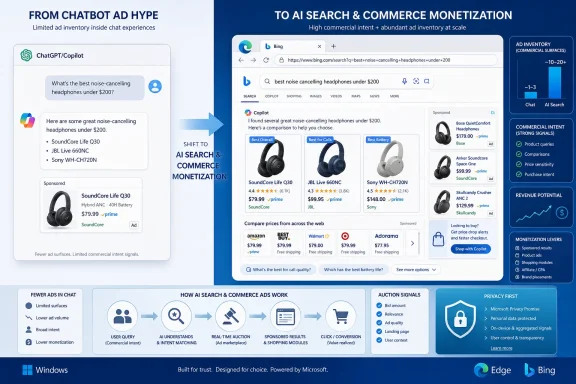
The EMARKETER forecast cuts against that narrative. It does not say chatbot advertising is dead, or even irrelevant. It says the standalone chatbot is likely to be the smallest slice of the AI advertising market, with US chatbot ad spending projected to reach only a little over $5 billion by 2030. In a market forecast to exceed $68 billion, that is not the commanding position many assumed ChatGPT-style interfaces would occupy.
That is a meaningful reset. It suggests that conversational AI may be a powerful user interface, a costly compute platform, and a strategic wedge into productivity software, while still being a surprisingly awkward place to run ads at scale.
That sounds less futuristic than a sponsored answer inside ChatGPT. It is also much easier to buy, measure, optimize, and defend in a marketing budget meeting. Search advertising has two decades of infrastructure behind it: bidding systems, conversion tracking, negative keywords, quality scores, landing-page testing, agency playbooks, brand-safety rules, and CFO-friendly dashboards.
AI does not erase that machinery. It gives Google and Microsoft a way to extend it. If a user sees an AI-generated answer at the top of a results page, the surrounding commercial real estate can still be sold through familiar systems. The ad buyer may not need a new chatbot strategy; they may need a revised search strategy.
That is why the forecast is so damaging to the idea that ChatGPT instantly becomes the new Google Ads. The advertising industry does not just follow attention. It follows measurable intent, repeatable formats, and procurement paths that agencies can scale across thousands of clients. Search already has those. Standalone chatbots are still inventing them.
Put too many ads into a chatbot response and the assistant stops feeling like an assistant. Put too few in, and the economics disappoint. That is the structural problem now confronting AI platforms that hoped advertising would become a compute-subsidy engine.
A chatbot answer also has fewer natural surfaces. A search page can show several sponsored results without breaking the basic contract of search. A conversational assistant usually gives one answer, or a small set of recommendations. If an ad appears inside that answer, users may wonder whether the model is helping them or steering them.
That trust problem is not cosmetic. It goes to the core of the product. People use AI assistants because they expect synthesis, judgment, and reduced friction. If the assistant’s judgment is visibly monetized, every recommendation becomes suspect. Advertising may be financially necessary for AI companies, but it is also corrosive if users believe the model has been converted from adviser into sales rep.
The forecast implies a colder view. Even if ChatGPT remains one of the most important consumer AI products, importance does not automatically translate into ad inventory. A tool can be culturally central and commercially constrained. Wikipedia is central. Messaging apps are central. Operating systems are central. None of those map neatly onto search-style ad monetization without creating user experience problems.
The bigger issue is pricing. Early AI ad experiments can command novelty premiums, especially when brands want to be seen as forward-looking. But novelty premiums rarely survive scale. Once advertisers demand proof, CPMs fall toward what performance and measurement can justify.
That is why “ChatGPT ads” may prove less like search ads and more like a high-touch emerging-media format. Useful for brand experiments, interesting for certain categories, potentially lucrative in narrow contexts, but not necessarily the default destination for tens of billions of dollars in annual spend.
Microsoft already has Bing, Microsoft Advertising, Edge, LinkedIn, retail media partnerships, and a long history of selling into enterprise accounts. Its opportunity is not limited to putting ads in Copilot chat. It can embed AI into search, shopping, productivity discovery, and campaign tooling.
That distinction matters for WindowsForum readers because Copilot on the desktop is not just a product feature; it is part of Microsoft’s attempt to make Windows a front door to AI services. If the ad market does not reward direct chatbot inventory, Microsoft has less reason to turn every Copilot interaction into a sponsored suggestion. It has more reason to connect Copilot to search, commerce, and workflow contexts where advertising already makes sense.
The risk, of course, is that Microsoft tries to do both. Windows users have long memories when it comes to Start menu promotions, Edge nudges, Microsoft account prompts, and “recommended” content that feels more like inventory than assistance. If AI advertising migrates into the operating system, the backlash will not be theoretical.
The EMARKETER numbers suggest a more complicated story. AI may disrupt search behavior, but Google is still positioned to capture a large share of the resulting ad spend because the money is flowing into search-adjacent environments. In other words, the winning ad format may be AI wrapped around search, not AI replacing search.
That is why Google’s AI Overviews, AI Mode, and ad reporting changes matter. Google is not simply adding a chatbot to search. It is trying to preserve the commercial structure of search while changing the answer format. The user sees more synthesis; the advertiser still buys through a familiar marketplace.
This is classic incumbent adaptation. Google can afford to let the interface evolve as long as the auction survives. The threat is not that users see AI-generated answers. The threat is that users leave Google’s monetizable environment entirely. If they do not, AI becomes a feature inside the existing ad empire rather than a revolution outside it.
In a search ad, the advertiser can at least understand the rough relationship between query, keyword, ad copy, landing page, and conversion. In a chatbot or AI-generated answer environment, the chain is murkier. The model may interpret intent, rewrite context, blend sources, and present recommendations in ways the advertiser cannot fully inspect.
That makes AI advertising powerful and unsettling. If the system works, it may find customers no human media planner would have identified. If it fails, the advertiser may not know why. Worse, the brand may appear in contexts that are difficult to audit after the fact.
This explains the cautious confidence in the market. Marketers want AI tools in workflows because they reduce labor and increase speed. They are less eager to hand budget to AI-native ad systems that cannot clearly explain placement, attribution, or incrementality. The distinction between using AI to make ads and buying ads inside AI is becoming one of the industry’s most important dividing lines.
TikTok Shop’s rise as a standalone line item in agency planning points in the same direction. It is not merely a social platform with ads. It is a commerce environment where discovery, persuasion, and checkout sit close together. For many advertisers, that is easier to justify than an experimental chatbot placement whose downstream impact may be hard to prove.
This is where the AI ad conversation gets more grounded. Brands do not spend because a format is novel; they spend because it moves product. If AI search helps users choose a product, it can attract money. If commerce platforms use AI to personalize discovery and shorten the path to purchase, they can attract money. If a chatbot produces a pleasant conversation but cannot reliably generate measurable sales, it will struggle.
The future of AI advertising may therefore belong less to “assistants” and more to decision environments. Search is a decision environment. Retail media is a decision environment. Social commerce is becoming one. A general-purpose chatbot is sometimes a decision environment, but often it is a tutor, therapist, coding helper, writing partner, or brainstorming tool. Not every use case wants an ad.
A retailer using loyalty data for ad targeting cannot simply assume that a broad consent checkbox covers every downstream use. Regulators increasingly expect granular control, clear legal justification, and proof that data collected for one purpose is not quietly repurposed for another. AI makes those questions harder, not easier.
This is not just a European issue. Even US companies operating globally must design systems that can survive GDPR scrutiny, platform policy changes, and state-level privacy laws. If AI ad systems become too opaque, they will attract the same regulatory suspicion already aimed at behavioral advertising, with the added complication that model-driven decisions can be difficult to explain.
For enterprise IT, that means the AI advertising boom is not only a marketing story. It is a governance story. Data pipelines, consent records, identity graphs, customer match exports, and AI model integrations all become audit surfaces. The ad budget may sit in marketing, but the risk often lands with legal, security, and IT.
Edge, Chrome, Windows Search, Bing, Google Search, and AI-powered shopping surfaces are where user intent becomes monetizable at scale. If AI advertising follows search-adjacent formats, the browser becomes the battlefield. The chat window may be the demo; the address bar is the business.
This is particularly relevant as AI features become more deeply integrated into operating systems and productivity suites. A user asking Copilot to summarize a document is not necessarily in a buying frame of mind. A user asking Edge or Bing to compare monitors, book travel, choose software, or troubleshoot a device may be. The commercial opportunity is not evenly distributed across AI use cases.
That unevenness should reassure users in some contexts and worry them in others. It suggests that Microsoft may have limited incentive to jam ads into every Copilot interaction. It also suggests that search, shopping, and recommendation flows could become more aggressively commercial under the banner of AI assistance.
AI summaries weaken that bargain. If the answer is extracted, condensed, and presented on the results page, the user may never click. Yet ads can still appear around the AI-generated answer. The platform captures monetization; the publisher supplies some of the informational substrate; the user gets convenience; the open web loses another slice of economic oxygen.
Google and Microsoft argue, in different ways, that AI search can still drive high-quality traffic and that publishers can manage visibility through controls and optimization. Some of that may be true. But the direction of travel is obvious: the more complete the answer on the platform, the less necessary the click becomes.
For advertisers, this may be efficient. For publishers, it is existential. For users, it is ambiguous. AI summaries can be useful, but a web mediated by a handful of answer engines is a narrower web, especially when the answer engines also sell the ads.
A chatbot is not a search results page. AI Mode is not the same as ChatGPT. A shopping recommendation inside TikTok is not the same as a Copilot summary in Word. An AI-generated product comparison on Bing is not the same as a sponsored response in a general-purpose assistant.
EMARKETER’s forecast is valuable because it forces that segmentation. It says the market is growing quickly, but not evenly. The money is going where the ad industry already has buying habits, measurement systems, and user intent. That may sound conservative, but it is often how platform transitions work.
Mobile advertising did not win because every app became a perfect ad product. It won because search, social, video, and app-install ecosystems learned how to monetize mobile attention. AI advertising may follow the same pattern. The winners will not necessarily be the most magical interfaces; they will be the surfaces where commercial intent can be measured without destroying the user experience.
Standalone chatbot platforms have a harder job. They must preserve user trust, create ad formats, prove performance, manage brand safety, and avoid making the assistant feel compromised. They must do all of that while paying enormous infrastructure bills and competing with subscription, enterprise, and API revenue models.
That does not mean OpenAI or other AI labs cannot build large ad businesses. They may. But the forecast suggests that the easy assumption—that chatbots inherit the economics of search because they inherit some search behavior—is too simple. User intent is necessary for advertising. It is not sufficient.
The more realistic scenario is hybrid. Chatbots will carry some ads, some affiliate-like commerce, and some sponsored recommendations. Search engines will absorb AI features and keep selling auctions. Retail media will use AI to sharpen targeting and product discovery. Social commerce will turn recommendation into checkout. The ad market will call all of this “AI,” even though the business models will be very different.
 The Chatbot Was Supposed to Eat the Ad Market
For the past two years, one of the more seductive ideas in tech finance has been that conversational AI would become the next great advertising interface. If a user tells ChatGPT, Copilot, Gemini, or Claude exactly what they want, the theory goes, an ad system should be able to serve a pitch with almost supernatural precision. A chatbot knows the intent, the context, the constraints, and sometimes the budget.That is the fantasy version. It imagines the conversational prompt as a cleaner, higher-margin replacement for the search query. Instead of bidding on “best laptop for college,” advertisers could theoretically pay to influence the assistant when the user asks, “What laptop should I buy for engineering school if I need good battery life and Linux compatibility?”
The EMARKETER forecast cuts against that narrative. It does not say chatbot advertising is dead, or even irrelevant. It says the standalone chatbot is likely to be the smallest slice of the AI advertising market, with US chatbot ad spending projected to reach only a little over $5 billion by 2030. In a market forecast to exceed $68 billion, that is not the commanding position many assumed ChatGPT-style interfaces would occupy.
That is a meaningful reset. It suggests that conversational AI may be a powerful user interface, a costly compute platform, and a strategic wedge into productivity software, while still being a surprisingly awkward place to run ads at scale.
Search Keeps Winning Because It Already Knows How to Sell
The most important fact in the forecast is not the total number. It is the composition. More than 80 percent of US AI ad spending in 2026 is expected to go into AI search-adjacent placements: ads that appear near AI-generated summaries, AI Overviews, AI-assisted search pages, and traditional search results improved by machine learning.That sounds less futuristic than a sponsored answer inside ChatGPT. It is also much easier to buy, measure, optimize, and defend in a marketing budget meeting. Search advertising has two decades of infrastructure behind it: bidding systems, conversion tracking, negative keywords, quality scores, landing-page testing, agency playbooks, brand-safety rules, and CFO-friendly dashboards.
AI does not erase that machinery. It gives Google and Microsoft a way to extend it. If a user sees an AI-generated answer at the top of a results page, the surrounding commercial real estate can still be sold through familiar systems. The ad buyer may not need a new chatbot strategy; they may need a revised search strategy.
That is why the forecast is so damaging to the idea that ChatGPT instantly becomes the new Google Ads. The advertising industry does not just follow attention. It follows measurable intent, repeatable formats, and procurement paths that agencies can scale across thousands of clients. Search already has those. Standalone chatbots are still inventing them.
The Ad Slot Inside a Conversation Is Smaller Than the Hype
A search results page can tolerate clutter. Users may dislike it, publishers may resent it, and regulators may scrutinize it, but the format is built around multiple links, snippets, shopping units, local packs, and sponsored placements. A conversation is different. It feels personal, sequential, and fragile.Put too many ads into a chatbot response and the assistant stops feeling like an assistant. Put too few in, and the economics disappoint. That is the structural problem now confronting AI platforms that hoped advertising would become a compute-subsidy engine.
A chatbot answer also has fewer natural surfaces. A search page can show several sponsored results without breaking the basic contract of search. A conversational assistant usually gives one answer, or a small set of recommendations. If an ad appears inside that answer, users may wonder whether the model is helping them or steering them.
That trust problem is not cosmetic. It goes to the core of the product. People use AI assistants because they expect synthesis, judgment, and reduced friction. If the assistant’s judgment is visibly monetized, every recommendation becomes suspect. Advertising may be financially necessary for AI companies, but it is also corrosive if users believe the model has been converted from adviser into sales rep.
OpenAI’s Ambition Meets the Math of Inventory
OpenAI has reportedly floated very large advertising ambitions, including projections far above what EMARKETER now sees for the entire US chatbot ad category. Those numbers are not impossible in a global, long-term sense, but they require assumptions that are hard to square with the early shape of the market. A platform would need massive user reach, very high ad prices, broad advertiser adoption, and little user backlash.The forecast implies a colder view. Even if ChatGPT remains one of the most important consumer AI products, importance does not automatically translate into ad inventory. A tool can be culturally central and commercially constrained. Wikipedia is central. Messaging apps are central. Operating systems are central. None of those map neatly onto search-style ad monetization without creating user experience problems.
The bigger issue is pricing. Early AI ad experiments can command novelty premiums, especially when brands want to be seen as forward-looking. But novelty premiums rarely survive scale. Once advertisers demand proof, CPMs fall toward what performance and measurement can justify.
That is why “ChatGPT ads” may prove less like search ads and more like a high-touch emerging-media format. Useful for brand experiments, interesting for certain categories, potentially lucrative in narrow contexts, but not necessarily the default destination for tens of billions of dollars in annual spend.
Microsoft’s Copilot Problem Is Also Microsoft’s Advantage
For Microsoft, the forecast lands in an especially interesting place. Copilot is both a standalone assistant and a layer across Windows, Edge, Bing, Microsoft 365, GitHub, and enterprise workflows. If chatbot ads underperform, that may weaken one version of the Copilot monetization story. But it does not necessarily weaken Microsoft’s broader AI advertising position.Microsoft already has Bing, Microsoft Advertising, Edge, LinkedIn, retail media partnerships, and a long history of selling into enterprise accounts. Its opportunity is not limited to putting ads in Copilot chat. It can embed AI into search, shopping, productivity discovery, and campaign tooling.
That distinction matters for WindowsForum readers because Copilot on the desktop is not just a product feature; it is part of Microsoft’s attempt to make Windows a front door to AI services. If the ad market does not reward direct chatbot inventory, Microsoft has less reason to turn every Copilot interaction into a sponsored suggestion. It has more reason to connect Copilot to search, commerce, and workflow contexts where advertising already makes sense.
The risk, of course, is that Microsoft tries to do both. Windows users have long memories when it comes to Start menu promotions, Edge nudges, Microsoft account prompts, and “recommended” content that feels more like inventory than assistance. If AI advertising migrates into the operating system, the backlash will not be theoretical.
Google’s Supposed Disruption Looks More Like Self-Defense
Google appears, at first glance, to be the company most threatened by AI search. If AI answers satisfy the query without a click, the traditional search engine results page becomes less central. Publishers lose traffic, users change habits, and Google’s ad machine faces pressure.The EMARKETER numbers suggest a more complicated story. AI may disrupt search behavior, but Google is still positioned to capture a large share of the resulting ad spend because the money is flowing into search-adjacent environments. In other words, the winning ad format may be AI wrapped around search, not AI replacing search.
That is why Google’s AI Overviews, AI Mode, and ad reporting changes matter. Google is not simply adding a chatbot to search. It is trying to preserve the commercial structure of search while changing the answer format. The user sees more synthesis; the advertiser still buys through a familiar marketplace.
This is classic incumbent adaptation. Google can afford to let the interface evolve as long as the auction survives. The threat is not that users see AI-generated answers. The threat is that users leave Google’s monetizable environment entirely. If they do not, AI becomes a feature inside the existing ad empire rather than a revolution outside it.
The “Black Box” Problem Is Bigger in AI Than in Search
Marketers already complain that modern digital advertising is opaque. Performance Max campaigns, automated bidding, algorithmic placements, and privacy-constrained measurement have trained advertisers to accept less control than they once had. AI-native advertising adds another layer of uncertainty.In a search ad, the advertiser can at least understand the rough relationship between query, keyword, ad copy, landing page, and conversion. In a chatbot or AI-generated answer environment, the chain is murkier. The model may interpret intent, rewrite context, blend sources, and present recommendations in ways the advertiser cannot fully inspect.
That makes AI advertising powerful and unsettling. If the system works, it may find customers no human media planner would have identified. If it fails, the advertiser may not know why. Worse, the brand may appear in contexts that are difficult to audit after the fact.
This explains the cautious confidence in the market. Marketers want AI tools in workflows because they reduce labor and increase speed. They are less eager to hand budget to AI-native ad systems that cannot clearly explain placement, attribution, or incrementality. The distinction between using AI to make ads and buying ads inside AI is becoming one of the industry’s most important dividing lines.
Retail Media Has the One Thing Chatbots Lack
While chatbot advertising wrestles with trust and inventory, retail media keeps gaining ground for a simpler reason: it is close to the transaction. Amazon, Walmart, Instacart, Target, and other retail media networks can connect ad exposure to purchase behavior in ways that look concrete to brands. That clarity is seductive in a measurement-starved market.TikTok Shop’s rise as a standalone line item in agency planning points in the same direction. It is not merely a social platform with ads. It is a commerce environment where discovery, persuasion, and checkout sit close together. For many advertisers, that is easier to justify than an experimental chatbot placement whose downstream impact may be hard to prove.
This is where the AI ad conversation gets more grounded. Brands do not spend because a format is novel; they spend because it moves product. If AI search helps users choose a product, it can attract money. If commerce platforms use AI to personalize discovery and shorten the path to purchase, they can attract money. If a chatbot produces a pleasant conversation but cannot reliably generate measurable sales, it will struggle.
The future of AI advertising may therefore belong less to “assistants” and more to decision environments. Search is a decision environment. Retail media is a decision environment. Social commerce is becoming one. A general-purpose chatbot is sometimes a decision environment, but often it is a tutor, therapist, coding helper, writing partner, or brainstorming tool. Not every use case wants an ad.
Privacy Enforcement Will Shape the Market Before Users Do
The forecast also sits against a tightening regulatory backdrop, particularly in Europe. Privacy authorities are paying close attention to consent, loyalty-program data, customer matching, and purpose limitation. That matters because AI advertising depends heavily on data interpretation, enrichment, and prediction.A retailer using loyalty data for ad targeting cannot simply assume that a broad consent checkbox covers every downstream use. Regulators increasingly expect granular control, clear legal justification, and proof that data collected for one purpose is not quietly repurposed for another. AI makes those questions harder, not easier.
This is not just a European issue. Even US companies operating globally must design systems that can survive GDPR scrutiny, platform policy changes, and state-level privacy laws. If AI ad systems become too opaque, they will attract the same regulatory suspicion already aimed at behavioral advertising, with the added complication that model-driven decisions can be difficult to explain.
For enterprise IT, that means the AI advertising boom is not only a marketing story. It is a governance story. Data pipelines, consent records, identity graphs, customer match exports, and AI model integrations all become audit surfaces. The ad budget may sit in marketing, but the risk often lands with legal, security, and IT.
Windows Users Should Watch the Browser, Not Just the Bot
The consumer debate often focuses on whether ChatGPT, Copilot, or Gemini will show ads in chat. That is understandable, because a sponsored answer inside a personal assistant feels like a bright line. But the more consequential shift may happen in the browser and search box.Edge, Chrome, Windows Search, Bing, Google Search, and AI-powered shopping surfaces are where user intent becomes monetizable at scale. If AI advertising follows search-adjacent formats, the browser becomes the battlefield. The chat window may be the demo; the address bar is the business.
This is particularly relevant as AI features become more deeply integrated into operating systems and productivity suites. A user asking Copilot to summarize a document is not necessarily in a buying frame of mind. A user asking Edge or Bing to compare monitors, book travel, choose software, or troubleshoot a device may be. The commercial opportunity is not evenly distributed across AI use cases.
That unevenness should reassure users in some contexts and worry them in others. It suggests that Microsoft may have limited incentive to jam ads into every Copilot interaction. It also suggests that search, shopping, and recommendation flows could become more aggressively commercial under the banner of AI assistance.
The Publisher Bargain Is Getting Worse
AI search-adjacent advertising also raises an uncomfortable question: who gets paid when AI summarizes the web? Traditional search sent traffic outward, at least in theory. Publishers tolerated Google’s dominance because ranking well could produce visits, subscriptions, affiliate revenue, and display ad impressions.AI summaries weaken that bargain. If the answer is extracted, condensed, and presented on the results page, the user may never click. Yet ads can still appear around the AI-generated answer. The platform captures monetization; the publisher supplies some of the informational substrate; the user gets convenience; the open web loses another slice of economic oxygen.
Google and Microsoft argue, in different ways, that AI search can still drive high-quality traffic and that publishers can manage visibility through controls and optimization. Some of that may be true. But the direction of travel is obvious: the more complete the answer on the platform, the less necessary the click becomes.
For advertisers, this may be efficient. For publishers, it is existential. For users, it is ambiguous. AI summaries can be useful, but a web mediated by a handful of answer engines is a narrower web, especially when the answer engines also sell the ads.
The Forecast Is a Warning Against Category Error
The biggest mistake in early AI advertising discourse was treating “AI” as a single media channel. It is not. AI is a capability being inserted into search, social, retail, productivity, customer service, creative tooling, analytics, and operating systems. Each surface has different economics.A chatbot is not a search results page. AI Mode is not the same as ChatGPT. A shopping recommendation inside TikTok is not the same as a Copilot summary in Word. An AI-generated product comparison on Bing is not the same as a sponsored response in a general-purpose assistant.
EMARKETER’s forecast is valuable because it forces that segmentation. It says the market is growing quickly, but not evenly. The money is going where the ad industry already has buying habits, measurement systems, and user intent. That may sound conservative, but it is often how platform transitions work.
Mobile advertising did not win because every app became a perfect ad product. It won because search, social, video, and app-install ecosystems learned how to monetize mobile attention. AI advertising may follow the same pattern. The winners will not necessarily be the most magical interfaces; they will be the surfaces where commercial intent can be measured without destroying the user experience.
The Near-Term Winners Are the Least Surprising Ones
The companies best positioned for this phase are the ones that already sit between intent and transaction. Google has search scale. Microsoft has Bing, Edge, Copilot, LinkedIn, and enterprise distribution. Amazon and Walmart have purchase data. TikTok has social commerce momentum. Ad tech firms have incentives to package AI inventory into something agencies can buy without reinventing their operating model.Standalone chatbot platforms have a harder job. They must preserve user trust, create ad formats, prove performance, manage brand safety, and avoid making the assistant feel compromised. They must do all of that while paying enormous infrastructure bills and competing with subscription, enterprise, and API revenue models.
That does not mean OpenAI or other AI labs cannot build large ad businesses. They may. But the forecast suggests that the easy assumption—that chatbots inherit the economics of search because they inherit some search behavior—is too simple. User intent is necessary for advertising. It is not sufficient.
The more realistic scenario is hybrid. Chatbots will carry some ads, some affiliate-like commerce, and some sponsored recommendations. Search engines will absorb AI features and keep selling auctions. Retail media will use AI to sharpen targeting and product discovery. Social commerce will turn recommendation into checkout. The ad market will call all of this “AI,” even though the business models will be very different.
The Numbers Point Back to the Search Box
The practical lesson from the forecast is not that ChatGPT has failed as an advertising platform. It is that the market is assigning a lower value to standalone conversational inventory than the hype cycle implied. That has several concrete consequences for the next four years.- Advertisers should treat chatbot ads as an experimental channel, not as a replacement for paid search, retail media, or social commerce.
- Search teams will likely own much of the first wave of AI ad spending because the dominant formats still resemble search more than conversational media.
- Microsoft’s biggest AI ad opportunity may be in Bing, Edge, shopping, and campaign infrastructure rather than in forcing ads into every Copilot exchange.
- Brands should be cautious about AI visibility vendors promising special tricks, because Google is framing generative search optimization as an extension of ordinary SEO rather than a separate magic discipline.
- IT and compliance teams should expect more scrutiny of consent, customer matching, and loyalty-data reuse as AI targeting systems become more complex.
- Users should watch for commercialization in search and shopping surfaces first, because that is where AI advertising can scale without looking like a banner ad pasted into a private conversation.
References
- Primary source: Mathrubhumi English
Published: 2026-06-10T08:50:11.911388
US AI Ad Spending Forecast: Search-Driven Growth Reaches $68B by 2030
EMARKETER projects US AI ad spend to hit $68B by 2030. Discover why search-integrated ads are outpacing chatbots. Read the full industry analysis now.english.mathrubhumi.com - Related coverage: emarketer.com
US AI Advertising Forecast 2026
AI is reshaping search faster than AI platforms can build their ad offerings, which is why most spending still sits beside AI-generated results. Conversational search ads will grow quickly and chatbot ads will struggle to prove their effectiveness.www.emarketer.com - Related coverage: scba.com
- Related coverage: ppcnewsfeed.com
Microsoft Advertising Introduces Data-Driven Attribution
Microsoft Ads has launched data-driven attribution, improving conversion tracking by assigning credit throughout the customer journey.ppcnewsfeed.com - Related coverage: techradar.com
What is Google AI Mode – and should you use it? | TechRadar
With Gemini 3's latest boost, AI Mode promises clearer results and more conversational searchwww.techradar.com
