

Search Engine Roundtable’s July 6, 2026 forum recap captured a revealing day in search: Google dismissed Cloudflare’s new content-use robots.txt signals, OpenAI’s ChatGPT Ads showed automated ad creation, Google AI Overviews expanded exploratory prompts, Shopify merchants faced a Merchant Center tracking scare, and Bing tested richer shopping overlays. The common thread is not merely that search is changing. It is that the old bargain between publishers, platforms, merchants, and users is being rewritten in product interfaces before the rulebook has caught up.
That makes this otherwise ordinary Monday recap more interesting than the usual grab bag of SEO sightings. As reported by Search Engine Roundtable, the day’s forum chatter moved from robots.txt semantics to AI-generated advertising to product feeds and shopping surfaces. Underneath each item is the same question: who gets to define intent on the modern web — the site owner, the platform, the advertiser, or the model?
The sharpest item in the roundup came from Google’s John Mueller, who said Cloudflare’s Content Signals robots.txt directive has “no effects whatsoever for any crawler or LLM,” according to Search Engine Roundtable. That is a brutal assessment because Cloudflare’s pitch has been that website operators need a clearer way to express whether content can be used for search, AI inputs, or AI training.
Cloudflare’s own documentation frames its managed robots.txt feature as a way to instruct known AI crawlers to stay away from content, while its Content Signals Policy adds preferences such as search allowed and AI training disallowed. The company has positioned the feature as both a practical control and a rights-reservation mechanism, especially in a world where AI companies have been accused of treating the open web as training substrate.
Mueller’s point cuts through that positioning. Robots.txt has always been partly technical and partly social: a voluntary convention that respectable crawlers honor because the ecosystem works better when they do. A new directive, however well intentioned, does not become enforceable just because a powerful infrastructure company emits it at scale.
That is why this fight matters beyond SEO housekeeping. If Google does not recognize the directive, and if major LLM crawlers do not treat it as binding, then the directive mostly becomes a statement of preference. That may still matter legally or politically, but it does not necessarily alter crawler behavior today.
The uncomfortable lesson for publishers is that machine-readable preference is not the same thing as control. Cloudflare can generate a cleaner vocabulary for content rights, but the enforcement layer remains split between crawler compliance, network blocking, contractual pressure, copyright law, and platform self-interest.
The trouble is that the standards void is real. The classic robots.txt file tells bots where they may crawl, not what they may do with material after access. AI training, retrieval-augmented generation, summarization, answer generation, and commercial indexing all blur the old line between “read this page” and “reuse this page.”
Cloudflare’s Content-Signal syntax tries to fill that gap with values for search, AI input, and AI training. In plain terms, a publisher can say: index me for search, but do not use my content to train models. That distinction maps well to what publishers actually want. Many still need Google, Bing, and other discovery channels; fewer are comfortable being silently absorbed into model weights or chatbot answers.
Google’s dismissal shows the weakness in unilateral standards-making. Cloudflare can make the signal visible. Google can ignore it. Other crawlers can choose their own interpretation, and bad actors can disregard the whole thing.
That leaves site owners in the worst possible middle ground. They now have more knobs to turn, more warnings to interpret, and more forum debates to read, but not necessarily more certainty. A directive that sounds like policy may behave like decoration.
That is why Mueller reportedly called the Cloudflare directive bloat and future maintenance. For a search engineer, an unrecognized robots.txt line is not a moral claim; it is a syntax artifact. If it does not map to a crawler’s documented behavior, it does nothing.
But platform pragmatism can sound tone-deaf to publishers. Google is simultaneously expanding AI Overviews, integrating generative answers deeper into search, and telling site owners that a prominent new content-use signal does not matter. Even if Google is technically right, the optics are combustible.
The broader platform view is that search quality, AI answers, shopping results, and ads are products that platforms optimize according to their own rules. Publishers and merchants can feed those products, but they rarely get to define the product boundary. Robots.txt used to be one of the few simple mechanisms that made the relationship legible.
The AI era has made that simplicity collapse. A crawler can index for search, collect context for an answer, help train a model, support a shopping assistant, or verify an ad destination. The same page may travel through multiple systems, each with its own stated policy and unstated incentives.
That separation is the key promise. OpenAI has said in its public advertising materials that ads do not influence the answers ChatGPT gives, and that ad placement is meant to preserve user trust. The company is trying to tell users and advertisers that it can monetize conversational intent without poisoning the thing that made ChatGPT useful in the first place.
The “generated ads for you” interface is unsurprising, but it is still symbolically important. Search advertising was built around keywords, bids, landing pages, and copy testing. Conversational advertising wants the advertiser to describe the offer, the customer, and the moment of relevance — then let the system synthesize the creative.
That shifts power from the advertiser’s handcrafted message to the platform’s interpretation of commercial fit. In a search box, the user supplies a query. In a chatbot, the user supplies context, constraints, preferences, and sometimes highly personal intent. The ad system sitting beside that context has more signal than a keyword auction ever did.
OpenAI is not alone here. Google has spent years pushing automated campaign types, AI-generated creative, and performance systems that reduce the advertiser’s manual control. The difference is that ChatGPT begins from a conversational relationship rather than a results page. The user is not just searching for “best running shoes”; they may be describing an injury, a budget, a training plan, and a deadline.
That is valuable inventory. It is also volatile inventory.
That may be good for small businesses. A local vendor that cannot afford an agency can describe its service and let the platform generate a plausible ad. It may also reduce low-quality ad copy, broken messaging, and mismatched landing pages if the system is competent.
But the risks are familiar to anyone who has managed automated ad products. Automation often hides the reason money is being spent. It can generate bland sameness at scale. It can also create claims that sound polished but require careful review, especially in regulated categories.
OpenAI’s ad policies matter here because conversational ads will be judged by a higher trust standard than banner ads. Users tolerate commercial clutter in search because they understand the results page as a marketplace. Chatbots have been marketed as assistants. An assistant that starts selling in the same breath as it advises will be scrutinized differently.
The phrase “review, edit, and approve” is doing a lot of work. If advertisers approve generated copy, OpenAI can say the human remains accountable. But if the system writes the ad, chooses the audience moment, and controls delivery, accountability becomes more distributed than the interface suggests.
Google’s AI Overviews were already controversial because they compress information that users might otherwise gather by clicking through to publishers. A “Further Exploration” module intensifies that shift. It tells users not just what the answer is, but where curiosity should go next.
That is a powerful editorial function. Traditional search results gave users a list of possible paths, ranked by Google but still visibly sourced. AI Overviews synthesize. Further exploration curates the next layer of inquiry.
For users, this can be genuinely useful. Many searches are not single-answer tasks; they are research sessions. A good exploration module can surface angles the user did not know to ask about, reduce query reformulation friction, and make Google feel less like an index and more like an analyst.
For publishers, the trade-off is harsher. If Google answers the first question and suggests the next five, the open web becomes less a destination than a supply chain. Sites still matter, but their value is increasingly mediated through Google’s interface.
This is the same pattern as the robots.txt fight, seen from the front end rather than the crawl layer. Publishers want control over how their content is used. Google wants to turn content into better user experiences. Users want answers quickly. The economic settlement among those interests remains unresolved.
That sounds like a helpful retail feature, and it probably is. A shopper comparing prices does not want to bounce across a dozen retailer pages just to learn whether a deal is real. A well-designed overlay can reduce friction and make Bing more competitive against Google Shopping, Amazon, and dedicated deal sites.
But it is also another example of the search results page absorbing the destination. The product page, like the publisher article, becomes raw material for a richer platform surface. Retailers get visibility, but the platform owns the comparison context.
Microsoft has a strong incentive to make Bing shopping feel more like an app than a set of blue links. Price history, retailer comparison, and related products are not merely search features; they are retention mechanics. They keep the user in Bing long enough for Microsoft to learn more, show more, and possibly monetize more.
For merchants, that creates a familiar bargain. Participation may be necessary because visibility matters. But the more complete the platform overlay becomes, the less control the merchant has over presentation, differentiation, and customer relationship.
A retailer may win the click because its price is lowest. It may lose the brand experience because the shopper never enters the store’s environment until the final moment. In platform commerce, the merchant increasingly competes inside someone else’s frame.
This is the kind of change that sounds boring until it breaks reporting. Product IDs are not just database trivia. They are the connective tissue among Merchant Center listings, product history, campaign learning, conversion reporting, diagnostics, and third-party analytics.
If IDs change unexpectedly, advertisers may see products treated as new items, historical continuity disrupted, feed rules misapplied, or reporting fragmented. Even if conversion actions remain intact, the product-level context that performance marketers rely on can get muddied. In shopping campaigns, identity stability matters.
The story remains somewhat uncertain because the strongest claims appear to be circulating through merchant and PPC forums rather than a clean, universal announcement that every Shopify merchant will experience the same rewrite. That uncertainty is itself part of the problem. Small merchants depend on official apps precisely because they do not want to become feed engineers.
Google’s official Merchant Center help describes the Google and YouTube Shopify app as a way to sync product data between Shopify and Merchant Center. That phrasing sounds simple. The underlying migration from one commerce API regime to another is not simple for anyone whose ad performance depends on persistent identifiers.
The practical lesson is that merchants should not wait until mid-August to discover whether their product IDs are stable. They should export current IDs, document feed structure, check app notices, consult Shopify and Google support channels, and test any migration path before the deadline. The cost of preparation is small compared with the cost of rebuilding trust in product-level reporting after the fact.
That is not ideal governance. Publishers should not have to infer crawler policy from a Search Console warning and a Googler’s forum reply. Advertisers should not have to discover new AI ad creation flows by stumbling through a beta interface. Merchants should not have to rely on Reddit-style war stories to understand whether an app migration will rewrite product IDs.
But this is how modern platforms move. They test in production, roll out gradually, document unevenly, and let power users reverse-engineer the implications. The official story arrives after the operational reality has already begun.
For WindowsForum readers, especially sysadmins and IT pros, the pattern should feel familiar. Cloud platforms changed enterprise IT the same way. First came convenience, then abstraction, then automation, then a long fight over observability and control.
Search is now going through that cycle at high speed. The interfaces are friendlier, the systems are smarter, and the logs are often thinner. That combination creates productivity and dependency at the same time.
Website owners once controlled files, pages, markup, and crawl rules. Merchants controlled feeds, product pages, and ad copy. Users controlled queries and clicked through results. Platforms ranked, indexed, and mediated, but the seams were visible.
Now the seams are being hidden. AI Overviews summarize before the click. Further Exploration suggests the next query. Bing overlays the product detail. ChatGPT Ads may generate the advertisement itself. Cloudflare writes a content-use signal that Google says carries no crawler effect.
Each move is defensible in isolation. Users like convenience. Advertisers like automation. Platforms like retention. Infrastructure providers like giving customers controls. But the total effect is a web where the decisive layer is increasingly the platform interface, not the underlying site.
That should worry anyone who cares about interoperability. The more behavior is governed by proprietary interpretation, the less portable web strategy becomes. A publisher’s AI policy may mean one thing to Cloudflare, another to Google, another to OpenAI, and nothing at all to a rogue crawler.
The same is true for commerce. A product identifier may be stable inside Shopify, transformed inside Merchant Center, optimized inside an ad platform, and represented inside a Bing or Google shopping surface. The merchant sees the business outcome, but not always the full chain of transformations that produced it.
That makes this otherwise ordinary Monday recap more interesting than the usual grab bag of SEO sightings. As reported by Search Engine Roundtable, the day’s forum chatter moved from robots.txt semantics to AI-generated advertising to product feeds and shopping surfaces. Underneath each item is the same question: who gets to define intent on the modern web — the site owner, the platform, the advertiser, or the model?
 The Web’s Permission Layer Is Starting to Look Ceremonial
The sharpest item in the roundup came from Google’s John Mueller, who said Cloudflare’s Content Signals robots.txt directive has “no effects whatsoever for any crawler or LLM,” according to Search Engine Roundtable. That is a brutal assessment because Cloudflare’s pitch has been that website operators need a clearer way to express whether content can be used for search, AI inputs, or AI training.Cloudflare’s own documentation frames its managed robots.txt feature as a way to instruct known AI crawlers to stay away from content, while its Content Signals Policy adds preferences such as search allowed and AI training disallowed. The company has positioned the feature as both a practical control and a rights-reservation mechanism, especially in a world where AI companies have been accused of treating the open web as training substrate.
Mueller’s point cuts through that positioning. Robots.txt has always been partly technical and partly social: a voluntary convention that respectable crawlers honor because the ecosystem works better when they do. A new directive, however well intentioned, does not become enforceable just because a powerful infrastructure company emits it at scale.
That is why this fight matters beyond SEO housekeeping. If Google does not recognize the directive, and if major LLM crawlers do not treat it as binding, then the directive mostly becomes a statement of preference. That may still matter legally or politically, but it does not necessarily alter crawler behavior today.
The uncomfortable lesson for publishers is that machine-readable preference is not the same thing as control. Cloudflare can generate a cleaner vocabulary for content rights, but the enforcement layer remains split between crawler compliance, network blocking, contractual pressure, copyright law, and platform self-interest.
Cloudflare Is Trying to Write a Norm Before the Norm Exists
Cloudflare’s move is not irrational. The company sits in front of a large share of the web, sees crawler traffic at scale, and has spent the last year trying to turn that vantage point into AI-era leverage. Its managed robots.txt and AI crawler controls are an attempt to give site owners something more practical than yelling into a standards void.The trouble is that the standards void is real. The classic robots.txt file tells bots where they may crawl, not what they may do with material after access. AI training, retrieval-augmented generation, summarization, answer generation, and commercial indexing all blur the old line between “read this page” and “reuse this page.”
Cloudflare’s Content-Signal syntax tries to fill that gap with values for search, AI input, and AI training. In plain terms, a publisher can say: index me for search, but do not use my content to train models. That distinction maps well to what publishers actually want. Many still need Google, Bing, and other discovery channels; fewer are comfortable being silently absorbed into model weights or chatbot answers.
Google’s dismissal shows the weakness in unilateral standards-making. Cloudflare can make the signal visible. Google can ignore it. Other crawlers can choose their own interpretation, and bad actors can disregard the whole thing.
That leaves site owners in the worst possible middle ground. They now have more knobs to turn, more warnings to interpret, and more forum debates to read, but not necessarily more certainty. A directive that sounds like policy may behave like decoration.
Google’s Answer Reveals the Platform View of the Open Web
Google’s position is also predictable. The company already operates recognized crawler controls such as Googlebot and Google-Extended, and it has little incentive to bless a third-party syntax that could complicate its own parsing, indexing, and AI product boundaries. From Google’s perspective, unsupported directives are not policy. They are noise.That is why Mueller reportedly called the Cloudflare directive bloat and future maintenance. For a search engineer, an unrecognized robots.txt line is not a moral claim; it is a syntax artifact. If it does not map to a crawler’s documented behavior, it does nothing.
But platform pragmatism can sound tone-deaf to publishers. Google is simultaneously expanding AI Overviews, integrating generative answers deeper into search, and telling site owners that a prominent new content-use signal does not matter. Even if Google is technically right, the optics are combustible.
The broader platform view is that search quality, AI answers, shopping results, and ads are products that platforms optimize according to their own rules. Publishers and merchants can feed those products, but they rarely get to define the product boundary. Robots.txt used to be one of the few simple mechanisms that made the relationship legible.
The AI era has made that simplicity collapse. A crawler can index for search, collect context for an answer, help train a model, support a shopping assistant, or verify an ad destination. The same page may travel through multiple systems, each with its own stated policy and unstated incentives.
ChatGPT Ads Make the Search Business Model Feel Inevitable Again
The second major item in the recap was Search Engine Roundtable’s note that OpenAI’s ChatGPT Ads can now generate ads for advertisers. OpenAI’s own ads materials describe an Ads Manager beta, campaign creation, ad formats, pricing models, and policies meant to keep advertising separate from answer generation.That separation is the key promise. OpenAI has said in its public advertising materials that ads do not influence the answers ChatGPT gives, and that ad placement is meant to preserve user trust. The company is trying to tell users and advertisers that it can monetize conversational intent without poisoning the thing that made ChatGPT useful in the first place.
The “generated ads for you” interface is unsurprising, but it is still symbolically important. Search advertising was built around keywords, bids, landing pages, and copy testing. Conversational advertising wants the advertiser to describe the offer, the customer, and the moment of relevance — then let the system synthesize the creative.
That shifts power from the advertiser’s handcrafted message to the platform’s interpretation of commercial fit. In a search box, the user supplies a query. In a chatbot, the user supplies context, constraints, preferences, and sometimes highly personal intent. The ad system sitting beside that context has more signal than a keyword auction ever did.
OpenAI is not alone here. Google has spent years pushing automated campaign types, AI-generated creative, and performance systems that reduce the advertiser’s manual control. The difference is that ChatGPT begins from a conversational relationship rather than a results page. The user is not just searching for “best running shoes”; they may be describing an injury, a budget, a training plan, and a deadline.
That is valuable inventory. It is also volatile inventory.
The Ad Copy Is Automated Because the Auction Is Becoming Automated
AI-generated ad creation sounds like a convenience feature, but it is part of a larger automation stack. If the system can infer user intent, match that intent to a sponsor, generate ad copy, test variants, and optimize delivery, then the human advertiser becomes more of a supervisor than a copywriter.That may be good for small businesses. A local vendor that cannot afford an agency can describe its service and let the platform generate a plausible ad. It may also reduce low-quality ad copy, broken messaging, and mismatched landing pages if the system is competent.
But the risks are familiar to anyone who has managed automated ad products. Automation often hides the reason money is being spent. It can generate bland sameness at scale. It can also create claims that sound polished but require careful review, especially in regulated categories.
OpenAI’s ad policies matter here because conversational ads will be judged by a higher trust standard than banner ads. Users tolerate commercial clutter in search because they understand the results page as a marketplace. Chatbots have been marketed as assistants. An assistant that starts selling in the same breath as it advises will be scrutinized differently.
The phrase “review, edit, and approve” is doing a lot of work. If advertisers approve generated copy, OpenAI can say the human remains accountable. But if the system writes the ad, chooses the audience moment, and controls delivery, accountability becomes more distributed than the interface suggests.
Google AI Overviews Are Becoming a Journey, Not an Answer
Search Engine Roundtable also noted that Google’s “Further Exploration” section for AI Overviews, previewed around Google I/O, is now being seen in the wild. That feature matters because it changes the role of an AI Overview from a summary at the top of results into a guided path through related questions and refinements.Google’s AI Overviews were already controversial because they compress information that users might otherwise gather by clicking through to publishers. A “Further Exploration” module intensifies that shift. It tells users not just what the answer is, but where curiosity should go next.
That is a powerful editorial function. Traditional search results gave users a list of possible paths, ranked by Google but still visibly sourced. AI Overviews synthesize. Further exploration curates the next layer of inquiry.
For users, this can be genuinely useful. Many searches are not single-answer tasks; they are research sessions. A good exploration module can surface angles the user did not know to ask about, reduce query reformulation friction, and make Google feel less like an index and more like an analyst.
For publishers, the trade-off is harsher. If Google answers the first question and suggests the next five, the open web becomes less a destination than a supply chain. Sites still matter, but their value is increasingly mediated through Google’s interface.
This is the same pattern as the robots.txt fight, seen from the front end rather than the crawl layer. Publishers want control over how their content is used. Google wants to turn content into better user experiences. Users want answers quickly. The economic settlement among those interests remains unresolved.
The Search Page Is Learning to Keep the User Inside
The Bing shopping overlay item belongs in the same story. According to Search Engine Roundtable, Microsoft Bing is testing a product detail overlay that appears when a user clicks a product listing, showing images, descriptions, retailer prices, price insights, history, related products, and more.That sounds like a helpful retail feature, and it probably is. A shopper comparing prices does not want to bounce across a dozen retailer pages just to learn whether a deal is real. A well-designed overlay can reduce friction and make Bing more competitive against Google Shopping, Amazon, and dedicated deal sites.
But it is also another example of the search results page absorbing the destination. The product page, like the publisher article, becomes raw material for a richer platform surface. Retailers get visibility, but the platform owns the comparison context.
Microsoft has a strong incentive to make Bing shopping feel more like an app than a set of blue links. Price history, retailer comparison, and related products are not merely search features; they are retention mechanics. They keep the user in Bing long enough for Microsoft to learn more, show more, and possibly monetize more.
For merchants, that creates a familiar bargain. Participation may be necessary because visibility matters. But the more complete the platform overlay becomes, the less control the merchant has over presentation, differentiation, and customer relationship.
A retailer may win the click because its price is lowest. It may lose the brand experience because the shopper never enters the store’s environment until the final moment. In platform commerce, the merchant increasingly competes inside someone else’s frame.
Shopify’s Product ID Scare Shows How Fragile Performance Marketing Really Is
The Shopify item is more operational but no less important. Search Engine Roundtable reported forum concern that users of the Google and YouTube Shopify app may need to reinstall by August 18, 2026, and that doing so could rewrite every product ID. Separate discussion in PPC communities has tied the date to Google’s migration away from the old Content API for Shopping toward the newer Merchant API.This is the kind of change that sounds boring until it breaks reporting. Product IDs are not just database trivia. They are the connective tissue among Merchant Center listings, product history, campaign learning, conversion reporting, diagnostics, and third-party analytics.
If IDs change unexpectedly, advertisers may see products treated as new items, historical continuity disrupted, feed rules misapplied, or reporting fragmented. Even if conversion actions remain intact, the product-level context that performance marketers rely on can get muddied. In shopping campaigns, identity stability matters.
The story remains somewhat uncertain because the strongest claims appear to be circulating through merchant and PPC forums rather than a clean, universal announcement that every Shopify merchant will experience the same rewrite. That uncertainty is itself part of the problem. Small merchants depend on official apps precisely because they do not want to become feed engineers.
Google’s official Merchant Center help describes the Google and YouTube Shopify app as a way to sync product data between Shopify and Merchant Center. That phrasing sounds simple. The underlying migration from one commerce API regime to another is not simple for anyone whose ad performance depends on persistent identifiers.
The practical lesson is that merchants should not wait until mid-August to discover whether their product IDs are stable. They should export current IDs, document feed structure, check app notices, consult Shopify and Google support channels, and test any migration path before the deadline. The cost of preparation is small compared with the cost of rebuilding trust in product-level reporting after the fact.
The Forums Are Detecting Platform Risk Before the Platforms Explain It
One reason Search Engine Roundtable remains useful is that it captures the messy edge where official documentation, platform tests, and practitioner anxiety collide. Today’s recap is full of features that may seem minor individually. Together they describe a web where critical changes are often first experienced as screenshots, warnings, forum threads, or support rumors.That is not ideal governance. Publishers should not have to infer crawler policy from a Search Console warning and a Googler’s forum reply. Advertisers should not have to discover new AI ad creation flows by stumbling through a beta interface. Merchants should not have to rely on Reddit-style war stories to understand whether an app migration will rewrite product IDs.
But this is how modern platforms move. They test in production, roll out gradually, document unevenly, and let power users reverse-engineer the implications. The official story arrives after the operational reality has already begun.
For WindowsForum readers, especially sysadmins and IT pros, the pattern should feel familiar. Cloud platforms changed enterprise IT the same way. First came convenience, then abstraction, then automation, then a long fight over observability and control.
Search is now going through that cycle at high speed. The interfaces are friendlier, the systems are smarter, and the logs are often thinner. That combination creates productivity and dependency at the same time.
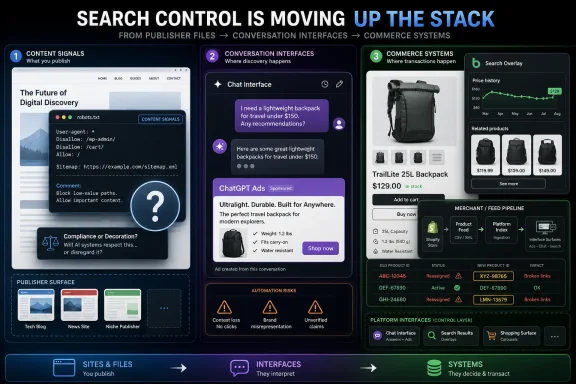
The Real Story Is Control Moving Up the Stack
The day’s news is not that robots.txt is dead, ChatGPT has ads, Google has AI suggestions, Shopify feeds are fragile, or Bing is testing shopping overlays. The real story is that control keeps moving up the stack.Website owners once controlled files, pages, markup, and crawl rules. Merchants controlled feeds, product pages, and ad copy. Users controlled queries and clicked through results. Platforms ranked, indexed, and mediated, but the seams were visible.
Now the seams are being hidden. AI Overviews summarize before the click. Further Exploration suggests the next query. Bing overlays the product detail. ChatGPT Ads may generate the advertisement itself. Cloudflare writes a content-use signal that Google says carries no crawler effect.
Each move is defensible in isolation. Users like convenience. Advertisers like automation. Platforms like retention. Infrastructure providers like giving customers controls. But the total effect is a web where the decisive layer is increasingly the platform interface, not the underlying site.
That should worry anyone who cares about interoperability. The more behavior is governed by proprietary interpretation, the less portable web strategy becomes. A publisher’s AI policy may mean one thing to Cloudflare, another to Google, another to OpenAI, and nothing at all to a rogue crawler.
The same is true for commerce. A product identifier may be stable inside Shopify, transformed inside Merchant Center, optimized inside an ad platform, and represented inside a Bing or Google shopping surface. The merchant sees the business outcome, but not always the full chain of transformations that produced it.
The July 6 Search Recap Was Really a Warning Label
The concrete lesson from this recap is that search professionals should treat platform convenience as a dependency that must be monitored, not a free upgrade to be trusted blindly.- Cloudflare’s Content Signals may express a publisher’s AI-use preferences, but Google’s reported position is that the directive has no crawler or LLM effect in its systems today.
- Site owners should distinguish between robots.txt preferences, crawler-specific controls, network-level blocking, and legal rights reservations instead of assuming one directive covers every AI use case.
- ChatGPT Ads generating creative is a predictable step toward conversational ad automation, but advertisers still need human review for claims, targeting fit, landing-page accuracy, and brand safety.
- Google’s Further Exploration in AI Overviews reinforces that Search is becoming a guided research environment rather than a neutral handoff to external pages.
- Shopify merchants using the Google and YouTube app should audit product IDs and feed history before the August 18, 2026 API-related deadline becomes an emergency.
- Bing’s richer product overlays may improve shopping comparison for users while further shifting product discovery and presentation into Microsoft’s own interface.
References
- Primary source: Search Engine Roundtable
Published: Mon, 06 Jul 2026 14:00:00 GMT
Loading…
www.seroundtable.com - Related coverage: lionheartsearch.com
Loading…
www.lionheartsearch.com - Related coverage: androidcentral.com
Don't trust Google AI? Search is getting a major credibility upgrade | Android Central
Google is making AI Search more focused on trusted websites and original reporting.www.androidcentral.com - Related coverage: techradar.com
Google Search gets smarter AI Overviews with Gemini 3 — and adds follow‑up chats to your search results | TechRadar
AI-powered snapshots now lead straight into conversationwww.techradar.com - Related coverage: tomsguide.com
Loading…
www.tomsguide.com