

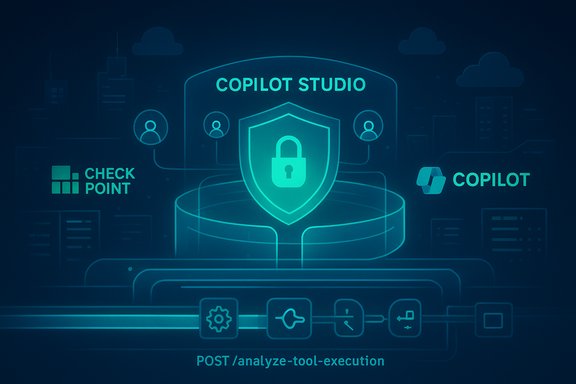
Check Point’s announcement that it is teaming with Microsoft to bring AI security into Microsoft Copilot Studio marks another inflection point in enterprise AI governance — but the story is more nuanced than a single headline suggests. The core claim — that Check Point’s AI Guardrails, Data Loss Prevention (DLP) and Threat Prevention controls are being integrated into Copilot Studio to provide continuous protection for agent runtime — traces back to vendor messaging and market reporting, yet Microsoft’s own public materials and independent verification remain limited at the time of writing.
Microsoft Copilot Studio is the low-code/pro-code authoring and lifecycle platform Microsoft created to enable enterprises to build, tune and deploy generative-AI agents that act on tenant data, call connectors and perform automated tasks across Microsoft 365 and external systems. The platform exposes build-time governance (labels, DLP integration, Entra identities for agents) and runtime extension points so third-party security tooling can interpose or inspect agent actions. Microsoft’s product documentation and Ignite materials show that Copilot Studio is designed to be extended with partner controls for discovery, labeling and runtime mediation. Check Point has been active in the AI and security narrative, expanding the company’s Infinity Platform and Infinity AI Copilot offerings and publicizing collaborations with Microsoft technologies such as Azure OpenAI for security automation. Recent Check Point releases discuss AI-powered features across its product portfolio and include executive commentary from Check Point’s leadership, including Chief Product Officer Nataly Kremer. Those releases and corporate pages confirm Check Point’s focus on embedding AI into security workflows, and the company has issued statements about collaborations that leverage Microsoft cloud AI services. That combination — an extensible Copilot Studio and a security vendor positioning an “AI security stack” — is the context behind reports that Check Point and Microsoft are teaming to deliver integrated AI security for Copilot Studio. However, the exact nature of the integration, the interfaces used, and the responsibilities of each party vary by vendor and require careful validation by prospective customers.
Recommended next steps for Windows‑first enterprises:
Source: TipRanks Check Point, Microsoft team to deliver AI security for Microsoft Copilot Studio - TipRanks.com
 Background / Overview
Microsoft Copilot Studio is the low-code/pro-code authoring and lifecycle platform Microsoft created to enable enterprises to build, tune and deploy generative-AI agents that act on tenant data, call connectors and perform automated tasks across Microsoft 365 and external systems. The platform exposes build-time governance (labels, DLP integration, Entra identities for agents) and runtime extension points so third-party security tooling can interpose or inspect agent actions. Microsoft’s product documentation and Ignite materials show that Copilot Studio is designed to be extended with partner controls for discovery, labeling and runtime mediation. Check Point has been active in the AI and security narrative, expanding the company’s Infinity Platform and Infinity AI Copilot offerings and publicizing collaborations with Microsoft technologies such as Azure OpenAI for security automation. Recent Check Point releases discuss AI-powered features across its product portfolio and include executive commentary from Check Point’s leadership, including Chief Product Officer Nataly Kremer. Those releases and corporate pages confirm Check Point’s focus on embedding AI into security workflows, and the company has issued statements about collaborations that leverage Microsoft cloud AI services. That combination — an extensible Copilot Studio and a security vendor positioning an “AI security stack” — is the context behind reports that Check Point and Microsoft are teaming to deliver integrated AI security for Copilot Studio. However, the exact nature of the integration, the interfaces used, and the responsibilities of each party vary by vendor and require careful validation by prospective customers.What the announcement reportedly delivers
- Runtime protection for Copilot Studio agents: The headline claim is that Check Point’s suite (AI Guardrails, DLP and Threat Prevention) will be able to interpose when Copilot Studio agents attempt actions that could exfiltrate or misuse sensitive data, enforcing enterprise policies at execution time rather than only via post‑hoc detection. This is presented as an extension of Check Point’s end-to-end AI security stack to the Copilot Studio runtime.
- Integrated governance and compliance: The collaboration is described as embedding compliance and governance into agent development workflows, so that policy, auditing and data‑handling constraints travel with an agent from build time through runtime. Vendors and Microsoft materials stress this lifecycle approach as central to safe agent adoption.
- Stop-gap on prompt injection and data exfiltration: The vendor messaging explicitly calls out protection against prompt injection, accidental leakage of labeled documents, and misuse of connectors — threats that are material in agentic automation. Check Point frames its offering as preventing misuse of sensitive information across agent conversations and actions.
- Developer and admin workflow integration: The messaging implies the capability will be surfaced directly inside developer or admin flows in Copilot Studio — enabling teams to test, enforce and audit policies without excessive switching between consoles. Microsoft’s Copilot Studio is designed for this kind of extensibility, with admin controls, Purview and DLP hooks exposed for partner integration.
Verifying the claims — what’s confirmed and what’s not
- Check Point’s AI security positioning, Infinity AI Copilot and collaborations with Microsoft cloud AI services are documented in Check Point press materials and syndications. Those materials confirm joint work with Microsoft technologies such as Azure OpenAI Service and emphasize AI-driven security controls.
- Microsoft has published the architectural patterns Copilot Studio supports for partner controls, including runtime webhooks that can be used to evaluate and gate tool or connector invocations from agents. Vendor integrations to Copilot Studio — aimed at inline enforcement — have been announced by other vendors (for example Zenity and several runtime‑security startups), and the technical pattern frequently described is the POST /analyze-tool-execution webhook or security webhooks API. That API enables a synchronous allow/deny/modify decision path before an agent’s tool call completes.
- What is currently less clear and should be treated as unverified until the vendor(s) publish explicit technical documentation:
- A formal Microsoft press release confirming a named, productized Copilot Studio integration with Check Point specifically (as opposed to broader Azure or Azure OpenAI collaboration). Public Check Point releases and syndicated coverage confirm Microsoft collaboration on AI and on Azure OpenAI but do not appear to include an explicit Microsoft-authored announcement that names a Copilot Studio runtime integration from Microsoft’s side. Prospective buyers should validate product listings, Azure Marketplace entries, and technical integration documents directly with both Check Point and Microsoft before assuming availability or production readiness.
- The wording attributed to Check Point’s CPO in market coverage (the quote about “rapid adoption of AI agents” and the emphasis on continuous protection) is consistent with Check Point’s public commentary about AI security, but the precise quote used in syndicated news items may be paraphrased from company materials. Check Point’s leadership pages and prior press releases confirm Nataly Kremer’s role and frequent commentary on AI-driven security, which supports the credibility of the attribution. Still, anyone relying on verbatim remarks should refer to the primary press release or the company’s newsroom for exact wording.
Why runtime enforcement matters for Copilot Studio agents
Microsoft’s Copilot Studio enables agents to call connectors and take autonomous actions — this gives them the reach to perform useful automation but also creates a new attack surface. Traditional security tooling is often built around static code analysis, perimeter controls or endpoint monitoring; agentic systems can change behavior at runtime, chain multiple tool calls together, and impersonate workflows that look legitimate. The industry pattern for closing these gaps has converged around three crucial controls:- Inventory and posture: discover agents, their creators, connectors, permissions and the models they use — turning agents into auditable assets rather than invisible processes. Without inventory you cannot enforce least privilege or manage lifecycle scope.
- Synchronous runtime gating: before an agent executes a tool call or connector invocation, a synchronous policy engine evaluates the intended action and can allow, deny or mutate it — preventing exfiltration, blocking unauthorized actions, and inserting redaction. The Copilot Studio webhook model offers precisely this capability through a POST /analyze-tool-execution-style API pattern.
- Model and memory controls: inspect model inputs/outputs, scan for prompt injection payloads, redact sensitive tokens from memory or conversation history, and continuously red-team the agent to expose edge cases. These are controls aimed at the reasoning layer rather than only the transport or storage layer.
Strengths of the reported Check Point + Microsoft approach
- End-to-end guardrails: If Check Point’s AI Guardrails, DLP and Threat Prevention are truly embedded into the Copilot Studio execution path, enterprises gain deterministic protection at the moment of action — not only alerts after the fact. That reduces mean time to containment and gives compliance teams auditable enforcement events.
- Enterprise alignment: Check Point already operates widely in enterprise environments (Infinity Platform, Harmony, CloudGuard); integration with Microsoft’s Copilot ecosystem aligns security policies across network, endpoint, cloud and now agentic AI surfaces. This simplifies policy rationalization for customers that run Microsoft 365 and Azure at scale.
- Operational maturity: Established security vendors bring SOC playbooks, threat intelligence feeds and detection engineering that can accelerate a buyer’s readiness for agentic AI. Combining those established practices with runtime enforcement can reduce operational blind spots that new agent toolchains create.
- Reduced risk of human error: Embedding DLP and sensitivity label inheritance into agent outputs reduces accidental leakage that occurs when humans paste or reuse sensitive data in prompts — a common and realistic failure mode in early AI adoption. Microsoft Purview and Copilot Studio integration points are already oriented to this pattern.
Real operational questions and risks customers must evaluate
Vendor claims are one thing; production behavior is another. IT and security leaders evaluating this class of integration should scrutinize the following items carefully.1) What exact integration pattern is used?
- Is enforcement implemented as a synchronous webhook that can block tool invocations (fail-closed), or is it an asynchronous monitor that only triggers alerts (fail-open)? The security posture difference is material: synchronous gating can prevent exfiltration, but risks operational disruption if latency or compatibility issues exist. Microsoft and multiple vendors have documented a synchronous POST /analyze-tool-execution pattern — enterprises should validate schema compatibility and SLA numbers before roll-out.
2) Authentication, identity, and least privilege
- How are agent identities represented (Microsoft Entra Agent ID or a service principal)? Who owns the agent’s credentials and tokens? Are vendors relying on tenant‑level consent or per-agent least-privilege assignments? Misconfigured consent defaults are a recurring source of risk. Confirm whether the integration uses Entra and Federated Identity Credentials to avoid secret leakage.
3) Latency and scale
- Synchronous checks must meet tight latency SLAs or agent workflows will fail or degrade. Evaluate whether the vendor’s runtime path introduces measurable delay at expected production scale (e.g., thousands of daily autonomous runs). Vendors must publish performance numbers and offer deployment options that meet enterprise scale requirements.
4) Audit fidelity and forensics
- Does the integration record full step-level telemetry (prompts, actions, connector requests) and does it preserve context for forensics while still protecting sensitive tokens? Audit trails must be admissible for compliance investigations without leaking secrets.
5) Model integrity and open models
- Does the protection extend to model behavior (detecting poisoned or backdoor models) and memory (redaction of persisted context)? Enterprises using third‑party or open models need controls across different model endpoints. Several runtime security tools claim model scanning and memory redaction, but vendors differ on supported model families and depth of analysis.
6) Operational complexity and false positives
- Inline enforcement can generate false positives that break legitimate automations. Escalation paths, safe-listing, and automated remediation must be part of the offering to avoid operational disruptions when false matches occur.
How this fits into the broader Copilot Studio security ecosystem
Check Point is not alone. Multiple vendors have announced or publicized integrations with Microsoft’s agent stack — Zenity, Palo Alto (Prisma AIRS), Nokod, Sentra and others have positioned runtime enforcement and discovery solutions that target Copilot Studio and Azure AI Foundry customers. Those vendors emphasize inventory, step-level visibility and inline prevention (hard stops) as core capabilities. Microsoft’s Agent 365 control plane, Purview DLP and Entra identity plumbing form the platform primitives that these vendors integrate with. This multi-vendor dynamic is important for two reasons:- It creates choice and competitive innovation — buyers can evaluate differentiated approaches (agent inventory + runtime gating vs. model-side protections vs. network/data egress controls).
- It imposes a testing burden: each vendor’s runtime hooks, schemas and fail-over semantics must be validated in a customer’s own tenant because subtle differences affect behavior.
Practical guidance for Windows‑centric enterprises
Enterprises running Windows 10/11, Windows Server and Microsoft 365 should treat Copilot Studio agent rollouts like any other production platform — but with additional AI‑specific guardrails.- Inventory first: run a full discovery of Microsoft Graph content, SharePoint and Dataverse, then classify sensitive sources using Purview. Without accurate sensitivity maps, neither DLP nor runtime gates can be applied reliably.
- Harden consent: disable user app consent by default and require admin approvals for connector consent. Monitor consent events and token scopes so you know which agents have access to which systems.
- Pilot the integration in a controlled environment: simulate high‑volume agent runs, test latency at scale, and validate fail-closed vs. fail-open behaviors. Use red‑team scenarios (prompt injection, chained tool misuse, encoded exfiltration) to see how the protection responds.
- Validate audit trails: confirm that telemetry includes step-level context, that logs are immutable for compliance, and that sensitive tokens are redacted in exports. Check retention and eDiscovery features align with legal needs.
- Treat agents as production services: assign owners, enforce regular security reviews, and include agents in vulnerability and incident response playbooks — don’t leave them to ad-hoc makers. Microsoft’s governance primitives are maturing to support lifecycle controls; pair them with vendor runtime checks for layered defense.
What to ask Check Point and Microsoft before a buying decision
- Can you provide an explicit technical integration guide for Copilot Studio (schema, endpoints, auth flows, latency SLAs)?
- Is the integration available in Azure Marketplace or as a managed service — and what is the availability timeline for GA vs preview?
- How does the solution authenticate and represent agent identities (Entra Agent ID, service principals, or tenant tokens)?
- What models and model endpoints does the vendor support for model‑integrity checks (OpenAI, Anthropic, Gemini, private models)?
- What happens during vendor service outages — do agents fail closed or continue with reduced checks?
- Can you demonstrate step‑level telemetry, incident playbooks, and a sample compliance report from a sandbox tenant?
Balanced assessment — opportunities and limits
- Opportunity: If the Check Point + Microsoft integration works as promised, enterprises gain an additional layer of deterministic protection for the rising class of agentic automations. Inline DLP, prompt-injection blocking and step-level visibility would materially reduce both accidental leakage and active exploitation risk across Copilot-driven workflows. The strategic value is significant for regulated industries where data handling must be auditable and enforceable.
- Limit: Vendor messaging sometimes conflates roadmap intents with production availability. At the time of reporting, Check Point’s collaboration with Microsoft on Azure AI services is documented; a fully public Microsoft confirmation of a Copilot Studio runtime integration with Check Point is not broadly available, and independent verification of the exact technical contract (webhook behavior, fail modes, performance) is limited. Buyers must treat announcements as the start of due diligence, not final assurance.
- Risk: Inline enforcement raises classic security triage tradeoffs — stronger prevention can increase operational friction and the risk of breaking legitimate agent workflows if not tuned carefully. False positives and latency at scale are the main operational hazards. Establishing robust escalation and safe-list processes is mandatory.
Final verdict and next steps for IT leaders
The move by Check Point to position its AI Guardrails, DLP and Threat Prevention for Microsoft Copilot Studio reflects an industry‑wide recognition that agentic AI needs runtime controls that look and behave differently from legacy security tooling. The capability set described — inventory, synchronous gating, model controls and step-level telemetry — maps to what enterprise security teams need. However, the practical security value depends on low-latency, high-fidelity enforcement combined with clear identity and lifecycle management.Recommended next steps for Windows‑first enterprises:
- Treat the announcement as a clear signal that runtime security vendors are maturing for agentic AI, and start pilot programs that test vendor integrations end‑to‑end in a sandbox tenant.
- Validate claims against at least two sources (vendor docs, Azure Marketplace listing, and Microsoft partner pages) before purchase — do not rely solely on secondary coverage.
- Run adversarial tests (prompt injection, credential chaining, encoded exfiltration) and measure the integration’s telemetry, false positive rate and latency under realistic load.
- Update governance policies: require agent owners, scheduled security reviews, and include agents in incident response and compliance audits.
Source: TipRanks Check Point, Microsoft team to deliver AI security for Microsoft Copilot Studio - TipRanks.com
