

Check Point’s November announcement that it will embed runtime AI guardrails, Data Loss Prevention (DLP), and Threat Prevention into Microsoft Copilot Studio marks a clear strategic push to make the vendor a visible player in the emergent market for enterprise AI security—and it’s a development investors should neither ignore nor overreact to without careful due diligence.
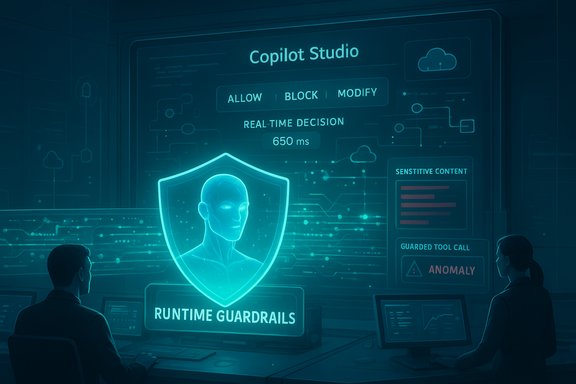
Microsoft’s Copilot Studio is positioned as the enterprise platform for authoring, testing and operating “agentic” AI assistants that can read tenant data, call connectors, execute automation flows and take other actions on behalf of users. That shift—from passive AI assistants to agents that act—creates a new control plane where security must shift from design-time checks to continuous runtime enforcement. Check Point’s partnership with Microsoft promises to insert prevention-first controls directly into that runtime path: inspecting planned tool calls and agent intents, applying DLP, and blocking or modifying risky actions before they execute.
This partnership was publicly announced in mid-November 2025 and was framed by both companies as a way to help enterprise customers scale agent deployments while meeting compliance and operational safety needs. Check Point positions the work as an extension of its Infinity AI security stack—bringing guardrails and inline protections into the Copilot Studio execution flow.
Key risk classes that runtime enforcement aims to address:
However, the announcement is not a silver bullet for short-term valuation re‑rating. The commercial significance depends on three measurable proofs: (1) low-latency, high-availability production deployments; (2) joint customer references demonstrating policy tuning and measurable prevention outcomes; and (3) a predictable conversion of integrations into recurring subscription ARR. Absent those proofs, investors should view the partnership as positive for long-term strategic positioning but incremental to the near-term revenue thesis—especially given the continued risk that macroeconomic headwinds can delay deals.
Finally, note that some valuation and forecast figures attributed to market writeups (for example, multi‑year revenue/earnings scenarios and community fair-value ranges) should be verified directly with the original analyses and the company’s filings. Those financial projections are inherently model‑dependent and may not fully capture the timing risk attached to enterprise procurement cycles and execution milestones; treat them as directional rather than definitive until corroborated by company‑reported ARR and bookings data. (If you require, request the vendor’s latest customer win announcements, and cross-check with earnings call transcripts to validate adoption momentum.
In short: the Check Point–Microsoft Copilot Studio partnership is an important strategic development that merits a closer look by investors—but that look should be methodical, data-driven, and focused on production evidence (latency, SLAs, POCs and joint references) rather than headline PR.
Source: simplywall.st Should Check Point’s (CHKP) Microsoft Partnership on AI Security Prompt a Closer Look by Investors?
 Background
Microsoft’s Copilot Studio is positioned as the enterprise platform for authoring, testing and operating “agentic” AI assistants that can read tenant data, call connectors, execute automation flows and take other actions on behalf of users. That shift—from passive AI assistants to agents that act—creates a new control plane where security must shift from design-time checks to continuous runtime enforcement. Check Point’s partnership with Microsoft promises to insert prevention-first controls directly into that runtime path: inspecting planned tool calls and agent intents, applying DLP, and blocking or modifying risky actions before they execute.This partnership was publicly announced in mid-November 2025 and was framed by both companies as a way to help enterprise customers scale agent deployments while meeting compliance and operational safety needs. Check Point positions the work as an extension of its Infinity AI security stack—bringing guardrails and inline protections into the Copilot Studio execution flow.
What the announcement actually promises
- Runtime AI Guardrails — real-time inspection of agent prompts, planner context and tool invocations to detect prompt injections, jailbreaks and malicious instruction sequences during execution.
- Agent-aware DLP — content-level inspection applied to tool inputs/outputs and retrieval-augmented generation (RAG) contexts, with the ability to redact, quarantine or block sensitive results synchronously.
- Threat Prevention — runtime detection of anomalous agent behavior, suspicious connector use, and indicators of compromise tied to agent lifecycles, plus synchronous blocking of risky tool calls.
- Enterprise-scale packaging and low-latency claims — the vendors say the enforcement plane will operate at scale while minimizing user-visible latency; this is a claim that requires empirical validation in customer environments.
Why this matters: the attack surface AI agents introduce
AI agents turn model outputs into actions: reading tenant data, invoking connectors (SharePoint, OneDrive, Exchange, Dataverse), launching automation flows, or even running code. That reach materially increases the blast radius of classical AI weaknesses such as prompt injection. Now, a successful prompt injection or RAG-poisoning attack can lead to actual exfiltration, unauthorized actions or operational incidents rather than merely a misleading response. Recent vulnerabilities and vendor security updates in the AI/agent ecosystem underscore this risk vector and explain why runtime enforcement is becoming a priority for platform providers and third-party security vendors alike.Key risk classes that runtime enforcement aims to address:
- Prompt injection and cross‑prompt injection (XPIA) that manipulates an agent’s internal planning.
- Zero‑click exfiltration where embedded content (documents, images) causes an agent to disclose tenant data without explicit user prompts.
- Credential and connector abuse: OAuth tokens, malicious connectors or compromised third‑party APIs used by agents.
- Operational and forensic gaps: insufficient audit trails and telemetry for reconstructing agent decisions and proving compliance.
Technical realities and integration constraints
Enterprises evaluating this integration must validate technical details that materially affect security, privacy and availability.Architecture and data flow
The model used by Copilot Studio and third-party vendors is synchronous pre-execution policy checking: the platform delivers a structured payload to the security endpoint for real‑time analysis and awaits a decision. That payload can include sensitive context, prompt history and connector metadata—and thus raises questions about where the content is processed and stored, retention policies, and whether the inspection occurs in-tenant or in a vendor-controlled cloud.Latency and fail-open semantics
Microsoft’s webhook contract imposes tight latency budgets. If the vendor’s security endpoint fails to respond within the window, default platform behavior can be fail-open (allowing the action) or another conservative setting that customers must configure. Enterprises must validate latency SLAs and insist on fail‑closed options for critical workflows. Claims of “low-latency, enterprise‑grade scale” are vendor promises that require independent validation.Data residency, encryption and auditability
Policy decisions should be auditable with tamper-evident logs, SIEM hooks and configurable retention. For regulated customers, tenant-isolated processing or appliance/edge options may be required to meet sovereignty rules. Contractual guarantees for encryption-in-transit, encryption-at-rest, and customer-managed keys should be confirmed before production deployment.False positives and developer ergonomics
Applying strict DLP to agent outputs that combine multiple data sources can easily generate false positives that degrade productivity. Enterprises must test detection thresholds and policy tuning aggressively and ensure that policy authoring is accessible to developer and security teams without creating governance drift.Independent validation
Independent benchmarks—latency, false positive rates, and adversarial prompt-resistance tests—will be decisive. Until vendors and Microsoft publish joint, third‑party validated POCs showing latency and efficacy in diverse tenant conditions, the integration should be treated as promising but not yet proven at scale.Market and competitive context
Check Point’s move follows a broader industry push where major security vendors and startups are racing to secure agent runtimes. Competitors such as Palo Alto Networks, Fortinet, and specialized cloud/AI security startups are all pursuing similar integrations or product extensions. The differentiators over the next 12–24 months will be:- Depth of integration with major cloud platforms (native hooks, marketplace distribution).
- Measurable latency and availability guarantees under production load.
- Developer ergonomics for policy authoring and seamless deployment in CI/CD and DevOps flows.
- Strong, verifiable customer success stories and joint references demonstrating production readiness.
What this means for investors: strategic upside vs. execution risk
From an investor’s perspective, the Microsoft partnership has three immediate implications:- Narrative alignment with AI security demand
The deal strengthens Check Point’s positioning in a fast-growing control plane (agent runtime) and helps preserve the long-term relevance of its prevention-first brand as enterprises adopt agentic AI. This is a strategic positive: vendor relevance matters in enterprise renewals and cross-sell cycles. - Near‑term revenue impact is likely incremental
Public materials and analyst commentary suggest the immediate commercial impact on Check Point’s near-term revenue or its ongoing Infinity platform adoption may be limited; partnerships of this type typically translate to longer sales cycles, OEM or managed-service offerings, and subscription expansion over quarters rather than instant revenue lifts. Investors should not expect the announcement alone to materially re-rate short‑term guidance without demonstrable bookings. - Execution, SLAs and macro uncertainty are the larger risks
Delivering low-latency runtime enforcement at enterprise scale, securing joint customer references, and converting integration into recurring ARR are the main execution milestones. Macro headwinds causing elongated deal cycles remain an outsized near‑term risk that could delay revenue realization even if the product is compelling.
The valuation angle (what to watch)
Some investor commentary referenced multi-year revenue forecasts and upside scenarios tied to successful product adoption. Those projections can be meaningful—but they hinge on two pivotal conditions:- Execution that turns partnerships into recurring subscription bookings and measurable customer wins.
- A macro climate that supports normal enterprise procurement cycles rather than prolonged delays.
Due diligence checklist for investors and security buyers
Investors conducting deeper due diligence on Check Point should ask management and product teams (and validate via references and technical reviews) the following:- Can you provide at least three joint production customer references that demonstrate the Copilot Studio integration under realistic workloads, showing:
- Measured average and tail latency for the external webhook path.
- False positive rates for DLP policies in mixed RAG contexts.
- Evidence of significant prevented exfiltration incidents or blocked injections (anonymized telemetry).
- Where is content processed? Ask for explicit data-flow diagrams showing whether prompts, retrieved context and telemetry are processed:
- In-tenant or vendor-cloud?
- With what retention and redaction policies?
- Under what encryption / key‑management model?
- What are the contractual SLAs for latency, availability and fail‑closed behavior? Request explicit SLA credits and runbook commitments for critical workflows.
- What are the integration boundaries with Microsoft? Is there a Microsoft co‑written technical integration document or joint support offering for enterprise customers? Confirm whether Microsoft’s default webhook behavior remains fail‑open for timeouts and how that is configurable.
- How will Check Point keep pace with changing model endpoints, agent APIs and Copilot Studio evolution? Request a roadmap showing cadence for updates and backward-compatibility guarantees.
- For regulated customers, can processing be restricted to regional data centers or to on‑prem/appliance options? If not, what contractual protections exist for data sovereignty?
- Operational questions: How are audit logs exported to customer SIEMs? Are logs tamper‑evident and do they include enough provenance to reconstruct agent decision chains?
Strengths and potential red flags (balanced assessment)
Strengths
- Strategic fit: The capability addresses an urgent and growing enterprise need—runtime protections for agentic AI—while leveraging Check Point’s prevention-first heritage.
- Platform leverage: Integration with Microsoft Copilot Studio gives Check Point exposure to an enterprise-leverage channel and the possibility of joint sales motions.
- Complementary moves: Check Point’s other partnerships (e.g., Wiz) show a broader strategy to cover cloud, network and AI layers—an attractive narrative if execution follows.
Red flags / things that could go wrong
- Latency and fail-open defaults: Tight response windows make low-latency enforcement technically challenging; default fail-open platform behavior for timeouts is a commercial and security risk if SLAs are not nailed down.
- Proof-in-production gap: Vendor claims need independent benchmarks and customer references; without those, the integration risks being a marketing checkbox.
- Competitive crowding: Large incumbents and specialized startups are solving similar problems; differentiation will depend on integration fidelity, developer ergonomics and cost of ownership.
- Macro-driven deal timing: Even a technically successful product can see delayed revenue recognition if enterprises slow procurement during economic uncertainty.
Practical next steps for investors
- Monitor Check Point’s next two quarterly earnings calls for concrete metrics: ARR contribution from AI security, bookings tied to Copilot Studio integrations, and customer reference announcements.
- Request independent benchmark data or POC reports showing latency distributions, false positive/negative rates and real-world adversarial testing results.
- Watch for Microsoft validation: a co‑published technical integration guide or joint case study materially reduces execution risk.
- Track competitive announcements from Palo Alto Networks, Fortinet and cloud-native AI-security startups to see whether Check Point’s offering meaningfully differentiates on latency, scope, or cost.
Closing analysis
Check Point’s integration with Microsoft Copilot Studio is a strategically sensible and technically plausible extension of the company’s prevention-first approach, and it helps anchor the vendor in a critical, fast-growing control plane for enterprise AI. That strategic alignment reduces some long‑term obsolescence risk and gives Check Point a credible seat at the table as agent deployment accelerates.However, the announcement is not a silver bullet for short-term valuation re‑rating. The commercial significance depends on three measurable proofs: (1) low-latency, high-availability production deployments; (2) joint customer references demonstrating policy tuning and measurable prevention outcomes; and (3) a predictable conversion of integrations into recurring subscription ARR. Absent those proofs, investors should view the partnership as positive for long-term strategic positioning but incremental to the near-term revenue thesis—especially given the continued risk that macroeconomic headwinds can delay deals.
Finally, note that some valuation and forecast figures attributed to market writeups (for example, multi‑year revenue/earnings scenarios and community fair-value ranges) should be verified directly with the original analyses and the company’s filings. Those financial projections are inherently model‑dependent and may not fully capture the timing risk attached to enterprise procurement cycles and execution milestones; treat them as directional rather than definitive until corroborated by company‑reported ARR and bookings data. (If you require, request the vendor’s latest customer win announcements, and cross-check with earnings call transcripts to validate adoption momentum.
In short: the Check Point–Microsoft Copilot Studio partnership is an important strategic development that merits a closer look by investors—but that look should be methodical, data-driven, and focused on production evidence (latency, SLAs, POCs and joint references) rather than headline PR.
Source: simplywall.st Should Check Point’s (CHKP) Microsoft Partnership on AI Security Prompt a Closer Look by Investors?
