

Check Point Software’s announcement that it will integrate its AI Guardrails, Data Loss Prevention (DLP), and Threat Prevention engines directly into Microsoft Copilot Studio marks a consequential step in making agentic AI manageably secure for large enterprises, but it also raises several architectural and operational questions that organisations must validate before trusting agents with sensitive workflows.
Microsoft Copilot Studio is Microsoft’s enterprise-facing authoring and runtime environment for building generative-AI agents that connect to Microsoft 365 data, Power Platform flows, external APIs and line-of-business systems. Copilot Studio aims to let organisations construct, publish and govern agents at scale while integrating retrieval-augmented generation (RAG) patterns and tenant-grounded knowledge sources. The move toward an “agentic” enterprise—fleets of purpose-built assistants that read, act and write across corporate systems—has accelerated the need for runtime controls that operate at the point where agents execute actions and call external tools.
Check Point’s press materials describe the collaboration as embedding continuous runtime protection into Copilot Studio to stop prompt injection, prevent data leakage, and detect model misuse during agent execution. The company positions the integration as extending its Infinity AI security stack into the Copilot Studio runtime, combining guardrails, inline DLP scanning and threat prevention into a single enforcement plane for agent workflows. This is framed as protection “by design” that lives inside authoring and runtime paths so enterprises can innovate without exposing sensitive data or processes to new AI-specific attack vectors.
Check Point’s announcement and product claims are documented in company materials and syndication, and the broader Copilot Studio platform context and agentic risks are discussed in independent coverage and technical research. Organisations evaluating the integration should seek out demonstrable performance benchmarks, contractual SLAs for enforcement responsibilities, and red‑team validation of the guardrails before broad deployment.
Source: The Manila Times Check Point Software Collaborates with Microsoft to Deliver Enterprise-Grade AI Security for Microsoft Copilot Studio
 Background
Microsoft Copilot Studio is Microsoft’s enterprise-facing authoring and runtime environment for building generative-AI agents that connect to Microsoft 365 data, Power Platform flows, external APIs and line-of-business systems. Copilot Studio aims to let organisations construct, publish and govern agents at scale while integrating retrieval-augmented generation (RAG) patterns and tenant-grounded knowledge sources. The move toward an “agentic” enterprise—fleets of purpose-built assistants that read, act and write across corporate systems—has accelerated the need for runtime controls that operate at the point where agents execute actions and call external tools.Check Point’s press materials describe the collaboration as embedding continuous runtime protection into Copilot Studio to stop prompt injection, prevent data leakage, and detect model misuse during agent execution. The company positions the integration as extending its Infinity AI security stack into the Copilot Studio runtime, combining guardrails, inline DLP scanning and threat prevention into a single enforcement plane for agent workflows. This is framed as protection “by design” that lives inside authoring and runtime paths so enterprises can innovate without exposing sensitive data or processes to new AI-specific attack vectors.
What Check Point says it will deliver
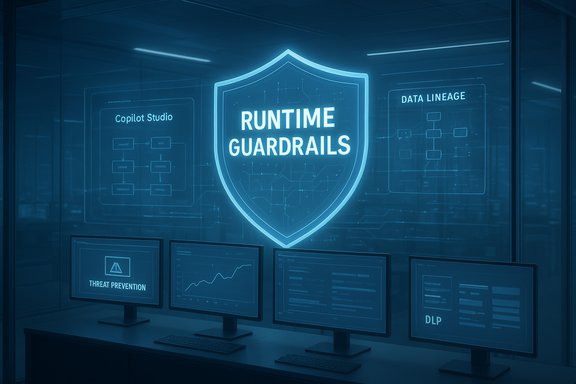
The core capabilities Check Point advertises for Copilot Studio fall into four buckets:- Runtime AI Guardrails — Continuous protection that inspects prompts and agent outputs at runtime to block or sanitize attempts at prompt injection, jailbreaks and tool misuse.
- Data Loss Prevention (DLP) — Integrated content inspection that enforces policies across every tool call and workflow, aiming to stop sensitive data (credentials, IP, PII, regulated data) from being exfiltrated by an agent.
- Threat Prevention — Monitoring and prevention of malicious activity associated with agent endpoints or third-party tool integrations, including blocking exploitation attempts and suspicious outbound calls.
- Enterprise-Grade Scale and Low Latency — A packaged stack designed to operate across large fleets of agents while asserting minimal performance impact on agent responsiveness (a vendor claim that customers will need to validate).
Why runtime guardrails matter: the threat landscape
The theoretical threats are well known; the practical, high-risk attack classes have already been demonstrated in the wild and in academic research. Key risks include:- Prompt injection and jailbreaks — Crafted inputs or embedded content that alter an agent’s instructions or coax it into exposing protected data or performing unsafe actions.
- Zero-click exfiltration — Scenarios where the agent ingests content (for example, an emailed attachment or a shared document) that contains embedded prompts or exploit primitives that cause the agent to reveal tenant data without human intervention.
- Model misuse and compliance drift — Agents that gradually alter behavior due to policy misconfiguration or learning loops, leading to outputs that violate regulations or contractual obligations.
- Third-party API compromises — Agents routinely call external connectors; a compromised connector or malicious third-party response can cause downstream data leakage or unwanted actions.
How the integration is likely to work (technical anatomy)
Neither vendor published a full technical blueprint of the integration at the announcement, but the combined public materials and product documentation let us infer a plausible architecture and enforcement model:- Agents in Copilot Studio run with identity and context (agent identity, Entra-managed service principal, or Agentic User), and when they issue a tool call, the call can be routed through a policy enforcement layer. Check Point’s engines would inspect the call payload, the RAG context and the agent’s instructions for indicators of prompt injection or disallowed data patterns.
- The DLP engine evaluates content using sensitivity rules, attribute matching and contextual checks (source provenance, intended recipient, and entitlements). When a violation is detected it can either block, redact, or quarantine the call depending on policy.
- Threat prevention leverages telemetry and signatures—combined with AI-driven anomaly detection—to flag suspicious patterns from agent interactions with external APIs (unexpected endpoints, anomalous payloads, or unusual volumes).
- Telemetry, audit logs and lineage are stored for governance and compliance; these traces are intended to provide an auditable record of agent decisions and data flows for post-incident analysis and regulatory evidence.
Verifying the vendors’ claims: what’s confirmed and what remains vendor statements
Confirmed by vendor materials and independent reports:- Check Point announced the collaboration and described the capabilities: runtime guardrails, integrated DLP and threat prevention for Copilot Studio. This announcement is documented in Check Point’s press release and widely syndicated coverage.
- Check Point’s product documentation already includes prompt-security features in its Infinity AI Copilot product, indicating technical maturity on prompt scanning and DLP mechanics.
- Industry reporting and forum analysis position Copilot Studio as the epicentre of agent development and governance requirements for enterprises—making the need for runtime guardrails credible.
- “Low latency without impacting performance” — Check Point states the unified stack delivers protection at scale without noticeable latency. That is a critical operational claim; independent benchmarks or third-party performance tests were not included in the announcement and must be assessed in customer pilots.
- Scope and enforcement modes — Details about where enforcement occurs (tenant side vs. cloud-side, inline vs. advisory), what API surfaces are instrumented, and whether enforcement can be tuned per agent are not public. These specifics materially affect privacy, compliance, and architecture.
- Supported model / runtime platforms — The announcement focuses on Copilot Studio but does not enumerate supported model families, whether enforcement works the same with Azure OpenAI, Microsoft-branded models, or third-party models plugged into the Copilot fabric. This matters for enterprises that use custom or industry models.
Strengths of the partnership
- Integrated prevention-first approach — Embedding DLP and guardrails into the authoring and runtime path reduces the likelihood that agents will be deployed without controls. That design-first approach is more robust than retrofitting protections after deployment.
- Leverages existing enterprise security telemetry — Check Point’s Infinity platform and its threat intelligence can enrich agent monitoring with broad telemetry and preexisting threat signals, providing better context than isolated AI-only monitors.
- Operational maturity — Check Point’s long history in DLP, IPS and enterprise threat prevention means they bring hardened detection engines rather than a single-point AI filter; that heterogeneity can reduce model-driven false negatives.
- Governance and audit focus — The promise of continuous runtime observability and lineage aligns with regulatory and internal audit needs for explainability and traceability of automated actions.
Risks, limitations and failure modes
- False positives and productivity friction — Aggressive inline DLP and guardrails can block legitimate agent actions, undermining the productivity gains agents aim to deliver. Tuning policy sets across thousands of agent workflows is a non-trivial operational cost.
- Latency and user experience — Even small latency spikes in conversational agents degrade user experience; vendor claims of “no impact” must be validated under representative workloads, including multi-step agent flows and large-context RAG calls.
- Policy complexity at scale — Mapping legal/regulatory boundaries and business policy into enforceable DLP and guardrails across disparate agents is a governance project that will require cross-functional teams (security, legal, product, and compliance).
- Blind spots in provenance and access-control — Agents that act on behalf of users require tight mapping between agent identity and entitlements. If the enforcement plane cannot see or correctly interpret identity provenance (actor vs. agent identity), it may either over-block or under-protect.
- Supply chain and connector risks — Agents often rely on third-party connectors or SaaS calls. If third-party services are compromised or return malformed content, those paths can bypass policy unless the enforcement layer inspects all outbound/inbound traffic comprehensively.
- Vendor lock-in and integration complexity — Deep integration between Copilot Studio and a third‑party runtime enforcement plane may introduce operational dependencies and update coupling that need contractual clarity (who patches what, who owns incident response for agent misuse).
Practical steps for IT and security teams (operational checklist)
- Run a focused pilot — Select representative agents (2–3 business-critical workflows) and measure baseline latency, throughput, and error rates before and after enabling Check Point protections. Document false positives and blocked flows.
- Map agent identities and entitlements — Ensure each agent is provisioned with Entra-managed identity and that the enforcement plane understands and respects tenant access controls.
- Create test-driven DLP rules — Begin with a conservative “monitor” mode for DLP that logs rather than blocks; iterate rules with business stakeholders and escalate to block mode only after acceptable false-positive rates are achieved.
- Simulate adversarial inputs — Run adversarial prompt-injection and jailbreak tests (red team) to validate guardrail efficacy and surface escape vectors. Include zero-click scenarios where content is fetched automatically by agents.
- Measure user experience — Track end-user latency, response coherency and agent fallbacks; quantify the productivity delta with and without protections in place.
- Define incident playbooks — Agree on runbooks for agent compromise, including isolation, forensic retention, and remediation responsibilities between Microsoft, Check Point and the customer.
- Document compliance controls — Map audit logs and lineage outputs to regulatory requirements (PCI, HIPAA, GDPR) and validate retention and redaction policies.
- Plan governance cadence — Establish policy review cycles, owner responsibilities and change-management for agent logic and DLP policies.
Questions organisations must ask Check Point and Microsoft (procurement & architecture)
- Where does the enforcement plane operate? (tenant VNet / private link vs. cloud-side proxy)
- Which model families and runtimes are supported (Azure OpenAI, Microsoft models, custom models hosted in Foundry)?
- What enforcement modes are available (monitor, block, redact), and can they be applied per-agent or per-connector?
- What are the measured latency figures for representative agent workloads, and can those be validated via customer or third-party benchmarks?
- How are audit logs, sensitive detections and telemetry shared with customer SIEMs and retained for compliance?
- What shared-responsibility model governs updates, patching and incident response?
How this fits into the broader Copilot ecosystem
Microsoft’s Copilot Stack (Copilot Studio, Azure AI Foundry, Microsoft Fabric / OneLake and the Agent Store) is designed to be an orchestrator for enterprise agents—routing model calls, managing knowledge sources and enforcing tenant governance. Third-party runtime enforcement vendors like Check Point, as well as other security and orchestration partners, form a necessary ecosystem layer: they bring prevention-first controls that complement Microsoft’s native admin tooling and tenant-level governance measures. In practice, organisations will want a mix of native controls (Entra, Purview, admin settings) plus specialist enforcement where domain-specific DLP and threat intelligence are required.Readiness recommendations for WindowsForum readers and IT leaders
- Treat agents as first-class production software. Apply CI/CD, testing, code reviews and security scans to agent definitions and RAG connectors.
- Prioritise visibility. If you can’t log every tool call and data flow an agent makes, you don’t have governance. Ensure telemetry reaches your SIEM and that runbooks exist for automated isolation.
- Start with guardrails in monitor mode. Avoid blunt-block policies that will erode business trust in agents; instead iterate to an enforceable baseline.
- Invest in adversarial testing. Red teams should include prompt-injection and zero-click scenarios in their playbooks; those attack classes are practical and have been demonstrated.
Final analysis: an important step, not a finished state
Check Point’s collaboration with Microsoft to bring runtime AI guardrails and integrated DLP into Copilot Studio addresses a genuine and urgent gap in enterprise AI security: the need to enforce policy at the moment agents execute actions. The integration pairs a mature DLP and threat-prevention vendor with Microsoft’s enterprise agent platform, delivering a prevention-first narrative that CIOs and CISOs will find attractive. However, the announcement is a starting point rather than an endpoint. Critical operational questions—latency at scale, enforcement reach, support for model heterogeneity, and the true rate of false positives in complex agent workflows—remain to be answered through customer pilots and third-party validation. Until those results are public, organisations should adopt a cautious, evidence-driven approach: pilot early, measure everything, and codify governance before scaling agent fleets broadly. For Windows-centric IT teams and enterprise security practitioners, this collaboration is a useful development: it moves runtime agent protections into the mainstream vendor ecosystem. But the real test will be operational: whether these guardrails can protect sensitive data and business logic without creating the very friction that drives teams to bypass security—an outcome the industry cannot afford as agentic automation becomes embedded in mission-critical workflows.Check Point’s announcement and product claims are documented in company materials and syndication, and the broader Copilot Studio platform context and agentic risks are discussed in independent coverage and technical research. Organisations evaluating the integration should seek out demonstrable performance benchmarks, contractual SLAs for enforcement responsibilities, and red‑team validation of the guardrails before broad deployment.
Source: The Manila Times Check Point Software Collaborates with Microsoft to Deliver Enterprise-Grade AI Security for Microsoft Copilot Studio
