

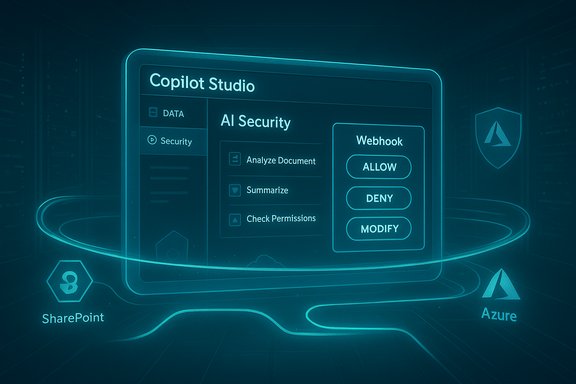
Check Point’s new tie-up with Microsoft to embed AI security directly into Copilot Studio marks a decisive moment in enterprise AI defense: the vendor is taking its AI Guardrails, Data Loss Prevention (DLP) and Threat Prevention engines into the runtime path of Copilot Studio agents to stop prompt injection, data leakage and model misuse while agents run in production.
Background / Overview
Copilot Studio is Microsoft’s low-code / developer platform for authoring, testing and operating AI agents across Microsoft 365, Azure AI Foundry and other enterprise endpoints. It exposes connectors, knowledge sources and action primitives (agent flows, Power Automate-style actions, code execution) that let agents do real work — but also expand attack surfaces far beyond traditional user-facing apps. Microsoft has layered governance (Purview DLP, admin controls, agent inventories) and runtime security hooks into the platform, including Security Webhooks that allow synchronous policy checks before an agent executes a tool call. Check Point’s announcement positions its technology as an inline enforcement layer for Copilot Studio: runtime guardrails that continuously inspect agent intents and tool calls, apply content-sensitive DLP checks across tool inputs and outputs, and block or modify dangerous actions before they execute. That architecture attempts to move security from post-hoc audit to real-time prevention in the agent execution path.Why this matters now
AI agents are not just chatbots — they can call databases, issue system commands, invoke third‑party APIs and compile data from many sources into tightly packaged outputs. That makes them extraordinarily useful, but also uniquely risky:- A single agent can access and surface data from across SharePoint, OneDrive, Dataverse, Exchange and external connectors, amplifying insider‑risk exposure.
- Prompt-injection and RAG-poisoning techniques can coax agents into revealing or exfiltrating sensitive data.
- Agentic actions (Power Automate flows, API calls, code execution) can convert a data leak into an operational incident.
What Check Point is delivering for Copilot Studio
Core capabilities (vendor summary)
Check Point’s offering for Copilot Studio focuses on three integrated capabilities:- Runtime AI Guardrails — real‑time analysis of agent prompts, planned tool invocations and the agent’s conversational memory, with heuristics and ML models to detect prompt injection, encoded exfiltration patterns and malicious instruction sequences.
- Data Loss Prevention (DLP) adapted for agents — content inspection applied to tool inputs/outputs and cross‑tool workflows, enforcing sensitivity labels, masking or blocking high‑risk responses and preventing unauthorized data exports.
- Threat Prevention — detection of anomalous agent behavior, connector misuse, and indicators of compromise across the agent lifecycle, plus the ability to stop suspicious tool calls synchronously.
How it integrates technically
The practical model for inline enforcement in Copilot Studio is a short synchronous webhook: before an agent executes a tool call, the studio can POST a structured payload describing the planned action (prompt, chat history, tool inputs, metadata) to a registered security endpoint and await an allow/deny/modify decision. Customers register an app in Entra and use federated credentials to authenticate the call. That pattern — pre‑execution posture checks plus runtime webhooks — is the integration point Check Point and other vendors use to mediate agent behavior. Key practical constraints of this pattern are latency and schema compatibility: calls must be low‑latency to avoid user impact, and customers must validate fail‑open vs fail‑closed semantics in their production environments. Check Point’s messaging emphasizes low-latency enforcement and near-real-time decisions tailored to enterprise scale.How this maps to Check Point’s broader AI security portfolio
Check Point has been investing heavily in AI security across multiple vectors: model and infrastructure protection, application-level safeguards, and now runtime agent enforcement. Recent product moves and partnerships highlight that trajectory:- Collaborations with Microsoft on Azure OpenAI/LLM-powered cyber automation have positioned Check Point to use Azure models and Microsoft tooling within its Infinity AI Copilot and other services.
- Press materials and releases show Check Point expanding its AI offerings (AI Cloud Protect, Infinity GenAI Protect, advanced DLP) to secure model training, inference and agentic applications.
- Check Point’s announced focus on runtime guardrails is consistent with industry momentum toward runtime enforcement for agents, mirroring moves by other security vendors to integrate with Copilot Studio and Azure AI Foundry.
Technical deep dive: what to test and verify before deployment
Integrating third‑party enforcement into an agent platform brings real operational tradeoffs. Security teams should validate the following when evaluating Check Point’s Copilot Studio integration (or similar vendor integrations):- Latency and throughput
- Measure round‑trip latency for POST /analyze-tool-execution and ensure it fits the UX targets for your agents. High‑volume agents may require scaled enforcement endpoints or edge deployment models.
- Fail‑open vs fail‑closed behavior
- Understand default behavior if the security webhook is unreachable. In some contexts a fail‑open approach is acceptable; in others (finance, legal), fail‑closed is mandatory. Document and test both modes.
- Policy fidelity and false positives
- Runtime blocking is powerful but brittle. Validate policy sets with representative agent workflows and tune redaction rules so that legitimate business outcomes aren’t unduly disrupted. Expect iteration.
- Connector and identity governance
- Ensure agents use least privilege service principals and that Entra consent/no‑grant policies are enforced for new connectors. Token scope management matters: an over‑privileged agent is an exposed agent.
- Data residency and compliance
- Verify where webhook payloads and decision logs are processed and stored. For regulated workloads, choose in‑country processing or appropriate contractual protections.
- Audit trails and observability
- Confirm that every runtime decision, including denied actions and redactions, emits auditable events to your SIEM and that retention is compliant with your regulatory needs.
- Red‑team and continuous testing
- Run adversarial tests (prompt injection, encoded exfiltration, logic chaining) to validate runtime defenses. Vendor claims should be stress‑tested against real‑world attack patterns.
Strengths: what this partnership does well
- Inline prevention reduces time‑to‑exposure. Blocking a malicious tool call while it is about to run is materially stronger than detecting exfiltration after the fact. This is the primary security win of runtime guardrails.
- Integrated DLP for agent workflows. Applying sensitivity labels and DLP redaction within agent flows closes a critical gap where agents might otherwise synthesize and export sensitive records. Microsoft’s Purview features for Copilot Studio complement this approach.
- Vendor synergy with Microsoft ecosystems. Check Point’s broader technical relationship with Microsoft (Azure OpenAI, co‑engineering of AI cops/controls) simplifies authentication, scale and joint support incentives for enterprise customers.
Risks, gaps and the hard tradeoffs
This is not a silver bullet. Security leaders must weigh several residual risks and operational costs before leaning entirely on any vendor integration.- Performance and UX friction. Inline enforcement introduces latency. At scale, that can impact agent responsiveness unless the enforcement layer is highly optimized and distributed. Vendors often publish low-latency targets; verify them under your actual load.
- False positives that break automation. Over‑zealous blocking can stop legitimate automation flows and erode trust in agents. Policies must be iterated with business owners, and human‑in‑the‑loop workflows should be defined for marginal cases.
- Visibility vs privacy tradeoffs. Security webhooks carry prompts and context; if those payloads include sensitive tenant data, they create a new data handling and residency surface to secure. Confirm that vendor processing adheres to your compliance needs.
- Supply chain and model integrity. Runtime guardrails protect behavior but don’t fully eliminate upstream risks like model poisoning or compromised dependencies. Vendors including Check Point are expanding into model inspection and pre‑deployment posture checks, but comprehensive model supply‑chain security remains a multi‑layer problem.
- Operational complexity. Agents multiply identities, connectors and principals. The administrative burden — inventories, token rotations, scoped consent reviews — grows rapidly and requires automation to remain manageable.
Practical rollout checklist for Windows and Microsoft 365 environments
Start with a small, measurable program and extend controls as confidence grows:- Inventory existing agents and connectors; create a central catalog.
- Apply sensitivity labeling and Purview DLP rules to the most critical sources first.
- Pilot runtime guardrails on a narrow set of agents (HR automation, internal IT helpdesk) and instrument latency, blocked-actions and false positives.
- Define fail‑open/fail‑closed policies for agent classes and test outage scenarios.
- Integrate webhook audit logs into your SIEM and validate retention & eDiscovery workflows.
- Run red‑team exercises specifically designed for agent threat models: prompt injection, RAG poisoning, step‑chaining exfiltration.
- Create IR playbooks for agent compromise: revoke agent service principal, revoke connectors, reclassify exposed documents, notify stakeholders.
Market implications and strategic analysis
Check Point’s Copilot Studio integration should be read as part of a broader vendor sprint to dominate AI agent security for enterprises. Several trends are converging:- Security vendors are embedding guardrails at the agent runtime because design‑time checks are necessary but not sufficient for agentic systems. Product announcements and vendor integrations across the Microsoft ecosystem demonstrate this industry-wide shift.
- Strategic partnerships with Microsoft (Azure OpenAI, Copilot integrations) accelerate vendor adoption inside enterprise Microsoft accounts, particularly for customers already invested in Microsoft 365, Entra and Purview. Check Point’s existing collaboration around Infinity AI Copilot and Azure services positions it well for this opportunity.
- The acquisitive push into AI-native security (for example, Check Point’s moves to expand runtime and model inspection capabilities) reflects the market’s need for end‑to‑end AI supply‑chain protections that go beyond content filtering. Expect consolidation and tighter integration between model-security, DLP and runtime enforcement features.
Verifiability and cautionary notes
- Check Point’s public statements about the Copilot Studio integration frame it as a runtime, continuous protection capability; however, specific enterprise case studies and third‑party benchmarks on real customer workloads are limited at the time of this announcement. Prospective buyers should request joint customer references and run pilot tests to measure detection rates and latency under their own conditions.
- Vendor metrics (detection rates, latency numbers) are typically measured in controlled environments. Those figures should be treated as directional until validated in production with representative data flows and scale.
- Integration semantics (what exact fields are provided by the POST payload, how long decisions can take, whether redactions preserve provenance) vary between vendors and Microsoft product releases; validate schema compatibility and SLA commitments during proof-of-concept.
Final assessment: a pragmatic verdict for WindowsForum readers
The Check Point — Microsoft alignment for Copilot Studio runtime security is an important and timely development. It advances a practical model for protecting agentic AI by inserting enforcement where agents act, combining DLP, guardrails and threat prevention into a controlled decision point. For organizations that intend to run production-grade agents connected to sensitive data and external systems, inline runtime enforcement is not optional — it is a crucial layer of defense.That said, enterprises should approach any vendor integration with disciplined verification: measure latency and false positives, confirm compliance of webhook payload handling, and ensure operational processes (inventory, identity hygiene, IR playbooks) scale with agent adoption. The right outcome is not a single vendor silver bullet, but a layered, tested program that combines Microsoft’s native governance (Purview, Entra, Defender) with specialized runtime enforcement from partners like Check Point.
Enterprises that adopt this hybrid defense model — inventory + posture + synchronous runtime enforcement + continuous red‑team testing — will materially reduce the risk that AI agents introduce new, uncontrolled data exfiltration or automation abuse while still reaping the productivity gains that Copilot Studio promises.
The rapid commercial push to secure agentic AI will produce more integrations, acquisitions and operational playbooks over the coming quarters. Security teams should treat today’s vendor claims as the start of an engineering journey: validate, tune, and automate, because the stakes are high and the speed of adoption will only increase.
Source: StreetInsider Check Point partners with Microsoft for AI security in Copilot Studio
