

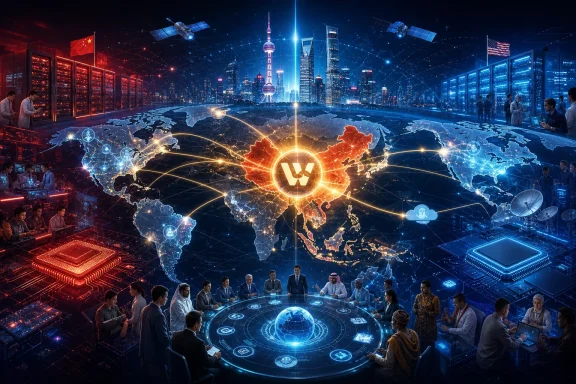
China has moved from publishing principles about artificial intelligence to building institutions capable of turning those principles into durable geopolitical influence. At the 2026 World Artificial Intelligence Conference in Shanghai, Beijing paired President Xi Jinping’s call for open and equitable AI development with action plans, interoperability proposals, training commitments and the founding of the World Artificial Intelligence Cooperation Organization, or WAICO. The result is not merely another diplomatic declaration but the outline of a China-centered AI ecosystem designed to compete with the United States over standards, infrastructure, model access and the loyalties of technology-dependent states.
China’s latest initiative did not emerge in isolation. Beijing has spent several years assembling a layered AI diplomacy that combines domestic industrial policy, support for developing economies, international standards work and criticism of technology restrictions imposed in the name of national security.
The 2023 Global AI Governance Initiative established the political vocabulary. It emphasized state sovereignty, opposition to ideological divisions, broad participation in rulemaking and the idea that all countries should share the benefits of AI rather than allowing a small group of technologically advanced states to dominate them.
The 2024 AI Capacity-Building Action Plan added a development component. China increasingly presented AI infrastructure, training, data resources and practical applications as international public goods that could be supplied through cooperation rather than reserved for wealthy countries.
By 2025, the Global AI Governance Action Plan had extended this agenda into more concrete areas, including joint laboratories, safety assessments, technical standards, educational programs and support for high-quality datasets. The framework remained voluntary and politically broad, but its direction was clear.
This progression matters because international technology governance rarely develops through a single binding treaty. It usually grows through committees, technical groups, procurement rules, training programs, certification processes and repeated cooperation among regulators and companies.
China is attempting to create those pathways before a universal AI governance system becomes established. If it succeeds, Beijing will not need to persuade every country to adopt a single Chinese rulebook; it will only need Chinese-backed practices to become familiar, affordable and interoperable enough to influence national decisions.
That expansion creates a dependency problem. A country adopting an AI platform also makes choices about cloud infrastructure, chips, model providers, data storage, identity systems, security controls and update mechanisms.
The diplomatic contest therefore concerns more than who builds the most intelligent model. It concerns who supplies the surrounding stack and who writes the rules governing its operation.
The speech also criticized the excessive use of national security arguments to restrict technology. That language directly challenges the expanding American use of export controls, investment screening and trusted-country arrangements.
Beijing is presenting access itself as a form of development assistance. Its commitments include thousands of training opportunities, international application centers and the deployment of the MAZU meteorological warning system in 30 countries.
These projects could produce immediate benefits. AI-supported weather forecasting, agricultural planning and disaster response have clearer public value for many governments than abstract promises about future artificial general intelligence.
They also create long-term relationships. Engineers trained on Chinese platforms are more likely to recommend compatible software, standards and infrastructure when they later design national systems.
The principle, however, has two sides. Sovereignty can protect countries from foreign technological domination, but it can also justify censorship, surveillance and restrictions on cross-border information.
China’s own domestic approach demonstrates that tension. Beijing supports international diffusion of Chinese models and services while maintaining extensive controls over online content, algorithms, data security and information flows inside China.
Its stated focus is civilian AI cooperation. Membership is formally open, participating states receive equal voting rights, and decisions may be reached by consensus or, when necessary, by a two-thirds majority.
WAICO’s potential functions include:
If China supplies most of the money, facilities and personnel, other members may struggle to challenge Chinese preferences. The organization could then appear multilateral while functioning mainly as an extension of Beijing’s foreign policy.
Alternatively, members may use WAICO to negotiate concessions and diversify their technology options. Countries accepting Chinese training or infrastructure will not necessarily accept every Chinese position on data governance, surveillance or platform regulation.
Yet the civilian-military boundary is increasingly difficult to maintain. Computer vision, autonomous navigation, cybersecurity models and logistics systems can all have dual-use applications.
WAICO will eventually need transparent rules for identifying prohibited projects and responding when civilian capabilities are redirected toward military, intelligence or coercive purposes.
This can be described as selective shaping: influencing the parts of the emerging order where technical leadership, development finance and coalition building can reinforce one another.
Technical standards offer a more practical route. Rules governing model evaluation, agent identity, logging, data provenance and security testing can be adopted incrementally without resolving every political dispute.
Once embedded in procurement systems and software development kits, such standards become costly to replace. A government may remain diplomatically nonaligned while its AI infrastructure becomes operationally dependent on one ecosystem.
The same dynamic has long shaped enterprise computing. Organizations frequently remain with a vendor because their employees, applications, support contracts and security procedures have accumulated around its products.
China can use capacity-building to create similar forms of institutional familiarity. This does not require explicit political pressure; convenience, affordability and local expertise may be enough.
That proposition differs from closed cloud services controlled by American providers. Governments concerned about foreign data access may prefer models they can host in domestic facilities.
Open weights do not automatically mean transparency or freedom. Training data, development decisions and safety processes may remain undisclosed, while running very large models can still require costly accelerators and specialist expertise.
The American AI Action Plan treats global deployment of the US technology stack as an economic and security objective. Chips, cloud platforms, models, software and data-center equipment become parts of an integrated export proposition.
Investment screening, supply-chain agreements and licensing requirements extend that logic. The policy aims to prevent adversaries from using American technology to improve military systems, surveillance capabilities or cyber operations.
The challenge is predictability. Customers may hesitate to build essential services around technology that could later become unavailable because of a regulatory decision in Washington.
The restrictions were subsequently lifted after additional safeguards were introduced. Even though the episode was short-lived, it demonstrated that export-control policy can reach beyond physical chips and affect access to model capabilities themselves.
For enterprises, this creates a new category of continuity risk. Compliance teams may need to evaluate the nationality of users, where inference occurs, whether model outputs cross borders and whether access could change with little notice.
Unlike WAICO, it is not organized primarily as an open-membership governance institution. Its logic is selective: partners receive closer integration because they meet strategic, security or supply-chain requirements.
The contrast can be summarized as follows:
Both governments want their national industries to succeed internationally. Both connect AI leadership to security, industrial strength and geopolitical influence, and both impose controls when they believe core interests are threatened.
Foreign companies operating in China face regulatory, data-localization and content-compliance obligations. Chinese AI services must operate within rules that give the state extensive influence over permissible outputs.
China’s international openness is therefore best understood as openness to the adoption of Chinese capabilities, not an abandonment of state control.
Washington nevertheless seeks to differentiate between allies, partners, neutral states and strategic competitors. This turns access into a privilege that can be expanded or withdrawn according to security policy.
American technology may offer stronger legal protections in some markets, but partners also face extraterritorial compliance requirements and political uncertainty. The advantages of the US ecosystem are inseparable from the influence Washington exercises over it.
Default standards generate power because organizations rarely replace functioning infrastructure without a compelling reason. The winner in a particular market may be the provider that reaches deployment first, even if a competitor later offers a technically superior model.
An AI agent may authenticate itself, access corporate data, call external services, execute code, negotiate with another agent and record the result. Each step requires agreements about identity, permissions, messaging formats and accountability.
Interoperability can reduce that risk, but the organization defining it gains influence. Standards may determine which identity authorities are trusted, what metadata must be disclosed and how disputes are resolved.
A China-backed framework could spread through countries adopting Chinese models and cloud systems. American companies may respond with protocols tied closely to their own identity, security and developer ecosystems.
For Windows administrators, interoperability is not an abstract diplomatic issue. It could determine whether a foreign-developed agent can:
Genuine interoperability must cover permissions, revocation, logging, data retention and incident response. Otherwise, a standardized connector could simply make insecure cross-border automation easier.
The gap between leading American and Chinese models has narrowed on several benchmark families. The precise distance varies by task, evaluation method and release cycle, but Chinese systems are no longer confined to a clearly inferior second tier.
Kimi K3 performed strongly in public coding comparisons, including front-end development tests where it competed with or surpassed prominent American models. Moonshot also positioned it as an open-weight release, with downloadable weights scheduled for July 27.
Benchmark results require caution. Performance can change according to prompts, agent harnesses, inference settings and the amount of compute allocated to each test.
Still, Kimi K3 strengthens China’s diplomacy because it connects political claims about accessibility with a model developers may genuinely want to use. A governance offer backed by competitive software is much more influential than one backed by slogans.
A Chinese model that reaches most of a frontier model’s capability at a significantly lower operational cost can win large numbers of practical workloads. Those deployments produce data, developer experience and commercial revenue that support further improvement.
The competitive unit is therefore not a benchmark score alone. It is the combination of capability, price, latency, licensing, hardware requirements and ease of integration.
Export controls increase China’s costs, but they also encourage efficiency. Chinese laboratories have strong incentives to develop architectures, training methods and inference systems that extract more value from constrained hardware.
That creates an unintended consequence for Washington. Controls may slow Chinese progress in the short term while accelerating investment in alternatives that reduce long-term dependence on American technology.
The traditional software-vendor questionnaire is no longer sufficient. Enterprises need to understand how governments may intervene in model availability and operation.
However, the immediate savings must be compared with long-term switching costs. Once tax, healthcare, education or identity systems depend on a specific model family, replacing that family could become politically and technically difficult.
Public agencies should demand auditable contracts, data portability and clear rules governing remote updates. They should also avoid allowing a foreign provider to become the sole source of expertise needed to operate critical systems.
Those firms are also less able to absorb sudden disruptions. A small software company built around one foreign API may have neither the engineers nor cash reserves needed to migrate quickly.
Open-weight models can help, but self-hosting is not free. Hardware, security, patching and model monitoring may exceed the capabilities of smaller IT teams.
Developers will confront a more fragmented marketplace. They may need to support multiple models because customers in different countries cannot access the same services.
A Windows application might use an American cloud model for customers in one market, a locally hosted Chinese open-weight model in another and a sovereign European provider for regulated public-sector deployments.
This architecture can improve resilience but also complicates testing. Developers must account for different token limits, tool-calling behavior, content policies and output quality.
Microsoft, Intel, AMD, Qualcomm and PC manufacturers have already invested heavily in neural processing units and AI-capable hardware. Competition between ecosystems gives those investments additional strategic value.
Local models will not replace frontier cloud systems for every task. They can, however, handle document summarization, translation, search, classification and routine automation while keeping sensitive data on the device.
Developers should expose provider information, retention settings and fallback behavior in clear language. Silent substitution between models may improve availability, but it can also change privacy, quality and content moderation without meaningful consent.
Kazakhstan’s participation in both WAICO and Pax Silica illustrates the possibility of selective engagement. Other governments are likely to pursue similar strategies even when they do not formally join both initiatives.
This approach preserves flexibility, but it also increases integration complexity. Systems assembled from multiple geopolitical ecosystems may contain incompatible security assumptions and legal obligations.
Multi-alignment is therefore not the absence of dependence. It is an attempt to distribute dependence so that no single provider can exercise decisive control.
Pressure will increase during crises. Export controls, sanctions or military tensions could force governments to choose which systems they can continue operating.
The likely global structure is a collection of overlapping ecosystems with varying degrees of access. Some countries will receive frontier capabilities, others will receive restricted versions, and still others will rely on open models running on older hardware.
Observers should also examine whether participating states can publish independent evaluations or challenge proposed standards. Transparency around decision-making will indicate whether WAICO is developing into a genuinely multilateral institution.
Washington may also expand financing for AI infrastructure and training. Competing only through controls would allow China to dominate the more appealing language of development and access.
WindowsForum users should watch for changes in model-routing options, local AI runtimes, agent permissions and enterprise management controls. Administrators will need policy tools capable of governing multiple models without trusting each provider equally.
If the model proves capable and practical to deploy, it could strengthen China’s broader governance narrative. If it remains prohibitively expensive or difficult to operate, the diplomatic value of its openness will be more limited.
China’s bid to reshape the global AI order is credible because it joins institutions, standards, training and increasingly competitive technology into one strategic package. The United States retains formidable advantages in chips, frontier research, cloud platforms and enterprise software, but it now faces an opponent offering many countries a different bargain: wider access and formal participation in exchange for deeper integration with Chinese infrastructure and norms. The future is unlikely to be a cleanly divided digital world; it will be a contested network of overlapping dependencies in which governments, enterprises and Windows users must judge not only what an AI system can do, but who can control it, restrict it and keep it running when politics intervenes.
 Background
China’s latest initiative did not emerge in isolation. Beijing has spent several years assembling a layered AI diplomacy that combines domestic industrial policy, support for developing economies, international standards work and criticism of technology restrictions imposed in the name of national security.The 2023 Global AI Governance Initiative established the political vocabulary. It emphasized state sovereignty, opposition to ideological divisions, broad participation in rulemaking and the idea that all countries should share the benefits of AI rather than allowing a small group of technologically advanced states to dominate them.
The 2024 AI Capacity-Building Action Plan added a development component. China increasingly presented AI infrastructure, training, data resources and practical applications as international public goods that could be supplied through cooperation rather than reserved for wealthy countries.
By 2025, the Global AI Governance Action Plan had extended this agenda into more concrete areas, including joint laboratories, safety assessments, technical standards, educational programs and support for high-quality datasets. The framework remained voluntary and politically broad, but its direction was clear.
From principles to institutional power
The Shanghai conference held from July 17 to July 20, 2026, marked a shift from diplomatic positioning to institution building. Its outcomes included a chair’s statement, plans covering cooperation and ethics, an initiative on trusted AI-agent interaction and a founding agreement for WAICO.This progression matters because international technology governance rarely develops through a single binding treaty. It usually grows through committees, technical groups, procurement rules, training programs, certification processes and repeated cooperation among regulators and companies.
China is attempting to create those pathways before a universal AI governance system becomes established. If it succeeds, Beijing will not need to persuade every country to adopt a single Chinese rulebook; it will only need Chinese-backed practices to become familiar, affordable and interoperable enough to influence national decisions.
Why AI diplomacy has become urgent
AI is no longer confined to chatbots and experimental software. Governments are connecting it to public administration, weather forecasting, healthcare, education, industrial automation, military planning and cybersecurity.That expansion creates a dependency problem. A country adopting an AI platform also makes choices about cloud infrastructure, chips, model providers, data storage, identity systems, security controls and update mechanisms.
The diplomatic contest therefore concerns more than who builds the most intelligent model. It concerns who supplies the surrounding stack and who writes the rules governing its operation.
Xi Jinping’s Proposition for the Global AI Order
Xi’s opening address framed AI as a shared global undertaking rather than a competition that should be controlled by a few leading powers. His priorities included greater openness, equitable access, human control over AI systems and stronger coordination centered on the United Nations.The speech also criticized the excessive use of national security arguments to restrict technology. That language directly challenges the expanding American use of export controls, investment screening and trusted-country arrangements.
Access as a diplomatic instrument
China’s offer is particularly attractive to countries worried about being excluded from advanced technology. Many developing economies lack the capital, specialist labor and data-center capacity required to train frontier models independently.Beijing is presenting access itself as a form of development assistance. Its commitments include thousands of training opportunities, international application centers and the deployment of the MAZU meteorological warning system in 30 countries.
These projects could produce immediate benefits. AI-supported weather forecasting, agricultural planning and disaster response have clearer public value for many governments than abstract promises about future artificial general intelligence.
They also create long-term relationships. Engineers trained on Chinese platforms are more likely to recommend compatible software, standards and infrastructure when they later design national systems.
Sovereignty and cultural difference
China’s message emphasizes that governments should retain authority over how AI reflects national law, language, culture and social priorities. This is likely to resonate in countries that regard Western platform policies as an indirect form of external rulemaking.The principle, however, has two sides. Sovereignty can protect countries from foreign technological domination, but it can also justify censorship, surveillance and restrictions on cross-border information.
China’s own domestic approach demonstrates that tension. Beijing supports international diffusion of Chinese models and services while maintaining extensive controls over online content, algorithms, data security and information flows inside China.
WAICO Turns Diplomacy Into an Institution
WAICO is the most consequential element of the Shanghai package because it gives China’s AI diplomacy a permanent organizational home. Twenty-nine countries signed the founding agreement, and the organization is expected to operate from Shanghai through a council and secretariat.Its stated focus is civilian AI cooperation. Membership is formally open, participating states receive equal voting rights, and decisions may be reached by consensus or, when necessary, by a two-thirds majority.
More than another conference
Annual conferences can generate attention, but they rarely sustain detailed technical work. A standing organization can convene working groups, maintain training programs, coordinate standards proposals and track projects over multiple years.WAICO’s potential functions include:
- It can coordinate AI capacity-building programs for governments that lack specialist institutions.
- It can promote common approaches to safety, ethics, testing and certification.
- It can encourage interoperability between models, agents and national platforms.
- It can support open-weight and open-source software ecosystems.
- It can channel developing-country positions into wider United Nations discussions.
- It can create recurring relationships among regulators, universities, technology companies and infrastructure providers.
The test of genuine multilateralism
WAICO’s credibility will depend on whether its members can shape its priorities. Equal voting rights look significant on paper, but practical influence also depends on funding, staffing, agenda control and access to technical expertise.If China supplies most of the money, facilities and personnel, other members may struggle to challenge Chinese preferences. The organization could then appear multilateral while functioning mainly as an extension of Beijing’s foreign policy.
Alternatively, members may use WAICO to negotiate concessions and diversify their technology options. Countries accepting Chinese training or infrastructure will not necessarily accept every Chinese position on data governance, surveillance or platform regulation.
The importance of civilian scope
Restricting WAICO’s formal mandate to civilian AI may make membership politically easier. Governments can join programs covering education, healthcare or weather systems without appearing to enter a Chinese-led security alliance.Yet the civilian-military boundary is increasingly difficult to maintain. Computer vision, autonomous navigation, cybersecurity models and logistics systems can all have dual-use applications.
WAICO will eventually need transparent rules for identifying prohibited projects and responding when civilian capabilities are redirected toward military, intelligence or coercive purposes.
China’s Selective-Shaping Strategy
Beijing is not trying to replace every existing AI forum. Instead, it is concentrating on areas where international rules remain unsettled and where Chinese institutions possess enough capability to offer practical alternatives.This can be described as selective shaping: influencing the parts of the emerging order where technical leadership, development finance and coalition building can reinforce one another.
Standards before treaties
A universal AI treaty would be extraordinarily difficult to negotiate. Countries disagree about human rights, content controls, military uses, intellectual property, data access and the acceptable role of private companies.Technical standards offer a more practical route. Rules governing model evaluation, agent identity, logging, data provenance and security testing can be adopted incrementally without resolving every political dispute.
Once embedded in procurement systems and software development kits, such standards become costly to replace. A government may remain diplomatically nonaligned while its AI infrastructure becomes operationally dependent on one ecosystem.
Capacity-building as ecosystem expansion
Training programs are often presented as neutral assistance, but technology education naturally reflects the platforms being taught. A course built around Chinese cloud services, model APIs and development tools can lower the cost of adopting the broader Chinese stack.The same dynamic has long shaped enterprise computing. Organizations frequently remain with a vendor because their employees, applications, support contracts and security procedures have accumulated around its products.
China can use capacity-building to create similar forms of institutional familiarity. This does not require explicit political pressure; convenience, affordability and local expertise may be enough.
Open weights as leverage
Chinese developers have increasingly used open-weight releases to increase global reach. Open-weight models allow organizations to download model parameters and deploy them on private or sovereign infrastructure, subject to license terms and practical hardware requirements.That proposition differs from closed cloud services controlled by American providers. Governments concerned about foreign data access may prefer models they can host in domestic facilities.
Open weights do not automatically mean transparency or freedom. Training data, development decisions and safety processes may remain undisclosed, while running very large models can still require costly accelerators and specialist expertise.
The American Model: Access Through Trusted Networks
The United States is pursuing a different form of AI diplomacy. Its strategy combines domestic innovation, infrastructure construction and international distribution of American technology with controls intended to prevent advanced capabilities from reaching strategic competitors.The American AI Action Plan treats global deployment of the US technology stack as an economic and security objective. Chips, cloud platforms, models, software and data-center equipment become parts of an integrated export proposition.
Security conditions shape access
Washington increasingly links access to trust, end use and strategic alignment. Semiconductor controls introduced since 2022 have restricted China’s ability to obtain certain advanced accelerators and manufacturing equipment.Investment screening, supply-chain agreements and licensing requirements extend that logic. The policy aims to prevent adversaries from using American technology to improve military systems, surveillance capabilities or cyber operations.
The challenge is predictability. Customers may hesitate to build essential services around technology that could later become unavailable because of a regulatory decision in Washington.
The Anthropic episode
That risk became visible in June 2026 when US authorities applied export restrictions to Anthropic’s Fable 5 and Mythos 5 models. Access for foreign nationals was disrupted shortly after the models’ release, generating uncertainty among international customers and security partners.The restrictions were subsequently lifted after additional safeguards were introduced. Even though the episode was short-lived, it demonstrated that export-control policy can reach beyond physical chips and affect access to model capabilities themselves.
For enterprises, this creates a new category of continuity risk. Compliance teams may need to evaluate the nationality of users, where inference occurs, whether model outputs cross borders and whether access could change with little notice.
Pax Silica and strategic alignment
Pax Silica represents the trusted-network side of American technology diplomacy. It emphasizes AI supply-chain security, resilience and cooperation among countries that Washington regards as reliable partners.Unlike WAICO, it is not organized primarily as an open-membership governance institution. Its logic is selective: partners receive closer integration because they meet strategic, security or supply-chain requirements.
The contrast can be summarized as follows:
- WAICO seeks legitimacy through broad membership, development assistance and multilateral procedures.
- Pax Silica seeks resilience through trusted participation, strategic coordination and controlled access.
- Both models expand the influence of their sponsor’s technology ecosystem.
- Neither model eliminates dependence; each changes the conditions under which dependence is managed.
Competing Visions, Similar Strategic Goals
It is tempting to describe China as open and the United States as restrictive. That framing is too simple.Both governments want their national industries to succeed internationally. Both connect AI leadership to security, industrial strength and geopolitical influence, and both impose controls when they believe core interests are threatened.
China’s qualified openness
China offers broad access to models, training and infrastructure, particularly where doing so can accelerate the use of Chinese technology. It does not offer unrestricted access to its domestic information environment or internal market.Foreign companies operating in China face regulatory, data-localization and content-compliance obligations. Chinese AI services must operate within rules that give the state extensive influence over permissible outputs.
China’s international openness is therefore best understood as openness to the adoption of Chinese capabilities, not an abandonment of state control.
America’s qualified diffusion
The United States wants American models, chips and platforms to become global defaults. Its companies benefit when developers build around Azure, Windows, Nvidia hardware, American APIs and related enterprise software.Washington nevertheless seeks to differentiate between allies, partners, neutral states and strategic competitors. This turns access into a privilege that can be expanded or withdrawn according to security policy.
American technology may offer stronger legal protections in some markets, but partners also face extraterritorial compliance requirements and political uncertainty. The advantages of the US ecosystem are inseparable from the influence Washington exercises over it.
The contest over default settings
The central question is not which side uses the word “open” more convincingly. It is which ecosystem becomes the default for identity, agent communication, cloud deployment, model evaluation, security logging and public procurement.Default standards generate power because organizations rarely replace functioning infrastructure without a compelling reason. The winner in a particular market may be the provider that reaches deployment first, even if a competitor later offers a technically superior model.
Interoperability Becomes a Strategic Battleground
The Shanghai initiative on agent mutual trust, interconnection and interoperability addresses a problem that will grow as AI shifts from chat interfaces to autonomous and semi-autonomous agents.An AI agent may authenticate itself, access corporate data, call external services, execute code, negotiate with another agent and record the result. Each step requires agreements about identity, permissions, messaging formats and accountability.
Why agent standards matter
Without common standards, agents from different providers may be unable to cooperate securely. Organizations could become locked into proprietary orchestration systems because moving a workflow would require rebuilding connectors, policies and audit controls.Interoperability can reduce that risk, but the organization defining it gains influence. Standards may determine which identity authorities are trusted, what metadata must be disclosed and how disputes are resolved.
A China-backed framework could spread through countries adopting Chinese models and cloud systems. American companies may respond with protocols tied closely to their own identity, security and developer ecosystems.
Implications for Windows
Windows remains one of the most important endpoints for enterprise AI. Agents running on Windows PCs can interact with local files, Microsoft 365 data, browsers, management tools and line-of-business applications.For Windows administrators, interoperability is not an abstract diplomatic issue. It could determine whether a foreign-developed agent can:
- Authenticate through Microsoft Entra ID or a national identity provider.
- Access local resources without bypassing Windows security controls.
- Invoke models hosted in different clouds.
- Produce logs compatible with Microsoft Sentinel and other security platforms.
- Respect data-loss prevention and conditional-access policies.
- Be disabled centrally if its provider becomes sanctioned or untrusted.
The danger of superficial compatibility
Two agents can exchange messages while remaining incompatible at the governance level. One system may require extensive auditing, while another permits opaque delegation or stores prompts in a jurisdiction with different privacy rules.Genuine interoperability must cover permissions, revocation, logging, data retention and incident response. Otherwise, a standardized connector could simply make insecure cross-border automation easier.
The Technology Gap Is Narrowing
China’s diplomatic proposition becomes more credible as its models improve. Countries will not adopt Chinese platforms merely because Beijing presents an attractive governance philosophy; the technology must also perform well at an acceptable cost.The gap between leading American and Chinese models has narrowed on several benchmark families. The precise distance varies by task, evaluation method and release cycle, but Chinese systems are no longer confined to a clearly inferior second tier.
Kimi K3 changes the conversation
Moonshot AI’s Kimi K3, released on July 16, 2026, illustrates the trend. The model has 2.8 trillion total parameters, native multimodal capabilities and a context window designed for long-running coding and knowledge tasks.Kimi K3 performed strongly in public coding comparisons, including front-end development tests where it competed with or surpassed prominent American models. Moonshot also positioned it as an open-weight release, with downloadable weights scheduled for July 27.
Benchmark results require caution. Performance can change according to prompts, agent harnesses, inference settings and the amount of compute allocated to each test.
Still, Kimi K3 strengthens China’s diplomacy because it connects political claims about accessibility with a model developers may genuinely want to use. A governance offer backed by competitive software is much more influential than one backed by slogans.
Cost matters as much as raw intelligence
Many organizations do not need the absolute best model. They need a model that is reliable enough, affordable enough and deployable within their legal and technical constraints.A Chinese model that reaches most of a frontier model’s capability at a significantly lower operational cost can win large numbers of practical workloads. Those deployments produce data, developer experience and commercial revenue that support further improvement.
The competitive unit is therefore not a benchmark score alone. It is the combination of capability, price, latency, licensing, hardware requirements and ease of integration.
Chips remain an American advantage
China’s model progress does not eliminate US advantages in advanced semiconductors, manufacturing equipment and access to high-end compute. American firms and allied suppliers remain deeply important across the accelerator and fabrication chain.Export controls increase China’s costs, but they also encourage efficiency. Chinese laboratories have strong incentives to develop architectures, training methods and inference systems that extract more value from constrained hardware.
That creates an unintended consequence for Washington. Controls may slow Chinese progress in the short term while accelerating investment in alternatives that reduce long-term dependence on American technology.
Impact on Enterprises and Governments
Organizations operating internationally will increasingly encounter AI as a geopolitical procurement decision. Choosing a model provider may affect sanctions compliance, cross-border data transfers, cybersecurity obligations and access to future upgrades.The traditional software-vendor questionnaire is no longer sufficient. Enterprises need to understand how governments may intervene in model availability and operation.
A new procurement checklist
Organizations evaluating AI platforms should proceed sequentially:- Map the complete dependency chain. This includes models, APIs, clouds, accelerators, identity services, data stores and orchestration software.
- Identify jurisdictional exposure. Determine which governments can impose export controls, disclosure orders or service restrictions.
- Test model portability. Confirm whether workloads can move to another provider without rewriting core applications.
- Separate data from orchestration. Keep valuable records in formats that do not depend on a single model vendor.
- Design an emergency fallback. Establish what happens if an API, model version or foreign service becomes unavailable.
- Verify agent permissions. Ensure that automated systems cannot expand their access when moved between platforms.
- Monitor policy changes. Treat geopolitical developments as operational risk rather than distant foreign-policy news.
Government procurement
Governments face additional complications because AI platforms may influence public services and sovereign data. A low-cost foreign system can be attractive, particularly when bundled with financing, infrastructure and training.However, the immediate savings must be compared with long-term switching costs. Once tax, healthcare, education or identity systems depend on a specific model family, replacing that family could become politically and technically difficult.
Public agencies should demand auditable contracts, data portability and clear rules governing remote updates. They should also avoid allowing a foreign provider to become the sole source of expertise needed to operate critical systems.
Small and midsize businesses
Smaller firms may benefit most from lower-cost competition between Chinese and American providers. More capable models at reduced prices can make automation accessible to businesses that cannot afford large enterprise agreements.Those firms are also less able to absorb sudden disruptions. A small software company built around one foreign API may have neither the engineers nor cash reserves needed to migrate quickly.
Open-weight models can help, but self-hosting is not free. Hardware, security, patching and model monitoring may exceed the capabilities of smaller IT teams.
Consumer and Developer Consequences
Consumers may experience the emerging AI order through app availability, privacy settings and differences in what assistants are permitted to say or do. Models optimized for different regulatory environments will not behave identically.Developers will confront a more fragmented marketplace. They may need to support multiple models because customers in different countries cannot access the same services.
AI applications become region-aware
Software already varies by region because of privacy, licensing and content requirements. AI adds export controls, model-specific safety rules and data-residency obligations.A Windows application might use an American cloud model for customers in one market, a locally hosted Chinese open-weight model in another and a sovereign European provider for regulated public-sector deployments.
This architecture can improve resilience but also complicates testing. Developers must account for different token limits, tool-calling behavior, content policies and output quality.
The return of local AI
Geopolitical fragmentation may accelerate local and on-device AI. Models running directly on a Windows PC avoid some cross-border data issues and can continue functioning when cloud access changes.Microsoft, Intel, AMD, Qualcomm and PC manufacturers have already invested heavily in neural processing units and AI-capable hardware. Competition between ecosystems gives those investments additional strategic value.
Local models will not replace frontier cloud systems for every task. They can, however, handle document summarization, translation, search, classification and routine automation while keeping sensitive data on the device.
User trust will depend on transparency
Consumers need to know which model operates an application, where their data goes and whether the service can be altered remotely. A generic “AI-powered” label reveals almost nothing about the underlying risks.Developers should expose provider information, retention settings and fallback behavior in clear language. Silent substitution between models may improve availability, but it can also change privacy, quality and content moderation without meaningful consent.
Why the World Is Unlikely to Split Into Two Blocs
The emerging order will not map neatly onto Cold War alliances. Most countries have economic, security and infrastructure relationships that cross geopolitical lines.Kazakhstan’s participation in both WAICO and Pax Silica illustrates the possibility of selective engagement. Other governments are likely to pursue similar strategies even when they do not formally join both initiatives.
Multi-alignment offers leverage
Countries can use competing offers to secure better prices, local investment and technology transfer. A government may buy American accelerators, deploy Chinese open-weight models and adopt European privacy rules within the same national strategy.This approach preserves flexibility, but it also increases integration complexity. Systems assembled from multiple geopolitical ecosystems may contain incompatible security assumptions and legal obligations.
Multi-alignment is therefore not the absence of dependence. It is an attempt to distribute dependence so that no single provider can exercise decisive control.
Digital nonalignment has limits
A country may seek neutrality while relying on chips produced with American-controlled tools or cloud services operated by Chinese companies. Supply chains can expose hidden dependencies that political declarations overlook.Pressure will increase during crises. Export controls, sanctions or military tensions could force governments to choose which systems they can continue operating.
The likely global structure is a collection of overlapping ecosystems with varying degrees of access. Some countries will receive frontier capabilities, others will receive restricted versions, and still others will rely on open models running on older hardware.
Strengths and Opportunities
China’s initiative introduces genuine opportunities, particularly for governments and organizations previously excluded from advanced AI development.- WAICO can give developing countries a regular forum in which capacity-building receives more attention than frontier-lab competition.
- Chinese open-weight models can increase price competition and reduce dependence on a small number of American cloud APIs.
- Training and application centers may help governments build local expertise rather than importing complete systems with no domestic capability.
- Interoperability work could reduce proprietary lock-in if standards remain transparent and broadly implementable.
- Weather, agriculture, health and education projects can demonstrate practical value beyond consumer chatbots.
- Competition between China and the United States may encourage both sides to offer better pricing, infrastructure investment and technical support.
- Windows developers could benefit from a wider selection of models compatible with local, cloud and hybrid deployment.
- Smaller states may gain bargaining power by participating in multiple initiatives instead of accepting a single technology patron.
Risks and Concerns
The same initiatives also carry significant political, technical and security risks.- WAICO could become China-dominated if Beijing controls its funding, staffing and technical agenda.
- Capacity-building may create vendor dependence when training, infrastructure and support all come from the same national ecosystem.
- Open-weight availability can spread valuable capabilities while also making misuse and unmonitored deployment easier.
- Interoperability standards could embed surveillance, identity or data-sharing assumptions that conflict with local rights protections.
- American export controls may disrupt legitimate customers and encourage organizations to abandon US services for more predictable alternatives.
- Competing standards may force developers to maintain expensive parallel implementations.
- Civilian AI projects may be repurposed for military, intelligence or coercive applications.
- Countries may overestimate their autonomy while remaining dependent on foreign chips, clouds and updates.
- Benchmark competition could encourage premature adoption of models whose reliability and security have not been independently established.
- Political pressure may transform routine software updates into instruments of state leverage.
What to Watch Next
WAICO’s significance will become clearer through implementation rather than ceremonial membership. The immediate questions concern budgets, staffing, working groups and the first countries selected for major projects.Observers should also examine whether participating states can publish independent evaluations or challenge proposed standards. Transparency around decision-making will indicate whether WAICO is developing into a genuinely multilateral institution.
Five indicators of lasting influence
The following indicators will show whether China’s initiative is becoming structurally important:- Members begin funding WAICO rather than relying almost entirely on China.
- National governments incorporate WAICO standards into procurement or legislation.
- Chinese-backed training programs produce permanent local institutions and technical teams.
- Major model and cloud providers implement WAICO interoperability specifications.
- Countries outside China’s traditional diplomatic partners join and actively shape the agenda.
Washington’s response
The United States must decide how to protect advanced capabilities without making its ecosystem appear unreliable. Clearer licensing rules and consultation with allies could reduce the uncertainty created by sudden restrictions.Washington may also expand financing for AI infrastructure and training. Competing only through controls would allow China to dominate the more appealing language of development and access.
Microsoft and the Windows ecosystem
Microsoft’s response deserves close attention because Windows, Azure, Entra and Microsoft 365 connect endpoint computing to cloud AI. Decisions about third-party model support could influence whether enterprises can operate across competing ecosystems.WindowsForum users should watch for changes in model-routing options, local AI runtimes, agent permissions and enterprise management controls. Administrators will need policy tools capable of governing multiple models without trusting each provider equally.
The open-weight test
Kimi K3’s planned weight release will offer an early test of China’s claim that capable AI can be distributed more broadly. Developers will examine license terms, hardware requirements, security behavior and whether published benchmark results survive independent evaluation.If the model proves capable and practical to deploy, it could strengthen China’s broader governance narrative. If it remains prohibitively expensive or difficult to operate, the diplomatic value of its openness will be more limited.
China’s bid to reshape the global AI order is credible because it joins institutions, standards, training and increasingly competitive technology into one strategic package. The United States retains formidable advantages in chips, frontier research, cloud platforms and enterprise software, but it now faces an opponent offering many countries a different bargain: wider access and formal participation in exchange for deeper integration with Chinese infrastructure and norms. The future is unlikely to be a cleanly divided digital world; it will be a contested network of overlapping dependencies in which governments, enterprises and Windows users must judge not only what an AI system can do, but who can control it, restrict it and keep it running when politics intervenes.
References
- Primary source: Eurasia Review
Published: 2026-07-21T16:15:31+00:00
China’s Bid To Reshape The Global AI Order - Analysis - Eurasia Review
By Basu Chandolawww.eurasiareview.com