

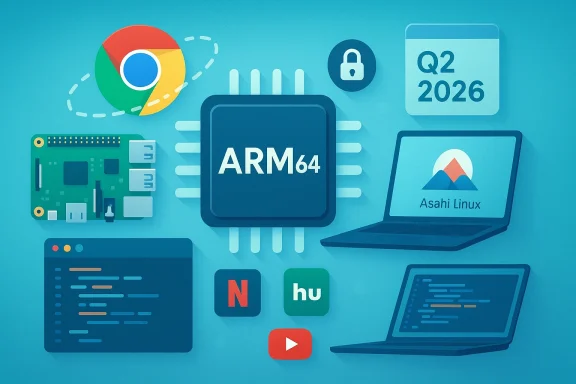
Google’s intent to ship an official Google Chrome build for ARM64 Linux in Q2 2026 — a window between April and June — is a watershed moment for a growing class of small, energy‑efficient computers and ARM laptops that until now have had to rely on Chromium builds or workarounds to approximate the full Chrome experience. The move promises feature parity with Chrome on x86 Linux, macOS, and Windows for things that matter to many users: account sync, DRM playback, proprietary codecs and components, and the commercial Google services tied to the official binary. That promise also arrives with practical questions and caveats: how Google will deliver Widevine DRM and proprietary codecs on aarch64, whether distributions and repos will pick up the package, and what this actually means for performance, security, and maintenance on devices from Raspberry Pi single‑board computers to M‑series Macs running Asahi Linux. Early reporting (noted in popular tech outlets) has set expectations for a Q2 2026 release; at time of writing Google has not published a single definitive release date in the Chrome Releases channel or a formal developer blog post that enumerates the rollout plan and technical constraints, so the community should treat the Q2 window as a company‑stated target rather than a hard ship date. ([chromereleases.goochromereleases.googleblog.com/2026/02/)
Google’s decision to prioritize ARM64 Linux for Chrome reflects the broader industry shift toward Arm architectures across consumer, education, and embedded devices. The impact will be real for many users — but the experience you get on Day One will depend on the interplay of Google’s packaging choices, Widevine availability and signing, and the maturity of SoC drivers on your chosen device. Stay patient, test carefully, and expect follow‑up patches as the ecosystem absorbs this important change.
Source: gHacks Google Chrome Is Coming to ARM64 Linux Devices in Q2 2026 - gHacks Tech News
 Background
Why ARM64 Linux has been waiting for Chrome
For years the Linux ARM community — hobbyists, educators, and developers alike — has used Chromium builds, third‑party ports, and community efforts to run Chromium on aarch64 devices. Chromium is the upstream, open‑source project that powers Google Chrome, but by design it does not include Google’s proprietary additions: account sync to Google services, licensed audio/video codecs in some binary distributions, the Widevine Content Decryption Module (CDM) required by many commercial streaming services, and other closed components. That difference has practical consequences: with Chromium you can browse the web, but you may not be able to sign into Chrome to sync bookmarks and passwords, or play DRM‑protected HD video from services like Netflix or Disney+ without additional steps. These limitations explain much of the persistent demand for an official Google Chrome build on ARM64 Linux.A short chronology
- ARM support arrived on macOS (Apple Silicon) with Google Chrome’s native Apple Silicon builds in 2020, substantially improving performance and efficiency on M‑series Macs.
- Google released native Arm64 Chrome builds for Windows in 2024 to support the rising class of Windows‑on‑Arm laptops and mini‑PCs.
- Linux remained the notable gap: community Chromium builds existed, but Google did not provide an official linux/arm64 binary for the Google Chrome package distributed from dl.google.com. That omission has caused friction for users who want official Google features on ARM Linux machines — a gap that the Q2 2026 announcement now aims to fill. Community discussion and project trackers across forums and developer channels have repeatedly flagged this as a long‑standing need.
What the announcement says — and what’s still unclear
The claim
Reports indicate Google told the community that an official Chrome build targeting ARM64 (aarch64) on Linux will ship in Q2 2026. That places the release sometime between April 1 and June 30, 2026. The significance is not just a native CPU build but the inclusion of Google Chrome’s proprietary features that Chromium lacks — account sync, commercial DRM support, and the packaged codecs and components many users expect from the official binary. The initial reporting identifies a set of devices that will benefit: Raspberry Pi boards, Pinebook ARM laptops, Macs running Asahi Linux, and other 64‑bit ARM hardware. (Note: those device lists are illustrative, highlighting common aarch64 Linux targets; the final supported hardware matrix will be defined by Google at release.)What Google has not confirmed publicly
- A precise release date (day/month) inside Q2 2026.
- The exact list of Linux distributions and installer formats (DEB, RPM, flatpak, snaps, or distro repositories) that will carry the official Google Chrome ARM64 packages at launch.
- Whether Google will deliver a bundled Widevine CDM (and in which security level — L1 vs L3), or whether users will need to install DRM components manually as with some community browsers on ARM.
- Whether the ARM64 Linux build will be immediately available across all Chrome release channels (Stable, Beta, Dev), or roll out to developers/testers first.
Why the arrival of Chrome for ARM64 Linux matters
1) Feature parity with official Chrome
Chromium and unofficial Chromium‑based builds are powerful, but they are intentionally stripped of Google‑branded services and certain proprietary codecs and components. Official Chrome binaries include:- Google Account sign‑in and Chrome Sync (bookmarks, history, passwords, open tabs).
- Widevine CDM for DRM‑protected streaming.
- Licensed proprietary codecs (if bundled), such as H.264 variants used by many streaming services.
- Google‑specific integrations (Safe Browsing by default, built‑in PDF viewers and updates mechanisms in certain distributions).
2) Developer and automation ecosystems
Tools and infrastructure that depend on the presence of Google Chrome — automated testing stacks, headless browsers, and containerized Selenium images — have been hampered on ARM64 Linux by the absence of an official Chrome binary. Many CI pipelines, device farms, or local development images either emulate x86 or rely on Chromium builds that behave slightly differently than Chrome for compatibility testing. A native, official Chrome should lower engineering friction for teams provisioning ARM64 test nodes and broaden the utility of aarch64 CI workers.3) Education and light computing
Raspberry Pi devices and Pinebook‑style ARM laptops are prominent in education, maker projects, digital signage, and lightweight desktops. For those deployments, having an officially supported Chrome binary could simplify device provisioning in labs and classrooms where Google account integration and media playback are expected by students and instructors.Technical realities and constraints: what will make or break the user experience
Widevine CDM on ARM64 Linux — a delicate dependency
The Widevine Content Decryption Module (CDM) is proprietary and historically has been distributed in platform‑specific binaries. Whether Google includes a prebuilt linux_arm64 Widevine CDM with Chrome for ARM64 Linux is the single most consequential technical question for DRM playback. Some community documentation and third‑party browsers show that a linux_arm64 Widevine bundle exists and can be installed manually in certain contexts, but the landscape is inconsistent: some distributions and media projects report that Widevine for aarch64 is missing or incompatible in practice, while other projects (and browser vendors) provide manual instructions to install a linux_arm64 libwidevinecdm.so. The practical upshot: DRM playback capability on ARM64 Linux will depend on how Google supplies and signs Widevine for the platform — and whether streaming services accept it for high security levels (L1) that unlock HD/4K streams. Until Google clarifies Widevine packaging for the official build, users should expect a phased experience where DRM support may arrive later or need additional setup in some cases.Hardware‑accelerated video decoding and compositors
ARM SoCs and their Linux drivers provide heterogeneous GPU and VPU stacks that are more fragmented than x86 drivers. For robust high‑resolution playback and low CPU usage, Chrome must integrate with platform video acceleration APIs (V4L2, VAAPI bindings, vendor driver extensions) and compositor pathways (Wayland, X11, Ozone layers). Google has engineering work to do to ensure platform‑specific acceleration runs reliably across the wide variety of ARM devices (Broadcom on Raspberry Pi, Rockchip, Allwinner, Qualcomm Snapdragon compute modules). The folks who maintain lightweight ARM distributions will pay close attention to hardware acceleration on Day One. The Chromium source tree and docs show the project continuously evolves Linux build targets and platform flags; however, vendor driver variance means users may need to tune their systems for optimal results.Package formats, repositories and update channels
Will Google ship .deb and .rpm packages, or will it rely on containerized packaging (flatpak, snap) or distribution repositories? The convenience of a native .deb for Debian/Ubuntu or an immediate appearance in Fedora’s repos would greatly accelerate adoption, but each packaging path has tradeoffs (automatic updates, sandboxing, system integration). Google’s historical approach has been to provide .deb/.rpm for x86_64 Linux; whether that pattern repeats — and whether distributions will accept the ARM64 artifacts into their official repos — will influence how quickly users can safely deploy Chrome across fleets. At time of writing, Google has not published a distribution matrix for ARM64 Linux Chrome packaging.Who benefits — and who still won’t
Short answer: a lot of users, but not everyone.- Beneficiaries:
- Hobbyists and power users running Raspberry Pi OS, Ubuntu aarch64, or Arch Linux on SBCs and single‑board desktops who want official sync and streaming support.
- Owners of ARM laptops (Pinebook, equivalent community boards) who want an out‑of‑box Chrome experience.
- Asahi Linux users on Apple Silicon Macs who need a native Linux browser that integrates with Google accounts without leaving macOS or running Chrome for macOS.
- Developers and automation teams who require official Chrome behavior for testing on native ARM64 machines.
- Who may still be left out:
- Devices where vendors do not provide compatible GPU drivers or hardware‑backed DRM support. In those cases, Chrome may run but not deliver the full multimedia experience.
- Distributions that prioritize fully open‑source stacks and remove proprietary blobs; those users may prefer Chromium or privacy‑focused forks and will avoid the official Chrome binary on principle.
Security implications and enterprise considerations
Security posture of an official build
An official Google Chrome release for ARM64 Linux will presumably receive the same security update cadence and CVE fixes as other Chrome platforms. That is a net positive for any organization using ARM Linux devices in production, because security patches and stable channel deployments are easier to manage when you can standardize on an official vendor binary. Google’s Chrome Releases blog shows the release process and CVE patching cadence for desktop channels; we should expect ARM64 Linux to be folded into that process once the build is mature and shipped.DRM, content protection and enterprise policy
Widevine’s presence introduces additional complexity for managed fleets and kiosk deployments. Enterprises that rely on Chrome policies and user profiles will need to consider the licensing and distribution of DRM binaries and whether those components are compatible with corporate policy. Additionally, some security‑minded organizations may prefer the transparency of Chromium builds with controlled policies rather than the black‑box nature of some proprietary DRM modules.Practical advice for users and integrators right now
- If you rely on Google account sync or DRM playback on an ARM64 Linux device, plan a short pilot program between April and June 2026 to test the official Chrome build when it appears. Expect an initial period where packaging, Widevine behavior, and hardware acceleration are still being tuned.
- Don’t assume your distribution will immediately include Google’s ARM64 Chrome in its official repositories. Bookmark the Chrome Releases blog and your distribution’s packaging channels to track when packages arrive.
- If you currently use Chromium and care about DRM playback today, investigate community instructions for installing linux_arm64 Widevine bundles; some browsers and distributions already provide manual steps to register a Widevine CDM for aarch64 systems. However, be ready for variability — the community experience suggests this is not yet a universal, friction‑free process.
- For developers building automated test images or Selenium containers, continue to follow the upstream Selenium and Docker multi‑arch work — the addition of an official Chrome build for linux/arm64 will simplify manifest handling and expected behavior for tests. But don’t switch rollout approaches until your test farm operators validate the official build in your environment.
Risks, limitations, and realistic expectations
Risk: DRM rollout and streaming compatibility
Even if Google ships a linux_arm64 Widevine CDM, streaming services perform server‑side checks and level negotiations that may not yield HD or 4K playback unless the CDM, hardware, and platform are all validated to their DRM requirements. That is an industry constraint, not a Google‑only problem. Users should temper expectations for immediate parity with x86 Chrome’s highest streaming security levels until ecosystems (CDM signatures, VPUs, and display protection) align.Risk: driver fragmentation and performance variance
ARM SoC vendors and the open‑source Linux community have made huge strides, but driver maturity still fluctuates between platforms. Some devices will enjoy excellent hardware‑accelerated video and compositing; others will only achieve acceptable results with community kernel patches or vendor driver updates. Performance will not be uniform on Day One.Risk: packaging and update mechanics
If Google provides an official package but distribution maintainers are slow to accept it into repositories, users will either need to add Google’s own repo or install manually. That scenario introduces operational risk for fleet managers who depend on distro‑maintained packages and automatic security updates. Consideration should be given to update channels and enterprise management tooling before large‑scale ARM Linux deployments.How this changes the Linux browser landscape
- For end users, the availability of a first‑party Chrome binary for ARM64 Linux reduces friction: fewer workarounds, fewer compatibility surprises, and native sync for users tied into Google’s ecosystem.
- For open‑source purists, the change is neutral to negative: Chrome’s inclusion of proprietary components (Widevine, codecs, Google services) reinforces the distinction between Chromium (open) and Chrome (proprietary).
- For developers and testers, the new binary simplifies cross‑architecture compatibis align behavior between local development systems and cloud CI running ARM64 runners.
Verification summary and what we checked
To ground the claims and technical guidance above we cross‑checked:- Google’s Chrome Releases feed and recent posts to see whether an official, dated announcement was present; at the time of writing the releases channel included the usual stable channel updates but no single dated post that enumerates an April/May/June 2026 launch day for linux/arm64 Chrome packaging. That reinforces that Q2 2026 should be viewed as a target window rather than a guaranteed calendar release.
- Chromium project documentation and community evidence concerning the difference between Chromium (open source) and Google Chrome (official, proprietary extras) to confirm which features are exclusive to official Chrome (account sync, Widevine inclusion in the binary distribution).
- Community and vendor documentation about Widevine on aarch64 Linux, which shows mixed practices: some distributions and browser vendors provide manual ways to register a linux_arm64 Widevine CDM, while others report compatibility gaps and manual intervention. That patchwork reinforces the cautionary stance that DRM playback on ARM64 Linux may require further Google action to be seamless.
- Multi‑arch and container tooling commentary (Selenium/CI) to confirm that the absence of an official Chrome aarch64 binary has been an operational pain point for automated testing and container images — a gap that an official build will reduce.
- Internal forum and community threads highlighting user demand for official Chrome on ARM64 Linux and real‑world pain points for Raspberry Pi and Asahi Linux users. These community voices are a consistent signal that demand is broad and practical.
Bottom line for WindowsForum readers
Google’s plan to ship Google Chrome for ARM64 Linux in Q2 2026 is an important and overdue step that will materially improve the browsing experience on a wide range of aarch64 devices. For hobbyists, educators, and developers who run ARM Linux, the arrival of an official build means fewer compromises: Chrome’s sync, update policies, and DRM behavior should align more closely with what users get on x86 and macOS today. That said, expect a phased, sometimes bumpy rollout: DRM and hardware‑accelerated playback are the two most likely areas to require follow‑up work by Google and device vendors. Keep watching Chrome Releases for the formal package announcement and test conservatively in production before you roll the new binary across fleets.Quick checklist — What to do the week the build lands
- Verify the release channel (Stable/Beta/Dev) and download the correct architecture build for your distribution.
- Test sign‑in and sync with a non‑critical Google account; validate bookmarks, passwords, and extensions sync.
- Test DRM playback for your most important streaming services and document whether HD/4K playback is available.
- Run performance profiling on target devices to confirm hardware acceleration paths (Wayland vs X11, VAAPI/V4L2) are functioning as expected.
- For fleets: stage the package in a QA environment, confirm update mechanics, and update deployment automation to include the new package repository or build.
Google’s decision to prioritize ARM64 Linux for Chrome reflects the broader industry shift toward Arm architectures across consumer, education, and embedded devices. The impact will be real for many users — but the experience you get on Day One will depend on the interplay of Google’s packaging choices, Widevine availability and signing, and the maturity of SoC drivers on your chosen device. Stay patient, test carefully, and expect follow‑up patches as the ecosystem absorbs this important change.
Source: gHacks Google Chrome Is Coming to ARM64 Linux Devices in Q2 2026 - gHacks Tech News
