
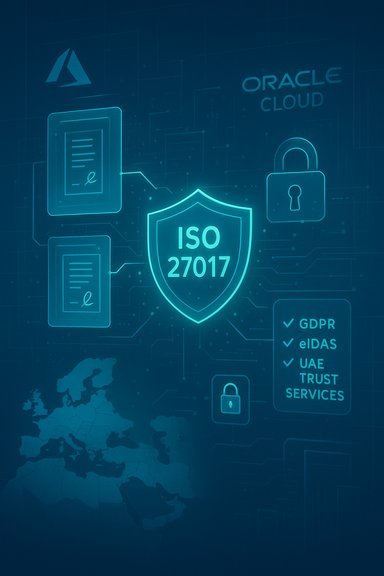
Circularo’s announcement that it has achieved ISO/IEC 27017 certification for its cloud-hosted eSigning platform is a meaningful signal to customers and procurement teams: the company says its cloud deployments on Microsoft Azure (EU and UAE regions) and Oracle Cloud Infrastructure (OCI) in Saudi Arabia are covered by the certification, and it frames the accreditation as a complement to its existing ISO/IEC 27001 posture and eIDAS‑compliant trust services.
ISO/IEC 27017 is an industry standard focused on information security controls for cloud services, intended as an extension to the widely adopted ISO/IEC 27001 management-system framework. In short, ISO/IEC 27001 confirms a company has a functioning Information Security Management System (ISMS); ISO/IEC 27017 adds cloud‑specific guidance — clarifying shared responsibilities, controls around virtualization, logical separation, and cloud operational activities. Organizations that hold ISO/IEC 27017 are signaling they’ve assessed and implemented controls specific to cloud service delivery and operations. Circularo’s press release states the certification applies to its Microsoft Azure deployments in Europe and the UAE and to Oracle Cloud Infrastructure in the Kingdom of Saudi Arabia, and quotes Circularo’s COO framing the achievement as reinforcing customer trust and regulatory alignment with GDPR, eIDAS and UAE trust‑services law. At the same time, Circularo’s public corporate pages list ISO/IEC 27001 and SOC 2 among their compliance claims and state the platform is eIDAS‑compliant — an important consideration for European customers requiring qualified or advanced signatures.
Vendors and customers alike should remember certification is a milestone, not a panacea: validate the scope, obtain the certificate and assessor details, and demand technical proof for any claim that materially affects legal compliance, evidence‑preservation or key custody. When those steps are followed, an ISO/IEC 27017 attestation can be a practical and useful element in an organization’s vendor‑risk playbook for cloud‑hosted eSigning services.
Key references cited in this article include Circularo’s press announcement and its corporate compliance statements; regulatory resources covering eIDAS and the UAE trust services framework; and industry guidance on the limitations and operational expectations behind ISO/IEC cloud security attestations. Further due‑diligence checklist (quick):
Source: News By Wire Circularo Achieves ISO/IEC 27017 Certification for Cloud-Hosted eSigning Platform
 Background / Overview
ISO/IEC 27017 is an industry standard focused on information security controls for cloud services, intended as an extension to the widely adopted ISO/IEC 27001 management-system framework. In short, ISO/IEC 27001 confirms a company has a functioning Information Security Management System (ISMS); ISO/IEC 27017 adds cloud‑specific guidance — clarifying shared responsibilities, controls around virtualization, logical separation, and cloud operational activities. Organizations that hold ISO/IEC 27017 are signaling they’ve assessed and implemented controls specific to cloud service delivery and operations. Circularo’s press release states the certification applies to its Microsoft Azure deployments in Europe and the UAE and to Oracle Cloud Infrastructure in the Kingdom of Saudi Arabia, and quotes Circularo’s COO framing the achievement as reinforcing customer trust and regulatory alignment with GDPR, eIDAS and UAE trust‑services law. At the same time, Circularo’s public corporate pages list ISO/IEC 27001 and SOC 2 among their compliance claims and state the platform is eIDAS‑compliant — an important consideration for European customers requiring qualified or advanced signatures. What the ISO/IEC 27017 milestone actually means
Why ISO/IEC 27017 matters for cloud eSigning platforms
- Cloud‑specific assurance: ISO/IEC 27017 focuses on cloud operations — things that general ISMS certifications do not explicitly address, such as logical separation of tenants, cloud provider selection and management, virtualization inventory controls, and cloud‑specific incident response processes. This is precisely the risk area for a hosted eSigning platform that performs signing operations and stores documents in the cloud.
- Shared responsibility clarified: Cloud certifications add value by clarifying which security responsibilities remain with the cloud provider (IaaS/PaaS) and which rest with the platform vendor or the customer — crucial for customers who must demonstrate compliance with GDPR, eIDAS or local trust‑services laws. Circularo’s statement explicitly calls out this “clear security responsibilities” benefit.
- Regulatory alignment: For organizations subject to EU regulations (GDPR and eIDAS) or regional rules like the UAE’s Federal Decree‑Law No. (46) of 2021 on Electronic Transactions and Trust Services, a cloud security certificate helps vendors demonstrate controls mapping to those obligations — though it does not automatically make a vendor “compliant” by itself. Circularo highlights alignment with eIDAS and GDPR as client benefits.
What it does not mean (important caveats)
- Certification is scope‑limited. ISO certifications are issued against a defined scope (services, locations, business units). The press release says the certification covers specific Azure and OCI deployments; customers should confirm the precise scope, start and expiry dates, and auditor/certification‑body details before relying on the claim as proof for procurement or regulatory evidence. The vendor press release did not name the third‑party certification body or publish the certificate serial/scope in the text — an omission procurement teams should treat as a normal red flag to verify.
- Certification does not replace contractual or technical controls. Even with ISO/IEC 27017, customers must still enforce contract language (data residency clauses, SLAs, incident response obligations), technical controls (encryption, key management, access controls), and independent audits (SOC 2 reports or the ISO attestation) based on their risk appetite. Industry best practices emphasize verifying both attestation evidence and technical implementation.
Strengths and practical benefits for customers
1) Independent third‑party attestation of cloud controls
A successful ISO/IEC 27017 audit requires an assessor to validate cloud‑specific policies, procedures and operational controls — not just written processes. For public‑sector and regulated private customers, that independent attestation reduces friction during procurement and risk reviews, and it can accelerate both vendor due diligence and internal approvals. Circularo’s announcement positions this as a trust enhancer.2) Regional data‑sovereignty claims
Circularo states the certification covers Azure EU and UAE regions and OCI in Saudi Arabia. For organizations requiring local hosting or legal residency guarantees, that regional footprint — if verified — simplifies compliance mappings and can help meet data‑locality requirements imposed by sectoral or national law. However, customers should confirm which services and environments in each region are in scope.3) Easier mappings to eIDAS, GDPR and UAE trust‑services law
Circularo specifically calls out alignment with eIDAS, GDPR and the UAE Federal Decree‑Law No. (46) of 2021. A cloud security certification can make it easier for security and compliance teams to map vendor controls to those frameworks. The UAE law and TDRA guidance on trust services set explicit requirements for qualified signatures and device approval — a notable regional factor for operations in the Gulf.4) Operational and procurement advantages
Buyers often prefer vendors with formal, internationally recognized certifications because they reduce the volume of contract terms they must negotiate around baseline security. Certifications provide a repeatable baseline that procurement, legal and security teams can reference when constructing supplier risk assessments.Risks, practical limits and what procurement teams must verify
Risk: Unclear audit trail and certifier details
The press release does not name the conformity assessment body that issued the ISO/IEC 27017 certificate. An ISO certificate’s evidentiary value depends on who audited the company and the exact scope of the audit. Always obtain the certificate copy, check the certifier (and whether it’s an accredited body), and validate the certificate number and scope. If a certifier isn’t named publicly, ask for the report of findings or a letter of attestation.Risk: Scope creep between environments
A statement that “the certification applies to all Circularo cloud deployments hosted in Azure EU and UAE and OCI Saudi” needs objective verification. Ask for:- The certificate’s formal scope statement.
- The list of named data centres/regions or service‑names covered.
- Any excluded services, connectors, or third‑party subsystems. Industry guidance warns that marketing language can over‑generalize audit scopes; always cross‑check with the certificate.
Risk: Shared responsibility gaps
ISO/IEC 27017 helps clarify cloud shared‑responsibility models, but it does not eliminate them. Customers remain responsible for proper configuration of their tenants and for controlling access to signing keys and documents. For signing platforms, who controls the signing keys? — a critical question for legal and security teams, particularly when qualified signatures or long‑term validation are required. Insist on detailed key‑custody documentation and a technical architecture diagram.Risk: Certifications don’t substitute for real‑world security operations
A certification shows a point‑in‑time attestation, but it does not guarantee perpetual operational perfection. Verify the vendor’s continuous improvement processes, patch cadence, incident‑response maturity, and evidence that the ISMS is actively managed (internal audit cycles, management reviews, vulnerability handling). Ask for recent audit reports, corrective action histories, and SOC 2 / penetration test results when available.Technical checklist: What to request from Circularo (or any cloud eSigning vendor) after a certification announcement
- Request a copy of the ISO/IEC 27017 certificate and confirm the certificate number, issue and expiry dates, and the accredited conformity assessment body.
- Ask for the auditor’s scope statement that explicitly lists which data centres, service components and operational processes were assessed.
- Obtain the vendor’s latest ISO/IEC 27001 certificate and supporting ISMS documentation (information‑security policy, risk‑treatment plan). Circularo’s public pages already reference ISO/IEC 27001; confirm certificate parity between the two standards.
- Request the vendor’s SOC 2 type report (if available) or a findings letter showing operational control testing results.
- Verify identity and signature key custody: where are signing keys generated, stored and protected; are they under hardware security modules (HSM), customer‑managed keys, or vendor custody? Ask for encryption and key‑management architecture diagrams.
- Confirm data‑residency commitments in the contract — including backup, DR replicas, and data‑erasure procedures for each jurisdiction.
- Seek a copy of the vendor’s incident response runbook and SLA commitments for security incidents.
- For eIDAS/qualified signature use cases, confirm which trust‑service provider (TSP) or Qualified Trust Service Provider (QTSP) integrations are in place and whether the necessary regulatory approvals (e.g., TDRA‑approved lists in the UAE) are satisfied. The UAE’s trust‑services framework includes explicit TDRA guidance on qualified trust services and device approvals.
How this affects common procurement and security decisions
For public‑sector buyers
- Use the certificate and auditor details as part of your compliance evidence package, but do not substitute it for jurisdictional approvals (e.g., TDRA licensing for providers offering qualified trust services in the UAE). Confirm whether Circularo’s offering is recognized within domain‑specific procurement frameworks and whether TDRA or other regulators have visibility into the vendor’s qualified‑trust arrangements.
For enterprise legal & privacy teams
- Map the vendor’s controls to GDPR data‑processing obligations and determine whether Circularo is acting as a processor or controller for different workflows. The vendor’s public claims of GDPR and eIDAS alignment are useful, but confirm roles and responsibilities contractually.
For security architects
- Validate that the vendor’s operational model supports secure key management, strong multi‑factor access, role‑based access control and encrypted audit logs. For signing platforms, immutable audit logs and long‑term validation mechanisms are operational requirements — look for documented retention and timestamping practices consistent with qualified‑signature lifecycles.
Strengths in Circularo’s positioning — and why they matter
- Regional presence and targeted cloud providers. The announcement specifically names Azure EU, Azure UAE and OCI Saudi — cloud providers and regions chosen with regulatory residency in mind. If true in scope, this helps organizations satisfy data‑sovereignty requirements in the EU, UAE and Saudi jurisdictions.
- Complementary certifications and trust services. Circularo already lists ISO/IEC 27001 and SOC2 among its compliance artifacts and markets eIDAS capabilities; adding ISO/IEC 27017 is a logical next step for a cloud platform focused on secure signing and document workflows. These combined attestations — when fully documented — can shorten vendor risk questionnaires.
- Regulatory framing for the Middle East. Circularo explicitly calls out the UAE trust‑services law and references governmental partnerships; this signals the vendor is aware of local trust‑service regimes (TDRA) and is positioning itself as a regional partner for government and regulated industries. Buyers operating in the region should still validate any claims against the TDRA registers and executive regulations.
Practical recommendations for WindowsForum readers and IT buyers
- Treat the ISO/IEC 27017 announcement as a positive signal, but request documentary evidence. Ask for a copy of the certificate, the auditor’s name and the formal scope. If the certificate is not immediately available, treat the PR as a marketing claim pending verification.
- Add due‑diligence questions specific to signing platforms:
- Can the vendor provide a diagram showing where signing keys are generated and whether those keys ever leave an HSM?
- Does the vendor support customer‑managed keys (CMK) or bring‑your‑own‑key (BYOK) options?
- Are qualified timestamps and long‑term validation (LTV) available for legally critical signatures?
- Insist on cross‑jurisdiction mapping: for EU customers, map vendor controls to eIDAS & GDPR; for UAE/Saudi customers, map to Federal Decree‑Law No. (46) of 2021 and TDRA/competent‑authority requirements. Regulatory pages and trust services guidance will help build those mappings.
- For high‑value or high‑risk signing workflows, require both the ISO attestation and an operational SOC 2 report (or equivalent) that demonstrates how controls perform over time. Static certifications are helpful but operational attestations are often more directly relevant to incident scenarios.
Conclusion — measured optimism with required verification
Circularo’s ISO/IEC 27017 announcement is welcome for buyers who need to see cloud‑specific security controls from an eSigning vendor, and the named regional cloud footprint addresses real data‑residency concerns for organizations operating in the EU, UAE and Saudi Arabia. The certification, combined with Circularo’s existing ISO/IEC 27001 and eIDAS positioning, strengthens the vendor’s compliance narrative and improves its procurement posture — provided that the certification’s scope and the certifying body are independently verifiable and the vendor supplements the attestation with operational evidence (SOC reports, pen tests, key‑management diagrams and contractual commitments).Vendors and customers alike should remember certification is a milestone, not a panacea: validate the scope, obtain the certificate and assessor details, and demand technical proof for any claim that materially affects legal compliance, evidence‑preservation or key custody. When those steps are followed, an ISO/IEC 27017 attestation can be a practical and useful element in an organization’s vendor‑risk playbook for cloud‑hosted eSigning services.
Key references cited in this article include Circularo’s press announcement and its corporate compliance statements; regulatory resources covering eIDAS and the UAE trust services framework; and industry guidance on the limitations and operational expectations behind ISO/IEC cloud security attestations. Further due‑diligence checklist (quick):
- Obtain the ISO/IEC 27017 certificate and scope.
- Request SOC/pen‑test reports and HSM/key‑custody diagrams.
- Confirm contractual data residency, backup and incident obligations.
- Map vendor controls to eIDAS/GDPR/UAE trust services as required by your legal/compliance teams.
Following these steps will turn a marketing announcement into verifiable procurement assurance.
Source: News By Wire Circularo Achieves ISO/IEC 27017 Certification for Cloud-Hosted eSigning Platform
