

CISA added a Google Chromium vulnerability — tracked as CVE‑2025‑14174 — to its Known Exploited Vulnerabilities (KEV) Catalog after evidence of active exploitation, marking the flaw as an urgent remediation priority for federal agencies and a high‑priority patching signal for enterprise defenders.
CISA’s Known Exploited Vulnerabilities (KEV) Catalog is a policy tool born from Binding Operational Directive (BOD) 22‑01, designed to convert observed exploitation telemetry into mandatory remediation timelines for the Federal Civilian Executive Branch (FCEB). When CISA places a CVE on the KEV list, agencies are required to remediate, mitigate, or isolate affected assets within the timeframes specified by CISA — a process that has become a de‑facto prioritization model for the private sector as well.
The KEV mechanism focuses on CVEs for which there is credible evidence of real‑world exploitation; it is deliberately operational in tone: entries are meant to trigger immediate, documented actions by administrators, not academic debate. For defenders, a KEV listing is shorthand for "patch this now, or segregate/disable the affected product until you can."
Security teams should view KEV as an early warning system for weaponized CVEs — not every vulnerability is added to KEV — which means the catalog is a practical indicator of active campaigns and a priority input to vulnerability management programs. Community discussion and operator playbooks frequently surface in industry forums as teams coordinate detection and patching strategies.
Acknowledging the dynamic nature of browser security and KEV entries, organizations should continue to monitor the KEV catalog and vendor advisories for updates, and treat renderer‑level CVEs as high priority in quarterly and emergency patch cycles.
Source: CISA CISA Adds One Known Exploited Vulnerability to Catalog | CISA
 Background
CISA’s Known Exploited Vulnerabilities (KEV) Catalog is a policy tool born from Binding Operational Directive (BOD) 22‑01, designed to convert observed exploitation telemetry into mandatory remediation timelines for the Federal Civilian Executive Branch (FCEB). When CISA places a CVE on the KEV list, agencies are required to remediate, mitigate, or isolate affected assets within the timeframes specified by CISA — a process that has become a de‑facto prioritization model for the private sector as well.The KEV mechanism focuses on CVEs for which there is credible evidence of real‑world exploitation; it is deliberately operational in tone: entries are meant to trigger immediate, documented actions by administrators, not academic debate. For defenders, a KEV listing is shorthand for "patch this now, or segregate/disable the affected product until you can."
What CISA added: the core facts
- The KEV entry concerns CVE‑2025‑14174, described as an out‑of‑bounds memory access vulnerability in ANGLE (the Almost Native Graphics Layer Engine) used by Google Chromium on macOS. Public trackers report the vulnerability was added to the KEV Catalog on December 12, 2025.
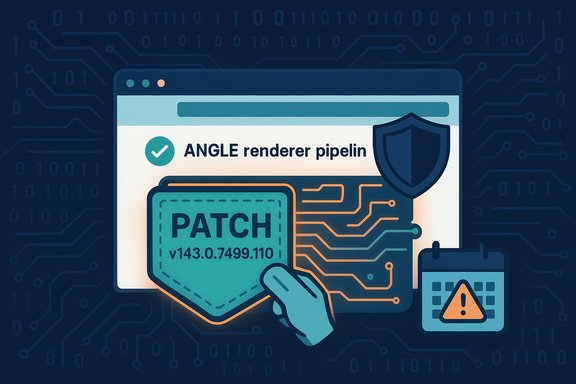
- The vulnerability was fixed in Chrome/Chromium version 143.0.7499.110 (or later), and vendor guidance recommends updating immediately. Attackers can exploit a crafted HTML page to trigger the issue in the renderer/graphics stack.
- Public vulnerability aggregators characterize the flaw’s Chromium security severity as High and note that successful exploitation could cause memory corruption, crashes, or — in the worst case — arbitrary code execution at the privilege level of the browser process.
Why this vulnerability matters
ANGLE, rendering engines, and exploitation risk
ANGLE sits between the browser’s rendering layers and the platform’s graphics APIs. Rendering and graphics code is an attractive target because it frequently handles untrusted input (HTML, CSS, WebGL payloads, SVG, etc. from arbitrary pages. Out‑of‑bounds memory access in ANGLE can allow attackers to corrupt memory or hijack control flow inside the renderer, and those primitives have historically been chained into sandbox escapes or remote code execution exploits. The risk profile is therefore very meaningful for end users and enterprises that rely on Chromium‑based browsers.Attack surface and affected populations
Although the immediate public descriptions single out Chrome on macOS, the underlying code paths are shared by Chromium derivatives. Enterprises that use Chromium‑based browsers (Chrome, Microsoft Edge, Brave, Vivaldi, etc. should assume potential exposure until each product vendor confirms a platform‑specific fix. Administrators must track vendor advisories for each browser build in their environment.Operational severity
- Exploits that target rendering engines are typically remote and low‑interaction: a victim navigates to a malicious page or opens a crafted document and the exploit chain runs in the browser process.
- KEV listing indicates observed exploitation in the wild, which shortens the window for safe remediation and raises the urgency for detection and containment work.
Technical summary (what the bug does)
- Vulnerability class: Out‑of‑bounds memory access (CWE‑125 / CWE‑787 family depending on read/write semantics).
- Component: ANGLE within the Chromium rendering/graphics stack.
- Exploit vector: Remotely exploitable via a crafted HTML page or web content that exercises the vulnerable graphics code path.
- Affected versions: Chromium/Chrome builds prior to 143.0.7499.110 on macOS according to vendor release notes aggregated by CVE mirrors.
Practical mitigations and immediate actions
For system administrators, security engineers, and IT operators, the response checklist below turns the KEV addition into an operational plan.- Update browsers immediately.
- Apply vendor patches for Chrome/Chromium to 143.0.7499.110 or later. Where enterprises manage updates centrally, push the patched build as high priority.
- Inventory and prioritize.
- Enumerate all Chromium‑based browsers and versions in the environment. Prioritize patching for internet‑facing and high‑privilege user endpoints first.
- Consider temporary mitigations.
- If a timely patch is not possible, consider disabling hardware acceleration in the browser as a temporary mitigation that can reduce exposure for graphics‑renderer bugs, and restrict access to high‑risk browsing for privileged accounts. Note this is a stopgap and not a substitute for the patched browser.
- Apply compensating controls.
- Implement network egress filtering, enforce web‑proxy content inspection, and block known malicious sites. For managed devices, restrict use of third‑party browser extensions and limit profiles that can install software.
- Hunt and detect.
- Review EDR/EDR‑like telemetry for unusual renderer crashes, new child processes spawned by browsers, or unexpected network communications. Search web proxy logs for anomalous payloads or high‑volume visits to unknown landing pages. Deploy targeted YARA/behavioral detections for browser crash artifacts and suspicious exploit indicators.
- Follow vendor guidance.
- Cross‑check vendor security advisories for platform‑specific notes (e.g., Microsoft Edge release schedule) and apply vendor recommendations for enterprise deployment and patch testing.
- Document and report.
- Federal agencies must follow the remediation reporting requirements under BOD 22‑01; private organizations should document remediation and evidence‑collection steps as part of incident readiness and compliance workflows.
Detection guidance: what to look for
- Unexplained browser crashes or renderer process terminations on macOS devices, especially if correlated across multiple systems.
- Newly created or modified startup items, unusual child processes initiated by browsers, or discovery of web shells and persistence artifacts on endpoints that show browser compromise indicators.
- Outbound connections from browser processes to uncommon domains, especially following a renderer crash or reload.
- Suspicious JavaScript or WebGL payloads observed in web proxy or content‑filter logs.
CISA’s KEV process — strengths and operational trade‑offs
Strengths
- Operational clarity: KEV transforms telemetry into a prioritized, actionable list that agencies must address under BOD 22‑01, making it a highly effective top‑down mechanism to reduce exposure to active threats.
- Urgency signaling: Because KEV entries indicate observed exploitation, the catalog provides a clear triage signal that reorders patch queues in large enterprises and government networks.
Trade‑offs and risks
- Operational stress: Accelerated remediation windows — often measured in days or a few weeks for post‑2021 CVEs — can strain operations teams, increasing the likelihood of configuration errors or insufficient validation before wide deployment.
- Regression risk: Rapid, forced updates may surface regressions in complex enterprise environments. Administrators balancing availability and security will face real tradeoffs when rolling emergency patches.
- Public PoC/weaponization: KEV listings and public advisories can accelerate exploit development and opportunistic scanning by attackers. When a CVE is explicitly announced as “known exploited,” it can motivate exploitation at scale unless countered by rapid patch adoption.
How to translate KEV into an enterprise patch plan
- Establish an emergency patching playbook that includes:
- Rapid inventory (hours)
- Staged deployment (pilot → broad release)
- Rollback procedures and post‑deploy health checks
- Use risk scoring to prioritize endpoints:
- Internet‑facing macOS devices and high‑privilege accounts first.
- Lighter‑risk or isolated systems later.
- Treat browser updates as high urgency when KEV indicates active exploitation of a renderer bug. For Chromium/Chrome updates, coordinate with software distribution tooling (SCCM, JAMF, Intune) to accelerate rollout and monitor for user‑reported regressions.
- Maintain a documented exception process for assets that cannot be patched within the timeline and require compensating controls (segmentation, application allow‑lists, or compensating monitoring). For FCEB agencies, these exceptions and compensating controls must be logged and justified under BOD 22‑01.
Broader context: what this KEV addition says about the threat landscape
The addition of CVE‑2025‑14174 to KEV continues a recurring pattern in 2024–2025: attackers targeting browser rendering engines and third‑party libraries to gain remote code execution. Graphics and JavaScript engines remain a fertile exploitation ground, and the frequency of KEV additions illustrates the operational pivot from discovery to immediate remediation.Security teams should view KEV as an early warning system for weaponized CVEs — not every vulnerability is added to KEV — which means the catalog is a practical indicator of active campaigns and a priority input to vulnerability management programs. Community discussion and operator playbooks frequently surface in industry forums as teams coordinate detection and patching strategies.
Critical analysis — strengths and potential gaps
Notable strengths
- KEV forces organizational attention and reduces the time attackers have to exploit widely‑deployed bugs.
- The requirement to remediate under BOD 22‑01 improves federal posture and creates a best‑practice model for the private sector.
Potential weaknesses and hazards
- KEV's operational urgency can lead to rushed rollouts and unintended downtime if not paired with robust staging and rollback processes.
- Public KEV listings may attract rapid exploit development and opportunistic scanning if proof‑of‑concept code or technical details are widely available.
- Not all Chromium forks or browser vendors align release timing with upstream Chrome; enterprises that rely on multiple Chromium derivatives must track each vendor's patch cadence individually, creating complexity.
Recommendations — a concise, actionable checklist
- Apply Chrome/Chromium updates to version 143.0.7499.110 or later across macOS fleets immediately.
- Verify and patch all Chromium‑based browsers used in the environment; confirm vendor patch timelines for Edge, Brave, and others.
- Implement temporary mitigations (disable hardware acceleration, restrict browsing for admin accounts) only as stopgaps.
- Hunt for browser exploitation indicators, review crash and proxy logs, and escalate suspicious findings.
- Document remediation and exceptions to satisfy internal audit and, for federal agencies, BOD 22‑01 reporting obligations.
- Communicate to users: reboot browsers after updates and avoid visiting unknown or suspicious websites until patches are applied.
What remains uncertain (and how to verify)
Public CVE aggregators and vendor release notes report the KEV addition and the patched Chrome build, but readers should confirm remediation deadlines and authoritative guidance directly in CISA’s KEV Catalog and the vendor security advisories for their specific browser vendor. Some public mirrors may display dates or remediation windows that differ from the official KEV entry; consult the KEV catalog for the final, agency‑published remediation timeline.Final verdict
CVE‑2025‑14174 is an urgent, real‑world risk to Chromium users — particularly macOS Chromium installations — and CISA's KEV listing translates that risk into a mandatory remediation priority for federal agencies and a practical emergency for private sector defenders. The combination of a rendering engine bug, an observed exploitation signal, and the availability of a vendor fix creates a straightforward operational task: patch now, hunt for early signs of exploitation, and harden detection. The KEV mechanism does its job by forcing attention; the real work now falls on operations teams to patch comprehensively, manage rollouts safely, and document compensating controls where immediate remediation isn’t feasible.Acknowledging the dynamic nature of browser security and KEV entries, organizations should continue to monitor the KEV catalog and vendor advisories for updates, and treat renderer‑level CVEs as high priority in quarterly and emergency patch cycles.
Source: CISA CISA Adds One Known Exploited Vulnerability to Catalog | CISA
