

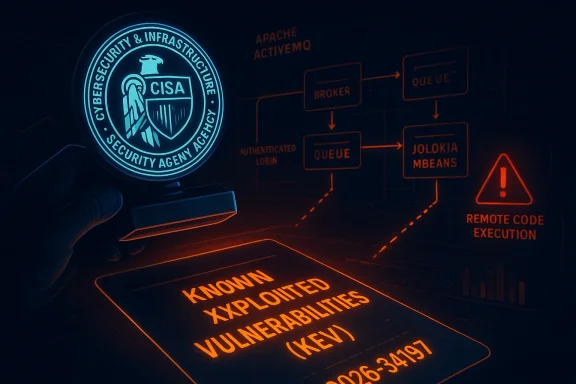
CISA’s latest addition to its Known Exploited Vulnerabilities Catalog is a sharp reminder that active exploitation still matters more than abstract severity scores. On April 16, 2026, the agency added CVE-2026-34197, an Apache ActiveMQ flaw described as an improper input validation vulnerability, after finding evidence that attackers were already using it in the wild. The move places the issue inside CISA’s operational risk framework, not just a database entry, and it immediately raises the priority level for defenders across government and industry.
The KEV Catalog exists because traditional vulnerability management has always had a blind spot: not every serious CVE is equally dangerous at any given moment. CISA created the catalog under Binding Operational Directive 22-01 to capture vulnerabilities that are not merely theoretical but actively exploited, forcing federal civilian agencies to treat them as urgent remediation items rather than background noise. That distinction matters because defenders have limited patch windows, limited staff, and far too many advisories to triage.
The catalog is intentionally living, which means it changes as threat activity changes. CISA’s public guidance says the KEV is the authoritative source for vulnerabilities exploited in the wild, and organizations are encouraged to use it as a prioritization input even when they are not subject to federal deadlines. In practice, that makes the catalog less like a compliance list and more like a real-time signal from the threat landscape.
Apache ActiveMQ is no stranger to CISA attention. The messaging broker has appeared in the catalog before, including the well-known CVE-2023-46604 deserialization issue, which became a major post-exploitation and ransomware concern. That historical pattern is important: when a product family has already attracted exploitation, new flaws in the same stack tend to get operationalized quickly because attackers know where the value lies.
What makes this latest entry notable is not just the CVE number, but the fact that Apache itself has already documented CVE-2026-34197 on its security page. Apache describes the issue as one in which authenticated users could achieve remote code execution via Jolokia MBeans, which implies the exploit path is likely to be especially attractive in real environments where administrative interfaces, middleware integrations, or inherited credentials are exposed. That combination—authentication context plus code execution—often turns a “single bug” into a foothold for broader intrusion.
The bigger lesson is that KEV inclusion compresses debate. Once CISA places a flaw in the catalog, the question for defenders shifts from “How bad is this?” to “How fast can we remove it from production?” That is a healthy reordering of priorities, because the cheapest vulnerability to fix is the one you still haven’t been breached through yet. That is the whole point of KEV.
The CISA language is consistent with past KEV notices: active exploitation, frequent attack vector, significant risk to the federal enterprise, and a reminder that all organizations should prioritize remediation. The wording is familiar because the operational logic is familiar. CISA is not trying to win a taxonomy debate; it is trying to move defenders toward fast action.
For federal agencies, the significance is even sharper because BOD 22-01 sets remediation expectations tied to the catalog. Those deadlines are not symbolic; they are meant to force a rapid response against what CISA already knows adversaries are exploiting. For everyone else, the directive is advisory rather than mandatory, but the threat is no less real.
Apache’s security page for ActiveMQ now lists CVE-2026-34197 among fixed issues and describes the flaw as enabling RCE for authenticated users via Jolokia MBeans. That suggests the vulnerability may live at the intersection of management functionality and authorization assumptions, which is exactly where enterprise products can become brittle. Authenticated does not necessarily mean safe if credentials are stolen, reused, or over-privileged.
That operational reality creates a dangerous delay pattern. Teams hesitate to patch because they fear breaking dependencies, while attackers move faster because they only need one viable path. The tension between uptime and security is not new, but KEV entries make the cost of delay much more visible. The longer a broker remains exposed, the more it becomes a standing invitation.
That is why defenders should not interpret “authenticated” as “less urgent.” In modern environments, authentication is frequently the part attackers can acquire through phishing, credential stuffing, token theft, or lateral movement. Once that happens, a management-interface flaw can become an internal detonation point.
That said, the available public information still leaves room for caution. We know the flaw is being exploited and we know it affects ActiveMQ Classic, but many organizations will still need to confirm which versions, configurations, and deployment topologies are affected. That uncertainty is normal in early-cycle vulnerability response, and it is one reason KEV entries are so useful: they force action before every detail is fully digested.
With ActiveMQ, the mention of Jolokia MBeans is a clue that the weakness may involve management-plane interaction. That should set off alarms for any team exposing broker administration interfaces, even indirectly, because control surfaces are commonly more powerful than the service’s main message path. Attackers prefer the door, not the wall.
This is especially true for organizations running large, complex Java middleware stacks. Those environments often have years of accumulated assumptions, and one overlooked endpoint, test broker, or admin panel can render the whole risk assessment overly optimistic. The catalog is telling defenders where to look first, not where to stop looking.
CISA’s KEV framework exists precisely for this moment. Once exploitation is confirmed, the vulnerability’s value to attackers is no longer theoretical, and the defense priority is no longer based on speculative future harm. That is why KEV has become such a central tool in vulnerability operations.
This approach is especially valuable in overloaded enterprises because it creates a defensible prioritization rule. When everything is “critical,” nothing is; when exploitation evidence exists, the decision becomes simpler. That simplicity is not a luxury — it is a survival mechanism.
That creates a favorable environment for threat actors. A flaw in a messaging platform may not make headlines the way a consumer app vulnerability does, but it can be far more valuable in a corporate network. The market reality is that attackers follow convenience and access, not news-cycle prominence.
Once discovered, the next question is ownership. Messaging platforms are often shared infrastructure, which means no one wants to be the team that owns the outage if a patch goes sideways. That social problem can delay security work even when the technical fix is available, and it is one reason KEV inclusion is so useful: it provides a non-negotiable reason to escalate.
That means security teams need to coordinate with infrastructure owners, cloud teams, and application teams at the same time. If the response is limited to simply “apply the patch,” organizations may miss the configuration changes, credential rotation, or segmentation adjustments needed to make the fix durable. Patching the binary without fixing the environment is often only half a defense.
This is where mature vulnerability management blends into detection engineering. A KEV-listed vulnerability on a core service should trigger not just remediation tickets but monitoring review, since an attacker may already have used the flaw to establish persistence or reconnaissance access. Enterprises that treat patching and hunting as separate disciplines risk leaving the second half of the problem untouched.
That does not mean the rest of the public sector can ignore it. CISA repeatedly emphasizes that state, local, tribal, territorial, and private-sector organizations should also treat KEV items as priority risks. The absence of a mandate is not the absence of consequence.
The result is that patch guidance can shape procurement, change windows, and managed-service commitments. Enterprises that support government work should expect immediate questions about exposure, because agencies may demand evidence that the issue is being tracked and addressed. A KEV listing turns informal risk acceptance into something much harder to defend.
The second step is governance. If remediation requires downtime or coordination across multiple authorities, it should be elevated quickly rather than handled as a normal ticket queue item. KEV is designed to shorten the time from discovery to closure, and that only works when leadership accepts the urgency.
Open-source software is not inherently less secure than commercial software, but it is often exposed to a different kind of operational pressure. Organizations assume transparency equals safety, when in reality transparency simply makes flaws easier to understand for both defenders and attackers. What matters is how quickly the ecosystem can detect, disclose, patch, and deploy fixes.
At the same time, a strong security advisory page and rapid fix publication can help preserve trust. Apache has clearly documented the issue on its security page, and that transparency gives operators a direct source to validate their version and remediation path. In a crowded market, that kind of clarity is a competitive asset.
The result is that CISA’s catalog functions as a market signal as much as a warning list. It tells customers which technologies are under active pressure, which vendors are coping with real-world exploitation, and which platforms may deserve deeper hardening or eventual replacement.
We should also watch whether this triggers more KEV additions around adjacent middleware components. Attackers often move in clusters, reusing the same access patterns across related technologies, and CISA’s catalog tends to reveal those waves as they form. That makes the next few weeks important for anyone running Java-based infrastructure.
CISA’s decision to add CVE-2026-34197 to the Known Exploited Vulnerabilities Catalog is not just another line item in a security feed. It is a demand for action, a validation of active threat pressure, and a warning that infrastructure software can become a breach multiplier when management interfaces are left exposed. Organizations that treat it as a routine patch ticket may find themselves learning the hard way that the catalog is named for the real world, not a hypothetical one.
Source: CISA CISA Adds One Known Exploited Vulnerability to Catalog | CISA
 Background
The KEV Catalog exists because traditional vulnerability management has always had a blind spot: not every serious CVE is equally dangerous at any given moment. CISA created the catalog under Binding Operational Directive 22-01 to capture vulnerabilities that are not merely theoretical but actively exploited, forcing federal civilian agencies to treat them as urgent remediation items rather than background noise. That distinction matters because defenders have limited patch windows, limited staff, and far too many advisories to triage.The catalog is intentionally living, which means it changes as threat activity changes. CISA’s public guidance says the KEV is the authoritative source for vulnerabilities exploited in the wild, and organizations are encouraged to use it as a prioritization input even when they are not subject to federal deadlines. In practice, that makes the catalog less like a compliance list and more like a real-time signal from the threat landscape.
Apache ActiveMQ is no stranger to CISA attention. The messaging broker has appeared in the catalog before, including the well-known CVE-2023-46604 deserialization issue, which became a major post-exploitation and ransomware concern. That historical pattern is important: when a product family has already attracted exploitation, new flaws in the same stack tend to get operationalized quickly because attackers know where the value lies.
What makes this latest entry notable is not just the CVE number, but the fact that Apache itself has already documented CVE-2026-34197 on its security page. Apache describes the issue as one in which authenticated users could achieve remote code execution via Jolokia MBeans, which implies the exploit path is likely to be especially attractive in real environments where administrative interfaces, middleware integrations, or inherited credentials are exposed. That combination—authentication context plus code execution—often turns a “single bug” into a foothold for broader intrusion.
The bigger lesson is that KEV inclusion compresses debate. Once CISA places a flaw in the catalog, the question for defenders shifts from “How bad is this?” to “How fast can we remove it from production?” That is a healthy reordering of priorities, because the cheapest vulnerability to fix is the one you still haven’t been breached through yet. That is the whole point of KEV.
What CISA’s New Entry Means
CISA’s announcement is short, but its implications are not. By adding CVE-2026-34197 to the KEV Catalog, the agency is effectively saying that defenders should treat this as an active threat rather than a routine patch item. That designation is especially important for teams that still rely on risk scores alone, because a high CVSS rating does not always tell you whether exploitation is happening right now.The CISA language is consistent with past KEV notices: active exploitation, frequent attack vector, significant risk to the federal enterprise, and a reminder that all organizations should prioritize remediation. The wording is familiar because the operational logic is familiar. CISA is not trying to win a taxonomy debate; it is trying to move defenders toward fast action.
Why catalog placement matters
When a vulnerability lands in KEV, it becomes more than a vendor issue. It becomes a procurement issue, an asset-management issue, and often a business-continuity issue, because organizations have to identify where the vulnerable product exists, whether it is internet-facing, whether patching is possible, and whether compensating controls are enough. In the real world, that means incident-response, infrastructure, and identity teams all get pulled in.For federal agencies, the significance is even sharper because BOD 22-01 sets remediation expectations tied to the catalog. Those deadlines are not symbolic; they are meant to force a rapid response against what CISA already knows adversaries are exploiting. For everyone else, the directive is advisory rather than mandatory, but the threat is no less real.
- KEV listing means confirmed exploitation in the wild
- Remediation becomes urgent, not optional
- Asset discovery becomes the first blocker
- Compensating controls may buy time, not safety
- Internet-facing deployments should be assumed highest risk
Apache ActiveMQ and the Attack Surface
Apache ActiveMQ Classic is a messaging backbone, and that is exactly why vulnerabilities in it are so attractive. Middleware systems often sit deep inside enterprise networks, connect to many applications, and possess the kind of trust that attackers love to abuse once they gain a foothold. A flaw in that layer can be a pivot point, not just a service disruption.Apache’s security page for ActiveMQ now lists CVE-2026-34197 among fixed issues and describes the flaw as enabling RCE for authenticated users via Jolokia MBeans. That suggests the vulnerability may live at the intersection of management functionality and authorization assumptions, which is exactly where enterprise products can become brittle. Authenticated does not necessarily mean safe if credentials are stolen, reused, or over-privileged.
Middleware is rarely “just middleware”
Messaging platforms tend to be wired into application ecosystems that are hard to untangle quickly. They may support order processing, internal orchestration, integration queues, telemetry, or service-to-service coordination. That means a vulnerable broker is not isolated in the abstract; it is often sitting beneath business-critical workflows that nobody wants to interrupt.That operational reality creates a dangerous delay pattern. Teams hesitate to patch because they fear breaking dependencies, while attackers move faster because they only need one viable path. The tension between uptime and security is not new, but KEV entries make the cost of delay much more visible. The longer a broker remains exposed, the more it becomes a standing invitation.
The significance of authenticated RCE
An RCE condition that requires authentication can still be devastating. In many enterprises, service accounts, admin credentials, API keys, or legacy credentials end up scattered across environments in ways that do not match the original security model. If an attacker can get valid access even once, the difference between authenticated exploitation and unauthenticated exploitation often collapses in practice.That is why defenders should not interpret “authenticated” as “less urgent.” In modern environments, authentication is frequently the part attackers can acquire through phishing, credential stuffing, token theft, or lateral movement. Once that happens, a management-interface flaw can become an internal detonation point.
- Messaging middleware often sits on critical paths
- Management interfaces are high-value targets
- Authenticated attacks can still lead to full compromise
- Legacy credentials magnify exposure
- Integration-heavy environments are hardest to isolate
What We Know About CVE-2026-34197
At the time of CISA’s listing, the public description is still relatively terse. CISA identifies CVE-2026-34197 as an Apache ActiveMQ improper input validation vulnerability and says it has evidence of active exploitation. Apache’s own security page adds the more specific detail that authenticated users could achieve RCE via Jolokia MBeans. Those two descriptions are complementary rather than contradictory: one is a catalog label, the other a vendor advisory summary.That said, the available public information still leaves room for caution. We know the flaw is being exploited and we know it affects ActiveMQ Classic, but many organizations will still need to confirm which versions, configurations, and deployment topologies are affected. That uncertainty is normal in early-cycle vulnerability response, and it is one reason KEV entries are so useful: they force action before every detail is fully digested.
How “improper input validation” usually lands
Improper input validation is a broad class, but in infrastructure software it often means the application accepts data it should reject, then interprets that data in a dangerous way. In management interfaces, that can translate into command execution, path manipulation, object deserialization, or other unsafe operations depending on how the input flows into underlying code. The point is not the label itself; it is the trust boundary failure behind it.With ActiveMQ, the mention of Jolokia MBeans is a clue that the weakness may involve management-plane interaction. That should set off alarms for any team exposing broker administration interfaces, even indirectly, because control surfaces are commonly more powerful than the service’s main message path. Attackers prefer the door, not the wall.
Why details matter less than exposure
A common defensive mistake is waiting for a perfect exploit narrative before taking action. In practice, the combination of vendor acknowledgment, CISA KEV placement, and active exploitation is enough to justify emergency triage. You do not need to know every technical step to know the risk has crossed from hypothetical to operational.This is especially true for organizations running large, complex Java middleware stacks. Those environments often have years of accumulated assumptions, and one overlooked endpoint, test broker, or admin panel can render the whole risk assessment overly optimistic. The catalog is telling defenders where to look first, not where to stop looking.
- Public details are enough to justify immediate triage
- Vendor and CISA signals reinforce each other
- Management-plane exposure is especially concerning
- Version and configuration checks are still necessary
- Attackers exploit ambiguity faster than defenders resolve it
Why Active Exploitation Changes the Equation
Security teams are used to volume. Every week brings CVEs, advisories, and vendor notices, and most of them never become immediate emergencies. Active exploitation changes that by collapsing the time between disclosure and danger, forcing defenders to act on evidence rather than probability.CISA’s KEV framework exists precisely for this moment. Once exploitation is confirmed, the vulnerability’s value to attackers is no longer theoretical, and the defense priority is no longer based on speculative future harm. That is why KEV has become such a central tool in vulnerability operations.
The operational meaning of “in the wild”
CISA’s guidance says the KEV catalog is built from vulnerabilities that have been exploited in real time, or “in the wild.” That matters because it excludes purely academic concerns and focuses attention on the threats that are already being weaponized by real adversaries. In other words, the list is curated by abuse, not by possibility.This approach is especially valuable in overloaded enterprises because it creates a defensible prioritization rule. When everything is “critical,” nothing is; when exploitation evidence exists, the decision becomes simpler. That simplicity is not a luxury — it is a survival mechanism.
Why attackers like infrastructure software
Infrastructure products are high leverage. Compromise one broker, directory, gateway, or VPN component and attackers may gain access to many downstream systems, credentials, or workflows. They also tend to be patched less rapidly than browsers or endpoint agents because they support mission-critical jobs and can require coordinated change windows.That creates a favorable environment for threat actors. A flaw in a messaging platform may not make headlines the way a consumer app vulnerability does, but it can be far more valuable in a corporate network. The market reality is that attackers follow convenience and access, not news-cycle prominence.
- Active exploitation shortens response timelines
- Infrastructure bugs carry leverage far beyond their footprint
- Patch coordination slows many enterprises
- KEV helps separate urgent issues from noise
- Operational simplicity improves defensive decision-making
Enterprise Impact: What Defenders Need to Think About
For enterprises, the immediate task is inventory. You cannot remediate what you cannot find, and many organizations have only partial visibility into where ActiveMQ is installed, which teams own it, and whether a given instance is exposed externally or restricted to internal segments. That is where vulnerability management often becomes an asset-management problem first.Once discovered, the next question is ownership. Messaging platforms are often shared infrastructure, which means no one wants to be the team that owns the outage if a patch goes sideways. That social problem can delay security work even when the technical fix is available, and it is one reason KEV inclusion is so useful: it provides a non-negotiable reason to escalate.
Prioritization should be exposure-aware
Not every ActiveMQ deployment carries the same risk. An internal test broker with no reachable management interface is not the same as a production broker exposed to partner networks, and neither is the same as an externally reachable system. Enterprise defenders should therefore rank instances by reachability, privilege context, and business criticality rather than patching in alphabetical order.That means security teams need to coordinate with infrastructure owners, cloud teams, and application teams at the same time. If the response is limited to simply “apply the patch,” organizations may miss the configuration changes, credential rotation, or segmentation adjustments needed to make the fix durable. Patching the binary without fixing the environment is often only half a defense.
Don’t forget post-compromise assumptions
Because CISA says the flaw is being actively exploited, teams should consider whether they need to look for signs of intrusion in environments that were exposed before patching. That may include authentication logs, unusual MBean activity, broker process anomalies, outbound connections, or evidence of lateral movement. The point is not to assume breach, but to prepare as though breach is plausible.This is where mature vulnerability management blends into detection engineering. A KEV-listed vulnerability on a core service should trigger not just remediation tickets but monitoring review, since an attacker may already have used the flaw to establish persistence or reconnaissance access. Enterprises that treat patching and hunting as separate disciplines risk leaving the second half of the problem untouched.
- Find every ActiveMQ instance
- Classify exposure by network reachability
- Identify owner, version, and configuration
- Patch or isolate aggressively
- Review logs for exploitation indicators
Federal and Public-Sector Implications
The federal angle is straightforward: BOD 22-01 requires FCEB agencies to remediate KEV vulnerabilities within prescribed timeframes. Because KEV entries are tied to that directive, every new listing becomes a compliance and operational event for agencies that may already be juggling large remediation backlogs.That does not mean the rest of the public sector can ignore it. CISA repeatedly emphasizes that state, local, tribal, territorial, and private-sector organizations should also treat KEV items as priority risks. The absence of a mandate is not the absence of consequence.
Federal urgency tends to ripple outward
When federal agencies prioritize a vulnerability, vendors, contractors, and critical-infrastructure partners often follow. That ripple effect matters because many public-sector environments are interconnected, and a flaw in shared middleware can affect both government systems and the contractors that support them. In that sense, a KEV entry is not just a federal compliance event; it is a coordination signal.The result is that patch guidance can shape procurement, change windows, and managed-service commitments. Enterprises that support government work should expect immediate questions about exposure, because agencies may demand evidence that the issue is being tracked and addressed. A KEV listing turns informal risk acceptance into something much harder to defend.
What agencies should do first
The first step is always discovery, followed by validation. Agencies need to know whether ActiveMQ is present, whether it is internet-facing, whether the vulnerable code path is enabled, and whether compensating controls exist. From there, they can decide whether patching, isolation, or service retirement is the fastest safe path.The second step is governance. If remediation requires downtime or coordination across multiple authorities, it should be elevated quickly rather than handled as a normal ticket queue item. KEV is designed to shorten the time from discovery to closure, and that only works when leadership accepts the urgency.
- FCEB agencies face formal remediation expectations
- Contractors should expect downstream pressure
- Shared service environments amplify the issue
- Leadership escalation may be required
- Asset discovery is the first gate to compliance
The Bigger Market Signal for Open Source
This notice also says something important about open-source infrastructure: popularity cuts both ways. Apache ActiveMQ is widely used because it is mature, flexible, and deeply integrated, but that also means attackers have a large installed base to target and a lot of preexisting knowledge to build on. Success breeds visibility, and visibility attracts adversaries.Open-source software is not inherently less secure than commercial software, but it is often exposed to a different kind of operational pressure. Organizations assume transparency equals safety, when in reality transparency simply makes flaws easier to understand for both defenders and attackers. What matters is how quickly the ecosystem can detect, disclose, patch, and deploy fixes.
Reputation risk extends beyond the CVE itself
For projects like ActiveMQ, recurring KEV appearances can create reputational drag even when the maintainers act responsibly. Buyers may start to question whether the product is too risky for critical workloads, while defenders may push for segmentation or replacement even when a patch exists. That dynamic is not necessarily fair, but it is real.At the same time, a strong security advisory page and rapid fix publication can help preserve trust. Apache has clearly documented the issue on its security page, and that transparency gives operators a direct source to validate their version and remediation path. In a crowded market, that kind of clarity is a competitive asset.
The ecosystem lesson
There is also a broader lesson here for all middleware vendors. Attackers increasingly target control planes, admin interfaces, and integration surfaces because those are the places where defenders assume too much trust. Secure-by-design thinking is not just about eliminating obvious flaws; it is about shrinking the number of hidden assumptions attackers can exploit. That is where real resilience is built.The result is that CISA’s catalog functions as a market signal as much as a warning list. It tells customers which technologies are under active pressure, which vendors are coping with real-world exploitation, and which platforms may deserve deeper hardening or eventual replacement.
- Popularity increases attacker attention
- Transparency helps defenders and attackers alike
- Vendor clarity matters to customer trust
- Control-plane weaknesses are especially dangerous
- Secure-by-design is now a competitive differentiator
Strengths and Opportunities
The upside of this announcement is that it gives defenders a clear, actionable priority backed by both CISA and Apache. That clarity reduces ambiguity, speeds triage, and helps organizations put scarce patching resources where they will matter most. It also offers an opportunity to improve the broader vulnerability management process rather than merely closing one issue.- Clear prioritization signal from CISA
- Vendor acknowledgment supports fast validation
- Opportunity to inventory hidden middleware
- Chance to improve asset ownership maps
- Useful trigger for log review and hunting
- Motivation to tighten management-plane exposure
- Potential catalyst for better segmentation practices
Risks and Concerns
The biggest concern is simple: many organizations will underestimate how broadly ActiveMQ is embedded. Middleware is easy to forget until it breaks, and forgotten services are often the easiest to exploit because they are not monitored with the same intensity as customer-facing apps. That is exactly the kind of gap adversaries look for.- Hidden deployments may remain unpatched
- Credential exposure can convert authenticated bugs into breaches
- Patch delays may persist due to uptime fears
- Internet-facing brokers are especially risky
- Operational complexity can hide exploitation signs
- Shared ownership may slow escalation
- Compensating controls may be overestimated
What to Watch Next
The immediate question is whether further exploitation details emerge from Apache, CISA, or the broader research community. If indicators of compromise, version ranges, or exploit chains become public, defenders will need to refine their response quickly. Until then, the safest assumption is that exposure combined with authentication makes this a high-priority issue.We should also watch whether this triggers more KEV additions around adjacent middleware components. Attackers often move in clusters, reusing the same access patterns across related technologies, and CISA’s catalog tends to reveal those waves as they form. That makes the next few weeks important for anyone running Java-based infrastructure.
Key things to monitor
- Apache follow-up guidance or patch notes
- CISA catalog updates involving related middleware
- Signs of exploitation in logs and EDR telemetry
- Enterprise disclosure from managed service providers
- Any evidence of ransomware or lateral movement
CISA’s decision to add CVE-2026-34197 to the Known Exploited Vulnerabilities Catalog is not just another line item in a security feed. It is a demand for action, a validation of active threat pressure, and a warning that infrastructure software can become a breach multiplier when management interfaces are left exposed. Organizations that treat it as a routine patch ticket may find themselves learning the hard way that the catalog is named for the real world, not a hypothetical one.
Source: CISA CISA Adds One Known Exploited Vulnerability to Catalog | CISA
Last edited:
