

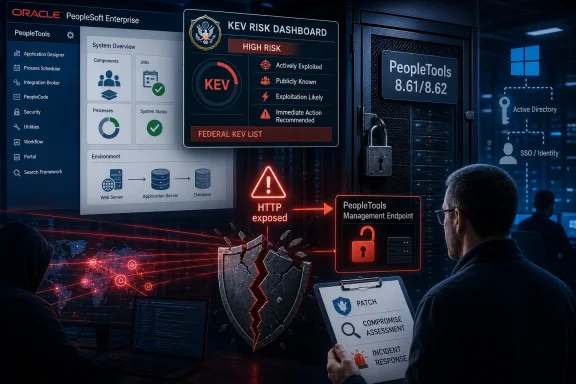
CISA added CVE-2026-35273, a critical Oracle PeopleSoft Enterprise PeopleTools flaw, to its Known Exploited Vulnerabilities catalog on June 12, 2026, after determining that attackers are actively exploiting the missing-authentication vulnerability in the wild. The move turns what might have looked like another vendor security alert into a federal remediation priority. More importantly, it shows how CISA’s newer risk-based patching regime is beginning to separate ordinary “critical” bugs from the vulnerabilities that have already crossed into operational danger.
The short version for WindowsForum readers is simple: if your organization runs PeopleSoft, especially in a university, government, healthcare, or large-enterprise environment, this is not a quarterly-patch-cycle item. It is an exposure-management event. The longer version is more interesting, because CVE-2026-35273 lands at the intersection of three uncomfortable realities: old enterprise platforms still sit close to sensitive data, authentication boundaries still fail in boring ways, and federal vulnerability policy is becoming less tolerant of patching theater.
The Known Exploited Vulnerabilities catalog began as a blunt but useful instrument: a government-maintained list of vulnerabilities with evidence of real-world exploitation. That sounds modest, but it changed the hierarchy of patching. A CVE with a high CVSS score might be dangerous in theory; a KEV-listed CVE is dangerous in practice.
CVE-2026-35273 fits the KEV model almost too neatly. Oracle described the issue as a vulnerability in PeopleSoft Enterprise PeopleTools, specifically the Updates Environment Management component, reachable over HTTP and exploitable without authentication. Its CVSS 3.1 base score is 9.8, the familiar top-tier severity reserved for network-accessible flaws with low attack complexity, no privileges required, no user interaction, and high impact across confidentiality, integrity, and availability.
That risk matrix language can feel sterile, but the practical translation is brutal. An unauthenticated attacker who can reach the exposed service may be able to compromise PeopleTools. Oracle’s own advisory language says successful exploitation can result in takeover of PeopleSoft Enterprise PeopleTools, which is the sort of sentence that should make administrators stop reading dashboards and start checking exposure.
CISA’s addition of the vulnerability to KEV matters because it narrows the debate. Security teams no longer need to argue whether the bug is merely severe, whether exploitability is plausible, or whether the business can absorb another emergency change. The government’s position is that exploitation is happening, mitigation guidance exists, and affected organizations should move.
In many environments, PeopleSoft is not a single application so much as a platform woven through business processes. It is integrated with identity providers, databases, reporting tools, workflow systems, and downstream applications that expect PeopleSoft to remain available and authoritative. That makes a platform-level compromise more consequential than a defacement or a single-server intrusion.
The affected versions identified by Oracle are PeopleTools 8.61 and 8.62. Those are not dusty antiques in a forgotten closet; they are current enough to appear in active enterprise deployments. That is part of the sting. This is not merely a story about unsupported software being left to rot. It is a reminder that even supported enterprise platforms can produce emergency advisories when a critical function lacks the authentication control everyone assumed was there.
For Windows administrators, the immediate connection may not be obvious, but the operational lesson should be familiar. Many Windows shops have spent the past decade hardening domain controllers, Exchange servers, VPN appliances, and identity infrastructure while leaving adjacent line-of-business platforms to application owners. PeopleSoft is often one of those adjacent systems. The directory may authenticate users, Windows servers may host supporting components, and SQL Server or Oracle Database may sit underneath, but ownership can be fragmented across HRIT, ERP teams, database administrators, and infrastructure operations.
That fragmentation is exactly where attackers like to work. When a system is everyone’s dependency but no one’s daily security problem, exposure persists longer than it should.
That plainness is why it keeps working. Enterprise software accumulates administrative endpoints, maintenance channels, update mechanisms, and environment-management components over years of product evolution. Some are intended for internal use, some are meant to be shielded by network controls, and some are documented in ways that make perfect sense to product engineers but less sense in a hybrid, internet-routed, outsourced, federated, post-acquisition enterprise.
Oracle’s advisory identifies the vulnerable component as Updates Environment Management. Even without diving into exploit mechanics, the name tells administrators where to focus their intuition. Update and environment-management functions tend to be privileged by design. They exist to inspect, configure, deploy, coordinate, or alter systems. If authentication is missing or bypassable at that layer, the blast radius can be much larger than the endpoint name suggests.
This is also why “it is only accessible over HTTP” is not comforting. HTTP is the enterprise’s universal solvent. It traverses proxies, load balancers, remote-access paths, cloud ingress rules, and monitoring exceptions. It is easy to expose intentionally, easy to expose accidentally, and easy for scanners to find once attackers know what to fingerprint.
The industry has become better at saying “don’t expose management interfaces to the internet,” but less successful at proving that they are not exposed. That distinction matters. A vulnerability like CVE-2026-35273 punishes organizations that rely on diagrams, assumptions, and last year’s asset inventory.
That shift is subtle but important. Federal agencies, like large enterprises, cannot patch everything instantly. Vulnerability management programs are flooded with CVEs, vendor updates, dependency advisories, container findings, endpoint detections, firmware notices, and scanner output. Treating all of that as one giant emergency queue produces either burnout or dishonesty.
BOD 26-04 tries to cut through that by asking which vulnerabilities combine exploitation evidence, exposure, and consequence. In that framework, CVE-2026-35273 is not just a critical Oracle flaw. It is the archetype of a vulnerability that deserves front-of-line treatment: remotely reachable, unauthenticated, exploited, and capable of takeover.
The directive also reinforces a point many organizations still underplay: patching is not always enough. CISA’s language emphasizes basic expectations for determining whether threat actors compromised a system before the patch was applied. That is a major operational distinction. If a vulnerability was exploited before remediation, the patch closes the door but does not remove the intruder.
This is where federal policy is aligning with what incident responders have said for years. For actively exploited remote code execution or takeover flaws, “we patched it” is not the end of the story. It is the start of a second workflow: log review, forensic triage, credential rotation, persistence checks, data-access review, and, where warranted, incident response escalation.
That is not because CISA is perfect. The KEV catalog is necessarily conservative; it requires a CVE ID, evidence of exploitation, and clear mitigation guidance. Some vulnerabilities are exploited before they appear in KEV, and some widely exploited issues may move through private telemetry before public confirmation catches up. Still, once a vulnerability lands in KEV, the governance conversation changes.
A private company that leaves a KEV-listed, internet-exposed, unauthenticated takeover flaw unpatched will have a hard time defending that decision after an incident. The question will not be whether the vulnerability was theoretically severe. The question will be why the organization failed to act after exploitation was publicly recognized and mitigation was available.
That is especially true for sectors where PeopleSoft remains common. Higher education, public agencies, healthcare networks, and large employers often run complex ERP estates with long maintenance windows and heavy customization. Those are exactly the environments where emergency patching is hardest — and where the data consequences of compromise are most painful.
The uncomfortable reality is that risk-based patching does not always make life easier. It can reduce noise, but it also removes excuses. When the risk signals line up this clearly, leadership has less room to hide behind generic change-management process.
Vendors do not casually interrupt patch rhythms for obscure theoretical issues. An emergency alert usually means the vendor believes the exposure is significant enough that customers need to act before the normal maintenance train arrives. In this case, Oracle said the vulnerability is remotely exploitable without authentication and strongly recommended immediate action.
For administrators, that should change the testing calculus. No serious IT shop wants to patch an ERP platform recklessly, especially one that touches payroll, student records, HR workflows, or financial approvals. But emergency advisories force a different risk comparison: the risk of patch-induced disruption versus the risk of leaving an actively exploited unauthenticated takeover path open.
That comparison is not symmetrical. A bad patch can cause downtime, failed integrations, and rollback pain. A successful exploit can produce credential theft, data exposure, unauthorized changes, persistence, ransomware staging, regulatory notification, and weeks of incident response. The former is an operational incident. The latter can become an institutional crisis.
The answer is not to abandon testing. The answer is to compress it intelligently. Stand up a focused validation path, test the most critical workflows, confirm integration health, and move. Organizations that spend days debating whether the advisory is “really applicable” while exposed instances remain reachable are making a decision, even if it does not appear in the change record.
The difference between an inventory and an exposure map becomes critical here. An inventory says the organization owns PeopleSoft. An exposure map says which PeopleTools versions are deployed, which components are reachable, which URLs and ports are externally accessible, which identity controls sit in front, which systems are unsupported, and which owners can approve emergency changes.
CISA’s BOD 26-04 logic implicitly rewards the second model. It prioritizes vulnerabilities on publicly exposed assets that can grant total control after exploitation. That requires organizations to understand not just software presence but attackability. A CVE on an isolated lab system is different from the same CVE on an internet-facing administrative endpoint.
Windows-heavy organizations should recognize this lesson from years of Exchange and RDP incidents. The most dangerous systems are often the ones that bridge internal trust and external reachability. PeopleSoft deployments can occupy that same bridge position, particularly when they support remote employees, students, contractors, or third-party service providers.
The first response to CVE-2026-35273 should therefore be discovery, not paperwork. Identify affected versions. Locate PeopleTools 8.61 and 8.62. Validate whether the Updates Environment Management component is present and reachable. Determine which instances are exposed directly or indirectly. Then patch or apply Oracle’s mitigations with the urgency appropriate to each exposure tier.
The right question is not merely “Did we patch?” It is “Were we hit before we patched?” That requires evidence. Administrators should preserve logs, review web access patterns, inspect authentication anomalies, examine process creation and file changes on relevant servers, and look for unexpected administrative activity in connected systems. If PeopleSoft integrates with directory services, databases, file shares, or reporting systems, those trust paths deserve review as well.
This is where many organizations under-resource ERP security. They may have mature endpoint detection on Windows workstations and servers, decent telemetry from identity providers, and centralized logging for firewalls. But application-layer logs from ERP platforms may be retained for shorter periods, stored separately, or understood by only a small number of specialists.
That gap becomes dangerous after an exploited application flaw. Attackers who compromise a platform like PeopleSoft may not behave like commodity malware immediately. They may enumerate data, create accounts, alter configurations, access integrations, or stage tools through legitimate application paths. If defenders look only for obvious Windows malware, they may miss the more important evidence.
Forensic triage does not have to become a months-long archaeology project for every organization. But externally exposed affected instances should be treated as potentially compromised until logs and system state say otherwise. That is the mindset CISA is trying to normalize.
If attackers gain control of PeopleTools, the next steps may involve credentials, tokens, service accounts, database connections, file exports, or integration secrets. Some of those paths may lead straight into Windows domains or Microsoft 365-connected workflows. Others may provide enough sensitive data to support phishing, extortion, or privilege escalation elsewhere.
Service accounts are a particular concern. ERP systems often use long-lived credentials for database access, batch jobs, reporting services, file transfers, directory lookups, and middleware integrations. Those accounts may have broad permissions because narrowing them is operationally difficult. A platform compromise can turn those conveniences into attacker tooling.
Administrators should also think about the jump boxes, management hosts, and deployment servers used to maintain PeopleSoft. If those systems are Windows-based, they may contain scripts, saved credentials, SSH keys, database clients, or administrative utilities. A clean application patch does not automatically sanitize the surrounding management plane.
This is why vulnerability response should include identity and infrastructure owners, not just the PeopleSoft application team. The patch closes a product flaw. The investigation has to follow the trust relationships.
CVE-2026-35273 is a useful corrective. The score says it is bad. The KEV listing says it is being used. The affected component suggests it has privileged consequences. The HTTP attack path suggests discoverability and reachability matter. Together, those facts provide a much stronger action signal than CVSS alone.
This is the direction vulnerability management has been heading for several years. Exploit prediction, asset exposure, business criticality, compensating controls, and threat intelligence all matter. The challenge is that many organizations still buy tools that produce more findings rather than better decisions.
A risk-based program should be able to answer, quickly, whether CVE-2026-35273 exists in the environment, whether affected systems are exposed, who owns them, what mitigation is available, whether exploitation indicators exist, and when executive escalation is required. If answering those questions takes a week, the vulnerability is not the only problem.
The lesson is not that every KEV entry requires panic. It is that KEV entries deserve a pre-built operating model. Security teams should not be inventing ownership, escalation, evidence collection, and exception handling during the incident.
Attackers understand calendars too. Public advisories and KEV additions can accelerate scanning and exploitation as opportunistic actors pile onto a newly documented bug. Even organizations that were not targeted before the advisory may become targets afterward if they leave exposed systems unmitigated.
That does not mean every affected organization must perform a blind Friday-night patch across all PeopleSoft environments. It means they need a Friday-night decision. Which systems are exposed? Which are affected? Which can be patched immediately? Which need temporary network restrictions? Which require vendor assistance? Which logs must be preserved now before rotation destroys evidence?
Temporary containment can buy time, but it should not become a substitute for remediation. Restricting access to management endpoints, tightening firewall rules, requiring VPN or zero-trust access paths, disabling unnecessary exposure, and increasing monitoring are reasonable emergency moves. But for an unauthenticated takeover flaw with active exploitation, compensating controls should be treated as a bridge to patching, not a new steady state.
This is where mature IT organizations distinguish themselves. They have emergency change processes that are fast without being reckless. They know who can approve risk. They can reach application owners after hours. They can validate critical workflows. They can document exceptions without allowing documentation to become delay.
But a risk-based mandate is only as good as the data behind it. Agencies and enterprises need accurate asset inventories, external attack-surface visibility, software version detection, exploit intelligence, and clear ownership. Without those, risk-based patching becomes a slogan pasted on top of the same old spreadsheet scramble.
CVE-2026-35273 is therefore both a vulnerability and a diagnostic. It will reveal which organizations know where their ERP management surfaces are, which can distinguish exposed production from isolated development, which can coordinate Oracle application teams with Windows and identity administrators, and which can investigate pre-patch compromise rather than simply closing tickets.
The uncomfortable truth is that many organizations will discover process debt during this response. They may find unsupported instances, unclear ownership, missing logs, overprivileged service accounts, brittle integrations, or emergency change procedures that exist only as policy documents. Those findings are painful, but they are also useful. Every one of them is a roadmap item for the next exploited enterprise-platform flaw.
The better organizations will not stop at applying Oracle’s fix. They will use this moment to ask why a PeopleSoft management component was reachable, why ownership was unclear, why logs were insufficient, or why service accounts had more access than needed. That is how an emergency patch becomes a security improvement rather than another closed ticket.
The short version for WindowsForum readers is simple: if your organization runs PeopleSoft, especially in a university, government, healthcare, or large-enterprise environment, this is not a quarterly-patch-cycle item. It is an exposure-management event. The longer version is more interesting, because CVE-2026-35273 lands at the intersection of three uncomfortable realities: old enterprise platforms still sit close to sensitive data, authentication boundaries still fail in boring ways, and federal vulnerability policy is becoming less tolerant of patching theater.
 CISA’s Catalog Is No Longer Just a Warning Light
The Known Exploited Vulnerabilities catalog began as a blunt but useful instrument: a government-maintained list of vulnerabilities with evidence of real-world exploitation. That sounds modest, but it changed the hierarchy of patching. A CVE with a high CVSS score might be dangerous in theory; a KEV-listed CVE is dangerous in practice.CVE-2026-35273 fits the KEV model almost too neatly. Oracle described the issue as a vulnerability in PeopleSoft Enterprise PeopleTools, specifically the Updates Environment Management component, reachable over HTTP and exploitable without authentication. Its CVSS 3.1 base score is 9.8, the familiar top-tier severity reserved for network-accessible flaws with low attack complexity, no privileges required, no user interaction, and high impact across confidentiality, integrity, and availability.
That risk matrix language can feel sterile, but the practical translation is brutal. An unauthenticated attacker who can reach the exposed service may be able to compromise PeopleTools. Oracle’s own advisory language says successful exploitation can result in takeover of PeopleSoft Enterprise PeopleTools, which is the sort of sentence that should make administrators stop reading dashboards and start checking exposure.
CISA’s addition of the vulnerability to KEV matters because it narrows the debate. Security teams no longer need to argue whether the bug is merely severe, whether exploitability is plausible, or whether the business can absorb another emergency change. The government’s position is that exploitation is happening, mitigation guidance exists, and affected organizations should move.
PeopleSoft Remains a Quietly Critical Part of the Enterprise
PeopleSoft does not have the cultural profile of Windows, Exchange, VMware, or cloud identity platforms, but that is exactly why a vulnerability like this deserves attention. It often lives in the administrative core of large institutions, handling human resources, finance, student information, payroll, procurement, and other systems that are both sensitive and operationally sticky.In many environments, PeopleSoft is not a single application so much as a platform woven through business processes. It is integrated with identity providers, databases, reporting tools, workflow systems, and downstream applications that expect PeopleSoft to remain available and authoritative. That makes a platform-level compromise more consequential than a defacement or a single-server intrusion.
The affected versions identified by Oracle are PeopleTools 8.61 and 8.62. Those are not dusty antiques in a forgotten closet; they are current enough to appear in active enterprise deployments. That is part of the sting. This is not merely a story about unsupported software being left to rot. It is a reminder that even supported enterprise platforms can produce emergency advisories when a critical function lacks the authentication control everyone assumed was there.
For Windows administrators, the immediate connection may not be obvious, but the operational lesson should be familiar. Many Windows shops have spent the past decade hardening domain controllers, Exchange servers, VPN appliances, and identity infrastructure while leaving adjacent line-of-business platforms to application owners. PeopleSoft is often one of those adjacent systems. The directory may authenticate users, Windows servers may host supporting components, and SQL Server or Oracle Database may sit underneath, but ownership can be fragmented across HRIT, ERP teams, database administrators, and infrastructure operations.
That fragmentation is exactly where attackers like to work. When a system is everyone’s dependency but no one’s daily security problem, exposure persists longer than it should.
The Bug Class Is Boring, and That Is the Point
“Missing authentication for critical function” is not a glamorous vulnerability class. It does not have the mystique of a speculative execution bug, the elegance of a cryptographic flaw, or the drama of a browser sandbox escape. It is the security equivalent of finding a bank vault door propped open because the service entrance was assumed to be internal.That plainness is why it keeps working. Enterprise software accumulates administrative endpoints, maintenance channels, update mechanisms, and environment-management components over years of product evolution. Some are intended for internal use, some are meant to be shielded by network controls, and some are documented in ways that make perfect sense to product engineers but less sense in a hybrid, internet-routed, outsourced, federated, post-acquisition enterprise.
Oracle’s advisory identifies the vulnerable component as Updates Environment Management. Even without diving into exploit mechanics, the name tells administrators where to focus their intuition. Update and environment-management functions tend to be privileged by design. They exist to inspect, configure, deploy, coordinate, or alter systems. If authentication is missing or bypassable at that layer, the blast radius can be much larger than the endpoint name suggests.
This is also why “it is only accessible over HTTP” is not comforting. HTTP is the enterprise’s universal solvent. It traverses proxies, load balancers, remote-access paths, cloud ingress rules, and monitoring exceptions. It is easy to expose intentionally, easy to expose accidentally, and easy for scanners to find once attackers know what to fingerprint.
The industry has become better at saying “don’t expose management interfaces to the internet,” but less successful at proving that they are not exposed. That distinction matters. A vulnerability like CVE-2026-35273 punishes organizations that rely on diagrams, assumptions, and last year’s asset inventory.
BOD 26-04 Turns Risk-Based Patching Into a Compliance Clock
CISA’s alert also points to a bigger policy change: Binding Operational Directive 26-04, “Prioritizing Security Updates Based on Risk,” which updates the earlier BOD 22-01 model. The old directive made KEV remediation a federal mandate for civilian executive branch agencies. The new approach is more explicitly risk-based, emphasizing rapid remediation of high-risk vulnerabilities, especially those that are KEV-listed, publicly exposed, and capable of granting total control after exploitation.That shift is subtle but important. Federal agencies, like large enterprises, cannot patch everything instantly. Vulnerability management programs are flooded with CVEs, vendor updates, dependency advisories, container findings, endpoint detections, firmware notices, and scanner output. Treating all of that as one giant emergency queue produces either burnout or dishonesty.
BOD 26-04 tries to cut through that by asking which vulnerabilities combine exploitation evidence, exposure, and consequence. In that framework, CVE-2026-35273 is not just a critical Oracle flaw. It is the archetype of a vulnerability that deserves front-of-line treatment: remotely reachable, unauthenticated, exploited, and capable of takeover.
The directive also reinforces a point many organizations still underplay: patching is not always enough. CISA’s language emphasizes basic expectations for determining whether threat actors compromised a system before the patch was applied. That is a major operational distinction. If a vulnerability was exploited before remediation, the patch closes the door but does not remove the intruder.
This is where federal policy is aligning with what incident responders have said for years. For actively exploited remote code execution or takeover flaws, “we patched it” is not the end of the story. It is the start of a second workflow: log review, forensic triage, credential rotation, persistence checks, data-access review, and, where warranted, incident response escalation.
The Federal Mandate Will Become the Private-Sector Baseline
Technically, BOD 26-04 applies to Federal Civilian Executive Branch agencies. Practically, it will influence everyone else. Cyber insurers, auditors, regulators, boards, and customers increasingly treat CISA’s KEV catalog as a reasonable baseline for vulnerability prioritization, even when no federal mandate applies.That is not because CISA is perfect. The KEV catalog is necessarily conservative; it requires a CVE ID, evidence of exploitation, and clear mitigation guidance. Some vulnerabilities are exploited before they appear in KEV, and some widely exploited issues may move through private telemetry before public confirmation catches up. Still, once a vulnerability lands in KEV, the governance conversation changes.
A private company that leaves a KEV-listed, internet-exposed, unauthenticated takeover flaw unpatched will have a hard time defending that decision after an incident. The question will not be whether the vulnerability was theoretically severe. The question will be why the organization failed to act after exploitation was publicly recognized and mitigation was available.
That is especially true for sectors where PeopleSoft remains common. Higher education, public agencies, healthcare networks, and large employers often run complex ERP estates with long maintenance windows and heavy customization. Those are exactly the environments where emergency patching is hardest — and where the data consequences of compromise are most painful.
The uncomfortable reality is that risk-based patching does not always make life easier. It can reduce noise, but it also removes excuses. When the risk signals line up this clearly, leadership has less room to hide behind generic change-management process.
Oracle’s Out-of-Band Alert Signals a Different Kind of Urgency
Oracle’s regular Critical Patch Update cadence is familiar to enterprise administrators. The company’s quarterly CPU process provides predictability, which matters for large customers coordinating testing across application stacks. CVE-2026-35273 did not wait for that comfort zone. Oracle issued a dedicated security alert for the vulnerability, and that out-of-band treatment is part of the story.Vendors do not casually interrupt patch rhythms for obscure theoretical issues. An emergency alert usually means the vendor believes the exposure is significant enough that customers need to act before the normal maintenance train arrives. In this case, Oracle said the vulnerability is remotely exploitable without authentication and strongly recommended immediate action.
For administrators, that should change the testing calculus. No serious IT shop wants to patch an ERP platform recklessly, especially one that touches payroll, student records, HR workflows, or financial approvals. But emergency advisories force a different risk comparison: the risk of patch-induced disruption versus the risk of leaving an actively exploited unauthenticated takeover path open.
That comparison is not symmetrical. A bad patch can cause downtime, failed integrations, and rollback pain. A successful exploit can produce credential theft, data exposure, unauthorized changes, persistence, ransomware staging, regulatory notification, and weeks of incident response. The former is an operational incident. The latter can become an institutional crisis.
The answer is not to abandon testing. The answer is to compress it intelligently. Stand up a focused validation path, test the most critical workflows, confirm integration health, and move. Organizations that spend days debating whether the advisory is “really applicable” while exposed instances remain reachable are making a decision, even if it does not appear in the change record.
Exposure Management Beats Asset Inventory Theater
Every major vulnerability incident eventually collides with the same question: do we know where the affected thing is running? For PeopleSoft, that question can be harder than it sounds. Instances may exist across production, disaster recovery, test, development, training, upgrade staging, and vendor-managed environments. Some may be protected behind VPNs or private networks; others may be reachable through portals, reverse proxies, or forgotten firewall rules.The difference between an inventory and an exposure map becomes critical here. An inventory says the organization owns PeopleSoft. An exposure map says which PeopleTools versions are deployed, which components are reachable, which URLs and ports are externally accessible, which identity controls sit in front, which systems are unsupported, and which owners can approve emergency changes.
CISA’s BOD 26-04 logic implicitly rewards the second model. It prioritizes vulnerabilities on publicly exposed assets that can grant total control after exploitation. That requires organizations to understand not just software presence but attackability. A CVE on an isolated lab system is different from the same CVE on an internet-facing administrative endpoint.
Windows-heavy organizations should recognize this lesson from years of Exchange and RDP incidents. The most dangerous systems are often the ones that bridge internal trust and external reachability. PeopleSoft deployments can occupy that same bridge position, particularly when they support remote employees, students, contractors, or third-party service providers.
The first response to CVE-2026-35273 should therefore be discovery, not paperwork. Identify affected versions. Locate PeopleTools 8.61 and 8.62. Validate whether the Updates Environment Management component is present and reachable. Determine which instances are exposed directly or indirectly. Then patch or apply Oracle’s mitigations with the urgency appropriate to each exposure tier.
Patching Without Hunting Leaves the Hard Question Unanswered
CISA’s alert explicitly raises the need to check whether systems were compromised before patches were applied. That point deserves more attention than it usually receives in emergency vulnerability coverage. Active exploitation means some organizations are already on the wrong side of the timeline.The right question is not merely “Did we patch?” It is “Were we hit before we patched?” That requires evidence. Administrators should preserve logs, review web access patterns, inspect authentication anomalies, examine process creation and file changes on relevant servers, and look for unexpected administrative activity in connected systems. If PeopleSoft integrates with directory services, databases, file shares, or reporting systems, those trust paths deserve review as well.
This is where many organizations under-resource ERP security. They may have mature endpoint detection on Windows workstations and servers, decent telemetry from identity providers, and centralized logging for firewalls. But application-layer logs from ERP platforms may be retained for shorter periods, stored separately, or understood by only a small number of specialists.
That gap becomes dangerous after an exploited application flaw. Attackers who compromise a platform like PeopleSoft may not behave like commodity malware immediately. They may enumerate data, create accounts, alter configurations, access integrations, or stage tools through legitimate application paths. If defenders look only for obvious Windows malware, they may miss the more important evidence.
Forensic triage does not have to become a months-long archaeology project for every organization. But externally exposed affected instances should be treated as potentially compromised until logs and system state say otherwise. That is the mindset CISA is trying to normalize.
The Windows Angle Is Identity, Infrastructure, and Lateral Movement
At first glance, CVE-2026-35273 is an Oracle story, not a Windows story. That boundary is artificial. In real enterprises, Oracle applications frequently run alongside Windows infrastructure, depend on Active Directory or federated identity, interact with Windows-based administrative workstations, and feed data into Microsoft-heavy productivity and analytics environments.If attackers gain control of PeopleTools, the next steps may involve credentials, tokens, service accounts, database connections, file exports, or integration secrets. Some of those paths may lead straight into Windows domains or Microsoft 365-connected workflows. Others may provide enough sensitive data to support phishing, extortion, or privilege escalation elsewhere.
Service accounts are a particular concern. ERP systems often use long-lived credentials for database access, batch jobs, reporting services, file transfers, directory lookups, and middleware integrations. Those accounts may have broad permissions because narrowing them is operationally difficult. A platform compromise can turn those conveniences into attacker tooling.
Administrators should also think about the jump boxes, management hosts, and deployment servers used to maintain PeopleSoft. If those systems are Windows-based, they may contain scripts, saved credentials, SSH keys, database clients, or administrative utilities. A clean application patch does not automatically sanitize the surrounding management plane.
This is why vulnerability response should include identity and infrastructure owners, not just the PeopleSoft application team. The patch closes a product flaw. The investigation has to follow the trust relationships.
The CVSS Score Got Attention, but Exploitation Should Drive Action
CVSS 9.8 is eye-catching, and in this case it is justified. But the industry’s addiction to numeric severity has often distorted patching priorities. Organizations build dashboards that count criticals, mediums, and lows, then celebrate percentage reductions without asking whether the remaining vulnerabilities are exposed, exploited, or strategically useful to attackers.CVE-2026-35273 is a useful corrective. The score says it is bad. The KEV listing says it is being used. The affected component suggests it has privileged consequences. The HTTP attack path suggests discoverability and reachability matter. Together, those facts provide a much stronger action signal than CVSS alone.
This is the direction vulnerability management has been heading for several years. Exploit prediction, asset exposure, business criticality, compensating controls, and threat intelligence all matter. The challenge is that many organizations still buy tools that produce more findings rather than better decisions.
A risk-based program should be able to answer, quickly, whether CVE-2026-35273 exists in the environment, whether affected systems are exposed, who owns them, what mitigation is available, whether exploitation indicators exist, and when executive escalation is required. If answering those questions takes a week, the vulnerability is not the only problem.
The lesson is not that every KEV entry requires panic. It is that KEV entries deserve a pre-built operating model. Security teams should not be inventing ownership, escalation, evidence collection, and exception handling during the incident.
The Real Test Is Whether Organizations Can Move Before the Weekend Ends
The timing of CISA’s addition matters. June 12, 2026, is a Friday. Anyone who has worked in enterprise IT knows what that means: emergency changes collide with weekend staffing, maintenance windows, business owners leaving early, and the temptation to defer until Monday because “nothing has happened yet.”Attackers understand calendars too. Public advisories and KEV additions can accelerate scanning and exploitation as opportunistic actors pile onto a newly documented bug. Even organizations that were not targeted before the advisory may become targets afterward if they leave exposed systems unmitigated.
That does not mean every affected organization must perform a blind Friday-night patch across all PeopleSoft environments. It means they need a Friday-night decision. Which systems are exposed? Which are affected? Which can be patched immediately? Which need temporary network restrictions? Which require vendor assistance? Which logs must be preserved now before rotation destroys evidence?
Temporary containment can buy time, but it should not become a substitute for remediation. Restricting access to management endpoints, tightening firewall rules, requiring VPN or zero-trust access paths, disabling unnecessary exposure, and increasing monitoring are reasonable emergency moves. But for an unauthenticated takeover flaw with active exploitation, compensating controls should be treated as a bridge to patching, not a new steady state.
This is where mature IT organizations distinguish themselves. They have emergency change processes that are fast without being reckless. They know who can approve risk. They can reach application owners after hours. They can validate critical workflows. They can document exceptions without allowing documentation to become delay.
CISA’s New Patch Philosophy Rewards Evidence Over Exhaustion
The most important policy signal in this alert may be the one hiding in plain sight. CISA is not telling agencies to patch everything faster. It is telling them to patch the right things faster and to check for compromise when the facts justify it. That is a healthier model than the old ritual of drowning teams in critical findings and blaming them for not achieving the impossible.But a risk-based mandate is only as good as the data behind it. Agencies and enterprises need accurate asset inventories, external attack-surface visibility, software version detection, exploit intelligence, and clear ownership. Without those, risk-based patching becomes a slogan pasted on top of the same old spreadsheet scramble.
CVE-2026-35273 is therefore both a vulnerability and a diagnostic. It will reveal which organizations know where their ERP management surfaces are, which can distinguish exposed production from isolated development, which can coordinate Oracle application teams with Windows and identity administrators, and which can investigate pre-patch compromise rather than simply closing tickets.
The uncomfortable truth is that many organizations will discover process debt during this response. They may find unsupported instances, unclear ownership, missing logs, overprivileged service accounts, brittle integrations, or emergency change procedures that exist only as policy documents. Those findings are painful, but they are also useful. Every one of them is a roadmap item for the next exploited enterprise-platform flaw.
The better organizations will not stop at applying Oracle’s fix. They will use this moment to ask why a PeopleSoft management component was reachable, why ownership was unclear, why logs were insufficient, or why service accounts had more access than needed. That is how an emergency patch becomes a security improvement rather than another closed ticket.
The PeopleSoft Flaw Turns Policy Language Into a Weekend Runbook
CVE-2026-35273 is the sort of vulnerability that compresses strategy into operations. CISA’s KEV listing, Oracle’s emergency alert, and BOD 26-04 all point in the same direction: find the exposed systems, fix them quickly, and do not assume the absence of alerts means the absence of compromise.- Organizations running PeopleSoft Enterprise PeopleTools 8.61 or 8.62 should treat CVE-2026-35273 as an emergency exposure-management issue, not a routine quarterly patch item.
- Internet-facing or indirectly exposed PeopleSoft management surfaces deserve the fastest remediation, especially where exploitation could lead to platform takeover.
- Patching should be paired with compromise assessment, because active exploitation means some systems may have been accessed before fixes were applied.
- Windows and identity teams should be involved because PeopleSoft compromise can intersect with Active Directory, service accounts, databases, jump boxes, and Microsoft-heavy administrative workflows.
- Temporary network restrictions can reduce immediate risk, but they should not become a long-term substitute for applying Oracle’s mitigation or patch guidance.
- The response should leave behind better asset visibility, logging, ownership, and emergency-change muscle for the next exploited enterprise application flaw.
References
- Primary source: CISA
Published: 2026-06-12T12:00:00+00:00
- Related coverage: oracle.com
Oracle Security Alert Advisory - CVE-2026-35273
Oracle Security Alert Advisory - CVE-2026-35273 www.oracle.com
- Related coverage: nucleussec.com
What is CISA BOD 26-04? Prioritizing Security Updates Based on Risk
CISA BOD 26-04 directs federal agencies to prioritize vulnerability remediation based on exposure, exploitability, system control, and known exploitation. Learn what the directive requires and how it impacts agency vulnerability management.nucleussec.com - Related coverage: minimus.io
Understanding CISA BOD 26-04 - Minimus
CISA BOD 26-04 shifts vulnerability management toward risk-based prioritization. Here's what changed and what it means in practice.www.minimus.io - Related coverage: vulncheck.com
Helping Federal Agencies Meet CISA’s Accelerated Remediation Timelines outlined in CISA BOD 26-04 | Blog | VulnCheck
VulnCheck provides automated SSVC decisions for federal and enterprise agencies to help address CISA BOD 26-04.www.vulncheck.com - Related coverage: afcea.org
CISA Issues Binding Directive on Security Updates to Federal Agencies
The agency aims to address high-risk cyber vulnerabilities.www.afcea.org
- Related coverage: automox.com
CISA BOD 26-04: The Three-Day Patching Clock | Automox
CISA's BOD 26-04 replaces CVSS severity with a risk-based model that demands three-day remediation of the highest-risk vulnerabilities. What the directive requires, how its decision tree really works, and why it will not stay federal.www.automox.com - Related coverage: techradar.com
10 emergency directives retired as CISA declares them redundant | TechRadar
The directives served their purposewww.techradar.com
