On June 29, 2026, CISA added CVE-2026-48558, a SimpleHelp authentication bypass flaw affecting OIDC-enabled remote support deployments, to its Known Exploited Vulnerabilities Catalog after determining that attackers are actively exploiting the bug in the wild against exposed systems. The addition turns what might have looked like a niche remote-management issue into a deadline-driven incident for federal agencies and a flashing warning light for everyone else. This is not merely another entry in the weekly vulnerability churn. It is a reminder that remote monitoring and management tools are now part of the primary attack surface.
The uncomfortable part is that SimpleHelp is exactly the kind of software defenders deploy because they need control. It gives technicians a way to reach endpoints, execute scripts, and administer systems across distance and time zones. When that control plane is reachable from the internet and authentication can be bypassed, the product’s greatest operational advantage becomes the attacker’s shortest path to privilege.
CISA’s Known Exploited Vulnerabilities catalog began as a practical answer to a problem every security team knows too well: there are far more vulnerabilities than there is time to patch them. CVSS scores, vendor bulletins, scanner findings, and threat-intelligence feeds all compete for attention, but the catalog cuts through the noise with one blunt criterion. Someone is exploiting this.
That matters because exploitation changes the moral and operational math of patching. A bug with a theoretical exploit can sit in a risk register while teams negotiate maintenance windows. A bug in the KEV catalog is different. It says the race has already started, and defenders may not be the only ones reading the advisory.
CVE-2026-48558 enters that list with the worst possible combination of traits. It is remotely exploitable, requires no prior authentication, can affect technician access, and targets software designed to reach many other machines. For federal civilian agencies, the catalog addition intersects with Binding Operational Directive 26-04, which tells agencies to prioritize remediation of high-risk vulnerabilities on publicly exposed assets that can grant total control after exploitation. For private-sector organizations, the directive is not legally binding, but pretending the logic does not apply would be negligent.
The most important phrase in CISA’s notice is not “authentication bypass.” It is active exploitation. The catalog is not an academic database, and CISA does not add entries because a researcher produced an interesting proof of concept. The agency’s move means the vulnerability has crossed from “could be bad” into “is being used.”
The vulnerability affects SimpleHelp versions 5.5.15 and earlier, along with affected 6.0 pre-release builds, when deployments use OpenID Connect authentication in a vulnerable configuration. The flaw sits in how SimpleHelp handles identity tokens during the OIDC login flow. In plain English, vulnerable servers can accept identity claims without properly verifying the cryptographic signature that proves those claims came from the trusted identity provider.
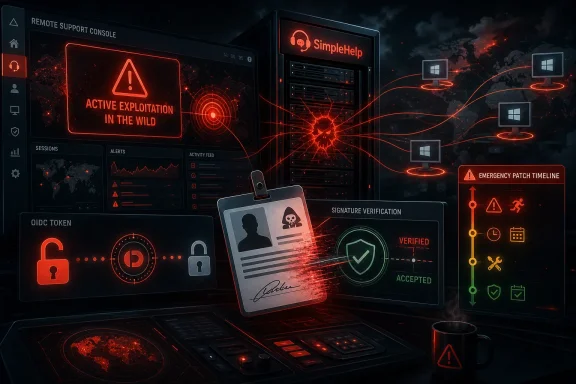
That is a subtle implementation error with unsubtle consequences. OIDC is supposed to let an application outsource identity to a trusted provider such as a corporate identity platform. If the application accepts a forged token, the trust boundary collapses. The attacker is no longer breaking the front door; the front door is accepting a fake badge.
In vulnerable configurations, researchers reported that a remote unauthenticated attacker could create or authenticate as a technician user. That technician role is not a cosmetic account. It is the kind of access that may allow remote endpoint access, script execution, and administrative actions through the SimpleHelp platform. For a defender, this is a helpdesk workflow. For an attacker, it is post-exploitation infrastructure already installed and trusted.
OIDC depends on signed tokens. The signature is not decoration; it is the mechanism that lets an application distinguish a real assertion from a forged one. If an application accepts claims without validating that signature, the attacker gets to write their own identity story. A fake token can say, in effect, “I am a technician,” and the vulnerable application may treat that statement as fact.
That is why this class of bug feels so jarring to administrators. MFA may be turned on. SSO may be configured. The login flow may look modern and enterprise-grade. Yet the failure is inside the relying party’s validation logic, below the level where a normal user or even many administrators would see it.
The reported MFA bypass angle is especially important. In some configurations, an attacker who creates or authenticates as a technician can enroll their own MFA method during first login. That does not defeat MFA by stealing a code or phishing a push approval. It walks around the entire premise by arriving at the enrollment step as a supposedly legitimate user.
This is the uncomfortable lesson for Windows shops that have embraced Entra ID, OIDC, SAML, and other identity plumbing. The identity provider can be configured correctly and still be undermined by a downstream application that mishandles assertions. Centralized identity reduces risk, but it does not eliminate the need to audit how applications consume identity.
That makes RMM products uniquely attractive to attackers. Compromising a remote support platform can give an intruder legitimacy, reach, and persistence in one move. Commands may look like technician actions. Network connections may originate from known infrastructure. Endpoint changes may arrive through a trusted administrative channel rather than a suspicious executable dropped from a random host.
For managed service providers, the risk is even sharper. A single vulnerable remote support system may provide access into multiple client environments. That is why RMM compromise so often reads like a supply-chain story even when the exploited software is self-hosted. The attacker is not just stealing a password or breaking into a server; they are hijacking a service relationship.
This is where the KEV designation becomes more than a government patching trigger. It tells procurement teams, MSPs, and customers to ask operational questions. Is SimpleHelp exposed to the internet? Is OIDC enabled? Which version is deployed? Are technician accounts reviewed? Are logs preserved long enough to reconstruct activity before the patch?
Those are not theoretical governance exercises. They are the difference between “we patched” and “we know whether we were compromised before we patched.” CISA’s current vulnerability management posture increasingly stresses that distinction, because remediation alone does not remove an attacker who already used the flaw.
The harder work begins after the upgrade. Administrators need to assume that a vulnerable, internet-facing instance may already have been touched. That means reviewing technician accounts, especially group-authenticated or recently created users. It means looking for unfamiliar names, unexpected email addresses, and account creation events that do not match helpdesk operations.
Server logs matter here. Reports from researchers point administrators toward SimpleHelp server logs and historical log directories for evidence of technician registration and configuration changes. The specific strings will vary by environment, but the investigative pattern is straightforward: identify when technician accounts were created, who created them, what source addresses were involved, and what actions followed.
Organizations should also inspect the endpoints reachable from SimpleHelp. If an attacker gained technician access, the compromise may not remain confined to the SimpleHelp server. Script execution, remote access sessions, file transfer, and credential exposure are all plausible downstream concerns depending on configuration and attacker behavior.
The response should therefore look less like routine patch management and more like a scoped incident investigation. Patch the application. Preserve logs. Review accounts. Revoke suspicious access. Rotate credentials where exposure is plausible. Hunt on managed endpoints for unusual remote sessions or scripts executed through the platform.
That is sensible. The catalog is not perfect, and it is not a complete map of risk. But it is one of the clearest public signals that a vulnerability has crossed into active attacker use. For overloaded teams, that signal deserves more weight than a raw severity score.
The SimpleHelp entry also lands in the middle of a broader policy shift. CISA is pushing agencies to focus on vulnerabilities that create real-world operational risk, especially on exposed systems that can grant full control after exploitation. That is an implicit critique of checkbox patching. Not every missing update is equally urgent, and not every high CVSS score deserves the same fire drill.
CVE-2026-48558 fits the new model almost too neatly. It is a remotely exploitable authentication bypass in a remote management product, with potential control over managed assets. If a security program cannot elevate that above routine backlog work, the problem is not tooling. It is governance.
Windows administrators should therefore think of this vulnerability in terms of endpoint consequence. If SimpleHelp is used to manage Windows clients or servers, a compromised technician account may become a route to run scripts, move laterally, collect data, or stage payloads. The vulnerable component may be the web-facing SimpleHelp server, but the likely impact fans out across the machines it manages.
This is also a reminder to inventory remote access tools with the same seriousness applied to domain controllers and VPN gateways. Many organizations can list their firewalls and identity providers from memory but have a fuzzier picture of remote support products installed by IT, departmental admins, vendors, or MSPs. Attackers do not care which team owns the tool. They care whether it opens a path.
Administrators should verify whether SimpleHelp agents are present, which server they report to, and who controls that server. In MSP relationships, customers should ask whether the provider uses SimpleHelp, whether it was affected, whether it was patched, and whether account and log reviews were performed. “We updated the software” is not enough of an answer when the vulnerability was already being exploited.
Windows estates have grown more resilient in many ways, but their operational tooling remains a soft underbelly. Remote support, remote monitoring, deployment agents, backup consoles, and identity connectors often sit above the endpoint security stack. When those tools are compromised, the attacker does not need to fight every endpoint one by one.
Authentication bugs in this category should be treated as catastrophic by default. The distinction between “an attacker can log in” and “an attacker can control managed endpoints” is narrow when the product’s purpose is management. A conventional web application compromise may expose records. An RMM compromise can become an execution fabric.
That does not mean every remote support product is unsafe. It means buyers and administrators need to evaluate them differently. Security review should include identity implementation, audit logging, emergency access controls, network exposure assumptions, and the vendor’s patch communication history. The old procurement checklist of features and pricing is inadequate for software that effectively becomes a privileged operations plane.
There is also a transparency issue. In this case, patches were reportedly available before broad public attention around the CVE, and researchers later published technical details and indicators. That sequence is not unusual; coordinated disclosure often involves a delay between fix and full public write-up. But customers need clear, timely security communication from vendors when an issue affects authentication and privileged access.
A vague release note is not enough when a product can touch thousands of endpoints. Administrators need to know whether a fix is security-relevant, whether configuration determines exposure, whether logs can reveal compromise, and whether additional mitigations are recommended. If vendors are worried about tipping off attackers, they should remember that attackers often reverse patches faster than customers read release notes.
For CVE-2026-48558, that would be risky. If an attacker used the flaw to create a technician account, patching the server may close the original door while leaving the attacker’s access path intact. If the account remains active, the vulnerability is no longer needed. The compromise has been converted into legitimate-looking access.
The same logic applies to scripts, remote sessions, and downstream endpoint changes. A malicious action performed through a trusted management tool may not look like malware at first glance. It may look like administration. That makes historical review essential, particularly around the window before patching and before CISA’s public catalog addition.
Security teams should preserve SimpleHelp logs before rotating or truncating them. They should correlate technician activity with identity-provider logs, endpoint telemetry, and network records. They should ask whether new accounts appeared shortly before unusual remote sessions, whether those sessions touched sensitive servers, and whether scripts executed from SimpleHelp correspond to approved tickets.
The broader lesson is that KEV entries should automatically trigger a compromise-assessment playbook, not just a patch ticket. The playbook can be lightweight for low-impact products. It cannot be lightweight for tools that grant administrative reach over endpoints.
The first step is inventory. Find SimpleHelp servers, determine their versions, identify whether they are internet-facing, and confirm whether OIDC or Azure AD OIDC authentication is enabled. Many organizations will discover that the official owner is not the security team but IT support, an MSP, or a business unit that needed remote access fast.
The second step is upgrade. Affected deployments should move to fixed releases, with emergency change procedures where exposure and configuration warrant it. Waiting for a normal patch cycle is hard to justify once CISA has placed the vulnerability in the exploited catalog.
The third step is containment. Limit technician login exposure, enforce source restrictions where available, review group-authenticated login settings, and remove unnecessary technician groups from federated authentication paths. A remote management console should not be treated like an ordinary internal web app.
The fourth step is investigation. Review technician accounts, search logs for registration events, and validate recent administrative actions through the platform. If anything looks wrong, widen the scope to managed endpoints and credentials that may have been accessed.
Finally, organizations should document the decision path. If they determine they are not vulnerable because OIDC is not enabled or because the server is not exposed, they should record that evidence. In a month, when an auditor or customer asks what happened, “we think we were fine” will not be good enough.
Those systems are attractive because they make administration scalable. They are dangerous for the same reason. A bug in a niche business application may inconvenience a department. A bug in an administrative control plane can become a fleet-wide compromise.
Authentication bypass vulnerabilities are particularly corrosive because they defeat the security control everyone else is depending on. Organizations can spend years improving passwords, enforcing MFA, consolidating identity, and educating users, only to have a relying application accept a forged assertion. The failure is not human gullibility. It is broken trust validation.
That makes secure implementation and independent testing more important than marketing language around SSO support. “Supports OIDC” is not a security claim by itself. The real claim is that the product validates tokens correctly, handles group mapping safely, logs authentication events clearly, and fails closed when identity assertions are invalid.
Administrators cannot easily prove all of that from the outside. But they can ask better questions, demand better vendor disclosure, and reduce blast radius. They can keep remote management portals off the open internet where possible, restrict administrative access by network and device posture, and monitor account creation as a high-signal event.
The uncomfortable part is that SimpleHelp is exactly the kind of software defenders deploy because they need control. It gives technicians a way to reach endpoints, execute scripts, and administer systems across distance and time zones. When that control plane is reachable from the internet and authentication can be bypassed, the product’s greatest operational advantage becomes the attacker’s shortest path to privilege.
 CISA’s Catalog Is No Longer Just a Warning List
CISA’s Known Exploited Vulnerabilities catalog began as a practical answer to a problem every security team knows too well: there are far more vulnerabilities than there is time to patch them. CVSS scores, vendor bulletins, scanner findings, and threat-intelligence feeds all compete for attention, but the catalog cuts through the noise with one blunt criterion. Someone is exploiting this.That matters because exploitation changes the moral and operational math of patching. A bug with a theoretical exploit can sit in a risk register while teams negotiate maintenance windows. A bug in the KEV catalog is different. It says the race has already started, and defenders may not be the only ones reading the advisory.
CVE-2026-48558 enters that list with the worst possible combination of traits. It is remotely exploitable, requires no prior authentication, can affect technician access, and targets software designed to reach many other machines. For federal civilian agencies, the catalog addition intersects with Binding Operational Directive 26-04, which tells agencies to prioritize remediation of high-risk vulnerabilities on publicly exposed assets that can grant total control after exploitation. For private-sector organizations, the directive is not legally binding, but pretending the logic does not apply would be negligent.
The most important phrase in CISA’s notice is not “authentication bypass.” It is active exploitation. The catalog is not an academic database, and CISA does not add entries because a researcher produced an interesting proof of concept. The agency’s move means the vulnerability has crossed from “could be bad” into “is being used.”
SimpleHelp Sits in the Blast Radius Business
SimpleHelp is remote support and remote monitoring software, the kind of tool used by managed service providers, internal IT departments, and support teams to reach endpoints without walking across the building or driving across town. In normal use, that is mundane infrastructure. In an incident, it is an enterprise-wide steering wheel.The vulnerability affects SimpleHelp versions 5.5.15 and earlier, along with affected 6.0 pre-release builds, when deployments use OpenID Connect authentication in a vulnerable configuration. The flaw sits in how SimpleHelp handles identity tokens during the OIDC login flow. In plain English, vulnerable servers can accept identity claims without properly verifying the cryptographic signature that proves those claims came from the trusted identity provider.
That is a subtle implementation error with unsubtle consequences. OIDC is supposed to let an application outsource identity to a trusted provider such as a corporate identity platform. If the application accepts a forged token, the trust boundary collapses. The attacker is no longer breaking the front door; the front door is accepting a fake badge.
In vulnerable configurations, researchers reported that a remote unauthenticated attacker could create or authenticate as a technician user. That technician role is not a cosmetic account. It is the kind of access that may allow remote endpoint access, script execution, and administrative actions through the SimpleHelp platform. For a defender, this is a helpdesk workflow. For an attacker, it is post-exploitation infrastructure already installed and trusted.
The Identity Layer Failed Where Everyone Was Told to Trust It
The industry has spent years telling organizations to centralize identity, federate logins, enforce MFA, and get away from local passwords. That advice is still broadly correct. But CVE-2026-48558 shows the catch: identity federation only improves security if the relying application actually verifies what it receives.OIDC depends on signed tokens. The signature is not decoration; it is the mechanism that lets an application distinguish a real assertion from a forged one. If an application accepts claims without validating that signature, the attacker gets to write their own identity story. A fake token can say, in effect, “I am a technician,” and the vulnerable application may treat that statement as fact.
That is why this class of bug feels so jarring to administrators. MFA may be turned on. SSO may be configured. The login flow may look modern and enterprise-grade. Yet the failure is inside the relying party’s validation logic, below the level where a normal user or even many administrators would see it.
The reported MFA bypass angle is especially important. In some configurations, an attacker who creates or authenticates as a technician can enroll their own MFA method during first login. That does not defeat MFA by stealing a code or phishing a push approval. It walks around the entire premise by arriving at the enrollment step as a supposedly legitimate user.
This is the uncomfortable lesson for Windows shops that have embraced Entra ID, OIDC, SAML, and other identity plumbing. The identity provider can be configured correctly and still be undermined by a downstream application that mishandles assertions. Centralized identity reduces risk, but it does not eliminate the need to audit how applications consume identity.
Remote Management Bugs Are Supply-Chain Incidents in Disguise
The reason CISA’s addition deserves attention beyond SimpleHelp customers is that remote management tools are multipliers. They do not merely sit on one server and expose one dataset. They sit above fleets of endpoints, sometimes across customer environments, and frequently with permissions that security teams would never grant to ordinary line-of-business applications.That makes RMM products uniquely attractive to attackers. Compromising a remote support platform can give an intruder legitimacy, reach, and persistence in one move. Commands may look like technician actions. Network connections may originate from known infrastructure. Endpoint changes may arrive through a trusted administrative channel rather than a suspicious executable dropped from a random host.
For managed service providers, the risk is even sharper. A single vulnerable remote support system may provide access into multiple client environments. That is why RMM compromise so often reads like a supply-chain story even when the exploited software is self-hosted. The attacker is not just stealing a password or breaking into a server; they are hijacking a service relationship.
This is where the KEV designation becomes more than a government patching trigger. It tells procurement teams, MSPs, and customers to ask operational questions. Is SimpleHelp exposed to the internet? Is OIDC enabled? Which version is deployed? Are technician accounts reviewed? Are logs preserved long enough to reconstruct activity before the patch?
Those are not theoretical governance exercises. They are the difference between “we patched” and “we know whether we were compromised before we patched.” CISA’s current vulnerability management posture increasingly stresses that distinction, because remediation alone does not remove an attacker who already used the flaw.
The Patch Is Necessary, but It Is Not the Whole Response
SimpleHelp has fixed the issue in version 5.5.16 and in the later corrected 6.0 release candidate line. Organizations running affected versions should treat upgrading as urgent, especially if the SimpleHelp server is publicly reachable and OIDC authentication is configured. If patching cannot happen immediately, restricting technician authentication to approved source IP addresses is a practical compensating control, but not a substitute for updating.The harder work begins after the upgrade. Administrators need to assume that a vulnerable, internet-facing instance may already have been touched. That means reviewing technician accounts, especially group-authenticated or recently created users. It means looking for unfamiliar names, unexpected email addresses, and account creation events that do not match helpdesk operations.
Server logs matter here. Reports from researchers point administrators toward SimpleHelp server logs and historical log directories for evidence of technician registration and configuration changes. The specific strings will vary by environment, but the investigative pattern is straightforward: identify when technician accounts were created, who created them, what source addresses were involved, and what actions followed.
Organizations should also inspect the endpoints reachable from SimpleHelp. If an attacker gained technician access, the compromise may not remain confined to the SimpleHelp server. Script execution, remote access sessions, file transfer, and credential exposure are all plausible downstream concerns depending on configuration and attacker behavior.
The response should therefore look less like routine patch management and more like a scoped incident investigation. Patch the application. Preserve logs. Review accounts. Revoke suspicious access. Rotate credentials where exposure is plausible. Hunt on managed endpoints for unusual remote sessions or scripts executed through the platform.
Federal Deadlines Are Becoming a De Facto Enterprise Standard
Binding Operational Directive 26-04 applies to Federal Civilian Executive Branch agencies, but its influence will not stop at the federal boundary. Government vulnerability-management rules have a way of becoming industry reference points because they translate vague urgency into concrete action. Security leaders in private organizations often use CISA’s KEV catalog as a defensible prioritization mechanism when every scanner says everything is critical.That is sensible. The catalog is not perfect, and it is not a complete map of risk. But it is one of the clearest public signals that a vulnerability has crossed into active attacker use. For overloaded teams, that signal deserves more weight than a raw severity score.
The SimpleHelp entry also lands in the middle of a broader policy shift. CISA is pushing agencies to focus on vulnerabilities that create real-world operational risk, especially on exposed systems that can grant full control after exploitation. That is an implicit critique of checkbox patching. Not every missing update is equally urgent, and not every high CVSS score deserves the same fire drill.
CVE-2026-48558 fits the new model almost too neatly. It is a remotely exploitable authentication bypass in a remote management product, with potential control over managed assets. If a security program cannot elevate that above routine backlog work, the problem is not tooling. It is governance.
Windows Administrators Should Read This as an Endpoint Story
For WindowsForum readers, the temptation may be to file this under “third-party server software” and move on. That would be a mistake. Remote support platforms are part of the Windows endpoint ecosystem whether or not they ship from Microsoft. They often have agents on Windows machines, permissions to execute commands, and a trusted place in firewall and EDR policy.Windows administrators should therefore think of this vulnerability in terms of endpoint consequence. If SimpleHelp is used to manage Windows clients or servers, a compromised technician account may become a route to run scripts, move laterally, collect data, or stage payloads. The vulnerable component may be the web-facing SimpleHelp server, but the likely impact fans out across the machines it manages.
This is also a reminder to inventory remote access tools with the same seriousness applied to domain controllers and VPN gateways. Many organizations can list their firewalls and identity providers from memory but have a fuzzier picture of remote support products installed by IT, departmental admins, vendors, or MSPs. Attackers do not care which team owns the tool. They care whether it opens a path.
Administrators should verify whether SimpleHelp agents are present, which server they report to, and who controls that server. In MSP relationships, customers should ask whether the provider uses SimpleHelp, whether it was affected, whether it was patched, and whether account and log reviews were performed. “We updated the software” is not enough of an answer when the vulnerability was already being exploited.
Windows estates have grown more resilient in many ways, but their operational tooling remains a soft underbelly. Remote support, remote monitoring, deployment agents, backup consoles, and identity connectors often sit above the endpoint security stack. When those tools are compromised, the attacker does not need to fight every endpoint one by one.
The RMM Market Has an Accountability Problem
The security industry likes to describe RMM tools as dual-use, but that phrase understates the problem. A spreadsheet macro is dual-use. A remote management platform is infrastructure for control. Vendors in this space are selling the ability to reach into machines at scale, which means they are also accepting responsibility for the consequences when that access path fails.Authentication bugs in this category should be treated as catastrophic by default. The distinction between “an attacker can log in” and “an attacker can control managed endpoints” is narrow when the product’s purpose is management. A conventional web application compromise may expose records. An RMM compromise can become an execution fabric.
That does not mean every remote support product is unsafe. It means buyers and administrators need to evaluate them differently. Security review should include identity implementation, audit logging, emergency access controls, network exposure assumptions, and the vendor’s patch communication history. The old procurement checklist of features and pricing is inadequate for software that effectively becomes a privileged operations plane.
There is also a transparency issue. In this case, patches were reportedly available before broad public attention around the CVE, and researchers later published technical details and indicators. That sequence is not unusual; coordinated disclosure often involves a delay between fix and full public write-up. But customers need clear, timely security communication from vendors when an issue affects authentication and privileged access.
A vague release note is not enough when a product can touch thousands of endpoints. Administrators need to know whether a fix is security-relevant, whether configuration determines exposure, whether logs can reveal compromise, and whether additional mitigations are recommended. If vendors are worried about tipping off attackers, they should remember that attackers often reverse patches faster than customers read release notes.
The Catalog Entry Turns Patching Into Evidence Collection
One subtle but important aspect of the CISA notice is its emphasis on checking whether threat actors compromised systems before patches were applied. That is the line between vulnerability management and incident response, and it is where many organizations still stumble. They treat exploitation-driven patching as if it were routine maintenance.For CVE-2026-48558, that would be risky. If an attacker used the flaw to create a technician account, patching the server may close the original door while leaving the attacker’s access path intact. If the account remains active, the vulnerability is no longer needed. The compromise has been converted into legitimate-looking access.
The same logic applies to scripts, remote sessions, and downstream endpoint changes. A malicious action performed through a trusted management tool may not look like malware at first glance. It may look like administration. That makes historical review essential, particularly around the window before patching and before CISA’s public catalog addition.
Security teams should preserve SimpleHelp logs before rotating or truncating them. They should correlate technician activity with identity-provider logs, endpoint telemetry, and network records. They should ask whether new accounts appeared shortly before unusual remote sessions, whether those sessions touched sensitive servers, and whether scripts executed from SimpleHelp correspond to approved tickets.
The broader lesson is that KEV entries should automatically trigger a compromise-assessment playbook, not just a patch ticket. The playbook can be lightweight for low-impact products. It cannot be lightweight for tools that grant administrative reach over endpoints.
The SimpleHelp Fix List Belongs on Monday’s Change Board
There is a practical path through this incident, but it requires treating configuration as part of exposure. Not every SimpleHelp deployment is vulnerable in the same way. The flaw is tied to OIDC-enabled configurations and particular technician group settings. That nuance matters for scoping, but it should not become an excuse for delay.The first step is inventory. Find SimpleHelp servers, determine their versions, identify whether they are internet-facing, and confirm whether OIDC or Azure AD OIDC authentication is enabled. Many organizations will discover that the official owner is not the security team but IT support, an MSP, or a business unit that needed remote access fast.
The second step is upgrade. Affected deployments should move to fixed releases, with emergency change procedures where exposure and configuration warrant it. Waiting for a normal patch cycle is hard to justify once CISA has placed the vulnerability in the exploited catalog.
The third step is containment. Limit technician login exposure, enforce source restrictions where available, review group-authenticated login settings, and remove unnecessary technician groups from federated authentication paths. A remote management console should not be treated like an ordinary internal web app.
The fourth step is investigation. Review technician accounts, search logs for registration events, and validate recent administrative actions through the platform. If anything looks wrong, widen the scope to managed endpoints and credentials that may have been accessed.
Finally, organizations should document the decision path. If they determine they are not vulnerable because OIDC is not enabled or because the server is not exposed, they should record that evidence. In a month, when an auditor or customer asks what happened, “we think we were fine” will not be good enough.
The Real Lesson Is Hiding in the Login Flow
The most tempting story is that this is a SimpleHelp problem. That is true in the narrow sense and incomplete in the useful sense. The larger story is that modern enterprise security increasingly concentrates trust in a handful of connective systems: identity providers, RMM tools, VPNs, cloud consoles, backup platforms, and endpoint management services.Those systems are attractive because they make administration scalable. They are dangerous for the same reason. A bug in a niche business application may inconvenience a department. A bug in an administrative control plane can become a fleet-wide compromise.
Authentication bypass vulnerabilities are particularly corrosive because they defeat the security control everyone else is depending on. Organizations can spend years improving passwords, enforcing MFA, consolidating identity, and educating users, only to have a relying application accept a forged assertion. The failure is not human gullibility. It is broken trust validation.
That makes secure implementation and independent testing more important than marketing language around SSO support. “Supports OIDC” is not a security claim by itself. The real claim is that the product validates tokens correctly, handles group mapping safely, logs authentication events clearly, and fails closed when identity assertions are invalid.
Administrators cannot easily prove all of that from the outside. But they can ask better questions, demand better vendor disclosure, and reduce blast radius. They can keep remote management portals off the open internet where possible, restrict administrative access by network and device posture, and monitor account creation as a high-signal event.
A Short List for the Teams That Own the Console
CVE-2026-48558 is the kind of vulnerability that rewards speed but punishes tunnel vision. The patch matters, but the surrounding work determines whether an organization actually reduced risk or merely updated a version number.- Organizations running SimpleHelp should verify immediately whether they use version 5.5.15 or earlier, or affected 6.0 pre-release builds, especially where OIDC authentication is enabled.
- Internet-facing SimpleHelp servers should be treated as high priority because the vulnerability can be exploited remotely without valid credentials in vulnerable configurations.
- Administrators should upgrade to fixed SimpleHelp releases and use source restrictions for technician authentication where immediate patching is not possible.
- Security teams should review technician accounts and SimpleHelp logs for unfamiliar registrations, configuration changes, and remote activity before assuming the patch ended the incident.
- MSP customers should ask providers whether SimpleHelp was in use, whether affected configurations existed, and whether compromise assessment was performed after remediation.
- Windows endpoint teams should treat remote management platforms as privileged infrastructure and monitor actions from those platforms with the same seriousness as domain admin activity.
References
- Primary source: CISA
Published: 2026-06-29T12:00:00+00:00
- Related coverage: thehackerwire.com
- Related coverage: o3.security
CVE-2026-48558: CWE-347 (Critical 10) | O3 Security
CVE-2026-48558 is a critical-severity vulnerability (CVSS 10). See affected versions, exploit status, EPSS, and fix guidance. o3.security
- Related coverage: dbugs.ptsecurity.com
CVE-2026-48558 — Remote Code Execution in Unknown Simplehelp | dbugs
Details on CVE-2026-48558: Remote Code Execution in Unknown Simplehelp. Exploited in the wild. Includes CVSS score, affected versions, and references.dbugs.ptsecurity.com