On May 22, 2026, CISA added CVE-2026-9082, a Drupal Core SQL injection vulnerability affecting PostgreSQL-backed sites, to its Known Exploited Vulnerabilities catalog after evidence showed active exploitation in the wild. The move turns what was already an urgent Drupal security release into a federal remediation mandate. More importantly, it is another reminder that the most dangerous software flaws are often not the ones with the most theatrical branding, but the ones sitting quietly in the infrastructure layer of public-facing systems.
CISA’s Known Exploited Vulnerabilities catalog is not a general-purpose severity scoreboard. It is a list of vulnerabilities that the agency believes are being used by attackers, and that distinction matters. A flaw can have a frightening CVSS score and still be theoretical; a KEV entry means defenders should assume someone, somewhere, has figured out how to operationalize it.
For Federal Civilian Executive Branch agencies, that assumption has teeth. Binding Operational Directive 22-01 requires those agencies to remediate KEV-listed vulnerabilities by CISA’s due date, which turns the catalog into a kind of national patch calendar for civilian federal networks. Private organizations are not legally bound by the directive, but ignoring the catalog has become increasingly hard to justify in front of auditors, insurers, boards, and customers.
CVE-2026-9082 lands in that catalog with an especially familiar shape: a content management system, a database abstraction layer, and anonymous network reachability. Drupal is not the scrappy niche CMS it is sometimes caricatured as. It remains a serious platform in government, education, nonprofits, media, healthcare, and large enterprises — exactly the sort of environments where “just patch it today” collides with change windows, custom modules, legacy integrations, and procurement reality.
That is why CISA’s alert is more than a line item. It is a forcing function. If an organization runs Drupal on PostgreSQL, the question is no longer whether the advisory looks scary enough to interrupt the week. The question is whether the organization can prove that every exposed site has either been updated, isolated, or taken through a compensating-control plan that survives contact with an actual attacker.
In this case, the bug affects sites using PostgreSQL. Drupal says specially crafted requests can result in arbitrary SQL injection against those deployments, and that anonymous users can exploit the issue. The advisory also warns of possible information disclosure and, depending on configuration, privilege escalation, remote code execution, or other attacks.
That combination is ugly. Anonymous reachability means attackers do not need a stolen editor account before taking a shot. SQL injection means the attack surface is not limited to web-page defacement or nuisance behavior. PostgreSQL specificity narrows the blast radius, but it also creates a dangerous psychological trap: teams running MySQL or MariaDB may relax too quickly, while teams that do not have perfect asset visibility may not know which database backs which Drupal instance.
The affected version ranges are broad across Drupal 10 and 11, and the advisory also offers best-effort guidance for older unsupported branches. Drupal 11.3.x users are directed to 11.3.10, 11.2.x users to 11.2.12, and 11.1.x or 11.0.x users to 11.1.10. Drupal 10 users are directed to 10.6.9, 10.5.10, or 10.4.10 depending on their branch. Drupal 8 and Drupal 9 are already end-of-life, which means their operators are not merely patching a single fire; they are carrying a structural security debt.
The nuance is that Drupal’s release also includes security updates for third-party dependencies, including Symfony and Twig. That makes the “PostgreSQL only” caveat less comforting than it first appears. Even if the headline SQL injection does not apply to a particular database backend, the broader update may still close other meaningful gaps in the stack.
The security industry often talks about “patch quickly” as if speed were a moral quality. In practice, speed is architecture. Organizations that can patch quickly usually have clean inventories, reproducible deployments, automated testing, rollback plans, and owners who know which systems matter. Organizations that cannot patch quickly usually discover, during moments like this, that the vulnerability is only one symptom of a much older operational problem.
CISA’s catalog entry raises the pressure because it confirms active exploitation rather than merely anticipating it. For public-facing Drupal sites, especially those with forms, search features, exposed entity queries, custom modules, and complex access-control logic, the prudent assumption is that attackers will look for internet-visible targets first and ask subtle questions later.
That does not mean every Drupal site has been compromised. It does mean “we have no alerts” is not a sufficient answer. SQL injection can be noisy, but mature exploitation can be selective, especially when attackers are probing for data exposure or chained access rather than immediate vandalism. The first useful defensive move is not panic; it is disciplined triage.
A Drupal estate is rarely a single tidy website. It may include production, staging, preview, campaign microsites, archival public sites, intranet portals, old acquisitions, abandoned contractor builds, and container images that have not been rebuilt in months. Some of those may run PostgreSQL because a team chose it deliberately. Others may run it because a platform template, hosting provider, or long-forgotten deployment script made the choice years ago.
For WindowsForum readers who live in Microsoft-heavy environments, the Drupal angle may feel slightly off the main road. But the operational lesson is directly relevant to Windows shops. Many enterprises that standardize on Windows endpoints, Active Directory, Microsoft 365, and Azure still host a mixed web estate. Linux VMs, container platforms, managed databases, and open-source CMS stacks often sit at the edge of the organization’s identity and data boundaries.
That edge is where attackers like to work. A compromised CMS can become a credential-harvesting platform, a staging point, a source of sensitive records, or a route into back-end integrations. Even if the vulnerable software is not running on Windows Server, the consequences may land in Entra ID logs, SIEM queues, database audit trails, and help-desk tickets.
CVE-2026-9082 is not identical to those earlier crises, and defenders should be wary of lazy comparisons. This issue is constrained to PostgreSQL-backed sites for the SQL injection component, and Drupal’s advisory gives clear fixed versions. Still, the pattern is familiar enough to matter: a core framework flaw, unauthenticated exploitation, rapid public attention, and then CISA confirmation of exploitation.
The lesson from past mass-exploitation waves is that attackers do not need to compromise the largest number of sites to make a vulnerability worth exploiting. They need a reliable enough path into valuable targets. Government portals, university systems, health organizations, public-service sites, and nonprofit platforms are all places where Drupal has historically been strong. They are also places where maintenance budgets are uneven and where downtime carries political or reputational cost.
That mismatch is why the KEV catalog has become a useful reality check. It cuts through debates about theoretical severity and asks a simpler operational question: is this being exploited now? For CVE-2026-9082, CISA’s answer is yes.
Asset management failures are rarely dramatic. They are the quiet background noise of enterprise security. A marketing site gets launched for a campaign and then forgotten. A university department runs its own Drupal instance because central IT was too slow. A contractor hands off a platform without documenting the database. A cloud migration leaves a test environment exposed because “temporary” became permanent.
For this vulnerability, inventory needs to answer specific questions. Which Drupal branches are running? Which sites use PostgreSQL? Which are internet-facing? Which have custom modules that touch entity queries or database APIs? Which run unsupported Drupal 8 or 9? Which are behind a web application firewall, and is that control actually seeing the relevant traffic?
Those questions should not wait for a post-incident report. They are the difference between patching a vulnerability and merely hoping the most visible instances have been patched. In an exploit-in-the-wild scenario, hope is not a control.
This is where security teams often lose the argument inside organizations. Application owners hear “end-of-life” as a budget problem, a migration problem, or a vendor problem. Attackers hear it as a target-selection signal. Unsupported platforms usually mean older dependencies, brittle custom code, incomplete test coverage, and a fear of change that keeps risky systems online longer than anyone intended.
The existence of a best-effort patch should not become a permission slip to stay put. It is an emergency bridge, not a maintenance strategy. An organization running end-of-life Drupal should treat CVE-2026-9082 as evidence in a larger case for migration funding, architectural simplification, or retirement.
That is especially true for public-sector and nonprofit organizations that rely heavily on Drupal. Their web platforms often carry civic information, constituent data, grant workflows, donation systems, or service portals. The argument for upgrading is not cosmetic. It is about reducing the number of times a critical public service has to be rescued from infrastructure decisions made a decade ago.
But WAFs are not a substitute for updating Drupal Core. SQL injection flaws in framework internals can manifest through application behavior that is difficult to capture with a generic rule, particularly when custom modules and site-specific routing complicate the request surface. Attackers also test around public signatures quickly, especially once a vulnerability is added to KEV and becomes a priority target for both defenders and criminals.
A WAF should be used as a temporary compensating control, not as the endpoint of the response. Rate limiting, virtual patching, stricter monitoring, and targeted blocking may buy time. They do not remove the vulnerable code path, and they do not resolve dependency updates bundled with the Drupal release.
The better framing is layered urgency. Patch the application. Review logs. Tighten ingress controls. Confirm database exposure boundaries. Monitor for unusual queries, authentication anomalies, changed content, unexpected administrative activity, and suspicious outbound connections. Any one of those measures can fail; together, they raise the cost of exploitation and improve the odds of detecting what has already happened.
That is why many private-sector teams now treat KEV entries as near-mandatory remediation items even without a legal requirement. Cyber insurers ask about known exploited vulnerabilities. Regulators look for evidence that organizations acted on widely available threat intelligence. Customers increasingly expect suppliers to know whether their public-facing systems include KEV-listed flaws.
For Drupal operators, the catalog addition compresses the acceptable response window. A routine monthly patch cycle is no longer an adequate answer for a public-facing PostgreSQL-backed Drupal site in an affected version range. Security teams should be able to show an exception process, an emergency change path, or a documented compensating-control decision signed by someone who understands the risk.
This is also where Windows and Microsoft-centric administrators should resist the temptation to classify the issue as “web team business.” In many enterprises, vulnerability management crosses endpoint, server, cloud, identity, and application boundaries. If a Drupal compromise leads to credential theft, lateral movement, or data exfiltration, the response will not remain politely confined to the CMS owner’s inbox.
Drupal’s advisory notes that exploit attempts are being detected in the wild, but a local organization still needs local evidence. Web server logs, Drupal watchdog logs, reverse-proxy logs, WAF events, database audit logs, authentication logs, and SIEM correlations all become relevant. The review window should begin before the advisory date, not after CISA’s catalog addition, because attackers often move quickly once hints of a critical release appear.
The most obvious signs may include unusual request parameters, database errors exposed in logs, unexpected anonymous interactions with endpoints that normally receive structured application traffic, spikes in 4xx or 5xx responses, and suspicious activity around forms, search, entity listings, or custom module routes. But defenders should also look for second-order effects: newly created administrator accounts, changed roles, modified content, unexpected PHP files, altered templates, or anomalous outbound traffic.
If that sounds broad, it is because SQL injection is not a single outcome. It is a class of access into data and application logic. Depending on privileges, schema, extensions, and surrounding application code, the practical effect can range from limited data exposure to a foothold that enables deeper compromise.
Those questions are reasonable in isolation, but together they can create dangerous delay. CVE-2026-9082 is a case study in why organizations need predefined emergency paths for public-facing software. The time to decide who can approve a Drupal Core update is not after CISA has confirmed active exploitation.
Good programs make the urgent path boring. They know who owns each application. They know how to rebuild it. They can test quickly. They can roll back. They can isolate a site if an update fails. They can communicate downtime without turning a patch into a political event. None of that is glamorous, but it is what separates a manageable advisory from a weekend incident bridge.
The broader cultural change is to treat CMS platforms as production application infrastructure, not as marketing tools that happen to run code. Drupal, WordPress, Joomla, SharePoint, Sitecore, and custom web stacks all deserve the same lifecycle discipline as line-of-business applications. If they are internet-facing and connected to data, they are part of the attack surface whether the org chart admits it or not.
For teams trying to turn that into action, the immediate priorities are concrete:
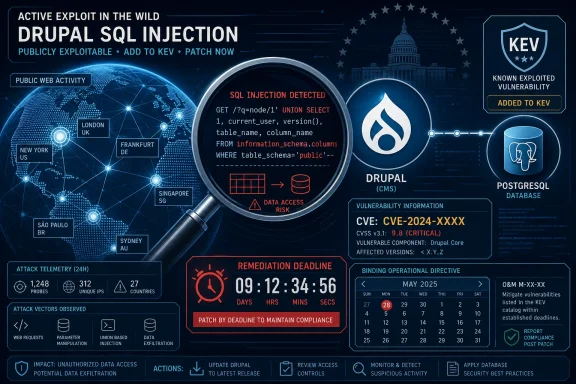 CISA Turns a Drupal Patch Into a Deadline
CISA’s Known Exploited Vulnerabilities catalog is not a general-purpose severity scoreboard. It is a list of vulnerabilities that the agency believes are being used by attackers, and that distinction matters. A flaw can have a frightening CVSS score and still be theoretical; a KEV entry means defenders should assume someone, somewhere, has figured out how to operationalize it.For Federal Civilian Executive Branch agencies, that assumption has teeth. Binding Operational Directive 22-01 requires those agencies to remediate KEV-listed vulnerabilities by CISA’s due date, which turns the catalog into a kind of national patch calendar for civilian federal networks. Private organizations are not legally bound by the directive, but ignoring the catalog has become increasingly hard to justify in front of auditors, insurers, boards, and customers.
CVE-2026-9082 lands in that catalog with an especially familiar shape: a content management system, a database abstraction layer, and anonymous network reachability. Drupal is not the scrappy niche CMS it is sometimes caricatured as. It remains a serious platform in government, education, nonprofits, media, healthcare, and large enterprises — exactly the sort of environments where “just patch it today” collides with change windows, custom modules, legacy integrations, and procurement reality.
That is why CISA’s alert is more than a line item. It is a forcing function. If an organization runs Drupal on PostgreSQL, the question is no longer whether the advisory looks scary enough to interrupt the week. The question is whether the organization can prove that every exposed site has either been updated, isolated, or taken through a compensating-control plan that survives contact with an actual attacker.
The Vulnerability Lives Where Developers Thought the Framework Was Helping
Drupal’s own advisory describes CVE-2026-9082 as a SQL injection vulnerability in Drupal Core’s database abstraction API. That detail should make administrators sit up straighter, because abstraction layers are supposed to be where frameworks save developers from themselves. They standardize query construction, sanitize input, and reduce the chance that a rushed module author accidentally hands raw user data to a database engine.In this case, the bug affects sites using PostgreSQL. Drupal says specially crafted requests can result in arbitrary SQL injection against those deployments, and that anonymous users can exploit the issue. The advisory also warns of possible information disclosure and, depending on configuration, privilege escalation, remote code execution, or other attacks.
That combination is ugly. Anonymous reachability means attackers do not need a stolen editor account before taking a shot. SQL injection means the attack surface is not limited to web-page defacement or nuisance behavior. PostgreSQL specificity narrows the blast radius, but it also creates a dangerous psychological trap: teams running MySQL or MariaDB may relax too quickly, while teams that do not have perfect asset visibility may not know which database backs which Drupal instance.
The affected version ranges are broad across Drupal 10 and 11, and the advisory also offers best-effort guidance for older unsupported branches. Drupal 11.3.x users are directed to 11.3.10, 11.2.x users to 11.2.12, and 11.1.x or 11.0.x users to 11.1.10. Drupal 10 users are directed to 10.6.9, 10.5.10, or 10.4.10 depending on their branch. Drupal 8 and Drupal 9 are already end-of-life, which means their operators are not merely patching a single fire; they are carrying a structural security debt.
The nuance is that Drupal’s release also includes security updates for third-party dependencies, including Symfony and Twig. That makes the “PostgreSQL only” caveat less comforting than it first appears. Even if the headline SQL injection does not apply to a particular database backend, the broader update may still close other meaningful gaps in the stack.
The Risk Score Changed Because the Threat Model Changed
Drupal published the advisory on May 20. By May 22, the risk score had been updated to reflect exploit attempts being detected in the wild. That two-day gap is the modern vulnerability lifecycle in miniature: coordinated disclosure, patch release, public analysis, scanning, exploit development, and then the uncomfortable moment when defenders learn that the patch window has collapsed into an incident window.The security industry often talks about “patch quickly” as if speed were a moral quality. In practice, speed is architecture. Organizations that can patch quickly usually have clean inventories, reproducible deployments, automated testing, rollback plans, and owners who know which systems matter. Organizations that cannot patch quickly usually discover, during moments like this, that the vulnerability is only one symptom of a much older operational problem.
CISA’s catalog entry raises the pressure because it confirms active exploitation rather than merely anticipating it. For public-facing Drupal sites, especially those with forms, search features, exposed entity queries, custom modules, and complex access-control logic, the prudent assumption is that attackers will look for internet-visible targets first and ask subtle questions later.
That does not mean every Drupal site has been compromised. It does mean “we have no alerts” is not a sufficient answer. SQL injection can be noisy, but mature exploitation can be selective, especially when attackers are probing for data exposure or chained access rather than immediate vandalism. The first useful defensive move is not panic; it is disciplined triage.
The Database Choice Narrows the Target, Not the Urgency
The PostgreSQL limitation will dominate some internal conversations, because it appears to divide Drupal operators into affected and unaffected camps. That division is real but not complete. It helps prioritize, but it should not become an excuse for drifting into complacency.A Drupal estate is rarely a single tidy website. It may include production, staging, preview, campaign microsites, archival public sites, intranet portals, old acquisitions, abandoned contractor builds, and container images that have not been rebuilt in months. Some of those may run PostgreSQL because a team chose it deliberately. Others may run it because a platform template, hosting provider, or long-forgotten deployment script made the choice years ago.
For WindowsForum readers who live in Microsoft-heavy environments, the Drupal angle may feel slightly off the main road. But the operational lesson is directly relevant to Windows shops. Many enterprises that standardize on Windows endpoints, Active Directory, Microsoft 365, and Azure still host a mixed web estate. Linux VMs, container platforms, managed databases, and open-source CMS stacks often sit at the edge of the organization’s identity and data boundaries.
That edge is where attackers like to work. A compromised CMS can become a credential-harvesting platform, a staging point, a source of sensitive records, or a route into back-end integrations. Even if the vulnerable software is not running on Windows Server, the consequences may land in Entra ID logs, SIEM queues, database audit trails, and help-desk tickets.
Drupalgeddon Still Haunts the Patch Room
Drupal administrators do not need to be reminded that SQL injection and remote exploitability have a history in this ecosystem. The word “Drupalgeddon” still functions as shorthand for the kind of CMS flaw that turns routine patch management into a race against mass exploitation. That history is not an argument that Drupal is uniquely unsafe; every major platform has its scars. It is an argument that attackers understand the value of popular, extensible, public-facing frameworks.CVE-2026-9082 is not identical to those earlier crises, and defenders should be wary of lazy comparisons. This issue is constrained to PostgreSQL-backed sites for the SQL injection component, and Drupal’s advisory gives clear fixed versions. Still, the pattern is familiar enough to matter: a core framework flaw, unauthenticated exploitation, rapid public attention, and then CISA confirmation of exploitation.
The lesson from past mass-exploitation waves is that attackers do not need to compromise the largest number of sites to make a vulnerability worth exploiting. They need a reliable enough path into valuable targets. Government portals, university systems, health organizations, public-service sites, and nonprofit platforms are all places where Drupal has historically been strong. They are also places where maintenance budgets are uneven and where downtime carries political or reputational cost.
That mismatch is why the KEV catalog has become a useful reality check. It cuts through debates about theoretical severity and asks a simpler operational question: is this being exploited now? For CVE-2026-9082, CISA’s answer is yes.
Patch Management Fails First at the Inventory Layer
The hardest part of responding to CVE-2026-9082 may not be applying the update. It may be finding every place where the update needs to be applied. That sounds banal until a security team asks for a list of all Drupal instances, their versions, their database backends, their hosting owners, and their exposure status — and gets five spreadsheets, two ServiceNow exports, and a Slack thread full of caveats.Asset management failures are rarely dramatic. They are the quiet background noise of enterprise security. A marketing site gets launched for a campaign and then forgotten. A university department runs its own Drupal instance because central IT was too slow. A contractor hands off a platform without documenting the database. A cloud migration leaves a test environment exposed because “temporary” became permanent.
For this vulnerability, inventory needs to answer specific questions. Which Drupal branches are running? Which sites use PostgreSQL? Which are internet-facing? Which have custom modules that touch entity queries or database APIs? Which run unsupported Drupal 8 or 9? Which are behind a web application firewall, and is that control actually seeing the relevant traffic?
Those questions should not wait for a post-incident report. They are the difference between patching a vulnerability and merely hoping the most visible instances have been patched. In an exploit-in-the-wild scenario, hope is not a control.
Unsupported Drupal Is No Longer a Maintenance Choice
Drupal’s advisory is blunt about unsupported branches. Drupal 8 and Drupal 9 have reached end-of-life, and older Drupal 10 and 11 branches outside security coverage also carry risk. The project provided best-effort patches for some unsupported versions because of the severity of the issue, but that is not the same as security support.This is where security teams often lose the argument inside organizations. Application owners hear “end-of-life” as a budget problem, a migration problem, or a vendor problem. Attackers hear it as a target-selection signal. Unsupported platforms usually mean older dependencies, brittle custom code, incomplete test coverage, and a fear of change that keeps risky systems online longer than anyone intended.
The existence of a best-effort patch should not become a permission slip to stay put. It is an emergency bridge, not a maintenance strategy. An organization running end-of-life Drupal should treat CVE-2026-9082 as evidence in a larger case for migration funding, architectural simplification, or retirement.
That is especially true for public-sector and nonprofit organizations that rely heavily on Drupal. Their web platforms often carry civic information, constituent data, grant workflows, donation systems, or service portals. The argument for upgrading is not cosmetic. It is about reducing the number of times a critical public service has to be rescued from infrastructure decisions made a decade ago.
Web Application Firewalls Are a Speed Bump, Not a Strategy
Security vendors will inevitably publish detections, signatures, and mitigations around CVE-2026-9082. Web application firewalls may help reduce exposure, especially during the narrow window between advisory and patch completion. For high-risk public-facing Drupal sites, that kind of layered defense can be valuable.But WAFs are not a substitute for updating Drupal Core. SQL injection flaws in framework internals can manifest through application behavior that is difficult to capture with a generic rule, particularly when custom modules and site-specific routing complicate the request surface. Attackers also test around public signatures quickly, especially once a vulnerability is added to KEV and becomes a priority target for both defenders and criminals.
A WAF should be used as a temporary compensating control, not as the endpoint of the response. Rate limiting, virtual patching, stricter monitoring, and targeted blocking may buy time. They do not remove the vulnerable code path, and they do not resolve dependency updates bundled with the Drupal release.
The better framing is layered urgency. Patch the application. Review logs. Tighten ingress controls. Confirm database exposure boundaries. Monitor for unusual queries, authentication anomalies, changed content, unexpected administrative activity, and suspicious outbound connections. Any one of those measures can fail; together, they raise the cost of exploitation and improve the odds of detecting what has already happened.
The Federal Mandate Shapes the Private-Sector Standard
BOD 22-01 formally applies to federal civilian agencies, but its influence reaches much further. KEV has become a shared language for vulnerability prioritization because it solves a problem that CVSS never could. CVSS tells you something about potential technical severity. KEV tells you that exploitation is known to be happening.That is why many private-sector teams now treat KEV entries as near-mandatory remediation items even without a legal requirement. Cyber insurers ask about known exploited vulnerabilities. Regulators look for evidence that organizations acted on widely available threat intelligence. Customers increasingly expect suppliers to know whether their public-facing systems include KEV-listed flaws.
For Drupal operators, the catalog addition compresses the acceptable response window. A routine monthly patch cycle is no longer an adequate answer for a public-facing PostgreSQL-backed Drupal site in an affected version range. Security teams should be able to show an exception process, an emergency change path, or a documented compensating-control decision signed by someone who understands the risk.
This is also where Windows and Microsoft-centric administrators should resist the temptation to classify the issue as “web team business.” In many enterprises, vulnerability management crosses endpoint, server, cloud, identity, and application boundaries. If a Drupal compromise leads to credential theft, lateral movement, or data exfiltration, the response will not remain politely confined to the CMS owner’s inbox.
The Logs Need to Be Read Before They Are Rotated Away
Once exploitation is confirmed, remediation has two halves: fixing the vulnerable software and determining whether it was already abused. Too many organizations do the first and skip the second, mainly because log review is messy and inconclusive. That is a mistake.Drupal’s advisory notes that exploit attempts are being detected in the wild, but a local organization still needs local evidence. Web server logs, Drupal watchdog logs, reverse-proxy logs, WAF events, database audit logs, authentication logs, and SIEM correlations all become relevant. The review window should begin before the advisory date, not after CISA’s catalog addition, because attackers often move quickly once hints of a critical release appear.
The most obvious signs may include unusual request parameters, database errors exposed in logs, unexpected anonymous interactions with endpoints that normally receive structured application traffic, spikes in 4xx or 5xx responses, and suspicious activity around forms, search, entity listings, or custom module routes. But defenders should also look for second-order effects: newly created administrator accounts, changed roles, modified content, unexpected PHP files, altered templates, or anomalous outbound traffic.
If that sounds broad, it is because SQL injection is not a single outcome. It is a class of access into data and application logic. Depending on privileges, schema, extensions, and surrounding application code, the practical effect can range from limited data exposure to a foothold that enables deeper compromise.
The Human Problem Is Bigger Than the Patch
Every emergency security update triggers the same organizational ritual. Security asks for immediate action. Application owners ask whether the vulnerability really applies. Operations asks whether there is a maintenance window. Leadership asks whether the site is important. Someone asks whether the WAF covers it. Someone else asks whether the vendor will handle it.Those questions are reasonable in isolation, but together they can create dangerous delay. CVE-2026-9082 is a case study in why organizations need predefined emergency paths for public-facing software. The time to decide who can approve a Drupal Core update is not after CISA has confirmed active exploitation.
Good programs make the urgent path boring. They know who owns each application. They know how to rebuild it. They can test quickly. They can roll back. They can isolate a site if an update fails. They can communicate downtime without turning a patch into a political event. None of that is glamorous, but it is what separates a manageable advisory from a weekend incident bridge.
The broader cultural change is to treat CMS platforms as production application infrastructure, not as marketing tools that happen to run code. Drupal, WordPress, Joomla, SharePoint, Sitecore, and custom web stacks all deserve the same lifecycle discipline as line-of-business applications. If they are internet-facing and connected to data, they are part of the attack surface whether the org chart admits it or not.
The Drupal KEV Entry Gives Defenders a Short, Uncomfortable Checklist
CISA’s addition of CVE-2026-9082 does not require every organization to invent a grand new vulnerability-management doctrine by Monday morning. It does require a sharp, defensible response to a narrow set of facts. Drupal Core has a highly critical SQL injection issue affecting PostgreSQL-backed sites, anonymous exploitation is possible, exploit attempts have been observed, and fixed releases exist.For teams trying to turn that into action, the immediate priorities are concrete:
- Identify every Drupal instance, including staging, archived, departmental, and contractor-managed sites that may not appear in the main CMDB.
- Confirm which Drupal sites use PostgreSQL and place internet-facing affected systems at the front of the remediation queue.
- Upgrade supported Drupal 10 and 11 branches to the fixed releases identified by the Drupal security advisory.
- Treat Drupal 8, Drupal 9, and other unsupported branches as emergency migration or retirement candidates, even if a best-effort patch is temporarily applied.
- Review web, application, WAF, authentication, and database logs for suspicious activity beginning before the May 20 advisory publication.
- Use WAF rules, rate limiting, and exposure reduction as temporary layers, not as substitutes for removing the vulnerable code.
References
- Primary source: CISA
Published: 2026-05-22T12:00:00+00:00
- Related coverage: security.berkeley.edu
Drupal Core SQL Injection Vulnerability CVE-2026-9082 | Information Security Office
security.berkeley.edu
- Related coverage: dbugs.ptsecurity.com
CVE-2026-9082 — Remote Code Execution in Drupal+1 Drupal+1 | dbugs
Details on CVE-2026-9082: Remote Code Execution in Drupal+1 Drupal+1. Exploited in the wild. Includes CVSS score, affected versions, and references.dbugs.ptsecurity.com - Related coverage: labs.cloudsecurityalliance.org
CISA KEV Alert: Fortinet, Adobe, and Microsoft Under Attack
PDF documentlabs.cloudsecurityalliance.org
- Related coverage: hivepro.com