

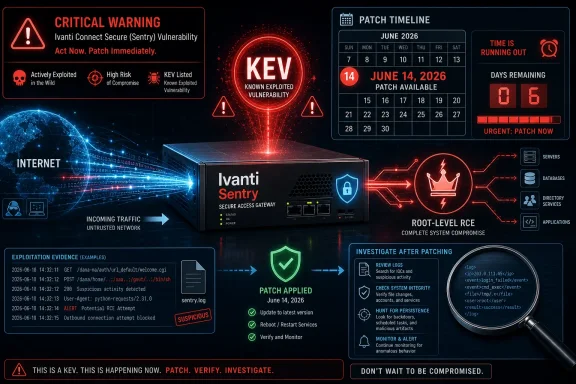
CISA on June 11, 2026 added CVE-2026-10520, a critical Ivanti Sentry OS command injection flaw enabling unauthenticated root-level remote code execution, to its Known Exploited Vulnerabilities catalog after evidence showed the bug is being actively exploited against exposed systems. The move turns another Ivanti appliance flaw from “urgent vendor advisory” into a federal remediation priority. For WindowsForum readers, the lesson is not merely that one more edge device needs patching; it is that the modern enterprise perimeter keeps failing in the same place, at the intersection of remote management, identity plumbing, and appliances assumed to be boring enough to trust. CISA’s new risk-based directive makes that assumption harder to defend.
There is a deceptive modesty to CISA’s alert: one vulnerability, one catalog entry, one product family. In a different era, that might have looked like a routine patching note. In 2026, a known-exploited flaw in an internet-facing security appliance is closer to a fire alarm than a calendar reminder.
CVE-2026-10520 affects Ivanti Sentry versions before R10.5.2, R10.6.2, and R10.7.1. The vulnerability is classified as OS command injection, the kind of bug that lets attacker-controlled input cross the membrane between application logic and the underlying operating system. In this case, the reported impact is remote unauthenticated execution as root, which is about as little ambiguity as vulnerability management ever gets.
That phrase — remote unauthenticated root-level remote code execution — should flatten most prioritization debates. No stolen password is required, no phishing click is necessary, and no low-privilege foothold needs to be chained into a later escalation. If a vulnerable Sentry appliance is reachable by an attacker, the device itself may become the initial access vector.
CISA’s addition of the flaw to the Known Exploited Vulnerabilities catalog means the agency has evidence of exploitation in the wild. The catalog is not a prediction market for scary CVSS scores. It is CISA’s list of vulnerabilities that attackers are already using, which is why a KEV entry should carry more operational weight than a theoretical severity rating alone.
Attackers have learned to value that connective tissue. Edge appliances and access brokers often sit close to authentication flows, certificate handling, mobile device management, VPN-adjacent traffic, and administrative interfaces. They may not be domain controllers, but compromising one can hand an intruder a privileged vantage point over the traffic and trust relationships that enterprises rely on every day.
That is why command injection on a gateway product has a different feel from command injection buried in a line-of-business application available only on an internal subnet. A vulnerable perimeter system is not merely one host among many. It is often the first host an attacker can touch and the last host administrators remember to monitor with the same fidelity they apply to Windows servers and endpoints.
The harsh truth for defenders is that appliances have historically benefited from an aura of containment. They arrive as hardened boxes or virtual appliances, run vendor-controlled software stacks, and discourage tinkering. That same packaging can make them opaque in incident response: fewer familiar logs, fewer EDR hooks, fewer standard rebuild procedures, and a patching process that may feel more delicate than updating a Windows cumulative patch.
But CVSS alone has never been enough. Security teams have spent years drowning in “critical” vulnerabilities that are technically severe but practically unreachable, mitigated by architecture, or irrelevant to their environment. The KEV designation matters because it cuts through that noise with one decisive fact: exploitation is not hypothetical.
This is the central shift behind CISA’s newer vulnerability management posture. The old ritual of ranking by severity score and patching by spreadsheet has been losing credibility for years. Attackers do not sort their exploit queues by CVSS in isolation; they sort by exposure, reliability, privilege, usefulness, and the likelihood that defenders will be slow.
A CVSS 10 on an exposed access appliance is therefore not just a bad score. It is an alignment of incentives. The vendor says the bug is catastrophic, CISA says exploitation is active, public analysis and proof-of-concept activity appear to have accelerated attention, and the affected product sits in a category attackers repeatedly target.
That is a meaningful correction. The original KEV regime helped agencies stop treating vulnerability management as a purely vendor-driven patch cycle. BOD 26-04 goes further by making risk context operational: whether an asset is publicly exposed, whether exploitation grants total control, and whether defenders must investigate compromise before declaring the patching job done.
For Federal Civilian Executive Branch agencies, the due date attached to this entry is June 14, 2026. That is an unusually compressed window in practical terms, especially for appliances that may require maintenance windows, backups, upgrade validation, and rollback planning. CISA is implicitly saying that when active exploitation meets root-level control on an exposed system, the normal tempo is not good enough.
Private organizations are not legally bound by BOD 26-04. They should still treat the directive as a preview of what good security governance increasingly looks like. Regulators, insurers, boards, and customers are all moving toward the same expectation: if a vulnerability is known exploited and gives attackers control of an exposed system, “we planned to patch next month” is not a mature answer.
For IT teams, three days is not a comfortable patch window. It collides with change-control boards, weekend staffing, dependency testing, and the operational fear of breaking a security gateway that users depend on. Yet those frictions are precisely why attackers like this class of target. The harder a system is to patch quickly, the longer a reliable exploit remains valuable.
This is where executive leadership often misunderstands vulnerability response. The question is not whether the patch might cause disruption. The question is whether leaving a root-level, unauthenticated, actively exploited flaw in place is a safer form of disruption. In most environments, that trade is indefensible.
The better discussion is about preparedness. Organizations that can patch an appliance class in three days are not lucky; they have asset inventories, staging environments, vendor support paths, backup configurations, emergency change procedures, and incident response playbooks already in place. Organizations that cannot do it discover during the emergency that vulnerability management is really a test of operations.
That changes the operational burden. A patched appliance may still be untrustworthy if attackers obtained root, modified files, created persistence, harvested credentials, tampered with configurations, or used the device as a pivot point. The more privileged and network-adjacent the product, the less satisfying a simple version check becomes.
This is uncomfortable for many Windows-centric teams because the best tooling is often concentrated on endpoints and servers, not sealed appliances. A domain-joined Windows Server with Defender for Endpoint, Sysmon, centralized logs, and EDR telemetry is relatively visible. A hardened gateway appliance may offer logs, but not always in the places or formats defenders are used to searching.
The practical response is to treat vulnerable exposed Sentry appliances as potentially compromised until evidence says otherwise. That means preserving logs, reviewing administrative account changes, checking configuration integrity, looking for unexpected outbound connections, rotating credentials or certificates if exposure suggests theft, and watching downstream systems for suspicious authentication or access patterns.
The industry has placed immense trust in edge and management appliances while giving them too little observability and too much implied permanence. VPN concentrators, secure access gateways, mobile management platforms, file transfer systems, and remote management products have become favored targets because they are valuable, exposed, and often difficult to instrument. Attackers understand enterprise architecture well enough to aim for the seams.
Ivanti Sentry fits that pattern. It is not merely software with a bug; it is software in a strategically sensitive location. When a command injection vulnerability lands there, the attacker’s reward is not just code execution on one box. It may be a foothold near identity, mobile access, mail flows, or internal application paths.
This is why the vendor-specific view can become a trap. Replacing one appliance with another does not solve the underlying architectural issue if the replacement remains internet-facing, privileged, weakly monitored, and slow to patch. The market has to get better at secure-by-design appliances, but customers also have to stop treating these systems as maintenance-free trust anchors.
Once attackers land on an edge device, the next steps frequently involve credentials and trust relationships that eventually touch Windows. They may capture authentication material, enumerate internal services, probe Exchange or Microsoft 365 integrations, pivot toward domain-joined systems, or use the appliance as a staging point that blends into expected traffic. The initial exploit may not involve Windows at all; the consequences often do.
This is especially relevant in hybrid environments. Mobile access, conditional access, certificate-based authentication, and mail connectivity can create complex dependencies between non-Windows infrastructure and Microsoft identity systems. A compromised gateway may not be a domain admin, but it may sit close enough to privileged paths to matter.
For administrators, the lesson is to expand the definition of a Windows security perimeter. If a device brokers access to Windows resources, authenticates users who later touch Windows resources, or routes traffic into Windows workloads, it belongs in the security conversation. Asset ownership silos do not protect the domain.
Security researchers often publish technical analysis to force transparency, help defenders validate exposure, and demonstrate impact. That work can be valuable. It can also hand attackers a map, particularly when the affected product is internet-facing and the vulnerability requires no authentication.
The uncomfortable reality is that modern vulnerability response now operates on internet time. Once a severe appliance flaw is disclosed and technical details circulate, scanning can begin within hours. Exploit attempts may follow shortly after, and compromised devices may become part of larger intrusion campaigns before slower organizations finish reading the advisory.
That dynamic favors defenders who have already answered boring questions. Where are our Sentry appliances? Which versions are they running? Are they publicly reachable? Who owns the upgrade? How do we back them up? Where are the logs? What credentials or certificates would we rotate if compromise were suspected? During a KEV emergency, every unanswered inventory question becomes an attacker’s advantage.
That does not mean internal-only systems can be ignored. Internal exposure still matters if an attacker already has a foothold, and appliances often have management paths or network positions that make lateral movement easier. But CISA’s BOD 26-04 framing correctly puts publicly exposed, total-control vulnerabilities at the front of the line.
The upgrade targets are straightforward: move to the fixed releases identified by Ivanti for the affected branches. Where patching is impossible, organizations should follow vendor mitigations if available or remove the product from exposure until a safe path exists. “Compensating controls” should not become a euphemism for wishful thinking when unauthenticated root execution is in play.
After patching, the work should shift to validation and investigation. Confirm the version, preserve relevant logs, inspect for suspicious administrative activity, review network connections, and consider credential rotation if the appliance’s role gives attackers access to secrets. This is not bureaucracy; it is the difference between vulnerability management and incident response.
That sounds obvious, but it is a departure from years of compliance theater. Many organizations still run patch programs that optimize for report cleanliness rather than risk reduction. They chase thousands of medium findings, negotiate SLA exceptions, and produce dashboards that look disciplined while the most dangerous exposed systems remain in limbo.
A KEV-driven model is not perfect. It depends on timely exploitation evidence, accurate asset visibility, vendor clarity, and the ability to distinguish internet exposure from theoretical reachability. It can also underweight vulnerabilities that are not yet observed in the wild but are obviously attractive. Still, it is closer to the attacker’s reality than treating every CVSS bucket as a queue.
For federal agencies, the directive adds teeth. For private companies, it adds a benchmark. When CISA says an actively exploited, exposed, total-control vulnerability deserves rapid remediation and forensic triage, security leaders outside government should expect auditors and boards to ask why their own process is slower.
Security appliances deserve at least the same scrutiny as servers. They need owners, inventories, maintenance windows, emergency patch paths, log forwarding, backup and restore drills, and decommissioning plans. If a gateway product cannot be monitored or patched at the speed modern exploitation demands, that limitation should influence procurement as much as feature checkboxes do.
Vendors also need to recognize that root-level unauthenticated RCE on edge products is not just another CVE in a quarterly advisory. It is a trust event. Customers increasingly judge suppliers not only by the presence of bugs, but by the speed of disclosure, clarity of remediation guidance, quality of forensic advice, and history of repeated high-impact flaws.
The strongest long-term answer may be architectural humility. Assume edge appliances can fail. Segment what they can reach, minimize secrets they hold, rotate credentials with compromise scenarios in mind, and design monitoring around the idea that a security device can become an attacker-controlled device.
 CISA’s New Entry Is Small, but the Blast Radius Is Not
There is a deceptive modesty to CISA’s alert: one vulnerability, one catalog entry, one product family. In a different era, that might have looked like a routine patching note. In 2026, a known-exploited flaw in an internet-facing security appliance is closer to a fire alarm than a calendar reminder.CVE-2026-10520 affects Ivanti Sentry versions before R10.5.2, R10.6.2, and R10.7.1. The vulnerability is classified as OS command injection, the kind of bug that lets attacker-controlled input cross the membrane between application logic and the underlying operating system. In this case, the reported impact is remote unauthenticated execution as root, which is about as little ambiguity as vulnerability management ever gets.
That phrase — remote unauthenticated root-level remote code execution — should flatten most prioritization debates. No stolen password is required, no phishing click is necessary, and no low-privilege foothold needs to be chained into a later escalation. If a vulnerable Sentry appliance is reachable by an attacker, the device itself may become the initial access vector.
CISA’s addition of the flaw to the Known Exploited Vulnerabilities catalog means the agency has evidence of exploitation in the wild. The catalog is not a prediction market for scary CVSS scores. It is CISA’s list of vulnerabilities that attackers are already using, which is why a KEV entry should carry more operational weight than a theoretical severity rating alone.
Ivanti Sentry Sits Exactly Where Attackers Want to Be
Ivanti Sentry, formerly associated with the MobileIron ecosystem, is not a random desktop application hiding in a software inventory report. It is a gateway product used to help secure and broker mobile access to enterprise resources. That makes it part of the connective tissue between users, devices, mail, apps, and internal services.Attackers have learned to value that connective tissue. Edge appliances and access brokers often sit close to authentication flows, certificate handling, mobile device management, VPN-adjacent traffic, and administrative interfaces. They may not be domain controllers, but compromising one can hand an intruder a privileged vantage point over the traffic and trust relationships that enterprises rely on every day.
That is why command injection on a gateway product has a different feel from command injection buried in a line-of-business application available only on an internal subnet. A vulnerable perimeter system is not merely one host among many. It is often the first host an attacker can touch and the last host administrators remember to monitor with the same fidelity they apply to Windows servers and endpoints.
The harsh truth for defenders is that appliances have historically benefited from an aura of containment. They arrive as hardened boxes or virtual appliances, run vendor-controlled software stacks, and discourage tinkering. That same packaging can make them opaque in incident response: fewer familiar logs, fewer EDR hooks, fewer standard rebuild procedures, and a patching process that may feel more delicate than updating a Windows cumulative patch.
The CVSS 10 Score Is Not the Whole Argument
CVE-2026-10520 carries a CVSS 3.1 score of 10.0 from Ivanti, the maximum possible rating. That score reflects a network-reachable, low-complexity attack requiring no privileges and no user interaction, with high impact to confidentiality, integrity, and availability. In plain English, the scoring system says the attacker gets everything.But CVSS alone has never been enough. Security teams have spent years drowning in “critical” vulnerabilities that are technically severe but practically unreachable, mitigated by architecture, or irrelevant to their environment. The KEV designation matters because it cuts through that noise with one decisive fact: exploitation is not hypothetical.
This is the central shift behind CISA’s newer vulnerability management posture. The old ritual of ranking by severity score and patching by spreadsheet has been losing credibility for years. Attackers do not sort their exploit queues by CVSS in isolation; they sort by exposure, reliability, privilege, usefulness, and the likelihood that defenders will be slow.
A CVSS 10 on an exposed access appliance is therefore not just a bad score. It is an alignment of incentives. The vendor says the bug is catastrophic, CISA says exploitation is active, public analysis and proof-of-concept activity appear to have accelerated attention, and the affected product sits in a category attackers repeatedly target.
BOD 26-04 Makes Exploitation the Center of Gravity
The CISA alert also points to Binding Operational Directive 26-04, “Prioritizing Security Updates Based on Risk,” which updates the federal playbook that began with BOD 22-01. The important change is not that the KEV catalog matters; it already did. The important change is that federal remediation is being tied more explicitly to asset exposure, exploitability, and post-exploitation control.That is a meaningful correction. The original KEV regime helped agencies stop treating vulnerability management as a purely vendor-driven patch cycle. BOD 26-04 goes further by making risk context operational: whether an asset is publicly exposed, whether exploitation grants total control, and whether defenders must investigate compromise before declaring the patching job done.
For Federal Civilian Executive Branch agencies, the due date attached to this entry is June 14, 2026. That is an unusually compressed window in practical terms, especially for appliances that may require maintenance windows, backups, upgrade validation, and rollback planning. CISA is implicitly saying that when active exploitation meets root-level control on an exposed system, the normal tempo is not good enough.
Private organizations are not legally bound by BOD 26-04. They should still treat the directive as a preview of what good security governance increasingly looks like. Regulators, insurers, boards, and customers are all moving toward the same expectation: if a vulnerability is known exploited and gives attackers control of an exposed system, “we planned to patch next month” is not a mature answer.
The Three-Day Deadline Is a Message to the Market
CISA’s catalog entry lists a June 11 addition date and a June 14 due date for covered agencies. That timing matters. It signals that the federal government is no longer content to use the KEV catalog merely as a warning label; it is using it as a scheduling mechanism for emergency work.For IT teams, three days is not a comfortable patch window. It collides with change-control boards, weekend staffing, dependency testing, and the operational fear of breaking a security gateway that users depend on. Yet those frictions are precisely why attackers like this class of target. The harder a system is to patch quickly, the longer a reliable exploit remains valuable.
This is where executive leadership often misunderstands vulnerability response. The question is not whether the patch might cause disruption. The question is whether leaving a root-level, unauthenticated, actively exploited flaw in place is a safer form of disruption. In most environments, that trade is indefensible.
The better discussion is about preparedness. Organizations that can patch an appliance class in three days are not lucky; they have asset inventories, staging environments, vendor support paths, backup configurations, emergency change procedures, and incident response playbooks already in place. Organizations that cannot do it discover during the emergency that vulnerability management is really a test of operations.
Patch Management Is No Longer Enough by Itself
CISA’s language about checking whether threat actors compromised a system before the patch was applied is one of the most important parts of the alert. For a vulnerability like CVE-2026-10520, remediation cannot stop at installing R10.5.2, R10.6.2, or R10.7.1. If the system was exposed before patching, defenders need to ask whether they are closing the door after someone has already walked through it.That changes the operational burden. A patched appliance may still be untrustworthy if attackers obtained root, modified files, created persistence, harvested credentials, tampered with configurations, or used the device as a pivot point. The more privileged and network-adjacent the product, the less satisfying a simple version check becomes.
This is uncomfortable for many Windows-centric teams because the best tooling is often concentrated on endpoints and servers, not sealed appliances. A domain-joined Windows Server with Defender for Endpoint, Sysmon, centralized logs, and EDR telemetry is relatively visible. A hardened gateway appliance may offer logs, but not always in the places or formats defenders are used to searching.
The practical response is to treat vulnerable exposed Sentry appliances as potentially compromised until evidence says otherwise. That means preserving logs, reviewing administrative account changes, checking configuration integrity, looking for unexpected outbound connections, rotating credentials or certificates if exposure suggests theft, and watching downstream systems for suspicious authentication or access patterns.
Ivanti’s Repeated Appliance Problem Is Now a Category Problem
It would be easy to turn every Ivanti KEV entry into a story about one vendor’s quality-control problem. Ivanti has certainly had a rough run across several product lines in recent years, and security teams have reason to scrutinize its appliances with unusual seriousness. But the broader lesson is larger than Ivanti.The industry has placed immense trust in edge and management appliances while giving them too little observability and too much implied permanence. VPN concentrators, secure access gateways, mobile management platforms, file transfer systems, and remote management products have become favored targets because they are valuable, exposed, and often difficult to instrument. Attackers understand enterprise architecture well enough to aim for the seams.
Ivanti Sentry fits that pattern. It is not merely software with a bug; it is software in a strategically sensitive location. When a command injection vulnerability lands there, the attacker’s reward is not just code execution on one box. It may be a foothold near identity, mobile access, mail flows, or internal application paths.
This is why the vendor-specific view can become a trap. Replacing one appliance with another does not solve the underlying architectural issue if the replacement remains internet-facing, privileged, weakly monitored, and slow to patch. The market has to get better at secure-by-design appliances, but customers also have to stop treating these systems as maintenance-free trust anchors.
Windows Shops Should Not Ignore a Non-Windows Appliance
WindowsForum readers may reasonably ask why an Ivanti Sentry vulnerability belongs in the same mental inbox as Patch Tuesday, Defender updates, Active Directory hardening, and Windows Server lifecycle planning. The answer is that Windows environments are rarely Windows-only environments. The compromise path into a Microsoft estate often begins on a Linux-based appliance, a Java management console, a VPN gateway, or a mobile access broker.Once attackers land on an edge device, the next steps frequently involve credentials and trust relationships that eventually touch Windows. They may capture authentication material, enumerate internal services, probe Exchange or Microsoft 365 integrations, pivot toward domain-joined systems, or use the appliance as a staging point that blends into expected traffic. The initial exploit may not involve Windows at all; the consequences often do.
This is especially relevant in hybrid environments. Mobile access, conditional access, certificate-based authentication, and mail connectivity can create complex dependencies between non-Windows infrastructure and Microsoft identity systems. A compromised gateway may not be a domain admin, but it may sit close enough to privileged paths to matter.
For administrators, the lesson is to expand the definition of a Windows security perimeter. If a device brokers access to Windows resources, authenticates users who later touch Windows resources, or routes traffic into Windows workloads, it belongs in the security conversation. Asset ownership silos do not protect the domain.
Public Proof-of-Concept Code Compresses the Defender’s Timeline
NVD’s references include public research and exploit material associated with CVE-2026-10520. That does not automatically mean every script kiddie has a turnkey intrusion kit, nor does it prove that all exploitation observed by CISA relies on public code. It does mean the time between disclosure, replication, scanning, and opportunistic exploitation can shrink dramatically.Security researchers often publish technical analysis to force transparency, help defenders validate exposure, and demonstrate impact. That work can be valuable. It can also hand attackers a map, particularly when the affected product is internet-facing and the vulnerability requires no authentication.
The uncomfortable reality is that modern vulnerability response now operates on internet time. Once a severe appliance flaw is disclosed and technical details circulate, scanning can begin within hours. Exploit attempts may follow shortly after, and compromised devices may become part of larger intrusion campaigns before slower organizations finish reading the advisory.
That dynamic favors defenders who have already answered boring questions. Where are our Sentry appliances? Which versions are they running? Are they publicly reachable? Who owns the upgrade? How do we back them up? Where are the logs? What credentials or certificates would we rotate if compromise were suspected? During a KEV emergency, every unanswered inventory question becomes an attacker’s advantage.
The Right Response Starts with Exposure, Not Panic
The first operational move is not panic-patching blindly. It is exposure triage. An organization should identify every Ivanti Sentry instance, determine its version, confirm whether it is reachable from the internet or untrusted networks, and prioritize upgrades for systems that match the vulnerable version ranges.That does not mean internal-only systems can be ignored. Internal exposure still matters if an attacker already has a foothold, and appliances often have management paths or network positions that make lateral movement easier. But CISA’s BOD 26-04 framing correctly puts publicly exposed, total-control vulnerabilities at the front of the line.
The upgrade targets are straightforward: move to the fixed releases identified by Ivanti for the affected branches. Where patching is impossible, organizations should follow vendor mitigations if available or remove the product from exposure until a safe path exists. “Compensating controls” should not become a euphemism for wishful thinking when unauthenticated root execution is in play.
After patching, the work should shift to validation and investigation. Confirm the version, preserve relevant logs, inspect for suspicious administrative activity, review network connections, and consider credential rotation if the appliance’s role gives attackers access to secrets. This is not bureaucracy; it is the difference between vulnerability management and incident response.
CISA Is Teaching Agencies to Patch Like Attackers Prioritize
The most interesting part of this episode is not the CVE itself. It is the way CISA is continuing to reshape federal vulnerability management around adversary behavior. Attackers prioritize exposed systems that give them high control with low effort; BOD 26-04 tells agencies to do the same in reverse.That sounds obvious, but it is a departure from years of compliance theater. Many organizations still run patch programs that optimize for report cleanliness rather than risk reduction. They chase thousands of medium findings, negotiate SLA exceptions, and produce dashboards that look disciplined while the most dangerous exposed systems remain in limbo.
A KEV-driven model is not perfect. It depends on timely exploitation evidence, accurate asset visibility, vendor clarity, and the ability to distinguish internet exposure from theoretical reachability. It can also underweight vulnerabilities that are not yet observed in the wild but are obviously attractive. Still, it is closer to the attacker’s reality than treating every CVSS bucket as a queue.
For federal agencies, the directive adds teeth. For private companies, it adds a benchmark. When CISA says an actively exploited, exposed, total-control vulnerability deserves rapid remediation and forensic triage, security leaders outside government should expect auditors and boards to ask why their own process is slower.
The Appliance Era Needs a New Trust Model
The industry’s appliance problem is partly technical and partly cultural. Technically, these systems need better isolation, safer update mechanisms, stronger default configurations, richer logging, and architectures that reduce the blast radius of a single injection flaw. Culturally, customers need to stop assuming that a product sold as a security control is automatically a secure control.Security appliances deserve at least the same scrutiny as servers. They need owners, inventories, maintenance windows, emergency patch paths, log forwarding, backup and restore drills, and decommissioning plans. If a gateway product cannot be monitored or patched at the speed modern exploitation demands, that limitation should influence procurement as much as feature checkboxes do.
Vendors also need to recognize that root-level unauthenticated RCE on edge products is not just another CVE in a quarterly advisory. It is a trust event. Customers increasingly judge suppliers not only by the presence of bugs, but by the speed of disclosure, clarity of remediation guidance, quality of forensic advice, and history of repeated high-impact flaws.
The strongest long-term answer may be architectural humility. Assume edge appliances can fail. Segment what they can reach, minimize secrets they hold, rotate credentials with compromise scenarios in mind, and design monitoring around the idea that a security device can become an attacker-controlled device.
The Ivanti Entry Turns KEV From Dashboard Noise Into Weekend Work
The practical meaning of CISA’s June 11 addition is simple: this is not a vulnerability to leave in the next routine patch cycle. The combination of active exploitation, unauthenticated access, root-level execution, and an edge security product makes CVE-2026-10520 the sort of flaw that should interrupt normal plans.- Organizations running Ivanti Sentry should identify all instances and confirm whether they are on R10.5.2, R10.6.2, R10.7.1, or later fixed releases.
- Publicly exposed vulnerable appliances should be treated as the highest priority because the attack path does not require credentials or user interaction.
- Patching should be followed by compromise assessment, not treated as proof that no intrusion occurred before the update.
- Windows administrators should include non-Windows gateways in their threat model when those systems broker access to Microsoft identity, mail, or internal application resources.
- CISA’s BOD 26-04 approach is a sign that vulnerability management is moving away from generic severity queues and toward exploitation-aware operational deadlines.
References
- Primary source: CISA
Published: 2026-06-11T12:00:00+00:00
- Related coverage: nucleussec.com
What is CISA BOD 26-04? Prioritizing Security Updates Based on Risk
CISA BOD 26-04 directs federal agencies to prioritize vulnerability remediation based on exposure, exploitability, system control, and known exploitation. Learn what the directive requires and how it impacts agency vulnerability management.nucleussec.com - Related coverage: minimus.io
Understanding CISA BOD 26-04 - Minimus
CISA BOD 26-04 shifts vulnerability management toward risk-based prioritization. Here's what changed and what it means in practice.www.minimus.io - Related coverage: vulncheck.com
Helping Federal Agencies Meet CISA’s Accelerated Remediation Timelines outlined in CISA BOD 26-04 | Blog | VulnCheck
VulnCheck provides automated SSVC decisions for federal and enterprise agencies to help address CISA BOD 26-04.www.vulncheck.com - Related coverage: vulnerability.circl.lu
Vulnerability-Lookup
Vulnerability-Lookup - Fast vulnerability lookup correlation from different sources.vulnerability.circl.lu - Related coverage: techradar.com
CISA puts US government agencies on two-week deadline to patch Microsoft Defender BlueHammer zero-day exploit | TechRadar
BlueHammer was disclosed in early April by a disgruntled researcherwww.techradar.com

- Related coverage: caloes.ca.gov
