

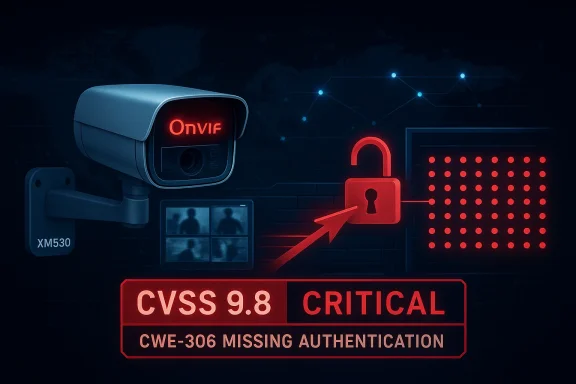
The latest CISA ICS advisory on the Hangzhou Xiongmai Technology Co., Ltd. XM530 IP Camera describes a severe authentication bypass that could let an unauthenticated attacker reach sensitive device information and live video streams. CISA says the affected firmware is V5.00.R02.000807D8.10010.346624.S.ONVIF_21.06, and it rates the issue CVSS 3.1 9.8 critical under CWE-306 Missing Authentication for Critical Function. The agency also notes that Xiongmai has not responded to requests to work with CISA on mitigation, while recommending classic exposure-reduction steps such as keeping control devices off the internet and behind firewalls.
This advisory matters because it is not describing a speculative weakness or a theoretical lab finding. It is describing a real, vendor-specific product failure in a widely deployed device class: IP cameras that often sit at the intersection of physical security, IT, and remote monitoring. In practical terms, those devices are trusted to see into spaces people assume are private, and that makes unauthorized access especially sensitive. The fact that CISA has issued an ICS advisory for it tells defenders to treat this as an operational risk, not just a software bug.
The vulnerability is framed as an authentication bypass in the device’s ONVIF implementation, which failed to enforce authentication on 31 critical endpoints. That detail is important because it suggests the weakness is not isolated to a single page or function; it likely affects a broad portion of the camera’s management and streaming surface. When an embedded device exposes that many unauthenticated endpoints, the problem stops being a one-off defect and becomes a trust-model failure.
CISA’s summary also points to the likely impact: remote attackers could access sensitive information, including live video streams, without authorization. That is the kind of exposure that can create downstream consequences well beyond privacy concerns. In many deployments, camera feeds are used for physical security, safety validation, compliance, or incident response, so unauthorized viewing can become a stepping stone to surveillance, reconnaissance, or operational intelligence gathering.
Another notable detail is the absence of a vendor-led mitigation path in the advisory. CISA says the vendor has not responded to requests to collaborate on mitigation, which leaves defenders with a narrower set of practical options. That typically shifts the burden onto network controls, device isolation, and inventory validation until a vendor fix or more formal guidance appears.
The advisory’s CVSS 9.8 rating reinforces that point. A score that high usually reflects a network-reachable, low-complexity, no-privileges-required issue with severe confidentiality impact. In other words, the likely abuse path is simple enough that defenders should assume opportunistic scanning and exploitation attempts are plausible if the product is reachable.
The advisory’s summary says successful exploitation could let an attacker bypass authentication and gain remote access to sensitive information on the device. The vulnerability entry expands on that by stating that the ONVIF implementation fails to enforce authentication on 31 critical endpoints, enabling direct unauthorized access to live video streams. That combination makes the issue much broader than a simple login bug: it is a loss of access control on the device’s core operational surface.
CISA assigned the issue a vendor-equipment severity of 9.8 critical and tied it to CWE-306 Missing Authentication for Critical Function. That classification is useful because it signals the underlying flaw category to defenders who need to think in terms of architectural exposure, not just patch deployment. In a device class like an IP camera, missing authentication on critical functions can map directly to viewing feeds, pulling metadata, changing configuration, or abusing management actions.
The advisory also says no known public exploitation has been reported to CISA at this time. That is a helpful window for defenders, but it should not be mistaken for safety. In practice, critical unauthenticated issues in internet-reachable devices often move from advisory status to active probing quickly once details become public.
In practical terms, that leaves three immediate levers: reduce exposure, segment the cameras, and verify whether the vulnerable firmware is deployed anywhere. For organizations with large camera fleets, those steps are usually more labor-intensive than applying a patch, because they require asset discovery, access-path review, and often coordination with physical security or facilities teams.
The CISA wording about 31 critical endpoints suggests the problem is not a single forgotten admin page. It implies that several functions within the camera’s ONVIF exposure may be callable without proper identity checks. That is the sort of design failure that can turn a small oversight into a platform-level compromise, because one unauthenticated route may expose enough internal functionality to reveal secrets, state, or live surveillance data.
This is a familiar pattern in embedded security: the feature that makes the product easy to deploy is also the feature that broadens its attack surface. In a camera, that can mean management convenience for installers and integrators, but it can also mean a wider set of network-callable functions that must be defended correctly. That tradeoff is not theoretical; the advisory is a live example of what happens when it goes wrong.
In an enterprise setting, a vulnerable camera can be more than a privacy problem. It can become a reconnaissance tool, a pivot point for network mapping, or a source of intelligence about building access patterns, security staffing, delivery schedules, and restricted areas. If the device is reachable from internal networks or remote viewing portals, the practical risk expands from observation to possible lateral movement and operational awareness.
The advisory also underscores the importance of inventory discipline. If you cannot identify which sites have XM530 cameras, which integrators deployed them, or whether they are connected to centralized monitoring, you cannot assess exposure accurately. That is the recurring lesson with embedded systems: security often begins with knowing what is actually on the network, not with the patch itself.
The advisory’s language about unauthorized access to live video streams is particularly concerning. Live video is not just passive imagery; it can disclose movement, occupancy, security posture, delivery timing, and even internal procedures. In some environments, access to camera streams is enough to support burglary planning, insider misuse, or targeted physical intrusion.
That makes the finding more severe than a leaked banner or a minor metadata exposure. It looks more like a complete breakdown in the access-control layer. In security terms, the difference between “information disclosure” and “unauthorized control path” is enormous, because the latter can enable deeper exploitation chains if the endpoint also reveals credentials, network details, or firmware state.
The second task is to identify exposure. If the cameras are reachable from the internet, or if management and streaming services are reachable from broad internal networks, the risk increases materially. CISA’s recommended defensive measures are aligned with that reality: minimize exposure, place systems behind firewalls, and isolate control networks from normal business traffic.
A sane response plan would typically include the following sequence:
It also reinforces a long-standing divide between consumer expectations and enterprise expectations. Consumers tend to assume “camera works” is the whole product story. Enterprises, by contrast, need lifecycle support, firmware transparency, segmentation compatibility, and clear vendor engagement when serious vulnerabilities surface. The XM530 advisory highlights how quickly those expectations can diverge when a critical flaw appears.
This is where vendor risk management becomes real. A camera is not just a lens and a sensor; it is a networked computing device with firmware, services, and trust dependencies. When those dependencies are broken, the downstream user is left with a device that may still function physically while failing digitally in ways that matter most.
It also creates an opportunity to improve camera governance more broadly. Many organizations still treat surveillance devices as isolated appliances, but the XM530 advisory is a reminder that they belong in the same security conversation as other networked endpoints. The response can therefore become a catalyst for better inventory, stronger segmentation, and more disciplined remote access.
A second concern is remediation delay. Camera fleets are often scattered, managed by multiple teams, and embedded in business processes that cannot easily tolerate downtime. That means even when the risk is obvious, the fix may be slow, which creates a window for misuse or exploitation. In security terms, delay is itself a vulnerability amplifier.
It will also be worth watching whether downstream integrators and camera-management platforms issue their own guidance. In real-world deployments, many organizations do not interact with the camera vendor directly; they interact with installers, MSPs, or video-management software providers. If those partners do not translate the advisory into practical remediation steps, the vulnerability may persist in the field longer than expected.
Source: CISA Hangzhou Xiongmai Technology Co., Ltd XM530 IP Camera | CISA
 Overview
This advisory matters because it is not describing a speculative weakness or a theoretical lab finding. It is describing a real, vendor-specific product failure in a widely deployed device class: IP cameras that often sit at the intersection of physical security, IT, and remote monitoring. In practical terms, those devices are trusted to see into spaces people assume are private, and that makes unauthorized access especially sensitive. The fact that CISA has issued an ICS advisory for it tells defenders to treat this as an operational risk, not just a software bug.The vulnerability is framed as an authentication bypass in the device’s ONVIF implementation, which failed to enforce authentication on 31 critical endpoints. That detail is important because it suggests the weakness is not isolated to a single page or function; it likely affects a broad portion of the camera’s management and streaming surface. When an embedded device exposes that many unauthenticated endpoints, the problem stops being a one-off defect and becomes a trust-model failure.
CISA’s summary also points to the likely impact: remote attackers could access sensitive information, including live video streams, without authorization. That is the kind of exposure that can create downstream consequences well beyond privacy concerns. In many deployments, camera feeds are used for physical security, safety validation, compliance, or incident response, so unauthorized viewing can become a stepping stone to surveillance, reconnaissance, or operational intelligence gathering.
Another notable detail is the absence of a vendor-led mitigation path in the advisory. CISA says the vendor has not responded to requests to collaborate on mitigation, which leaves defenders with a narrower set of practical options. That typically shifts the burden onto network controls, device isolation, and inventory validation until a vendor fix or more formal guidance appears.
Why this class of flaw is so dangerous
Authentication failures in cameras are especially serious because cameras are often deployed to be reachable from multiple networks. They may be used by security teams, facilities staff, integrators, or remote-support providers, which means the attack surface can include exposed web interfaces, ONVIF services, and vendor tools. If authentication is missing or incomplete on critical functions, an attacker does not need to crack the system in the traditional sense; they only need to find the path the device forgot to protect.The advisory’s CVSS 9.8 rating reinforces that point. A score that high usually reflects a network-reachable, low-complexity, no-privileges-required issue with severe confidentiality impact. In other words, the likely abuse path is simple enough that defenders should assume opportunistic scanning and exploitation attempts are plausible if the product is reachable.
- The flaw is unauthenticated and remote.
- The vulnerable interface appears to be the camera’s ONVIF stack.
- The exposure includes live video and other sensitive device data.
- The issue is rated critical and deserves emergency triage.
- The vendor has not yet engaged with CISA on mitigation.
What CISA Disclosed
CISA’s advisory is direct about the affected product family and firmware. The impacted device is the Hangzhou Xiongmai Technology Co., Ltd XM530 IP Camera, specifically XM530V200_X6-WEQ_8M firmware V5.00.R02.000807D8.10010.346624.S.ONVIF_21.06. That precision matters because embedded camera fleets can be fragmented across revisions, rebrands, and integrator-specific builds, making version matching the first step in response.The advisory’s summary says successful exploitation could let an attacker bypass authentication and gain remote access to sensitive information on the device. The vulnerability entry expands on that by stating that the ONVIF implementation fails to enforce authentication on 31 critical endpoints, enabling direct unauthorized access to live video streams. That combination makes the issue much broader than a simple login bug: it is a loss of access control on the device’s core operational surface.
CISA assigned the issue a vendor-equipment severity of 9.8 critical and tied it to CWE-306 Missing Authentication for Critical Function. That classification is useful because it signals the underlying flaw category to defenders who need to think in terms of architectural exposure, not just patch deployment. In a device class like an IP camera, missing authentication on critical functions can map directly to viewing feeds, pulling metadata, changing configuration, or abusing management actions.
The advisory also says no known public exploitation has been reported to CISA at this time. That is a helpful window for defenders, but it should not be mistaken for safety. In practice, critical unauthenticated issues in internet-reachable devices often move from advisory status to active probing quickly once details become public.
The vendor response gap
The most operationally important line in the disclosure may be the one about vendor engagement. CISA says Xiongmai has not responded to requests to work with the agency on mitigation. That does not prove a lack of internal remediation work, but it does mean defenders cannot rely on a coordinated response timeline from the vendor itself.In practical terms, that leaves three immediate levers: reduce exposure, segment the cameras, and verify whether the vulnerable firmware is deployed anywhere. For organizations with large camera fleets, those steps are usually more labor-intensive than applying a patch, because they require asset discovery, access-path review, and often coordination with physical security or facilities teams.
- Confirm whether the affected firmware is present.
- Reduce or eliminate direct internet exposure.
- Restrict camera access to necessary management networks only.
- Review ONVIF reachability and related service exposure.
- Escalate if the device is used in a sensitive physical-security context.
Why ONVIF Matters
ONVIF is important because it is the interoperability layer that makes many cameras and video systems usable across vendors. That convenience is a big reason IP cameras are so widely deployed, but it also means weaknesses in ONVIF implementations can have outsize impact. If authentication is missing at the service boundary, then a common interoperability feature becomes a common attack path.The CISA wording about 31 critical endpoints suggests the problem is not a single forgotten admin page. It implies that several functions within the camera’s ONVIF exposure may be callable without proper identity checks. That is the sort of design failure that can turn a small oversight into a platform-level compromise, because one unauthenticated route may expose enough internal functionality to reveal secrets, state, or live surveillance data.
Interoperability at a cost
The market pressure to support ONVIF is understandable. Buyers want cameras that work with third-party NVRs, management systems, and monitoring tools, and vendors compete on compatibility. But interoperability can become a liability when the security model is not implemented consistently across every endpoint that ONVIF exposes.This is a familiar pattern in embedded security: the feature that makes the product easy to deploy is also the feature that broadens its attack surface. In a camera, that can mean management convenience for installers and integrators, but it can also mean a wider set of network-callable functions that must be defended correctly. That tradeoff is not theoretical; the advisory is a live example of what happens when it goes wrong.
- ONVIF increases interoperability.
- ONVIF also expands the exposed service surface.
- Authentication must be enforced on every reachable critical function.
- One weak endpoint can undermine the entire device trust model.
- Camera ecosystems often hide complexity behind “simple” deployment.
Enterprise and Commercial Facilities Impact
CISA lists the affected sector context as Commercial Facilities, with deployment worldwide. That makes this advisory relevant to retail, hospitality, campuses, property management, logistics sites, and other environments that rely heavily on cameras for both security and operations. The global footprint matters because camera fleets are often installed through distributors and local integrators, which can leave organizations with weak visibility into exact models and firmware revisions.In an enterprise setting, a vulnerable camera can be more than a privacy problem. It can become a reconnaissance tool, a pivot point for network mapping, or a source of intelligence about building access patterns, security staffing, delivery schedules, and restricted areas. If the device is reachable from internal networks or remote viewing portals, the practical risk expands from observation to possible lateral movement and operational awareness.
Why commercial facilities should care first
Commercial facilities tend to have a lot of “edge trust.” Cameras are often installed by physical-security teams, but network routing is managed by IT, and remote access may be handled by a third party. That division of responsibility can create blind spots where a camera remains reachable long after it should have been segmented or replaced.The advisory also underscores the importance of inventory discipline. If you cannot identify which sites have XM530 cameras, which integrators deployed them, or whether they are connected to centralized monitoring, you cannot assess exposure accurately. That is the recurring lesson with embedded systems: security often begins with knowing what is actually on the network, not with the patch itself.
- Commercial facilities often rely on distributed camera deployments.
- Remote viewing adds convenience but also expands attack paths.
- Integrator-managed installs can obscure firmware status.
- Surveillance exposure can reveal operational routines.
- Asset visibility is a prerequisite for containment.
Technical Significance of the Vulnerability
This disclosure is significant not because it is fashionable, but because it hits the most fragile part of device security: trust enforcement. Authentication is the gatekeeper that decides who can ask for camera data, who can change settings, and who can perform sensitive actions. If the camera fails to enforce that gate at critical endpoints, then the rest of the security architecture becomes far less meaningful.The advisory’s language about unauthorized access to live video streams is particularly concerning. Live video is not just passive imagery; it can disclose movement, occupancy, security posture, delivery timing, and even internal procedures. In some environments, access to camera streams is enough to support burglary planning, insider misuse, or targeted physical intrusion.
What “critical endpoints” implies
CISA does not enumerate the 31 endpoints in the summary, but the phrase itself is meaningful. It suggests the vulnerable ONVIF service is exposing more than read-only status information. If a critical endpoint is reachable without authentication, then the attacker may be able to query, configure, or interact with camera functions that should have been reserved for authorized operators.That makes the finding more severe than a leaked banner or a minor metadata exposure. It looks more like a complete breakdown in the access-control layer. In security terms, the difference between “information disclosure” and “unauthorized control path” is enormous, because the latter can enable deeper exploitation chains if the endpoint also reveals credentials, network details, or firmware state.
- Access control failure is the central issue.
- Live streams are a high-value target.
- Critical endpoints imply management or control functions may be exposed.
- The weakness could support reconnaissance or deeper exploitation.
- A bad trust boundary can be worse than a visible login bug.
How This Affects Defenders
For defenders, the first task is to determine whether the vulnerable firmware exists anywhere in the environment. That means checking camera inventories, distributor records, and any centralized video management systems that might include the XM530 family. Because these devices are often deployed in large numbers and under different branding arrangements, matching the firmware string exactly is important.The second task is to identify exposure. If the cameras are reachable from the internet, or if management and streaming services are reachable from broad internal networks, the risk increases materially. CISA’s recommended defensive measures are aligned with that reality: minimize exposure, place systems behind firewalls, and isolate control networks from normal business traffic.
Practical containment steps
Immediate containment should focus on reachability and privilege boundaries, not just on waiting for a vendor patch that may not yet exist. This is especially true for cameras that support remote monitoring portals, mobile access, or third-party integration. In those situations, an organization may need to choose between convenience and acceptable risk for a short period.A sane response plan would typically include the following sequence:
- Identify all XM530 deployments and verify the exact firmware string.
- Remove public exposure of camera services wherever possible.
- Restrict ONVIF and management access to trusted administrative networks.
- Review video-management and remote-access paths for unnecessary reachability.
- Monitor for unusual access to camera streams and configuration endpoints.
- Coordinate with the vendor for any remediation notice or replacement guidance.
Broader Market Implications
This disclosure is another reminder that low-cost, globally distributed surveillance hardware continues to create systemic security exposure. IP camera fleets are often purchased on functionality, price, and compatibility, while security validation gets less scrutiny than it deserves. When a device line fails this badly on access control, the market consequence is not just one bad product — it is a renewed argument for tighter procurement standards.It also reinforces a long-standing divide between consumer expectations and enterprise expectations. Consumers tend to assume “camera works” is the whole product story. Enterprises, by contrast, need lifecycle support, firmware transparency, segmentation compatibility, and clear vendor engagement when serious vulnerabilities surface. The XM530 advisory highlights how quickly those expectations can diverge when a critical flaw appears.
Why procurement teams should pay attention
Security teams often inherit cameras after the purchase decision has already been made. That means procurement criteria matter just as much as patch policy. If a vendor cannot respond to a high-severity issue, or if its authentication model is weak on a common interoperability protocol, then the lifecycle cost of the hardware may be higher than its purchase price suggests.This is where vendor risk management becomes real. A camera is not just a lens and a sensor; it is a networked computing device with firmware, services, and trust dependencies. When those dependencies are broken, the downstream user is left with a device that may still function physically while failing digitally in ways that matter most.
- Low-cost cameras can carry high operational risk.
- Procurement should include security and support responsiveness.
- Compatibility features can widen attack surface.
- Device lifecycle support matters as much as specifications.
- Surveillance hardware is part of the network, not outside it.
Strengths and Opportunities
The positive side of this disclosure is that it gives defenders a clear, concrete target rather than a vague warning. The firmware string, device family, severity score, and access-control failure are all specific enough to support fast triage. That clarity is valuable because it lets security teams move from uncertainty to action without waiting for a long forensic analysis.It also creates an opportunity to improve camera governance more broadly. Many organizations still treat surveillance devices as isolated appliances, but the XM530 advisory is a reminder that they belong in the same security conversation as other networked endpoints. The response can therefore become a catalyst for better inventory, stronger segmentation, and more disciplined remote access.
- Clear versioning makes identification easier.
- High severity can justify urgent change control.
- The issue supports a broader review of camera exposure.
- Network segmentation can reduce risk quickly.
- Asset discovery projects may surface other weak devices.
- Procurement standards can be strengthened after triage.
- The advisory may prompt better ONVIF governance.
Risks and Concerns
The biggest concern is that the flaw appears to be simple to reach and serious in impact. An unauthenticated route to live video and sensitive information is exactly the kind of issue that can be exploited opportunistically once details are public. If those cameras are externally reachable or reachable from permissive internal networks, the operational risk rises quickly.A second concern is remediation delay. Camera fleets are often scattered, managed by multiple teams, and embedded in business processes that cannot easily tolerate downtime. That means even when the risk is obvious, the fix may be slow, which creates a window for misuse or exploitation. In security terms, delay is itself a vulnerability amplifier.
- Publicly reachable devices are the highest-risk case.
- Mixed ownership can slow remediation.
- Firmware matching may be harder than it looks.
- Remote access paths may remain open too long.
- Vendor silence complicates coordination.
- Surveillance exposure can have physical-world consequences.
- Unauthenticated endpoints are easy to overrun at scale.
Looking Ahead
The next question is whether Xiongmai will publish a firmware update, workaround guidance, or a formal statement that maps the vulnerability to a fix path. Until that happens, defenders should assume the device remains a high-priority exposure and act accordingly. CISA’s advisory gives a strong enough warning that waiting for perfect clarity would be a mistake.It will also be worth watching whether downstream integrators and camera-management platforms issue their own guidance. In real-world deployments, many organizations do not interact with the camera vendor directly; they interact with installers, MSPs, or video-management software providers. If those partners do not translate the advisory into practical remediation steps, the vulnerability may persist in the field longer than expected.
What to watch next
- Whether Xiongmai issues a patch or mitigation notice.
- Whether integrators publish compatibility or replacement guidance.
- Whether any public exploitation or scanning activity emerges.
- Whether organizations begin finding the affected firmware in older deployments.
- Whether ONVIF exposure is reduced in affected environments.
Source: CISA Hangzhou Xiongmai Technology Co., Ltd XM530 IP Camera | CISA
