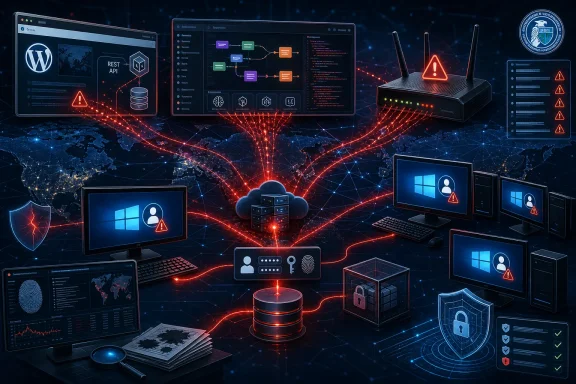
CISA’s decision on July 21, 2026, to add four vulnerabilities to its Known Exploited Vulnerabilities catalog is more than another routine patching notice. The update places an aging DD-WRT router flaw, a serious Langflow remote-code-execution issue, and two newly disclosed WordPress core vulnerabilities into the category security teams should treat as operationally urgent: weaknesses with evidence of active exploitation. For Windows administrators, web hosting operators, and enterprise security teams, the message is clear: this is an exposure-management event that crosses routers, AI workflow platforms, websites, cloud workloads, and the Windows endpoints that ultimately administer all of them.
CISA’s Known Exploited Vulnerabilities, or KEV, catalog was created to solve a basic but persistent security problem: organizations receive far more vulnerability notifications than they can remediate immediately. Severity scores alone do not resolve that problem. A critical vulnerability may be difficult to exploit, buried behind several controls, or located on an isolated system; a lower-scored defect may be actively used against public-facing infrastructure and therefore demand action first.
The KEV catalog supplies a more concrete signal. Inclusion means CISA has determined that there is credible evidence of exploitation in the wild. It does not necessarily reveal the scale of an attack campaign, who is responsible, or whether every internet-exposed instance is under attack. It does mean defenders should stop treating the issue as theoretical.
CISA’s newer approach under Binding Operational Directive 26-04 formalizes a risk-based model for federal civilian agencies. It places particular weight on public exposure, known exploitation, automation potential, and whether successful exploitation can give an attacker total control of the affected asset. That is a significant evolution from the earlier practice of treating every KEV entry principally as a deadline-driven patching requirement.
The age of the CVE is part of the story. A vulnerability identifier from 2021 entering KEV in 2026 reinforces the uncomfortable reality that unsupported or poorly inventoried edge devices often remain online for years. Routers are frequently deployed, configured once, and forgotten until an outage occurs. That makes them attractive targets and difficult remediation candidates.
That risk should concern organizations experimenting with generative AI, retrieval-augmented generation, agent workflows, and internal automation. Langflow deployments commonly sit near valuable credentials: model-provider API keys, database passwords, cloud access tokens, messaging-service credentials, and workflow secrets. A compromise may be more consequential than the loss of a single application server because the platform can serve as a bridge to multiple systems.
The fact that these are core vulnerabilities matters. Security teams are accustomed to plugin and theme risk in WordPress environments. Core flaws change the equation because a site may be exposed even with a minimal installation and a carefully selected plugin set. A managed service provider that hosts hundreds of WordPress sites must therefore assess every affected core version, not merely sites using a particular extension.
Interpretation flaws are especially dangerous because they often arise between components that each appear to enforce reasonable rules. One layer decides a route is allowed, another handles data as though different assumptions apply, and the mismatch becomes exploitable. Defenders should recognize this pattern beyond WordPress: API gateways, reverse proxies, web application frameworks, and identity systems can all suffer from security-impacting differences in how a request is parsed or routed.
A standalone SQL injection may allow data extraction, authentication bypasses, or database manipulation. In the WordPress case, the greater concern is that the issue can reportedly be paired with the route-confusion weakness to create an unauthenticated remote-code-execution path. Security leaders should avoid the mistake of triaging each CVE independently when the practical risk lies in their combined effect.
This is a case where version inventory is not optional. A dashboard may display a site as current while a staging environment, multisite tenant, abandoned microsite, recovery instance, container image, or manually maintained installation remains vulnerable. Internet-facing legacy sites are often the ones attackers find first because they receive the least administrative attention.
A web application firewall can reduce exposure temporarily, and managed hosting providers may have deployed mitigations. Neither control should be accepted as proof that patching can wait. WAF signatures can be bypassed, malformed variants can emerge, and an attacker operating from a trusted network path may not encounter the same protections as an internet-based scanner.
Router compromise has consequences beyond losing connectivity. An attacker who controls an edge device may alter DNS settings, redirect traffic, capture credentials, establish persistence, scan internal systems, or use the router in a botnet. Windows PCs connected to the same network may then face phishing redirection, rogue update destinations, password theft attempts, or opportunistic lateral movement.
That gap is increasingly important in hybrid-work environments. A managed Windows laptop may be fully compliant while the user’s home router runs unmaintained firmware. The laptop’s endpoint protections still matter, but an attacker who controls the network can manipulate the environment around it.
Where a verified vendor fix is available for the deployed build, organizations should apply it promptly after appropriate change control. Where patch status is unclear, the safer course is to disable unnecessary UPnP services, restrict management access, segment the device, block unneeded inbound traffic, and consider replacement with a supported platform. An unpatchable edge device should be treated as a lifecycle problem, not a permanent exception.
On a self-hosted server, root execution can expose every file readable by the operating system account, alter services, install persistence, and grant access to local container runtimes or orchestration credentials. In cloud deployments, the attacker may also attempt to reach instance metadata services, mounted secrets, deployment tokens, and internal APIs.
Windows-centric organizations should examine whether Langflow instances interact with Active Directory, Microsoft Entra ID, Azure resources, SQL Server, Power Platform connectors, Teams bots, or file shares. The most consequential impact may not be the compromised Linux host running Langflow; it may be the service principal, automation account, or API token the attacker retrieves from its environment.
Until patching is confirmed, organizations should remove direct public exposure, allow access only through a protected reverse proxy or VPN, restrict inbound paths to trusted administrative networks, and rotate credentials that could have been exposed. If compromise is suspected, merely applying an update is insufficient. The host, workflows, logs, secrets, cloud identities, and connected services must be investigated as part of a full incident response.
A compromised WordPress system may be used to steal credentials from administrators, host malware, send convincing phishing emails, alter downloadable content, or pivot toward internal resources. The operating system on the web server is only one element of the threat model. The trust relationships around it matter just as much.
This is why privileged access workstations, separate administrative identities, phishing-resistant multifactor authentication, and credential hygiene continue to matter. Patching the vulnerable application closes an entry point; reducing credential exposure limits what an intruder can do after an entry point is found.
Security teams should use their Windows and cloud monitoring stack to look for signs of follow-on activity, especially where compromised services are connected to Microsoft identities or workloads. The goal is to combine patching with threat hunting, not to choose between them.
That is a meaningful shift. It recognizes that a vulnerable public service is not merely a maintenance item. It is potentially an active incident, particularly when exploitation can be automated and lead to complete compromise.
For the WordPress vulnerabilities and Langflow flaw, that question should be standard practice even outside government. An organization that applies a patch but leaves a web shell, backdoor account, malicious scheduled task, altered deployment key, or stolen API credential in place has reduced the chance of reinfection while failing to remove the attacker.
Administrators should then review recent web logs for anomalous REST API batch requests, unexpected requests to WordPress API routes, suspicious POST patterns, and bursts of errors around the disclosure window. They should inspect for modified PHP files, unexpected administrator accounts, altered plugin directories, suspicious cron entries, unauthorized database changes, and unfamiliar outbound connections.
Teams should also inspect environment variables, mounted secret stores, API integrations, service accounts, cloud audit records, and network connections. Any credential that was accessible to the affected service should be considered potentially exposed until analysis demonstrates otherwise. Rotating only the primary model-provider key while leaving database, cloud, or source-control tokens untouched is an incomplete response.
If the hardware cannot be brought to a supported firmware level, replacement should be placed on the risk register with a defined deadline. Security teams should avoid accepting “it has worked for years” as an argument for retaining unsupported edge infrastructure. Reliability history is not evidence of resistance to active exploitation.
For each exposed asset, enterprises should identify:
Providers should communicate clearly, but technical action must come first. They need centralized verification of version status, prioritized patch deployment, WAF safeguards, customer-facing exposure reporting, and investigation workflows for affected sites. A generic advisory email is not a substitute for knowing whether every managed instance is patched.
These are supply-chain concerns in the broad operational sense. The attacked asset may not contain the crown jewels itself, but it can be a trusted component that delivers content, moves data, or mediates access between users and more critical services.
Windows users should also keep their systems updated, use secure DNS and endpoint protection where appropriate, and be wary of unexplained certificate warnings, login prompts, or router configuration changes. Router compromise can create subtle symptoms before a complete outage occurs.
After patching, site owners should change WordPress administrator passwords, review administrator accounts, update plugins and themes, check for unfamiliar files, and ensure backups are clean and accessible. If the site processes payments, customer data, or business email, a professional incident-response review may be warranted.
The correct answer is not to delay patching indefinitely for fear of incompatibility. It is to maintain tested backups, establish rollback procedures, use staging where feasible, and make emergency remediation a practiced operational capability rather than an improvised crisis.
The July 21 KEV additions are a useful test of whether vulnerability management has become genuinely risk-based. The organizations best positioned to respond will not be those with the longest patch lists or the most polished dashboards, but those that can rapidly answer a few urgent questions: what is exposed, who owns it, whether it is actively exploited, what it can reach, and whether an attacker may already be inside.
 Background
CISA’s Known Exploited Vulnerabilities, or KEV, catalog was created to solve a basic but persistent security problem: organizations receive far more vulnerability notifications than they can remediate immediately. Severity scores alone do not resolve that problem. A critical vulnerability may be difficult to exploit, buried behind several controls, or located on an isolated system; a lower-scored defect may be actively used against public-facing infrastructure and therefore demand action first.The KEV catalog supplies a more concrete signal. Inclusion means CISA has determined that there is credible evidence of exploitation in the wild. It does not necessarily reveal the scale of an attack campaign, who is responsible, or whether every internet-exposed instance is under attack. It does mean defenders should stop treating the issue as theoretical.
From patch volume to risk-based remediation
For years, vulnerability-management programs often emphasized the number of open findings, the percentage of systems patched, and the number of days a vulnerability remained unresolved. Those metrics remain useful, but they can produce distorted priorities. A team can close thousands of low-impact tickets while an exposed appliance, web application, or workflow server remains vulnerable to a public exploit.CISA’s newer approach under Binding Operational Directive 26-04 formalizes a risk-based model for federal civilian agencies. It places particular weight on public exposure, known exploitation, automation potential, and whether successful exploitation can give an attacker total control of the affected asset. That is a significant evolution from the earlier practice of treating every KEV entry principally as a deadline-driven patching requirement.
Why the July 21 update stands out
The four additions are diverse:- CVE-2021-27137 is a stack-based buffer overflow in DD-WRT router firmware.
- CVE-2026-0770 affects Langflow and can permit unauthenticated remote code execution through unsafe handling of an
exec_globalsparameter. - CVE-2026-63030 is a WordPress core interpretation-conflict issue involving REST API batch routing.
- CVE-2026-60137 is a WordPress core SQL injection vulnerability involving the
author__not_inparameter ofWP_Query.
The Four KEV Additions at a Glance
The list spans several generations of technology. DD-WRT represents the long tail of router and embedded-device management. Langflow represents the rapidly expanding AI application and automation ecosystem. WordPress remains one of the most widely deployed web publishing platforms in the world, used by personal sites, small businesses, public-sector organizations, enterprises, and managed service providers.CVE-2021-27137: DD-WRT UPnP exposure
CVE-2021-27137 is a stack-based buffer overflow in the UPnP service of certain DD-WRT firmware builds. The flaw involves handling of specially crafted SSDP M-SEARCH traffic, typically associated with UDP port 1900. A successful attack could allow an unauthenticated attacker to compromise a vulnerable device.The age of the CVE is part of the story. A vulnerability identifier from 2021 entering KEV in 2026 reinforces the uncomfortable reality that unsupported or poorly inventoried edge devices often remain online for years. Routers are frequently deployed, configured once, and forgotten until an outage occurs. That makes them attractive targets and difficult remediation candidates.
CVE-2026-0770: Langflow and unsafe functionality inclusion
CVE-2026-0770 affects Langflow, a platform used to build and run AI-driven workflows. The vulnerability is associated with theexec_globals parameter processed by a validation endpoint. According to the available technical description, an unauthenticated remote attacker may be able to execute arbitrary code, potentially in the context of the root account.That risk should concern organizations experimenting with generative AI, retrieval-augmented generation, agent workflows, and internal automation. Langflow deployments commonly sit near valuable credentials: model-provider API keys, database passwords, cloud access tokens, messaging-service credentials, and workflow secrets. A compromise may be more consequential than the loss of a single application server because the platform can serve as a bridge to multiple systems.
CVE-2026-63030 and CVE-2026-60137: WordPress core chain
The WordPress additions must be read together. CVE-2026-60137 concerns inadequate sanitization related to theauthor__not_in parameter in WP_Query, allowing SQL injection under vulnerable conditions. CVE-2026-63030 concerns REST API batch endpoint route confusion. The reported combination can turn SQL injection into remote code execution without requiring an authenticated WordPress account.The fact that these are core vulnerabilities matters. Security teams are accustomed to plugin and theme risk in WordPress environments. Core flaws change the equation because a site may be exposed even with a minimal installation and a carefully selected plugin set. A managed service provider that hosts hundreds of WordPress sites must therefore assess every affected core version, not merely sites using a particular extension.
Why WordPress Is the Immediate Operational Priority
The WordPress vulnerabilities are newly disclosed, publicly discussed, and now listed by CISA as actively exploited. That combination compresses defenders’ response window. Once a vulnerability chain becomes broadly understood, attackers do not need deep research capabilities; they can automate scanning, attempt exploitation at scale, and identify successful compromises through ordinary web requests.The route-confusion problem
CVE-2026-63030 affects the REST API batch endpoint behavior in WordPress versions 6.9.x before 6.9.5 and 7.0.x before 7.0.2. The vulnerability is characterized as an interpretation conflict or route-confusion issue. In practical terms, the application can interpret a crafted request in a way that creates an unintended path through security-relevant logic.Interpretation flaws are especially dangerous because they often arise between components that each appear to enforce reasonable rules. One layer decides a route is allowed, another handles data as though different assumptions apply, and the mismatch becomes exploitable. Defenders should recognize this pattern beyond WordPress: API gateways, reverse proxies, web application frameworks, and identity systems can all suffer from security-impacting differences in how a request is parsed or routed.
The SQL injection component
CVE-2026-60137 affects WordPress 6.8 and later under the relevant conditions, involving how untrusted input can reach theauthor__not_in parameter of WP_Query. SQL injection remains one of the oldest classes of web vulnerability, but it endures because applications are complex, databases are powerful, and input validation errors can be subtle.A standalone SQL injection may allow data extraction, authentication bypasses, or database manipulation. In the WordPress case, the greater concern is that the issue can reportedly be paired with the route-confusion weakness to create an unauthenticated remote-code-execution path. Security leaders should avoid the mistake of triaging each CVE independently when the practical risk lies in their combined effect.
Affected versions and patched releases
Organizations should verify exact deployed versions rather than assume automatic updates have succeeded. The emergency fixes include WordPress 7.0.2 and 6.9.5, with a 6.8.6 release addressing the SQL injection issue in the affected older branch. WordPress 7.1 beta 2 also contains the relevant fixes for pre-release users.This is a case where version inventory is not optional. A dashboard may display a site as current while a staging environment, multisite tenant, abandoned microsite, recovery instance, container image, or manually maintained installation remains vulnerable. Internet-facing legacy sites are often the ones attackers find first because they receive the least administrative attention.
Persistent object caching is not a substitute for patching
Some reports have noted that the complete remote-code-execution chain may depend on the absence of a persistent object cache. That is useful defensive context, but it should not be mistaken for a remediation strategy. Configuration-dependent exploitation does not eliminate risk; configurations change, assumptions are often wrong, and attackers may still exploit the SQL injection component or discover alternative paths.A web application firewall can reduce exposure temporarily, and managed hosting providers may have deployed mitigations. Neither control should be accepted as proof that patching can wait. WAF signatures can be bypassed, malformed variants can emerge, and an attacker operating from a trusted network path may not encounter the same protections as an internet-based scanner.
DD-WRT Shows Why Edge Assets Remain a Security Blind Spot
The DD-WRT entry may not generate the same immediate attention as a fresh WordPress remote-code-execution chain, but it represents a category of exposure that is often more difficult to eradicate. Consumer-grade and prosumer-grade routers sit at the network edge, may run years-old firmware, and can be reachable through exposed management services, UPnP behavior, port forwarding, or internal lateral movement.The danger of an old vulnerability
CVE-2021-27137 concerns a stack-based buffer overflow in DD-WRT’s UPnP service. Memory-safety flaws in routers are serious because successful exploitation can provide control over a device that sees, routes, and sometimes modifies network traffic. Even where the vulnerable service is not exposed directly to the public internet, a compromised local device or malicious actor on an adjacent network may be able to attack it.Router compromise has consequences beyond losing connectivity. An attacker who controls an edge device may alter DNS settings, redirect traffic, capture credentials, establish persistence, scan internal systems, or use the router in a botnet. Windows PCs connected to the same network may then face phishing redirection, rogue update destinations, password theft attempts, or opportunistic lateral movement.
Firmware management is not Windows Update
Windows administrators are accustomed to centralized patching through Windows Update for Business, Windows Server Update Services, Microsoft Intune, Configuration Manager, or third-party endpoint tools. Router firmware rarely benefits from equivalent infrastructure. Inventory may be incomplete, updates may require manual intervention, and an organization may not even know which device is acting as the upstream gateway at a small office or home worker location.That gap is increasingly important in hybrid-work environments. A managed Windows laptop may be fully compliant while the user’s home router runs unmaintained firmware. The laptop’s endpoint protections still matter, but an attacker who controls the network can manipulate the environment around it.
Practical DD-WRT response
The correct response is not simply to search for the CVE in a vulnerability scanner and close the ticket if no result appears. Teams should identify all DD-WRT deployments, establish firmware build numbers, determine whether UPnP is enabled, and confirm whether SSDP traffic is exposed beyond intended network segments.Where a verified vendor fix is available for the deployed build, organizations should apply it promptly after appropriate change control. Where patch status is unclear, the safer course is to disable unnecessary UPnP services, restrict management access, segment the device, block unneeded inbound traffic, and consider replacement with a supported platform. An unpatchable edge device should be treated as a lifecycle problem, not a permanent exception.
Langflow Raises the Stakes for AI Workflow Security
Langflow’s addition to KEV is a reminder that AI infrastructure is still application infrastructure. A flow-building tool may be presented as a productivity platform, but if it accepts external requests, executes code, stores secrets, and integrates with cloud APIs, it deserves the same security discipline as a public-facing development platform or automation server.Why remote code execution in Langflow matters
CVE-2026-0770 reportedly allows unauthenticated code execution through handling of a parameter calledexec_globals at a validation endpoint. The vulnerability is severe not only because an attacker can run code, but because the reported execution context can be root. Root-level compromise converts a single application flaw into a host-level incident.On a self-hosted server, root execution can expose every file readable by the operating system account, alter services, install persistence, and grant access to local container runtimes or orchestration credentials. In cloud deployments, the attacker may also attempt to reach instance metadata services, mounted secrets, deployment tokens, and internal APIs.
AI workflows often centralize valuable secrets
AI platforms frequently centralize credentials because that is how they provide convenience. A single workflow may connect to an LLM provider, a vector database, SharePoint, Microsoft 365, Slack, GitHub, a CRM platform, and an internal SQL database. This creates a concentration-of-risk problem: compromise of one orchestration layer can expose several downstream systems.Windows-centric organizations should examine whether Langflow instances interact with Active Directory, Microsoft Entra ID, Azure resources, SQL Server, Power Platform connectors, Teams bots, or file shares. The most consequential impact may not be the compromised Linux host running Langflow; it may be the service principal, automation account, or API token the attacker retrieves from its environment.
Containment before confidence
Administrators should first determine whether Langflow is deployed at all, including proof-of-concept instances created by developers or data-science teams outside formal IT processes. Next, identify whether any instance is internet-accessible, whether it uses affected versions, and whether authentication is enforced at the application and network layers.Until patching is confirmed, organizations should remove direct public exposure, allow access only through a protected reverse proxy or VPN, restrict inbound paths to trusted administrative networks, and rotate credentials that could have been exposed. If compromise is suspected, merely applying an update is insufficient. The host, workflows, logs, secrets, cloud identities, and connected services must be investigated as part of a full incident response.
What This Means for Windows Administrators
None of the four vulnerabilities is a Windows kernel or Microsoft Office flaw, but that does not make the update peripheral to Windows environments. Windows networks are typically administered through browsers, remote tools, credentials, identity systems, and cloud dashboards. Any compromise of the infrastructure surrounding those systems can become a direct risk to Windows users and business data.Web servers and IIS-adjacent estates
WordPress is most commonly associated with Linux, PHP, and Apache or Nginx, but Windows Server deployments remain possible. More importantly, many organizations host WordPress through third parties while using Windows-based administrative workstations, file servers, SQL Server instances, or Active Directory-backed services behind the site.A compromised WordPress system may be used to steal credentials from administrators, host malware, send convincing phishing emails, alter downloadable content, or pivot toward internal resources. The operating system on the web server is only one element of the threat model. The trust relationships around it matter just as much.
Administrative workstations are an attractive follow-on target
Attackers who compromise a website or workflow server often search for configuration files, browser-session data, deployment keys, remote-management credentials, and documentation. If privileged administrators use the same Windows workstation for browsing, web administration, cloud management, email, and server access, one compromised service can set the stage for broader identity compromise.This is why privileged access workstations, separate administrative identities, phishing-resistant multifactor authentication, and credential hygiene continue to matter. Patching the vulnerable application closes an entry point; reducing credential exposure limits what an intruder can do after an entry point is found.
Microsoft security tooling can assist, but not replace remediation
Microsoft Defender for Endpoint, Defender for Cloud, Sentinel, Intune, and Azure monitoring can contribute valuable telemetry. They can help detect suspicious PowerShell usage, unusual sign-in patterns, web-shell behavior, anomalous process activity, and evidence of credential theft. However, detection tools do not erase an actively exploited vulnerability.Security teams should use their Windows and cloud monitoring stack to look for signs of follow-on activity, especially where compromised services are connected to Microsoft identities or workloads. The goal is to combine patching with threat hunting, not to choose between them.
BOD 26-04 Changes the Federal Operating Model
CISA’s July 21 alert arrives shortly after the release of Binding Operational Directive 26-04, which was issued on June 10, 2026. The directive modernizes how Federal Civilian Executive Branch agencies prioritize security updates by placing active exploitation and operational exposure at the center of the decision process.The highest-risk category receives the fastest attention
The most urgent category under the directive is designed around a dangerous combination: a KEV-listed vulnerability on a publicly exposed asset that can be exploited automatically and grants total technical impact after exploitation. For that class of issue, federal agencies face the shortest remediation expectations and must also evaluate whether the system was compromised before the patch was installed.That is a meaningful shift. It recognizes that a vulnerable public service is not merely a maintenance item. It is potentially an active incident, particularly when exploitation can be automated and lead to complete compromise.
Patching is not the end of the obligation
Traditional vulnerability management can be overly transactional: identify a CVE, deploy an update, close the record. BOD 26-04 pushes agencies to ask a harder question: was the system already compromised before the fix was applied?For the WordPress vulnerabilities and Langflow flaw, that question should be standard practice even outside government. An organization that applies a patch but leaves a web shell, backdoor account, malicious scheduled task, altered deployment key, or stolen API credential in place has reduced the chance of reinfection while failing to remove the attacker.
Private-sector relevance
The directive applies directly to federal civilian agencies, not private companies, schools, households, or state and local governments. Yet the underlying model is broadly applicable. A practical private-sector adaptation is to prioritize remediation based on four questions:- Is the vulnerability known to be actively exploited?
- Is the affected system exposed to the internet or otherwise reachable by untrusted users?
- Can exploitation be automated at scale?
- Would successful exploitation produce full control, sensitive-data access, or a path to critical systems?
A Practical Remediation Plan
Speed matters, but hurried changes without verification can create false confidence. The most effective response combines inventory, containment, patching, validation, and investigation. Different teams can work on these streams simultaneously rather than waiting for one task to finish before beginning another.First 24 hours: establish exposure
Security and infrastructure teams should complete the following sequence immediately:- Identify all WordPress, Langflow, and DD-WRT assets, including development, staging, disaster-recovery, branch-office, and vendor-managed environments.
- Determine public exposure, including direct internet access, reverse-proxy paths, cloud load balancers, VPN exceptions, and third-party hosting arrangements.
- Record exact versions and configurations, rather than relying on product names or inventory categories alone.
- Apply verified vendor fixes to affected WordPress installations and Langflow deployments as a priority.
- Disable or restrict unnecessary exposure for DD-WRT UPnP services and any unpatched Langflow endpoint.
- Preserve logs and forensic evidence before making broad cleanup changes if compromise indicators exist.
- Rotate exposed secrets and tokens where a vulnerable Langflow instance or WordPress host stored credentials.
WordPress-specific actions
For WordPress, upgrade affected 6.9 deployments to 6.9.5 or later and affected 7.0 deployments to 7.0.2 or later. Organizations on the 6.8 branch should move to 6.8.6 or a later supported release to address the SQL injection issue. Pre-release installations should be updated to the patched beta release or removed from any reachable environment.Administrators should then review recent web logs for anomalous REST API batch requests, unexpected requests to WordPress API routes, suspicious POST patterns, and bursts of errors around the disclosure window. They should inspect for modified PHP files, unexpected administrator accounts, altered plugin directories, suspicious cron entries, unauthorized database changes, and unfamiliar outbound connections.
Langflow-specific actions
For Langflow, update to the vendor-provided fixed release applicable to the deployment and confirm that the update has actually reached the running service. In container environments, that means checking the image digest and redeploying workloads, not merely updating a repository tag or changing a compose file.Teams should also inspect environment variables, mounted secret stores, API integrations, service accounts, cloud audit records, and network connections. Any credential that was accessible to the affected service should be considered potentially exposed until analysis demonstrates otherwise. Rotating only the primary model-provider key while leaving database, cloud, or source-control tokens untouched is an incomplete response.
DD-WRT-specific actions
For DD-WRT, determine whether the router firmware includes the vulnerable UPnP implementation and whether a confirmed fixed build exists. Disable UPnP where it is not operationally required, prevent administrative access from untrusted networks, and ensure the router management interface is not exposed to the internet.If the hardware cannot be brought to a supported firmware level, replacement should be placed on the risk register with a defined deadline. Security teams should avoid accepting “it has worked for years” as an argument for retaining unsupported edge infrastructure. Reliability history is not evidence of resistance to active exploitation.
Enterprise Impact: More Than a Patch Window
Enterprises face a coordination challenge because these products are often managed by different teams. Networking may own routers, web operations may own WordPress, developers may own Langflow, and security may only see the resulting vulnerability notifications. Attackers benefit from these silos; defenders must bridge them.Asset ownership determines response quality
An inventory that lists “WordPress server” without an accountable owner, business purpose, data classification, exposure status, and recovery plan is not enough for effective risk management. The same is true for AI workflow instances launched as departmental experiments. Security cannot prioritize what the organization cannot describe.For each exposed asset, enterprises should identify:
- The service owner and technical administrator.
- The authentication model and administrative access paths.
- The data and credentials accessible from the host.
- The business impact of emergency maintenance or temporary isolation.
- The monitoring sources available for compromise review.
Managed service providers face amplified risk
Managed service providers, web agencies, and cloud hosting companies deserve special attention because one vulnerability can affect a large client base. WordPress core weaknesses can become a multi-tenant incident if automated update systems fail, site management portals are not comprehensive, or customers have disabled updates for compatibility reasons.Providers should communicate clearly, but technical action must come first. They need centralized verification of version status, prioritized patch deployment, WAF safeguards, customer-facing exposure reporting, and investigation workflows for affected sites. A generic advisory email is not a substitute for knowing whether every managed instance is patched.
Supply-chain consequences
A compromised WordPress site can distribute malicious downloads, redirect visitors, or damage a trusted brand. A compromised Langflow server can tamper with AI-generated content, manipulate automated decisions, or exfiltrate sensitive prompts and documents. A compromised router can undermine the integrity of traffic flowing to numerous systems.These are supply-chain concerns in the broad operational sense. The attacked asset may not contain the crown jewels itself, but it can be a trusted component that delivers content, moves data, or mediates access between users and more critical services.
Consumer and Small-Business Impact
Small organizations are frequently more exposed to these issues because they rely on all-in-one devices, shared hosting, low-cost managed services, and informal administrative practices. They may not have a dedicated vulnerability-management team, but active exploitation does not distinguish between large and small targets.Home routers are business infrastructure now
A home office router may support remote work, personal financial activity, small-business transactions, and connected devices. Users who run DD-WRT should check the firmware build, disable unused UPnP functionality, ensure remote administration is off unless strictly needed, and replace hardware that is no longer supported.Windows users should also keep their systems updated, use secure DNS and endpoint protection where appropriate, and be wary of unexplained certificate warnings, login prompts, or router configuration changes. Router compromise can create subtle symptoms before a complete outage occurs.
WordPress site owners need to verify, not assume
Owners of small WordPress sites should confirm their installed version through the WordPress dashboard, hosting control panel, or a trusted administrator. They should not assume that auto-update succeeded merely because the feature is enabled. Hosting providers may delay changes, custom configurations may disable automatic updates, and a forgotten staging site may still be publicly reachable.After patching, site owners should change WordPress administrator passwords, review administrator accounts, update plugins and themes, check for unfamiliar files, and ensure backups are clean and accessible. If the site processes payments, customer data, or business email, a professional incident-response review may be warranted.
Strengths and Opportunities
The July 21 KEV update offers organizations an opportunity to improve their security practice rather than simply close four tickets.- It provides a high-confidence prioritization signal. Active exploitation evidence gives security teams a defensible reason to move resources quickly.
- It demonstrates the value of exposure-based inventory. Public-facing WordPress sites, AI workflow services, and routers must be identified before they can be protected.
- It encourages compromise assessment after patching. This reduces the risk of treating a breached system as clean merely because it now runs a fixed version.
- It reveals where asset ownership is fragmented. The mix of network, web, and AI tooling can expose organizational blind spots.
- It supports security modernization. Unsupported routers, unmanaged web instances, and shadow AI deployments are strong candidates for consolidation or replacement.
A better metric for leadership
Leadership teams should ask not only, “How fast did we patch?” but also, “How many internet-exposed KEV assets did we have, how quickly did we identify them, and how many were checked for compromise?” Those questions measure operational readiness more accurately than a broad vulnerability backlog count.Risks and Concerns
Rapid remediation is necessary, but organizations should avoid simplistic responses that create new blind spots.- Patching without investigation can leave persistence behind. Web shells, stolen secrets, altered accounts, and malicious scheduled tasks can survive an update.
- WAF rules can reduce risk but cannot guarantee safety. They should be treated as temporary compensating controls, not permanent replacements for patches.
- Automatic updates can fail silently or be disabled. Verification must occur at the installed-version and running-service level.
- Legacy equipment can turn into permanent exposure. If DD-WRT hardware lacks a supported path forward, replacement may be the only responsible option.
- Shadow AI deployments may evade normal controls. Langflow instances created for experimentation can carry production credentials despite having no formal ownership.
- Overreliance on severity scores can delay action. KEV status, reachability, exploitability, and technical impact deserve equal or greater attention.
The unintended consequence of emergency patching
Emergency changes can occasionally disrupt customized sites, integrations, or workflow automations. That is a real operational concern, especially for organizations with limited testing capacity. Yet downtime from a controlled update is generally preferable to downtime from a compromised router, encrypted server, defaced website, leaked database, or revoked cloud identity.The correct answer is not to delay patching indefinitely for fear of incompatibility. It is to maintain tested backups, establish rollback procedures, use staging where feasible, and make emergency remediation a practiced operational capability rather than an improvised crisis.
What to Watch Next
The next several days will likely determine the practical scale of this update. Security teams should expect additional scanning activity, new exploit variants, detections from web application firewalls, and potentially more detailed indicators of compromise from vendors and security researchers. The WordPress chain is especially likely to attract rapid automation because of the platform’s enormous footprint and the appeal of unauthenticated remote code execution.Watch for exploitation adaptations
Attackers frequently alter request formatting, encoding, headers, timing, and route syntax to evade initial detection rules. Organizations should keep WAF signatures, intrusion-detection content, and threat-hunting queries current. They should also watch for secondary activity rather than focusing only on an initial exploit request: new PHP files, unauthorized users, suspicious outbound DNS, credential changes, and anomalous cloud API calls may be more durable indicators of compromise.Watch the KEV catalog as a living operational feed
The wider lesson is that KEV should not be treated as a periodic compliance spreadsheet. It is a living threat-prioritization feed. When a relevant CVE enters the catalog, organizations should have a repeatable process that identifies exposed instances, assigns ownership, applies containment and remediation, validates the result, and determines whether an incident response is required.Prepare for more AI-platform vulnerabilities
Langflow’s presence in this update is unlikely to be an isolated event. AI application tooling is expanding quickly, often connecting experimental interfaces to high-value enterprise data and credentials. Organizations should expect continued scrutiny of workflow engines, agent frameworks, model gateways, plugin systems, notebook environments, and integration servers.The July 21 KEV additions are a useful test of whether vulnerability management has become genuinely risk-based. The organizations best positioned to respond will not be those with the longest patch lists or the most polished dashboards, but those that can rapidly answer a few urgent questions: what is exposed, who owns it, whether it is actively exploited, what it can reach, and whether an attacker may already be inside.
References
- Primary source: CISA
Published: 2026-07-21T12:00:00+00:00