

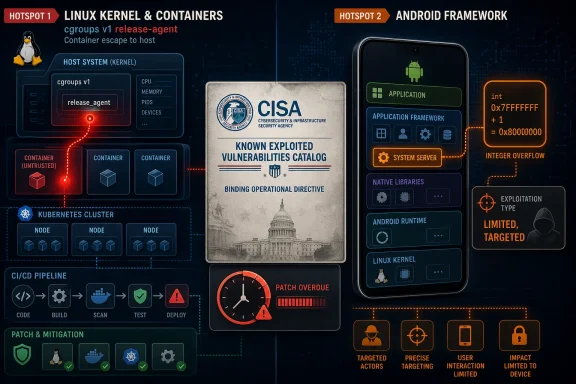
On June 2, 2026, CISA added CVE-2022-0492, a Linux kernel cgroups privilege-escalation flaw, and CVE-2025-48595, an Android Framework integer-overflow flaw, to its Known Exploited Vulnerabilities Catalog after determining both are being exploited in the wild. That terse federal alert is more than another patching reminder. It is a useful snapshot of where modern endpoint risk actually lives: inside the shared kernel assumptions of cloud infrastructure and the fragmented update chain of mobile devices. The two entries sit on different planets technically, but they tell the same story operationally: old bugs and new bugs become urgent only when attackers make them real.
The Known Exploited Vulnerabilities Catalog is not a conventional vulnerability database. It is smaller, sharper, and more political in the best sense of the word: it turns evidence of exploitation into a mandate for federal civilian agencies, then broadcasts that signal to everyone else who has to decide what to patch first.
Binding Operational Directive 22-01 gives the catalog its force inside the federal civilian executive branch. Agencies are required to remediate listed vulnerabilities by CISA’s deadline, which means the KEV list is not merely advisory copy for security teams to skim between meetings. It is a compliance clock attached to observed attacker behavior.
That matters because most vulnerability management programs drown in abundance. Every month brings scores or hundreds of CVEs across operating systems, browsers, mobile platforms, firewalls, VPNs, drivers, and third-party libraries. Severity scores help, but they are not enough. A critical vulnerability that nobody can reach may be less urgent than a high-severity local flaw that attackers are chaining after phishing, credential theft, or a browser escape.
CISA’s June 2 update lands squarely in that reality. CVE-2022-0492 is not new; it dates to the Linux kernel’s cgroups v1 release-agent handling and has been discussed for years as a container-escape and privilege-escalation risk under particular conditions. CVE-2025-48595 is newer in the Android ecosystem, tied to the Framework component and described by Google as an integer overflow with indications of limited, targeted exploitation.
The pairing is instructive. One vulnerability is a reminder that old infrastructure debt does not expire just because a patch exists. The other is a reminder that mobile zero-days rarely arrive with complete public detail when defenders most need to act. The practical answer, in both cases, is not panic. It is disciplined prioritization.
That maturity is precisely why its KEV listing is uncomfortable. A vulnerability that has been known for years should not remain exploitable in environments that matter. Yet real networks are not clean-room diagrams. They contain forgotten kernels, pinned appliance images, aging container hosts, embedded Linux systems, lab clusters that quietly became production dependencies, and “temporary” workloads that outlived the team that deployed them.
The technical shape of the flaw is especially relevant to WindowsForum readers because Windows shops are now almost always Linux shops too, whether or not the org chart admits it. Hyper-V hosts, WSL workflows, Azure workloads, Kubernetes clusters, CI runners, edge devices, security appliances, NAS boxes, and containerized services all drag Linux kernel exposure into environments that used to think of themselves as Windows-first.
CVE-2022-0492 involves improper permission checks around cgroups v1’s release-agent functionality. Under vulnerable configurations, an attacker with local access and the right container conditions may be able to escape isolation boundaries or escalate privileges on the host. The exact exploitability depends on kernel version, container runtime settings, cgroup configuration, Linux security modules, capabilities, and whether cgroups v1 is present and reachable.
That caveat should not be mistaken for comfort. Attackers love conditional bugs when the conditions are common enough and scanning is cheap. They do not need every container host to be exploitable; they need enough misconfigured or unpatched hosts to make the trade worthwhile.
That is why Linux kernel privilege-escalation flaws remain so important in modern enterprise security. A remote code execution flaw in an application may be the first step, but a local privilege escalation can be the step that turns access into persistence, lateral movement, credential theft, or control over the host. The attacker’s playbook is rarely one CVE deep.
CVE-2022-0492 is not a universal container escape button. Sensible defaults in many container environments reduce exposure, and hardened deployments may block the needed primitives through capability restrictions, seccomp, AppArmor, SELinux, or the move away from cgroups v1. But the lesson of the last decade is that defaults are unevenly applied and exceptions accumulate.
For administrators, the right question is not whether their environment theoretically “uses Linux.” It is where Linux kernels sit in the path of trusted workloads, privileged containers, build systems, or management planes. A Kubernetes node that runs internal services may be more valuable to an attacker than a traditional desktop. A CI runner with access to signing keys, deployment secrets, or source repositories may be a far better target than a random workstation.
This is where vulnerability management often lags behind architecture. Asset inventories still tend to be strongest for desktops, servers, and managed software. They are weaker for transient cloud instances, self-hosted runners, base images, inherited appliances, and nodes managed by platform teams outside traditional endpoint processes. A KEV entry for an old Linux kernel flaw is therefore less a news item than a stress test of whether the organization can find its Linux exposure at all.
Mobile platform vendors often disclose very little about actively exploited flaws at first. There are defensible reasons for that. Too much detail too early can help copycat attackers, especially when the installed base remains unpatched. But defenders are then left to make decisions from a narrow public record: component, impact category, affected versions, patch level, and the phrase that changes everything — exploitation in the wild.
The Android ecosystem makes that harder. Pixel devices may receive updates quickly, but the broader fleet depends on device makers, carriers, regional variants, enterprise mobility policies, and user behavior. Even in well-managed environments, Android patch deployment is less uniform than Windows Update or a centrally managed Linux server fleet. In unmanaged or bring-your-own-device environments, the security team may not be able to force remediation at all.
That fragmentation is not just a consumer inconvenience. It is an enterprise risk surface. Phones hold authentication apps, session cookies, corporate chat histories, email, files, browser tokens, device certificates, and access to cloud dashboards. A mobile exploit does not need to look like old-school desktop malware to be dangerous. It may be enough to steal tokens, read sensitive messages, or assist a broader intrusion.
CVE-2025-48595 also reflects the increasingly blurred line between personal device compromise and organizational compromise. A targeted Android exploit may be aimed at journalists, officials, executives, engineers, activists, or administrators. Once the phone is compromised, the attacker may not need to attack the corporate laptop first.
Targeted exploitation often means the attackers are rationing access to a valuable capability. Mobile zero-days are expensive to develop or acquire, and they are usually burned carefully. The victims may be few, but the stakes may be high. For government agencies, defense contractors, law firms, media organizations, dissident communities, and companies handling sensitive intellectual property, “limited” can mean “people like us.”
For enterprise IT, the response should be tiered. A general employee Android fleet needs patch-level visibility and update enforcement where possible. High-risk users need stronger controls: faster update requirements, restricted sideloading, managed profiles, app vetting, phishing-resistant authentication, and incident response playbooks that treat mobile compromise as a credible initial access path.
The uncomfortable truth is that mobile device management often becomes a compliance artifact rather than a defensive capability. Devices are enrolled, policies are checked, and dashboards are reviewed, but patch age and exploit exposure may not be integrated into real risk decisions. A KEV listing should push that data into the same conversation as endpoint detection, identity risk, and conditional access.
For consumers, the advice is simpler but still unevenly actionable: install the June 2026 Android security update when available, replace devices that no longer receive security patches, avoid sideloading untrusted apps, and treat unexplained device behavior as worth investigating. But the bigger systemic issue remains vendor support lifetimes. A device that cannot receive a patch for an exploited Framework bug is not merely old. It is unsupported infrastructure in pocket form.
That distinction is essential. CVSS measures characteristics of a vulnerability, not attacker adoption. Exploit Prediction Scoring System data can estimate likelihood, but it is still probabilistic. Vendor advisories tell you what was fixed. KEV tells you what attackers are already using, according to CISA’s evidentiary threshold.
This does not make KEV perfect. It is necessarily incomplete, because not all exploitation is detected or publicly confirmed. It can lag private incident response findings. It can include vulnerabilities that are urgent for some sectors but less relevant to others. But it remains one of the clearest public signals available to security teams that must rank thousands of possible actions.
The June 2 additions show why that signal matters outside the federal government. The federal mandate applies to civilian executive branch agencies, but private-sector defenders use KEV as a triage lens because attackers do not respect procurement categories. If a flaw is being exploited against one class of target, the technique may spread, the exploit may leak, or the same vulnerable technology may exist elsewhere.
The more heterogeneous the enterprise, the more useful that lens becomes. A modern organization may have Windows endpoints, Linux servers, Android phones, iOS devices, SaaS identity platforms, container clusters, network appliances, developer tooling, and operational technology. No single vendor patch cycle can govern all of it. KEV gives security teams a cross-platform emergency queue.
For CVE-2022-0492, the work begins with kernel inventory. Teams need to identify Linux hosts running vulnerable kernels, especially container hosts, Kubernetes nodes, CI/CD infrastructure, appliances, and cloud instances created from old images. They also need to understand whether cgroups v1 is enabled, whether privileged containers are used, and whether security controls prevent the relevant abuse path.
That sounds straightforward until it meets reality. Kernel versions may vary across node pools. Managed Kubernetes services may abstract some host responsibilities while leaving others to customers. Legacy workloads may require old distributions. Appliances may not expose normal package management. Build environments may be recreated from stale templates that nobody scans with the same rigor as production servers.
For CVE-2025-48595, the inventory problem is different. Administrators need to know which Android devices are in use, what patch level they have, whether the June 2026 security update is available for each model, and whether noncompliant devices should be blocked from sensitive resources. In a mature environment, conditional access can enforce this. In a looser one, the security team may be reduced to guidance and hope.
Both vulnerabilities reward organizations that already know their assets and punish those that treat inventory as paperwork. Asset management is not glamorous, but it is the substrate of every urgent patch cycle. A vulnerability cannot be remediated if nobody knows the affected system exists.
There is also a sequencing problem. Not every Linux system or Android phone carries the same risk. Internet-facing systems, privileged container hosts, production clusters, devices used by administrators, and phones belonging to high-risk staff should move first. The goal is not theatrical patching everywhere at once. The goal is reducing the most likely and most damaging exploit paths before attackers exploit organizational delay.
Windows developers use WSL to build Linux software. Enterprises run Linux containers on cloud infrastructure managed from Windows laptops. Microsoft’s own platform strategy embraces Linux across Azure, GitHub, container tooling, and hybrid infrastructure. Android devices authenticate into Microsoft 365, receive Outlook mail, approve MFA prompts, and access Teams chats.
That does not mean every Windows administrator must become a Linux kernel engineer or Android reverse engineer. It means Windows-centric security programs must account for the platforms that now carry Windows-adjacent trust. The domain admin who approves sign-ins from an Android phone is part of the Windows risk model. The Kubernetes node that hosts an internal identity-adjacent service is part of the Windows risk model. The CI pipeline that produces code deployed into a Microsoft environment is part of the Windows risk model.
Attackers already think this way. They do not care whether compromise begins on a phone, a container host, a VPN appliance, a SharePoint server, or a developer workstation. They care about credentials, tokens, access paths, persistence, and privilege. Platform silos are defender conveniences, not attacker constraints.
The practical consequence is that KEV alerts should flow into cross-platform operations. A Windows team should know who owns Linux kernel patching. A mobile team should know how an exploited Android device could affect identity risk. A cloud team should know whether old node images are still in use. If those conversations only begin after CISA adds a vulnerability to KEV, the organization is already late.
For CVE-2022-0492, moving to fixed kernels is the clean answer. But reducing unnecessary privileged containers, limiting capabilities, enforcing seccomp profiles, using AppArmor or SELinux, avoiding cgroups v1 where possible, and monitoring for suspicious cgroup mount or release-agent activity all matter. A patched kernel closes the known bug; hardening reduces the blast radius of the next one.
For CVE-2025-48595, installing the Android security update is the obvious step. But mobile fleet posture also depends on device support policies, app installation controls, phishing resistance, conditional access, and the ability to quarantine devices that lag security patch levels. A phone that is technically enrolled but perpetually behind on patches is not managed in any meaningful security sense.
This is why KEV should trigger more than a ticket. It should trigger a short review of why the vulnerable condition exists. Is the Linux fleet carrying old kernels because maintenance windows are too rare? Are container hosts running with broad privileges because developers never received safer patterns? Are Android devices allowed to access sensitive data even after falling months behind patch levels? The patch fixes today’s exposure; the answers fix tomorrow’s.
Security teams should also avoid overfitting their response to public exploit details. When exploitation is confirmed but details are sparse, defenders sometimes wait for indicators of compromise that may never be reliable. That is backwards. KEV is valuable precisely because it lets teams act before every detection vendor has a polished rule and every attacker has a commodity exploit kit.
CISA’s latest KEV additions are small in number but large in implication. CVE-2022-0492 shows that yesterday’s patched Linux flaw can remain today’s attacker opportunity when infrastructure ages unevenly; CVE-2025-48595 shows that mobile exploitation remains a quiet front in enterprise compromise. The future of vulnerability management will not be won by chasing every CVE with equal urgency, but by building systems that can recognize when a flaw has become operationally real — and move before attackers turn that recognition gap into access.
 CISA Turns Two Platform Bugs Into A Deadline
The Known Exploited Vulnerabilities Catalog is not a conventional vulnerability database. It is smaller, sharper, and more political in the best sense of the word: it turns evidence of exploitation into a mandate for federal civilian agencies, then broadcasts that signal to everyone else who has to decide what to patch first.Binding Operational Directive 22-01 gives the catalog its force inside the federal civilian executive branch. Agencies are required to remediate listed vulnerabilities by CISA’s deadline, which means the KEV list is not merely advisory copy for security teams to skim between meetings. It is a compliance clock attached to observed attacker behavior.
That matters because most vulnerability management programs drown in abundance. Every month brings scores or hundreds of CVEs across operating systems, browsers, mobile platforms, firewalls, VPNs, drivers, and third-party libraries. Severity scores help, but they are not enough. A critical vulnerability that nobody can reach may be less urgent than a high-severity local flaw that attackers are chaining after phishing, credential theft, or a browser escape.
CISA’s June 2 update lands squarely in that reality. CVE-2022-0492 is not new; it dates to the Linux kernel’s cgroups v1 release-agent handling and has been discussed for years as a container-escape and privilege-escalation risk under particular conditions. CVE-2025-48595 is newer in the Android ecosystem, tied to the Framework component and described by Google as an integer overflow with indications of limited, targeted exploitation.
The pairing is instructive. One vulnerability is a reminder that old infrastructure debt does not expire just because a patch exists. The other is a reminder that mobile zero-days rarely arrive with complete public detail when defenders most need to act. The practical answer, in both cases, is not panic. It is disciplined prioritization.
The Linux Flaw Is Old Enough To Be Boring, Which Is Why It Still Matters
CVE-2022-0492 is the kind of Linux vulnerability that can tempt teams into complacency. It was disclosed in 2022. The affected code path is well understood. Major distributions have long since issued fixes. Container security vendors and researchers have published analysis, detection guidance, and proof-of-concept discussion around the cgroups v1release_agent mechanism.That maturity is precisely why its KEV listing is uncomfortable. A vulnerability that has been known for years should not remain exploitable in environments that matter. Yet real networks are not clean-room diagrams. They contain forgotten kernels, pinned appliance images, aging container hosts, embedded Linux systems, lab clusters that quietly became production dependencies, and “temporary” workloads that outlived the team that deployed them.
The technical shape of the flaw is especially relevant to WindowsForum readers because Windows shops are now almost always Linux shops too, whether or not the org chart admits it. Hyper-V hosts, WSL workflows, Azure workloads, Kubernetes clusters, CI runners, edge devices, security appliances, NAS boxes, and containerized services all drag Linux kernel exposure into environments that used to think of themselves as Windows-first.
CVE-2022-0492 involves improper permission checks around cgroups v1’s release-agent functionality. Under vulnerable configurations, an attacker with local access and the right container conditions may be able to escape isolation boundaries or escalate privileges on the host. The exact exploitability depends on kernel version, container runtime settings, cgroup configuration, Linux security modules, capabilities, and whether cgroups v1 is present and reachable.
That caveat should not be mistaken for comfort. Attackers love conditional bugs when the conditions are common enough and scanning is cheap. They do not need every container host to be exploitable; they need enough misconfigured or unpatched hosts to make the trade worthwhile.
Containers Made The Kernel A Shared Blast Radius
The container era sold a tidy abstraction: package the app, ship the image, orchestrate the fleet. Underneath that abstraction, containers still share a host kernel. The kernel becomes the thin line between one workload and another, between an application compromise and a platform compromise, between “we lost a pod” and “we lost the node.”That is why Linux kernel privilege-escalation flaws remain so important in modern enterprise security. A remote code execution flaw in an application may be the first step, but a local privilege escalation can be the step that turns access into persistence, lateral movement, credential theft, or control over the host. The attacker’s playbook is rarely one CVE deep.
CVE-2022-0492 is not a universal container escape button. Sensible defaults in many container environments reduce exposure, and hardened deployments may block the needed primitives through capability restrictions, seccomp, AppArmor, SELinux, or the move away from cgroups v1. But the lesson of the last decade is that defaults are unevenly applied and exceptions accumulate.
For administrators, the right question is not whether their environment theoretically “uses Linux.” It is where Linux kernels sit in the path of trusted workloads, privileged containers, build systems, or management planes. A Kubernetes node that runs internal services may be more valuable to an attacker than a traditional desktop. A CI runner with access to signing keys, deployment secrets, or source repositories may be a far better target than a random workstation.
This is where vulnerability management often lags behind architecture. Asset inventories still tend to be strongest for desktops, servers, and managed software. They are weaker for transient cloud instances, self-hosted runners, base images, inherited appliances, and nodes managed by platform teams outside traditional endpoint processes. A KEV entry for an old Linux kernel flaw is therefore less a news item than a stress test of whether the organization can find its Linux exposure at all.
The Android Bug Is The Quieter, More Personal Half Of The Alert
CVE-2025-48595 sits in the Android Framework and is described as an integer overflow vulnerability. Google’s June 2026 Android security bulletin identifies it as a Framework issue with indications that it may be under limited, targeted exploitation. That wording is familiar in mobile security: sparse by design, careful in tone, and ominous in implication.Mobile platform vendors often disclose very little about actively exploited flaws at first. There are defensible reasons for that. Too much detail too early can help copycat attackers, especially when the installed base remains unpatched. But defenders are then left to make decisions from a narrow public record: component, impact category, affected versions, patch level, and the phrase that changes everything — exploitation in the wild.
The Android ecosystem makes that harder. Pixel devices may receive updates quickly, but the broader fleet depends on device makers, carriers, regional variants, enterprise mobility policies, and user behavior. Even in well-managed environments, Android patch deployment is less uniform than Windows Update or a centrally managed Linux server fleet. In unmanaged or bring-your-own-device environments, the security team may not be able to force remediation at all.
That fragmentation is not just a consumer inconvenience. It is an enterprise risk surface. Phones hold authentication apps, session cookies, corporate chat histories, email, files, browser tokens, device certificates, and access to cloud dashboards. A mobile exploit does not need to look like old-school desktop malware to be dangerous. It may be enough to steal tokens, read sensitive messages, or assist a broader intrusion.
CVE-2025-48595 also reflects the increasingly blurred line between personal device compromise and organizational compromise. A targeted Android exploit may be aimed at journalists, officials, executives, engineers, activists, or administrators. Once the phone is compromised, the attacker may not need to attack the corporate laptop first.
Limited Exploitation Is Not Limited Importance
The phrase “limited, targeted exploitation” can sound reassuring if read too quickly. It suggests that the average user is not being swept up in commodity attacks. That may be true. But it also suggests the vulnerability is useful enough that someone chose to deploy it selectively.Targeted exploitation often means the attackers are rationing access to a valuable capability. Mobile zero-days are expensive to develop or acquire, and they are usually burned carefully. The victims may be few, but the stakes may be high. For government agencies, defense contractors, law firms, media organizations, dissident communities, and companies handling sensitive intellectual property, “limited” can mean “people like us.”
For enterprise IT, the response should be tiered. A general employee Android fleet needs patch-level visibility and update enforcement where possible. High-risk users need stronger controls: faster update requirements, restricted sideloading, managed profiles, app vetting, phishing-resistant authentication, and incident response playbooks that treat mobile compromise as a credible initial access path.
The uncomfortable truth is that mobile device management often becomes a compliance artifact rather than a defensive capability. Devices are enrolled, policies are checked, and dashboards are reviewed, but patch age and exploit exposure may not be integrated into real risk decisions. A KEV listing should push that data into the same conversation as endpoint detection, identity risk, and conditional access.
For consumers, the advice is simpler but still unevenly actionable: install the June 2026 Android security update when available, replace devices that no longer receive security patches, avoid sideloading untrusted apps, and treat unexplained device behavior as worth investigating. But the bigger systemic issue remains vendor support lifetimes. A device that cannot receive a patch for an exploited Framework bug is not merely old. It is unsupported infrastructure in pocket form.
KEV Is Becoming The Patch Tuesday For Everything Else
Microsoft administrators understand Patch Tuesday because it imposes rhythm on chaos. There is a calendar, a predictable release model, known testing windows, and a familiar set of tradeoffs. CISA’s KEV catalog performs a different but increasingly similar function across the wider technology stack: it tells defenders which vulnerabilities have crossed from possible to proven.That distinction is essential. CVSS measures characteristics of a vulnerability, not attacker adoption. Exploit Prediction Scoring System data can estimate likelihood, but it is still probabilistic. Vendor advisories tell you what was fixed. KEV tells you what attackers are already using, according to CISA’s evidentiary threshold.
This does not make KEV perfect. It is necessarily incomplete, because not all exploitation is detected or publicly confirmed. It can lag private incident response findings. It can include vulnerabilities that are urgent for some sectors but less relevant to others. But it remains one of the clearest public signals available to security teams that must rank thousands of possible actions.
The June 2 additions show why that signal matters outside the federal government. The federal mandate applies to civilian executive branch agencies, but private-sector defenders use KEV as a triage lens because attackers do not respect procurement categories. If a flaw is being exploited against one class of target, the technique may spread, the exploit may leak, or the same vulnerable technology may exist elsewhere.
The more heterogeneous the enterprise, the more useful that lens becomes. A modern organization may have Windows endpoints, Linux servers, Android phones, iOS devices, SaaS identity platforms, container clusters, network appliances, developer tooling, and operational technology. No single vendor patch cycle can govern all of it. KEV gives security teams a cross-platform emergency queue.
The Real Work Is Finding The Affected Systems
The hardest part of responding to this alert is not understanding the CVEs. It is finding the systems that matter.For CVE-2022-0492, the work begins with kernel inventory. Teams need to identify Linux hosts running vulnerable kernels, especially container hosts, Kubernetes nodes, CI/CD infrastructure, appliances, and cloud instances created from old images. They also need to understand whether cgroups v1 is enabled, whether privileged containers are used, and whether security controls prevent the relevant abuse path.
That sounds straightforward until it meets reality. Kernel versions may vary across node pools. Managed Kubernetes services may abstract some host responsibilities while leaving others to customers. Legacy workloads may require old distributions. Appliances may not expose normal package management. Build environments may be recreated from stale templates that nobody scans with the same rigor as production servers.
For CVE-2025-48595, the inventory problem is different. Administrators need to know which Android devices are in use, what patch level they have, whether the June 2026 security update is available for each model, and whether noncompliant devices should be blocked from sensitive resources. In a mature environment, conditional access can enforce this. In a looser one, the security team may be reduced to guidance and hope.
Both vulnerabilities reward organizations that already know their assets and punish those that treat inventory as paperwork. Asset management is not glamorous, but it is the substrate of every urgent patch cycle. A vulnerability cannot be remediated if nobody knows the affected system exists.
There is also a sequencing problem. Not every Linux system or Android phone carries the same risk. Internet-facing systems, privileged container hosts, production clusters, devices used by administrators, and phones belonging to high-risk staff should move first. The goal is not theatrical patching everywhere at once. The goal is reducing the most likely and most damaging exploit paths before attackers exploit organizational delay.
Windows Shops Should Resist The “Not Our Platform” Reflex
A CISA alert about Linux and Android may look peripheral to a WindowsForum audience. It is not. The Windows ecosystem has become deeply entangled with Linux and mobile platforms, and the boundaries that once made operating-system categories feel clean are now mostly administrative fiction.Windows developers use WSL to build Linux software. Enterprises run Linux containers on cloud infrastructure managed from Windows laptops. Microsoft’s own platform strategy embraces Linux across Azure, GitHub, container tooling, and hybrid infrastructure. Android devices authenticate into Microsoft 365, receive Outlook mail, approve MFA prompts, and access Teams chats.
That does not mean every Windows administrator must become a Linux kernel engineer or Android reverse engineer. It means Windows-centric security programs must account for the platforms that now carry Windows-adjacent trust. The domain admin who approves sign-ins from an Android phone is part of the Windows risk model. The Kubernetes node that hosts an internal identity-adjacent service is part of the Windows risk model. The CI pipeline that produces code deployed into a Microsoft environment is part of the Windows risk model.
Attackers already think this way. They do not care whether compromise begins on a phone, a container host, a VPN appliance, a SharePoint server, or a developer workstation. They care about credentials, tokens, access paths, persistence, and privilege. Platform silos are defender conveniences, not attacker constraints.
The practical consequence is that KEV alerts should flow into cross-platform operations. A Windows team should know who owns Linux kernel patching. A mobile team should know how an exploited Android device could affect identity risk. A cloud team should know whether old node images are still in use. If those conversations only begin after CISA adds a vulnerability to KEV, the organization is already late.
Vendor Patching Is Necessary, But Configuration Decides Exposure
One of the traps in vulnerability coverage is the implied simplicity of “apply the patch.” Patching is necessary, and for both vulnerabilities it is the center of gravity. But exposure is also shaped by configuration, architecture, and operational habit.For CVE-2022-0492, moving to fixed kernels is the clean answer. But reducing unnecessary privileged containers, limiting capabilities, enforcing seccomp profiles, using AppArmor or SELinux, avoiding cgroups v1 where possible, and monitoring for suspicious cgroup mount or release-agent activity all matter. A patched kernel closes the known bug; hardening reduces the blast radius of the next one.
For CVE-2025-48595, installing the Android security update is the obvious step. But mobile fleet posture also depends on device support policies, app installation controls, phishing resistance, conditional access, and the ability to quarantine devices that lag security patch levels. A phone that is technically enrolled but perpetually behind on patches is not managed in any meaningful security sense.
This is why KEV should trigger more than a ticket. It should trigger a short review of why the vulnerable condition exists. Is the Linux fleet carrying old kernels because maintenance windows are too rare? Are container hosts running with broad privileges because developers never received safer patterns? Are Android devices allowed to access sensitive data even after falling months behind patch levels? The patch fixes today’s exposure; the answers fix tomorrow’s.
Security teams should also avoid overfitting their response to public exploit details. When exploitation is confirmed but details are sparse, defenders sometimes wait for indicators of compromise that may never be reliable. That is backwards. KEV is valuable precisely because it lets teams act before every detection vendor has a polished rule and every attacker has a commodity exploit kit.
The June 2 Alert Rewards Teams That Already Know Their Edges
The immediate response to CISA’s update is concrete, but the broader lesson is about preparedness. These two vulnerabilities touch different parts of the stack, yet they expose the same organizational weakness: uncertainty at the edge of ownership.- Organizations should verify whether any Linux hosts, container nodes, appliances, or build systems still run kernels vulnerable to CVE-2022-0492.
- Administrators should prioritize container hosts and CI/CD systems because local privilege escalation there can become platform compromise.
- Android fleet owners should confirm whether devices have received the June 2026 security patch level that addresses CVE-2025-48595.
- Security teams should treat “limited, targeted exploitation” as a reason to accelerate protection for high-risk users, not as a reason to wait.
- Windows-first environments should include Linux infrastructure and Android devices in identity, access, and incident-response planning.
- KEV additions should become an operational trigger for asset discovery, patch enforcement, compensating controls, and executive visibility.
CISA’s latest KEV additions are small in number but large in implication. CVE-2022-0492 shows that yesterday’s patched Linux flaw can remain today’s attacker opportunity when infrastructure ages unevenly; CVE-2025-48595 shows that mobile exploitation remains a quiet front in enterprise compromise. The future of vulnerability management will not be won by chasing every CVE with equal urgency, but by building systems that can recognize when a flaw has become operationally real — and move before attackers turn that recognition gap into access.
References
- Primary source: CISA
Published: 2026-06-02T12:00:00+00:00

CISA Adds Two Known Exploited Vulnerabilities to Catalog | CISA
CISA has added two new vulnerabilities to its KEV Catalog, based on evidence of active exploitation.
www.cisa.gov
