

CISA’s Catalog Is Becoming a Map of Technical Debt
The Known Exploited Vulnerabilities Catalog was built to cut through the noise. Every month brings a swollen crop of CVEs, severity scores, vendor advisories, scanner findings, and threat-intelligence chatter, most of which no organization can treat as equally urgent. CISA’s KEV list is different because it applies a harsher filter: the vulnerability is not merely serious, plausible, or theoretically weaponizable; it has been seen in active exploitation.
That distinction matters because modern vulnerability management has a ranking problem. CVSS tells defenders how bad a bug could be in isolation, but KEV tells them something more operationally useful: attackers have decided this one is worth using. Once a CVE lands there, it becomes less of a line item and more of a demand signal from the adversary economy.
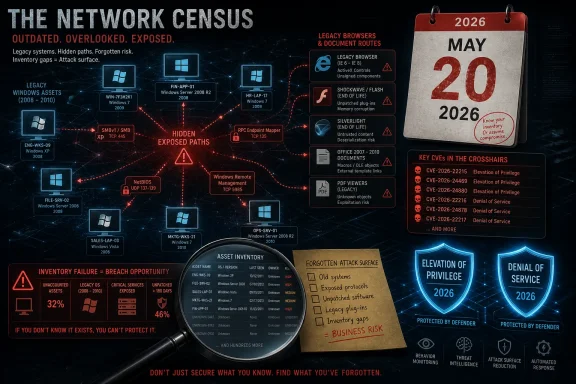
The May 20 batch is striking because it spans nearly two decades of Windows security history. CVE-2008-4250, CVE-2009-1537, CVE-2010-0249, CVE-2010-0806, and CVE-2009-3459 belong to the era of Conficker, drive-by browser exploits, malicious PDFs, and media-parser attacks. CVE-2026-41091 and CVE-2026-45498, by contrast, sit inside Microsoft Defender, the product family many organizations rely on to detect and contain exactly this kind of activity.
That mix is the story. Attackers do not care whether a vulnerability feels antique or embarrassing. They care whether it gives them access, persistence, privilege, evasion, or disruption on machines that still exist.
The Oldest Bug in the Batch Still Casts the Longest Shadow
CVE-2008-4250 is better remembered by its bulletin name: MS08-067. For many Windows veterans, that string evokes a particular moment when remote code execution in the Windows Server service moved from advisory text into wormable reality. Microsoft issued an out-of-band patch in October 2008 because the flaw affected supported Windows versions and could be triggered remotely by crafted RPC traffic.
The flaw became inseparable from Conficker, one of the most consequential Windows worms of its generation. Even years later, MS08-067 has remained a fixture in penetration-testing labs, legacy-system audits, and incident reports where old Windows machines are quietly doing old Windows things behind newer firewalls. Its continued relevance is an indictment not of Microsoft’s 2008 response, which was urgent and unusually visible, but of the long afterlife of unsupported systems.
In a cleanly managed enterprise, CVE-2008-4250 should be a museum piece. Windows 2000, Windows XP, and Windows Server 2003 should not be handling meaningful production workloads in 2026, and if they are, they should be isolated to the point of operational loneliness. Yet CISA’s decision to add the bug now says exploitation evidence still exists, which means someone is finding reachable systems, fragile embedded devices, stale virtual machines, or forgotten industrial and departmental hosts that never made it through the replacement cycle.
This is why old Windows vulnerabilities often refuse to die. They are not always present on the obvious corporate laptop fleet. They live in badge systems, factory equipment, medical devices, lab instruments, kiosk images, vendor-managed appliances, and “temporary” servers whose owners left the company years ago.
Internet Explorer Is Dead, but Its Attack Surface Was Never Buried Cleanly
Two of the seven additions, CVE-2010-0249 and CVE-2010-0806, are Internet Explorer use-after-free vulnerabilities from the period when browser exploitation was a primary route into Windows endpoints. CVE-2010-0249 is tied historically to the Operation Aurora era, when targeted attacks against major companies pushed Internet Explorer security into mainstream public view. CVE-2010-0806 followed in the same broader period of memory-corruption bugs that made malformed web content a credible entry point.
In 2026, Internet Explorer is no longer a mainstream browser. Microsoft retired the desktop application for most supported Windows versions years ago, pushed customers toward Edge, and tried to contain legacy compatibility through IE mode. But browser retirement is not the same thing as engine disappearance, and enterprise software has a habit of preserving old dependencies long after consumers have moved on.
The practical risk is not that a modern Windows 11 user is happily browsing the web with IE6. The risk is that legacy line-of-business applications, old ActiveX controls, compatibility layers, archived intranet portals, and frozen virtual desktops still expose code paths defenders stopped thinking about. Attackers are good at finding the places where an organization’s official architecture diagram and its actual network diverge.
The phrase “use-after-free” also deserves a moment of respect. It is not just jargon from old exploit writeups; it describes a class of memory-safety failure that has haunted browsers, document readers, media libraries, and operating-system components for decades. If an attacker can manipulate a program into reusing memory after it has been freed, the path from crash to code execution can be short, especially on older platforms with weaker mitigations.
Malicious Files Remain the Oldest Social Network
CVE-2009-1537 and CVE-2009-3459 point to another enduring truth: files are still an attack surface. The DirectX NULL byte overwrite vulnerability involved crafted media content processed through Microsoft’s DirectShow stack. The Adobe Acrobat and Reader heap-based buffer overflow vulnerability came from the period when malicious PDFs were one of the most reliable ways to get code running on a victim’s workstation.
Those categories remain familiar because they map neatly onto human behavior. People open documents. People preview media. People receive attachments from customers, suppliers, lawyers, recruiters, auditors, and unknown senders who may or may not be legitimate. Security vendors can wrap those actions in sandboxes, reputation checks, and content disarm-and-reconstruction systems, but the workflow itself remains stubbornly normal.
The age of these flaws makes them sound unsophisticated, but that can be misleading. Old exploit chains can be valuable precisely because defenders tune their attention toward newer branded zero-days. A malicious document targeting a 2009-era Adobe Reader build should fail instantly in a modern, patched environment. In an environment with old engineering workstations, vendor-controlled PCs, or disconnected-but-not-really-disconnected operational networks, the same document may find a softer target.
This is the recurring lesson of KEV additions involving antique software. The attacker does not need your flagship managed fleet to be vulnerable. They need one neglected foothold with enough network visibility, credentials, or operational importance to matter.
The Defender Entries Change the Tone of the Warning
The two newest entries in the batch, CVE-2026-41091 and CVE-2026-45498, change the emotional temperature of the advisory. One is a Microsoft Defender elevation-of-privilege vulnerability. The other is a Microsoft Defender denial-of-service vulnerability. Even without a public exploit narrative attached in CISA’s short alert, the product context alone is enough to make administrators pay attention.
Security products occupy an awkward place in system architecture. They run deeply, update frequently, inspect untrusted content, interact with privileged services, and often have broad visibility across endpoints. That makes them valuable defensive tools, but it also means vulnerabilities inside them can have consequences that feel disproportionate to an ordinary application flaw.
An elevation-of-privilege bug in a defensive component is especially concerning because it can turn a post-compromise foothold into something more durable. Many real intrusions do not begin with instant domain-admin access. They begin with a user context, a weak service account, a vulnerable application, or a compromised endpoint, and then rely on privilege escalation to move from opportunity to control.
A denial-of-service flaw in Defender has a different but still serious profile. If exploitation can crash, disable, or destabilize protective services, it may create a window in which other tooling operates with less scrutiny. In ransomware and hands-on-keyboard intrusions, blinding or degrading security controls is often part of the playbook, not a side effect.
The broader implication is uncomfortable for buyers of consolidated security platforms. The more an organization centralizes detection, response, vulnerability management, and endpoint policy into a few privileged agents, the more those agents become high-value software assets that need the same aggressive patch discipline as browsers, VPNs, hypervisors, and identity systems.
Federal Deadlines Turn Advisory Text Into Operational Pressure
CISA’s KEV process is backed by Binding Operational Directive 22-01 for Federal Civilian Executive Branch agencies. Once a vulnerability enters the catalog, covered agencies are required to remediate it by the listed due date. For most newly added KEV entries, that generally means a short runway measured in weeks, not quarters.
That legal scope is narrow, but the practical audience is much larger. State governments, local agencies, schools, hospitals, managed service providers, critical-infrastructure operators, and private enterprises all use the KEV catalog as a prioritization layer. Even when they are not legally bound by BOD 22-01, they are often bound by reality: exploited vulnerabilities should outrank speculative ones.
The May 20 additions also challenge a common executive misunderstanding about patching. Vulnerability management is not just the monthly act of applying the newest cumulative update. It is the slower work of proving that unsupported and unpatchable technology is gone, contained, or compensated for. A scanner finding on a Windows XP-era host is not merely a missing patch; it may be evidence of an asset-management failure.
For federal agencies, remediation may mean applying vendor fixes where available, removing vulnerable products, disabling affected functionality, segmenting systems, or otherwise meeting CISA’s required action. For everyone else, the same menu applies, minus the formal reporting chain. The work is still unavoidable.
Legacy Exposure Is Usually an Inventory Failure First
The most revealing part of an alert like this is not the CVE list itself. It is the gap between what security teams think they own and what attackers are able to reach. If a 2008 Windows Server service vulnerability is still exploitable somewhere, the first failure happened before patch management: the organization did not have a complete, accurate, actionable inventory.
Inventory sounds dull until an incident begins. Then every unanswered question becomes urgent. Which subnets still contain unsupported Windows hosts? Which vendors maintain remote access? Which business unit owns the old PDF-processing workstation? Which virtual machine was cloned from a golden image in 2011 and never retired?
Old vulnerabilities thrive in ambiguity. A modern endpoint-management platform may give beautiful compliance dashboards for enrolled Windows 10 and Windows 11 devices while saying nothing about the one Windows Server 2003 system attached to a lab instrument. A vulnerability scanner may flag it every week, but if the finding is accepted as background noise because nobody owns the asset, the scanner becomes a ritual rather than a control.
The hardest cases are systems that cannot be patched without breaking something real. Industrial control workstations, medical devices, and vendor-certified machines often live under constraints that ordinary IT patch cycles do not tolerate. But “cannot patch” is not the same as “cannot manage.” It means segmentation, strict access controls, application allow-listing, monitored jump hosts, compensating detection, and a retirement plan with dates rather than aspirations.
The Patch Tuesday Mindset Is Too Narrow for KEV
Windows administrators are trained by years of Patch Tuesday rhythm, and that rhythm is useful. It creates organizational muscle memory. It gives change boards a calendar. It lets administrators test, deploy, roll back, and report in a repeatable cadence.
KEV does not respect that rhythm. CISA adds exploited vulnerabilities when evidence supports the addition, not when it is convenient for maintenance windows. That means the operational model has to include out-of-band triage, especially for internet-facing systems, security tooling, remote-access infrastructure, identity components, and software with known exploitation.
The May 20 batch is a useful example because some fixes are ancient and some are contemporary. The legacy vulnerabilities require discovery and eradication more than ordinary patch deployment. The Defender vulnerabilities require current servicing discipline, telemetry review, and confidence that endpoint security components are actually updating across the fleet.
Administrators should resist treating all seven items as one task. The right response to MS08-067 is to hunt for unsupported Windows and exposed SMB/RPC pathways. The right response to Internet Explorer and Adobe-era bugs is to look for legacy document and browser runtimes. The right response to Defender flaws is to verify platform, engine, and security-intelligence update levels and review whether any endpoints show signs of tampering or service instability.
This is where mature vulnerability management separates itself from checkbox compliance. A checkbox asks whether a CVE is present. A mature program asks why the affected component exists, who depends on it, how reachable it is, whether exploitation would be detected, and what removes the condition permanently.
Attackers Keep a Back Catalog Because Enterprises Keep One Too
There is a tendency in security coverage to obsess over the newest exploit name, logo, and proof-of-concept video. That obsession is understandable. New bugs create new uncertainty, and defenders need to know whether today’s patch has become tonight’s intrusion path. But the attacker marketplace is not a literary culture that throws away last year’s books.
Old exploits are attractive because they are documented, reliable, and cheap to operationalize. They often have mature modules in public frameworks, known indicators, and years of attacker experience behind them. Against a current enterprise desktop, they may be useless. Against the forgotten system that still bridges an old operational network and a modern domain, they can be enough.
This is one reason KEV is valuable as a defensive artifact. It does not flatter the industry’s appetite for novelty. It says, in effect, here is what attackers are actually using. Sometimes that is a shiny zero-day. Sometimes it is a vulnerability old enough to vote.
The lesson for Windows shops is that modernization is a security control. Moving off obsolete operating systems, retiring Internet Explorer dependencies, eliminating old Reader builds, and replacing fragile embedded Windows deployments are not merely platform hygiene projects. They reduce the attacker’s usable catalog.
Defender’s Role Makes Update Assurance a Security Control
The Microsoft Defender entries also underline a less glamorous but critical issue: security agents must be managed as production software. Organizations often assume Defender is simply “there” because it ships with Windows or because Microsoft 365 Defender tooling reports into a portal. But presence is not assurance.
A security product can be installed, outdated, misconfigured, disabled by policy drift, excluded into weakness, or unhealthy in ways that do not always trigger executive-level alarm. If attackers are exploiting Defender vulnerabilities, administrators need to validate not just that Windows is patched, but that Defender components are current and functioning as intended. That includes platform updates, engine updates, cloud-delivered protection settings, tamper protection posture, and the health of endpoint onboarding.
This is especially important in mixed environments. A fleet may include Windows 11 laptops with modern management, Windows Server workloads with different maintenance windows, VDI images that revert state, and isolated systems that receive updates through internal channels. Defender’s update story is only as strong as the weakest distribution path.
The security irony is obvious but useful. Defensive software expands visibility by running everywhere. That ubiquity means any flaw inside it also has a broad potential footprint. The answer is not to distrust Defender as a category; it is to treat it with the seriousness its privileges deserve.
The May 20 List Rewards the Teams That Know Their Weird Corners
This batch is not a simple “install the latest patches” story. It is a test of whether organizations know where their oldest and strangest Windows dependencies live, and whether they can move quickly when a defensive component itself enters the exploited-vulnerability conversation.
- Organizations should treat CVE-2008-4250 as a hunt for unsupported Windows systems and exposed legacy SMB/RPC pathways, not as a normal patch ticket.
- Organizations should look for remaining Internet Explorer, ActiveX, legacy web-app, and old document-reader dependencies that may not appear in standard desktop inventories.
- Organizations should verify Microsoft Defender health and update status across endpoints and servers, especially where servicing channels differ from the mainstream client fleet.
- Organizations should prioritize KEV-listed vulnerabilities above equally severe but unexploited findings when remediation capacity is constrained.
- Organizations should document compensating controls for systems that cannot be patched and attach those controls to a retirement or isolation plan with accountable owners.
- Organizations should assume that old exploit chains remain useful wherever old software remains reachable.
The uncomfortable common thread is ownership. Every one of these findings becomes easier to manage when an organization can name the asset, the business owner, the exposure path, the patch state, and the fallback plan. Without that, KEV becomes another urgent list landing on top of a pile of unresolved uncertainty.
CISA’s May 20 update is a reminder that Windows security in 2026 is not only about the newest kernel bug or the latest cloud console alert; it is also about the sedimentary layers of decisions that enterprises made in 2008, 2009, 2010, and every year since. Attackers keep testing those layers because they know corporate networks rarely age evenly. The organizations that fare best will not be the ones that merely react fastest to the newest CVE, but the ones that can finally make their oldest exposure visible, governed, and, wherever possible, gone.
References
- CISA Adds Seven Known Exploited Vulnerabilities to Catalog CISA · 2026-05-20T12:00:00+00:00