

CISA Turns a Vendor Advisory Into an Operational Deadline
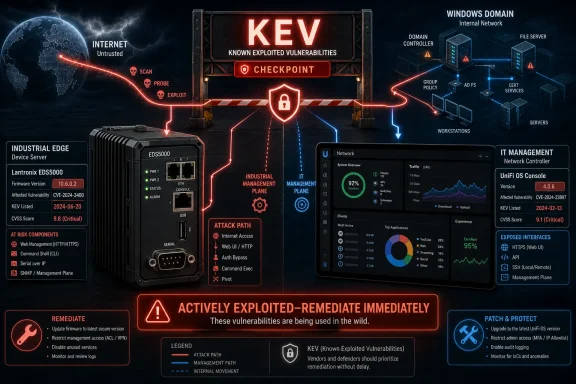
The four newly listed flaws are CVE-2025-67038 in Lantronix EDS5000 devices and three UniFi OS vulnerabilities: CVE-2026-34908, CVE-2026-34909, and CVE-2026-34910. CISA says all four were added to the KEV Catalog because there is evidence of active exploitation, which is the key distinction between an interesting vulnerability and one that belongs at the front of the remediation queue.
That distinction matters. The KEV Catalog has become the closest thing the U.S. government has to a public triage board for exploited software and firmware flaws. A CVSS score tells defenders how bad a vulnerability might be in theory; KEV status tells them that someone has already decided it is worth using in the wild.
The Lantronix issue is described as a code injection vulnerability affecting EDS5000 secure device servers. These are not consumer gadgets in the casual sense. Devices in this class often bridge serial equipment, industrial systems, remote-management functions, and Ethernet networks, which makes compromise more consequential than a single endpoint infection.
The Ubiquiti issues are just as concerning for a different audience. UniFi has become a default choice for prosumer labs, small offices, churches, schools, retail locations, MSP-managed networks, and cost-sensitive enterprises that want centralized management without traditional enterprise networking prices. When UniFi OS has a bad month, the impact is not limited to hobbyists arguing over firmware channels on Reddit.
The Edge Is Where Attackers Keep Finding Leverage
The pattern here is bigger than Lantronix or Ubiquiti. Attackers have spent the last several years moving aggressively toward infrastructure that sits between users and the internet: firewalls, VPN appliances, routers, access controllers, NAS devices, remote management gateways, and network controllers. These systems are attractive because they are trusted, exposed, under-monitored, and often patched more cautiously than desktops.
A compromised Windows laptop is noisy. It has EDR agents, user activity, browser telemetry, Defender events, and administrators who know how to investigate it. A compromised network appliance can be quieter, more durable, and better positioned to observe or redirect traffic before it ever reaches the machines defenders watch most closely.
That asymmetry is the attacker’s edge. The most sophisticated ransomware crews and state-linked operators do not need to begin with a phishing email if they can start from a device that already sits at the perimeter or inside the management plane. They can use that foothold to harvest credentials, pivot into Windows domains, manipulate routing, disable visibility, or simply maintain access while defenders rebuild endpoint images downstream.
This is why CISA’s KEV additions deserve attention even from readers who do not own the exact affected hardware. The entries are a warning about where the center of gravity has shifted. The infrastructure layer is no longer boring plumbing; it is contested terrain.
UniFi’s Appeal Is Also Its Exposure Problem
Ubiquiti’s success has always rested on an appealing proposition: enterprise-like network management without the enterprise-like licensing maze. A single UniFi console can manage gateways, switches, access points, cameras, door access systems, phones, and signage. For administrators stretched across multiple sites, that integration is a gift.
But integration cuts both ways. A management platform that controls multiple services becomes a high-value target when authorization checks, path handling, or input validation fail. The three UniFi OS vulnerabilities added to KEV cover exactly that uncomfortable territory: improper access control, path traversal, and improper input validation.
Those categories may sound generic, but they map to very concrete attacker outcomes. Access-control failures can let the wrong actor change settings they should not be allowed to touch. Path traversal bugs can let attackers reach files outside the intended directories. Input-validation failures can become command execution when untrusted data is passed into system-level operations.
The particular anxiety around UniFi is not simply the bug class. It is the install base and administrative culture around the product. UniFi deployments often live in environments that do not have a full-time network security team. They are administered by MSPs, technically capable owners, volunteer IT staff, or a lone sysadmin already balancing Windows patching, Microsoft 365 security, backups, identity, and user support.
That makes “patch immediately” easier to say than to execute. UniFi firmware updates can touch network availability, site-to-site connectivity, cameras, access control, and wireless service. A rushed update in a remote site can become an outage; a delayed update on an exposed console can become a breach. CISA’s KEV designation does not remove that operational tension, but it does settle the priority argument.
Lantronix Shows Why Industrial Edges Still Haunt Enterprise IT
The Lantronix EDS5000 vulnerability belongs to a category many corporate IT teams still underestimate: device servers and industrial connectivity equipment that quietly link older operational technology to modern networks. These systems frequently outlive normal IT refresh cycles, and they are often documented better in facilities binders than in vulnerability management dashboards.
That is dangerous because the compromise value is not always obvious from the asset name. A device server may not hold email, source code, or customer records. But it may provide a path into building systems, manufacturing equipment, badge infrastructure, lab instruments, energy systems, or serial-connected operational gear that was never designed for today’s threat model.
The reported mechanics of CVE-2025-67038 point toward a classic embedded-device problem: unsafe handling of input in a web or RPC management component leading to command injection. If commands execute with elevated privileges, the attacker is no longer merely abusing an application; they may be controlling the device itself.
For Windows-centric administrators, the operational relevance is direct. These appliances can sit on the same networks that host domain controllers, file servers, print systems, management workstations, backup repositories, and jump boxes. Once attackers establish control over a trusted embedded device, the next move may be toward the Windows estate.
This is why inventory is still the unglamorous heart of security. You cannot patch a Lantronix box you do not know exists, and you cannot assess exposure if your CMDB treats “network gear” as a vague category rather than a living list of firmware-bearing systems with management interfaces and owners.
BOD 26-04 Raises the Bar From Patching to Proving
CISA’s alert also points to Binding Operational Directive 26-04, “Prioritizing Security Updates Based on Risk,” which was released earlier this month. The directive applies to Federal Civilian Executive Branch agencies, but its logic is clearly meant to travel beyond Washington. It reinforces KEV as a central signal and requires agencies to prioritize rapid remediation for high-risk vulnerabilities, especially those on publicly exposed assets that can grant total control after exploitation.
That is a meaningful evolution. Earlier vulnerability programs often treated remediation as a queue sorted by severity, age, and compliance date. BOD 26-04 pushes agencies toward a sharper model: start with what is exploited, reachable, automatable, and catastrophic.
The directive also emphasizes a second obligation that many patching programs historically treated as optional: checking whether compromise happened before the fix landed. This is the difference between closing a door and confirming whether someone already walked through it. In the KEV era, patching without investigation can create a false sense of completion.
For administrators, that means the workflow after a KEV entry should not end with a firmware version screenshot. It should include log review, configuration validation, account audits, management-plane exposure checks, and, where feasible, evidence preservation. If an attacker used the vulnerability before the update, the patched device may still be a hostile device wearing current firmware.
Private organizations are not legally bound by BOD 26-04, but ignoring its priorities would be shortsighted. Federal directives often become de facto standards for vendors, auditors, insurers, and large customers. Even where there is no mandate, the risk model is sound: exploited vulnerabilities on exposed infrastructure should leapfrog routine patch cycles.
“Network-Adjacent” Is Not the Comforting Phrase It Used to Be
One recurring phrase in advisories for network appliances is “network access required” or “network-adjacent attacker.” That wording can lull administrators into thinking the risk is contained. In 2026, that assumption deserves skepticism.
Modern networks are porous. Guest Wi-Fi, contractor devices, compromised laptops, VPN users, unmanaged IoT systems, cloud connectors, site-to-site tunnels, and remote monitoring agents all expand what “adjacent” can mean. A vulnerability that requires access to the management network is still serious if the management network is reachable from too many places.
This is especially relevant for UniFi deployments. Many organizations segment management interfaces carefully; many others do not. Some have exposed consoles for convenience, remote support, or legacy configuration. Others rely on cloud-assisted access while underestimating which local services remain reachable from internal or semi-trusted networks.
The defensive answer is not panic. It is architecture. Management interfaces should not be generally reachable from user VLANs, guest networks, camera networks, VoIP systems, or random site-to-site peers. Admin access should require trusted workstations, strong authentication, explicit firewall rules, and preferably a jump host or VPN design that is itself monitored and patched.
The hard truth is that “internal only” is no longer a control by itself. It is a description. A control is a policy that says exactly which systems can talk to the management plane, how they authenticate, what gets logged, and what happens when that access pattern changes.
The Windows Angle Is Identity, Lateral Movement, and Recovery
This may look like a networking story, but Windows administrators should read it as an identity and recovery story. Network appliance compromise often becomes dangerous when it intersects with Active Directory, Entra ID, RADIUS, LDAP, syslog, backup networks, or administrative workstations.
A UniFi or Lantronix foothold can help an attacker map the environment. It can reveal subnets, device names, management IPs, VPN relationships, DNS behavior, and sometimes credentials or tokens depending on configuration. That intelligence can make later Windows exploitation faster and more precise.
If the appliance touches authentication infrastructure, the stakes rise. RADIUS integrations, directory-backed admin accounts, shared local passwords, and reused secrets can turn a device bug into a credential problem. Many organizations still treat network device credentials as a separate little kingdom, but attackers are happy to test whether those passwords also unlock servers, backup consoles, hypervisors, or domain admin workflows.
Recovery is another Windows-relevant issue. If a compromised network controller or device server can interfere with routing, firewall policy, DHCP, DNS, or management access, incident responders may find that the environment they need to investigate is also the environment the attacker can manipulate. That complicates imaging, evidence collection, remote access, and restoration from backup.
The best Windows shops already know this because ransomware has taught them painfully. Backups are only useful if the network path to restore them is trustworthy. Domain recovery is only clean if the infrastructure supporting authentication and routing is not quietly hostile. KEV entries for infrastructure devices should therefore trigger a broader question: would we know if the network layer was part of the intrusion?
Patch Management Needs a Firmware Lane With Real Authority
Most organizations have some process for Windows Update, Microsoft 365 changes, browser patches, and server maintenance. Firmware, however, often lives in a murkier lane. It may be owned by networking, facilities, security, an MSP, or whoever last touched the rack.
That model is increasingly untenable. The systems being targeted now are not peripheral to the business; they are the substrate on which the business runs. Firmware updates for network controllers and embedded devices need the same authority, scheduling discipline, rollback planning, and executive visibility as operating-system patches.
This does not mean every update should be installed blindly the moment it ships. Ubiquiti administrators, in particular, have learned that firmware updates can introduce regressions, and many run staged rollouts for good reason. But KEV status changes the calculus. Once active exploitation is confirmed, the risk of waiting moves from theoretical stability concerns to measurable intrusion exposure.
A mature process has room for both urgency and discipline. Test where possible, back up configurations, confirm release notes, schedule maintenance, communicate impact, and then move. The worst answer is neither cautious nor fast; it is the ambiguous middle where everyone assumes someone else owns the appliance.
Security teams should also stop treating “firmware updated” as a sufficient record. They need asset identity, affected version, exposure status, update timestamp, post-update validation, and investigation notes. That may sound bureaucratic, but it is exactly the evidence an organization will want if customers, auditors, insurers, or executives ask whether an actively exploited infrastructure flaw was handled properly.
Exploited Bugs Are Forcing a More Honest Asset Inventory
The KEV Catalog is sometimes described as a patching tool, but its more disruptive effect is on inventory. Every KEV update asks a deceptively simple question: do we have this product anywhere? For too many organizations, the answer requires Slack archaeology, spreadsheet archaeology, vendor portal archaeology, or a physical walk through a closet.
That weakness is not limited to small shops. Large enterprises also struggle with network and operational-technology inventory because acquisitions, remote sites, lab environments, facilities systems, and local procurement create hidden islands. The device may be supported by a vendor, paid for by a department, connected by networking, monitored by no one, and invisible to central vulnerability scanning.
Lantronix-style device servers are especially prone to this invisibility. They may be installed to solve a practical connectivity problem and then left alone for years because they “just work.” That phrase should now make security teams nervous. In 2026, a device that just works may also be a device that just sits unpatched with a web interface nobody remembers enabling.
UniFi has a different inventory challenge. The product is visible to the people who manage it, but not always visible to enterprise governance. A branch office, lab, executive home office, test network, or acquired subsidiary may run UniFi gear outside the standard networking catalog. Attackers do not care whether the deployment was officially blessed.
The way forward is not merely better scanning. Some embedded devices react poorly to aggressive probes, and some management interfaces are intentionally isolated. Organizations need procurement records, network discovery, DHCP and DNS review, MSP coordination, configuration backups, and human ownership mapped together. Asset inventory is not a product you buy once; it is a discipline you keep proving.
CISA’s Message Is Really About Exposure Triage
CISA’s alert repeats a message it has been sharpening for years: exploited vulnerabilities deserve priority. BOD 26-04 makes that message more explicit by distinguishing high-risk vulnerabilities from lower-risk ones and tying action to exposure and post-exploitation impact. That is the right direction.
Security teams have long complained that vulnerability management produces too many findings and too little guidance. A scanner can produce thousands of issues, many technically real and operationally irrelevant. KEV status helps cut through the noise by telling defenders where attackers have already voted with their tooling.
But KEV is not magic. It is necessarily incomplete and reactive. A vulnerability may be exploited before it lands in the catalog, and many intrusions never become public enough to influence government listings. Organizations should use KEV as a floor, not a ceiling.
The better model combines KEV with internal exposure data. A low-profile bug on an internet-facing management appliance may outrank a famous CVE on a buried test server. A KEV-listed flaw on a device that can grant full control should outrank almost everything. Risk-based patching works only when the organization knows both the external threat and its own architecture.
That is where many teams still fall short. They know the CVE, but not the route to exploitation. They know the vendor name, but not the exposed interface. They know the patch exists, but not whether the system was compromised last week. CISA’s alert should be read as a prompt to close those gaps.
The June 23 KEV Additions Leave Little Room for Comfortable Delay
For administrators looking at this advisory today, the practical message is narrower than the strategic one: identify affected Lantronix EDS5000 and UniFi OS systems, update them, and investigate them as potentially exposed infrastructure. That work should move ahead of ordinary maintenance because CISA’s addition means exploitation is no longer hypothetical.
The concrete priorities are straightforward:
- Organizations should determine whether they operate Lantronix EDS5000 devices or UniFi OS systems affected by CVE-2025-67038, CVE-2026-34908, CVE-2026-34909, or CVE-2026-34910.
- Administrators should patch affected systems using vendor-provided firmware or software updates and should not rely on CVSS scoring alone to decide urgency.
- Security teams should review whether management interfaces are exposed to the internet, reachable from user networks, or accessible from insufficiently trusted internal segments.
- Teams should inspect logs, administrator accounts, configuration changes, and network behavior for signs that exploitation occurred before remediation.
- Organizations should treat KEV-listed infrastructure flaws as incident-response triggers, not merely as patch tickets.
- MSPs and distributed IT teams should verify customer and remote-site inventories because unofficial or forgotten deployments are often where these risks linger.
The most important point is that the update button is only one part of the response. If an attacker already used one of these flaws, remediation may remove the initial entry point while leaving behind altered settings, new accounts, stolen credentials, or a mapped path into the rest of the network.
CISA’s latest KEV additions are another reminder that the perimeter did not disappear; it fragmented into hundreds of consoles, controllers, device servers, tunnels, and embedded web interfaces that now deserve first-class security treatment. The organizations that handle this well will be the ones that make infrastructure patching boring, visible, and accountable. The ones that do not may discover that the most important Windows security incident of the year began on a box that was never running Windows at all.