

CISA published advisory ICSA-26-188-06 on July 7, 2026, warning that Labcenter Electronics Proteus 9.1 SP4 Build 42914 contains three high-severity memory-safety vulnerabilities that can disclose information and allow arbitrary code execution when a user opens malicious content. The practical story is not that Proteus has suddenly become an internet-facing industrial control system; CISA says these flaws are not remotely exploitable. The story is that engineering workstations remain one of the softest paths into operational technology environments, and design files are still trusted far more than they should be.
The advisory, published by the Cybersecurity and Infrastructure Security Agency’s industrial control systems program, lands in an awkward but familiar space for defenders. Proteus is electronic design automation software, not a PLC, historian, gateway, or Windows domain controller. It is the kind of tool that sits on engineers’ PCs, lab machines, contractor laptops, university workstations, and development benches where simulated circuits and PCB layouts become real-world hardware.
That makes the attack surface easy to underestimate. A local, user-assisted vulnerability sounds less urgent than a wormable service bug or an exposed VPN appliance. But in an engineering environment, “open this project” is a normal business process, and the boundary between a trusted design artifact and a payload-bearing document can be thinner than policy teams like to imagine.
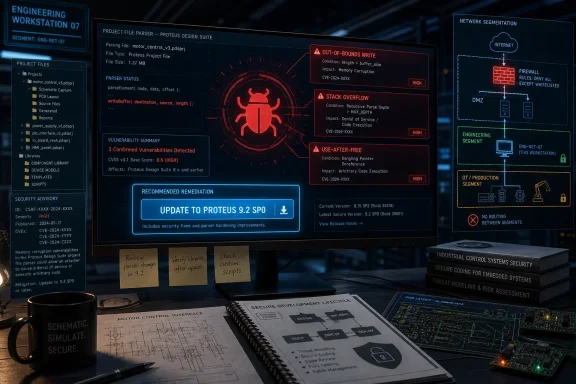
CISA’s advisory identifies three issues in Labcenter Proteus 9: an out-of-bounds write, a stack-based buffer overflow, and a use-after-free condition. All three are classic memory-corruption bug classes, and all three carry the same broad consequence: crafted input may cause Proteus to execute attacker-controlled code in the context of the current process.
The affected version named by CISA is Proteus 9.1_SP4_Build_42914. Labcenter’s remediation advice, as relayed in the advisory, is straightforward: update to the latest Proteus release, identified as version 9.2 SP0. That may sound routine, but routine is exactly where many engineering security failures begin.
That context matters because the exploit path described by CISA depends on user interaction. The CVSS 3.1 vector for the listed vulnerabilities is local attack vector, low attack complexity, no privileges required, and required user interaction. The CVSS 3.1 base score is 7.8, while the CVSS 4.0 base score is 8.4. Those numbers are high, but the vector string tells the more useful story: the attacker does not need an account, but someone needs to be induced into opening or processing the malicious input.
For consumer software, that often means phishing. For engineering software, it can mean something more subtle: a supplier-provided sample, a customer-submitted project, a shared library, a design archive, a forum download, or a file passed through a ticketing system. The payload can arrive wearing the clothes of collaboration.
That is why “not remotely exploitable” should not be translated into “not important.” CISA’s phrase means the vulnerability is not directly reachable over the network by itself. It does not mean the software is safe in workflows where files routinely cross organizational boundaries.
The second, CVE-2026-49033, is a stack-based buffer overflow tracked as CWE-121. Stack overflows have decades of exploit history behind them, and modern mitigations have made exploitation harder than it once was. But “harder” is not “impossible,” particularly when a vulnerable parser handles attacker-controlled data in a complex desktop application.
The third, CVE-2026-42958, is a use-after-free vulnerability tracked as CWE-416. That class of bug occurs when software continues to use memory after it has been released. CISA describes the issue as memory corruption while parsing specially crafted files, with possible arbitrary code execution in the current process.
Different bug classes, same operational shape: malicious content enters an engineering workflow; a user opens it; Proteus processes it; code runs with that user’s permissions. If the user is a local administrator, or if the workstation has access to sensitive project files, source code, signing keys, VPN sessions, SMB shares, or lab network tooling, the blast radius expands quickly.
That sector list should not be read as proof that every water utility or hospital is running Proteus in production. It is better understood as a map of where electronics design and embedded development appear in the supply chain. The software may be used by equipment makers, integrators, contractors, research teams, or internal engineering groups that serve those sectors.
This is the recurring blind spot in industrial cybersecurity. The equipment inside a plant may be segmented, monitored, and slow to change, while the engineering ecosystem around it is full of general-purpose Windows machines, third-party design tools, shared files, and contractor workflows. The attacker does not always need to compromise the PLC when compromising the workstation that prepares, tests, documents, or supports the device may be enough.
For Windows administrators, that means inventory has to include more than Microsoft, Adobe, browsers, VPN clients, and remote monitoring agents. EDA tools, CAD packages, simulation environments, firmware utilities, serial-console helpers, and vendor configuration tools all deserve patch visibility. They are not peripheral if they touch the systems that build or maintain operational technology.
That is friendly advice for an individual engineer. It is less satisfying for an enterprise administrator trying to answer a harder question: where is Proteus installed, which build is present, and who is allowed to open untrusted project files before the update is applied?
Specialist engineering tools often fall outside automated patching systems. They may be installed manually, licensed per seat, tied to USB dongles or activation systems, or kept on older builds because a particular project file, workflow, plugin, library, or training environment depends on it. That is not laziness; it is the reality of engineering software estates. But it also means “update to the latest version” is rarely the whole operational answer.
The right immediate move is to treat Proteus like any other vulnerable desktop code-execution surface. Locate installations, confirm the exact build, update to 9.2 SP0 where possible, and restrict handling of unsolicited or externally supplied Proteus files until that work is complete. If an upgrade must be delayed for compatibility reasons, isolate the workstation and limit its access to production networks and shared repositories.
Engineering applications are especially attractive because they process complex formats. They may parse nested objects, legacy project structures, compressed assets, imported libraries, and cross-version compatibility data. Complexity is useful; complexity is also where memory bugs hide.
A malicious Proteus project file does not need to look like malware to the recipient. It can look like work. It can be sent in a procurement exchange, a support case, a student lab, a supplier review, or a community forum thread. The social-engineering burden is lower when the file type is expected.
CISA’s recommended practices reflect that broader threat model. The agency advises minimizing network exposure, keeping control systems and remote devices behind firewalls, isolating control system networks from business networks, using more secure remote access methods such as updated VPNs when remote access is necessary, and educating users not to open unsolicited links or attachments. Some of that guidance is boilerplate, but in this case the boilerplate fits.
A code-execution bug in an engineering application therefore lands in a messy privilege environment. The compromised process may inherit access to project directories, Git repositories, network drives, build artifacts, licensing servers, and email attachments. If endpoint controls are permissive because “the engineering team needs flexibility,” the attacker may get exactly the room needed for staging and lateral movement.
There is also a cultural problem. Security programs tend to treat office documents as a mature risk category, with protected view modes, attachment scanning, sandboxing, and user training. Project files for specialist tools do not always get the same scrutiny. They may bypass content-disarm workflows, be excluded from scanning for performance reasons, or be shared through channels that security teams rarely inspect.
That gap is where this advisory should focus attention. The vulnerabilities are local, but the workflow is distributed. The exploit begins on a workstation, but the target may be intellectual property, design integrity, or a foothold into a better-connected environment.
CISA says no known public exploitation specifically targeting these vulnerabilities has been reported to the agency at this time. That matters. It means defenders are not being told to drop everything for a known in-the-wild campaign, at least based on CISA’s initial July 7 publication. But absence of reported exploitation is not a guarantee of absence, and memory-corruption bugs in file parsers are not theoretical curiosities.
The better prioritization question is whether an organization receives Proteus files from outside trusted channels. A company that only uses Proteus internally on isolated training machines faces one level of risk. A supplier, contractor, university lab, or product team that routinely opens customer, partner, or community-submitted files faces another.
Patch priority should follow exposure, not just score. Where Proteus workstations have access to sensitive design data, production-adjacent networks, or privileged engineering accounts, this update deserves fast handling. Where the software is isolated and rarely used, the fix still matters, but the urgency is different.
A competent response starts with asset discovery. Administrators should query endpoint management tools, software inventory systems, EDR telemetry, license records, and engineering team leads for Proteus installations. The exact version string matters because CISA names Proteus 9.1_SP4_Build_42914 as affected, and Labcenter recommends 9.2 SP0 as the current fixed line.
The next step is controlled deployment. Engineering software should not be patched blindly on a Friday afternoon if it drives active project deadlines, but it also should not sit unpatched for months under the vague banner of compatibility. A short validation cycle on representative project files is reasonable; indefinite deferral is not.
Finally, organizations should treat this as an opportunity to update file-handling rules. External Proteus files should be opened first on patched, monitored systems. If the sender is unknown or the file arrives unexpectedly, it should be handled like any other potentially hostile attachment. The fact that the file belongs to an engineering tool should raise scrutiny, not lower it.
Attackers follow trust. If an industry trusts PDFs, Word documents, or spreadsheets, attackers weaponize them. If an industry trusts project archives, board layouts, simulation files, or vendor configuration bundles, those become plausible delivery vehicles too.
The uncomfortable implication is that secure-by-default thinking has not fully reached the engineering desktop. Browser makers spent years hardening renderers, isolating processes, and shipping rapid updates because the web was obviously hostile. Many professional desktop tools still operate in a more innocent model, where files are assumed to be legitimate until the parser crashes.
That innocence is increasingly expensive. Engineering intellectual property is valuable, supply chains are contested, and operational environments are attractive targets for both criminals and state-aligned actors. A malicious file that compromises a design workstation can be the beginning of espionage, sabotage preparation, or plain ransomware staging.
That does not mean engineering teams should be buried under unusable restrictions. It means the security model should match the risk. Use patched tools, separate external intake from trusted workspaces, monitor high-value workstations, and avoid giving every engineering process broad access to everything an engineer can reach.
There is also a case here for stronger vendor-side hardening. Memory-safe rewrites are not always practical for mature commercial applications, but vendors can still invest in fuzzing, sandboxing, exploit mitigations, safer parsing libraries, and clearer security update channels. Users should not have to rely solely on whether they noticed an update banner inside a home page.
For software makers in the engineering market, this is becoming a competitive issue. Customers in regulated, defense, energy, manufacturing, and healthcare environments increasingly need evidence that development tools are maintained with security in mind. A fix is necessary; a mature security posture is better.
 A Local Bug Can Still Be an Operational Problem
The advisory, published by the Cybersecurity and Infrastructure Security Agency’s industrial control systems program, lands in an awkward but familiar space for defenders. Proteus is electronic design automation software, not a PLC, historian, gateway, or Windows domain controller. It is the kind of tool that sits on engineers’ PCs, lab machines, contractor laptops, university workstations, and development benches where simulated circuits and PCB layouts become real-world hardware.That makes the attack surface easy to underestimate. A local, user-assisted vulnerability sounds less urgent than a wormable service bug or an exposed VPN appliance. But in an engineering environment, “open this project” is a normal business process, and the boundary between a trusted design artifact and a payload-bearing document can be thinner than policy teams like to imagine.
CISA’s advisory identifies three issues in Labcenter Proteus 9: an out-of-bounds write, a stack-based buffer overflow, and a use-after-free condition. All three are classic memory-corruption bug classes, and all three carry the same broad consequence: crafted input may cause Proteus to execute attacker-controlled code in the context of the current process.
The affected version named by CISA is Proteus 9.1_SP4_Build_42914. Labcenter’s remediation advice, as relayed in the advisory, is straightforward: update to the latest Proteus release, identified as version 9.2 SP0. That may sound routine, but routine is exactly where many engineering security failures begin.
Proteus Is Not a Server, Which Is Why It Gets Trusted
Proteus occupies a niche that many WindowsForum readers will recognize from the long tail of specialist software: expensive, domain-specific, deeply useful, and often managed differently from mainstream enterprise applications. It is used for schematic capture, simulation, PCB design, and embedded-system development. In short, it lives where digital files become electrical behavior.That context matters because the exploit path described by CISA depends on user interaction. The CVSS 3.1 vector for the listed vulnerabilities is local attack vector, low attack complexity, no privileges required, and required user interaction. The CVSS 3.1 base score is 7.8, while the CVSS 4.0 base score is 8.4. Those numbers are high, but the vector string tells the more useful story: the attacker does not need an account, but someone needs to be induced into opening or processing the malicious input.
For consumer software, that often means phishing. For engineering software, it can mean something more subtle: a supplier-provided sample, a customer-submitted project, a shared library, a design archive, a forum download, or a file passed through a ticketing system. The payload can arrive wearing the clothes of collaboration.
That is why “not remotely exploitable” should not be translated into “not important.” CISA’s phrase means the vulnerability is not directly reachable over the network by itself. It does not mean the software is safe in workflows where files routinely cross organizational boundaries.
Three Memory Bugs, One Familiar Failure Mode
The first vulnerability, CVE-2026-42953, is an out-of-bounds write tracked as CWE-787. In plain English, the application can be made to write data beyond the end of an allocated memory buffer. That is one of the oldest and most consequential classes of software flaw because writing past a buffer boundary can corrupt adjacent memory and, under the right conditions, redirect execution.The second, CVE-2026-49033, is a stack-based buffer overflow tracked as CWE-121. Stack overflows have decades of exploit history behind them, and modern mitigations have made exploitation harder than it once was. But “harder” is not “impossible,” particularly when a vulnerable parser handles attacker-controlled data in a complex desktop application.
The third, CVE-2026-42958, is a use-after-free vulnerability tracked as CWE-416. That class of bug occurs when software continues to use memory after it has been released. CISA describes the issue as memory corruption while parsing specially crafted files, with possible arbitrary code execution in the current process.
Different bug classes, same operational shape: malicious content enters an engineering workflow; a user opens it; Proteus processes it; code runs with that user’s permissions. If the user is a local administrator, or if the workstation has access to sensitive project files, source code, signing keys, VPN sessions, SMB shares, or lab network tooling, the blast radius expands quickly.
CISA’s Sector List Is a Warning About Where Tools Travel
CISA lists a broad set of critical infrastructure sectors for this advisory: communications, critical manufacturing, defense industrial base, energy, healthcare and public health, transportation systems, and water and wastewater. It also identifies deployment as worldwide and notes Labcenter’s headquarters in the United Kingdom.That sector list should not be read as proof that every water utility or hospital is running Proteus in production. It is better understood as a map of where electronics design and embedded development appear in the supply chain. The software may be used by equipment makers, integrators, contractors, research teams, or internal engineering groups that serve those sectors.
This is the recurring blind spot in industrial cybersecurity. The equipment inside a plant may be segmented, monitored, and slow to change, while the engineering ecosystem around it is full of general-purpose Windows machines, third-party design tools, shared files, and contractor workflows. The attacker does not always need to compromise the PLC when compromising the workstation that prepares, tests, documents, or supports the device may be enough.
For Windows administrators, that means inventory has to include more than Microsoft, Adobe, browsers, VPN clients, and remote monitoring agents. EDA tools, CAD packages, simulation environments, firmware utilities, serial-console helpers, and vendor configuration tools all deserve patch visibility. They are not peripheral if they touch the systems that build or maintain operational technology.
The Patch Is Simple; Proving It Is Installed Is Not
Labcenter’s remediation, according to CISA, is to ensure users are on the latest version, Proteus 9.2 SP0. The advisory says users can find the version at the bottom-left of the Proteus home page for version 8 and higher, or through the About ISIS or About ARES options under the Help menu. It also says update notifications appear in the news and information section of the home page, where the download and installation can be started.That is friendly advice for an individual engineer. It is less satisfying for an enterprise administrator trying to answer a harder question: where is Proteus installed, which build is present, and who is allowed to open untrusted project files before the update is applied?
Specialist engineering tools often fall outside automated patching systems. They may be installed manually, licensed per seat, tied to USB dongles or activation systems, or kept on older builds because a particular project file, workflow, plugin, library, or training environment depends on it. That is not laziness; it is the reality of engineering software estates. But it also means “update to the latest version” is rarely the whole operational answer.
The right immediate move is to treat Proteus like any other vulnerable desktop code-execution surface. Locate installations, confirm the exact build, update to 9.2 SP0 where possible, and restrict handling of unsolicited or externally supplied Proteus files until that work is complete. If an upgrade must be delayed for compatibility reasons, isolate the workstation and limit its access to production networks and shared repositories.
The File Parser Is the New Perimeter
The most important security lesson in this advisory is not specific to Labcenter. It is about file parsers in trusted professional software. Attackers have long understood that users are trained to be cautious about executables but comfortable with documents, projects, drawings, models, and configuration archives.Engineering applications are especially attractive because they process complex formats. They may parse nested objects, legacy project structures, compressed assets, imported libraries, and cross-version compatibility data. Complexity is useful; complexity is also where memory bugs hide.
A malicious Proteus project file does not need to look like malware to the recipient. It can look like work. It can be sent in a procurement exchange, a support case, a student lab, a supplier review, or a community forum thread. The social-engineering burden is lower when the file type is expected.
CISA’s recommended practices reflect that broader threat model. The agency advises minimizing network exposure, keeping control systems and remote devices behind firewalls, isolating control system networks from business networks, using more secure remote access methods such as updated VPNs when remote access is necessary, and educating users not to open unsolicited links or attachments. Some of that guidance is boilerplate, but in this case the boilerplate fits.
Windows Workstations Are Still the Bridge
For WindowsForum’s audience, the Windows angle is not merely that Proteus runs on Windows. It is that Windows workstations often form the bridge between enterprise IT and engineering operations. They authenticate to corporate identity systems, mount shares, sync mail, run browsers, host VPN clients, and then also connect to lab equipment, embedded development boards, simulators, and vendor tooling.A code-execution bug in an engineering application therefore lands in a messy privilege environment. The compromised process may inherit access to project directories, Git repositories, network drives, build artifacts, licensing servers, and email attachments. If endpoint controls are permissive because “the engineering team needs flexibility,” the attacker may get exactly the room needed for staging and lateral movement.
There is also a cultural problem. Security programs tend to treat office documents as a mature risk category, with protected view modes, attachment scanning, sandboxing, and user training. Project files for specialist tools do not always get the same scrutiny. They may bypass content-disarm workflows, be excluded from scanning for performance reasons, or be shared through channels that security teams rarely inspect.
That gap is where this advisory should focus attention. The vulnerabilities are local, but the workflow is distributed. The exploit begins on a workstation, but the target may be intellectual property, design integrity, or a foothold into a better-connected environment.
CVSS Tells the Severity, Not the Priority
The 7.8 CVSS 3.1 score and 8.4 CVSS 4.0 score are useful for triage, but they should not be mistaken for a complete risk decision. CVSS captures technical severity under a standardized model. It does not know whether the affected workstation belongs to a student lab, a defense contractor, a water utility integrator, or an engineer with access to unreleased board designs.CISA says no known public exploitation specifically targeting these vulnerabilities has been reported to the agency at this time. That matters. It means defenders are not being told to drop everything for a known in-the-wild campaign, at least based on CISA’s initial July 7 publication. But absence of reported exploitation is not a guarantee of absence, and memory-corruption bugs in file parsers are not theoretical curiosities.
The better prioritization question is whether an organization receives Proteus files from outside trusted channels. A company that only uses Proteus internally on isolated training machines faces one level of risk. A supplier, contractor, university lab, or product team that routinely opens customer, partner, or community-submitted files faces another.
Patch priority should follow exposure, not just score. Where Proteus workstations have access to sensitive design data, production-adjacent networks, or privileged engineering accounts, this update deserves fast handling. Where the software is isolated and rarely used, the fix still matters, but the urgency is different.
The Vendor Fix Needs Administrative Discipline Around It
The vendor answer is a new version. The administrative answer is a control plan. Those are related but not the same.A competent response starts with asset discovery. Administrators should query endpoint management tools, software inventory systems, EDR telemetry, license records, and engineering team leads for Proteus installations. The exact version string matters because CISA names Proteus 9.1_SP4_Build_42914 as affected, and Labcenter recommends 9.2 SP0 as the current fixed line.
The next step is controlled deployment. Engineering software should not be patched blindly on a Friday afternoon if it drives active project deadlines, but it also should not sit unpatched for months under the vague banner of compatibility. A short validation cycle on representative project files is reasonable; indefinite deferral is not.
Finally, organizations should treat this as an opportunity to update file-handling rules. External Proteus files should be opened first on patched, monitored systems. If the sender is unknown or the file arrives unexpectedly, it should be handled like any other potentially hostile attachment. The fact that the file belongs to an engineering tool should raise scrutiny, not lower it.
The Advisory Fits a Broader Pattern in Engineering Software
This Labcenter advisory is part of a larger security pattern around specialized desktop applications. Over the past several years, vulnerability disclosures have repeatedly shown that CAD, EDA, modeling, simulation, and industrial configuration tools can contain exploitable parsers. These applications often support rich project formats and decades of compatibility expectations, and they are frequently used in high-value environments.Attackers follow trust. If an industry trusts PDFs, Word documents, or spreadsheets, attackers weaponize them. If an industry trusts project archives, board layouts, simulation files, or vendor configuration bundles, those become plausible delivery vehicles too.
The uncomfortable implication is that secure-by-default thinking has not fully reached the engineering desktop. Browser makers spent years hardening renderers, isolating processes, and shipping rapid updates because the web was obviously hostile. Many professional desktop tools still operate in a more innocent model, where files are assumed to be legitimate until the parser crashes.
That innocence is increasingly expensive. Engineering intellectual property is valuable, supply chains are contested, and operational environments are attractive targets for both criminals and state-aligned actors. A malicious file that compromises a design workstation can be the beginning of espionage, sabotage preparation, or plain ransomware staging.
The Real Fix Is Treating Design Files Like Executables
The most concrete lesson from CISA’s July 7 advisory is that organizations should stop treating engineering project files as harmless business documents. They are structured inputs to complex software. When that software contains memory-corruption flaws, the files become potential execution triggers.That does not mean engineering teams should be buried under unusable restrictions. It means the security model should match the risk. Use patched tools, separate external intake from trusted workspaces, monitor high-value workstations, and avoid giving every engineering process broad access to everything an engineer can reach.
There is also a case here for stronger vendor-side hardening. Memory-safe rewrites are not always practical for mature commercial applications, but vendors can still invest in fuzzing, sandboxing, exploit mitigations, safer parsing libraries, and clearer security update channels. Users should not have to rely solely on whether they noticed an update banner inside a home page.
For software makers in the engineering market, this is becoming a competitive issue. Customers in regulated, defense, energy, manufacturing, and healthcare environments increasingly need evidence that development tools are maintained with security in mind. A fix is necessary; a mature security posture is better.
The July 7 Proteus Warning Leaves Little Room for Complacency
CISA’s advisory is narrow, but the operational checklist it implies is not. The agency has named the affected build, described the bug classes, published the severity scores, stated that no known public exploitation has been reported to it, and passed along the vendor’s recommendation to update to Proteus 9.2 SP0. That gives defenders enough to act without pretending the sky is falling.- Organizations running Labcenter Proteus should identify any installations of Proteus 9.1_SP4_Build_42914 and plan upgrades to Proteus 9.2 SP0.
- Engineering teams should treat unexpected Proteus project files, libraries, and archives as potentially hostile until they are validated on patched systems.
- Administrators should prioritize updates for workstations that handle external designs, sensitive intellectual property, or production-adjacent engineering workflows.
- Temporary mitigations should focus on isolation, least privilege, restricted file intake, and reduced access from vulnerable workstations to broader business or OT networks.
- The absence of known public exploitation reported to CISA should lower panic, not justify inaction.
References
- Primary source: CISA
Published: 2026-07-07T12:00:00+00:00
Loading…
www.cisa.gov - Related coverage: cyber.gc.ca
[Control systems] CISA ICS security advisories (AV26–051) - Canadian Centre for Cyber Security
[Control systems] CISA ICS security advisories (AV26–051)www.cyber.gc.ca - Related coverage: hivepro.com
Loading…
hivepro.com