

CISA on May 28, 2026 published a medical advisory for Fourth Frontier’s Frontier X mobile applications and Frontier X2 wearable, warning that missing Bluetooth authentication could let a nearby attacker alter device functions and inject fabricated health readings. The advisory is not just another entry in the long scroll of IoT bugs. It is a reminder that the health-wearables market has spent years selling clinical-adjacent confidence while sometimes inheriting the security assumptions of disposable gadgets.
The affected products are the Frontier X Android app before version 15.0.0, the Frontier X iOS app before version 25.0.0, and all versions of the Frontier X2 device firmware as described in the advisory. CISA assigned the issue CVE-2026-5768 and a CVSS 3.1 score of 8.8, a high-severity rating that reflects the unusually broad confidentiality, integrity, and availability impact. The uncomfortable part is not merely that data can be read. It is that health data can be made up.
The Frontier X2 occupies a category that did not really exist at consumer scale a decade ago: a wearable that looks like a fitness accessory but talks like a medical instrument. Fourth Frontier markets the device around continuous ECG, heart rate, breathing rate, strain, HRV, activity metrics, and shareable reports. Even when a product is framed as health-and-fitness rather than diagnostic equipment, users do not experience those distinctions as cleanly as lawyers and regulators do.
That matters because telemetry from a chest-worn ECG device carries a different emotional and practical weight than a step counter. A bogus cadence reading is annoying. A bogus heart rhythm, breathing rate, or strain value can change behavior, trigger anxiety, distort training decisions, or contaminate conversations with clinicians and coaches.
The CISA advisory describes two related failures. The Frontier X2 allows unauthenticated Bluetooth Low Energy read and write access to critical GATT characteristics. Separately, the Frontier X mobile app lacks proper device authentication, allowing an attacker to impersonate a legitimate Frontier X2 by cloning expected Bluetooth advertisements and exposing the expected characteristics.
Those are not exotic cloud-chain attacks. They are local, proximity-based attacks. But proximity is not the same thing as safety when the device is designed for gyms, races, clinics, locker rooms, training facilities, and shared homes.
The issue here is authentication, not radio magic. BLE devices expose services and characteristics through the Generic Attribute Profile, or GATT. If a device exposes sensitive characteristics without requiring pairing, authorization, or an application-layer proof that the phone is actually the intended phone, an attacker within range may not need to break encryption at all.
That is why missing authentication for a critical function is such a plain-spoken weakness category. It means the system has a command surface, that command surface matters, and the device is not adequately checking who is touching it. In the Frontier X2 case, CISA says the result can include unauthorized control of functions such as starting and stopping activities, triggering vibrations, causing denial-of-service conditions, and fuzzing values to induce unexpected behavior.
The app-side problem is just as important. If the mobile application accepts a counterfeit peripheral that looks enough like the real one, the attacker does not need to compromise the real device to poison the user’s view. The fake device can feed the app fabricated telemetry, and the app can present those values as if they came from the user’s own monitor.
CISA’s advisory is especially notable because it treats the mobile app and device as a combined system. That is the right model. A sensor that produces accurate readings is still vulnerable if the app cannot authenticate the source of those readings. A mobile app with polished charts is still vulnerable if it cannot distinguish a real device from an impersonator.
This is where the consumer-wearable industry has a recurring blind spot. Product teams often think of Bluetooth pairing as the user experience hurdle: make it fast, make it forgiving, avoid support calls. Security teams think of pairing as part of identity. If the former view wins too often, the product becomes easy to connect and easy to spoof.
For WindowsForum readers, the analogy is familiar from enterprise identity. A beautifully hardened endpoint is not enough if the relying party accepts tokens from the wrong issuer. A strong password is not enough if the service fails to verify the domain. A health app is not enough if it accepts a radio neighbor as the patient.
But “not remotely exploitable” can mislead ordinary users because it sounds like a narrow lab issue. BLE attacks are adjacent attacks, not internet attacks. The attacker must be within Bluetooth range. That constraint substantially changes the threat model, but it does not erase it.
Hospitals, gyms, sports facilities, university labs, rehabilitation centers, and endurance events are all places where many people and many Bluetooth devices coexist. An attacker does not need global reach to cause harm if the target population is physically concentrated. The same is true in domestic abuse scenarios, where proximity is unfortunately built into the threat model.
The lack of known exploitation is also not the same as proof of safety. Many BLE abuses are quiet. A manipulated reading may look like an app glitch, a device malfunction, or an odd workout artifact. Unless a victim or researcher is capturing wireless traffic and comparing raw signals to app behavior, the attack may never be recognized as an attack.
But the CISA summary uses the phrase “clinical readings,” and that choice points to the messier reality. The device collects signals that users may interpret clinically even if the product is not marketed as a full diagnostic system. ECG traces, heart rate, breathing rate, strain, and shareable reports are precisely the kinds of data that can influence decisions outside the app.
This gap between formal intended use and practical use is one of the defining problems in modern digital health. A wearable company can tell users not to make medical decisions based solely on the device. Yet the entire value proposition of the product is that it gives meaningful insight into the body.
Security engineering has to assume that users believe the interface. If a dashboard says the user’s heart rate, breathing rate, or strain changed, many people will act on that information. Some will slow down. Some will stop exercising. Some will call a doctor. Some will ignore a real symptom because the app appears normal.
That is the difference between a theoretical radio bug and a meaningful product failure. The attacker does not need a stolen password. The attacker does not need the user to tap a phishing link. The attacker does not need to compromise Fourth Frontier’s cloud infrastructure. The attacker needs proximity and the ability to speak enough of the expected BLE language.
The integrity impact is the headline. In security, confidentiality failures tend to get the emotional reaction because they involve stolen data. But in healthcare and safety-adjacent systems, integrity failures can be worse. A private reading exposed to an attacker is bad; a false reading trusted by the user is potentially worse.
Availability also matters. CISA mentions denial-of-service conditions and unauthorized control of device functions. If a user relies on a device for real-time alerts during exertion, losing the device at the wrong moment is not merely inconvenient. It changes the risk calculation for a runner, cyclist, patient, or coach.
That mitigation is useful because it attempts to occupy the device’s single connection slot before an attacker can. It is a practical defensive habit, especially in public or shared spaces. But it is not the same as authentication.
A single-connection limit is a contention mechanism. It can reduce exposure during active use, but it does not prove identity, protect against spoofed devices at the app layer, or solve every race condition. It also assumes users remember to connect promptly and remain connected.
The real fix has to happen in product design. The device should require appropriate pairing and authorization for sensitive GATT access. The app should authenticate the device it trusts, not merely recognize a familiar advertisement or characteristic layout. Health telemetry should be treated as integrity-sensitive data from the moment it leaves the sensor.
The traditional enterprise response would be to say this is outside scope. It is a personal wearable using Bluetooth, not a Windows laptop, server, or managed endpoint. That response is getting less defensible as personal telemetry crosses into workplace systems and clinical-adjacent workflows.
For sysadmins, the lesson is not to ban every chest strap. It is to ask better procurement questions. Does the vendor authenticate the peripheral? Are sensitive GATT characteristics protected? Is firmware update integrity documented? Does the mobile app verify device identity? Is there a vulnerability disclosure program? Are advisories published quickly and plainly?
Consumer health technology often enters organizations through the side door because it is inexpensive, easy to buy, and popular with users. Once it influences decisions, it becomes part of the operational environment whether or not the CMDB knows its name.
The same users who sync wearables to phones may export PDFs to Windows PCs, upload reports through browsers, store files in OneDrive, discuss readings in Teams, or share them with providers through portals. The Windows endpoint may never connect to the Frontier X2 directly and still become part of the downstream trust chain.
This is especially relevant for administrators supporting clinicians, trainers, researchers, and executives. Once fabricated telemetry becomes a PDF, screenshot, CSV, or chart, it can outlive the wireless attack that created it. The file may look authoritative because it came from the official app.
That is the durable harm of integrity attacks. They do not merely affect a live session. They can create records, decisions, and narratives that persist after the attacker has left Bluetooth range.
That imbalance is visible across consumer IoT. Marketing pages explain how precisely a device measures the body, the home, the car, or the child. They rarely explain how the product knows which phone may command it, how the phone knows which device it is reading, or how firmware updates are protected against tampering.
Security cannot remain an invisible feature in products that present themselves as reliable interpreters of the human body. If a device claims to offer meaningful real-time insight, the product should also make clear how it protects that insight from nearby manipulation. The industry does not need more vague promises about secure transmission. It needs specific, testable claims about authentication, authorization, encryption, update signing, and disclosure response.
The best vendors will eventually compete on this. They will advertise not just better sensors but better trust architecture. The laggards will treat security as an engineering chore until an advisory forces the conversation into public view.
That boring clarity is valuable. It lets users understand that the risk is real but bounded. It lets administrators decide where the product is used, who relies on it, and whether additional controls are needed before a vendor fix arrives.
It also gives security researchers credit. Shakir Zari and Jerin Sunny are acknowledged for reporting the vulnerability to CISA. That matters because coordinated disclosure is still the mechanism that turns a private flaw into a public fix path without immediately maximizing user harm.
The advisory’s most important contribution may be forcing a category conversation. BLE health devices are not toys simply because they are sold to consumers. If they influence health behavior, they deserve security review closer to medical technology than novelty electronics.
The Frontier X2 vulnerability is a small-range bug with large-range implications: as wearables move from counting steps to shaping health decisions, the security bar has to move with them. The next generation of health devices will be judged not only by how accurately they sense the body, but by how reliably they prove that the body, the device, and the app all belong to the same trusted conversation.
The affected products are the Frontier X Android app before version 15.0.0, the Frontier X iOS app before version 25.0.0, and all versions of the Frontier X2 device firmware as described in the advisory. CISA assigned the issue CVE-2026-5768 and a CVSS 3.1 score of 8.8, a high-severity rating that reflects the unusually broad confidentiality, integrity, and availability impact. The uncomfortable part is not merely that data can be read. It is that health data can be made up.
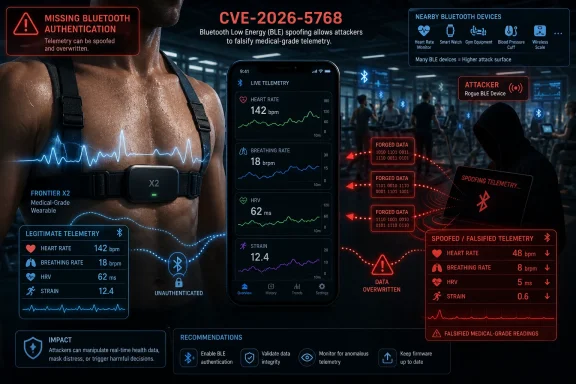 A Fitness Strap Becomes a Trust Boundary
The Frontier X2 occupies a category that did not really exist at consumer scale a decade ago: a wearable that looks like a fitness accessory but talks like a medical instrument. Fourth Frontier markets the device around continuous ECG, heart rate, breathing rate, strain, HRV, activity metrics, and shareable reports. Even when a product is framed as health-and-fitness rather than diagnostic equipment, users do not experience those distinctions as cleanly as lawyers and regulators do.That matters because telemetry from a chest-worn ECG device carries a different emotional and practical weight than a step counter. A bogus cadence reading is annoying. A bogus heart rhythm, breathing rate, or strain value can change behavior, trigger anxiety, distort training decisions, or contaminate conversations with clinicians and coaches.
The CISA advisory describes two related failures. The Frontier X2 allows unauthenticated Bluetooth Low Energy read and write access to critical GATT characteristics. Separately, the Frontier X mobile app lacks proper device authentication, allowing an attacker to impersonate a legitimate Frontier X2 by cloning expected Bluetooth advertisements and exposing the expected characteristics.
Those are not exotic cloud-chain attacks. They are local, proximity-based attacks. But proximity is not the same thing as safety when the device is designed for gyms, races, clinics, locker rooms, training facilities, and shared homes.
Bluetooth’s Convenience Tax Comes Due
Bluetooth Low Energy has been a gift to wearable makers because it made always-on sensor products practical. It lowered the power budget, simplified phone pairing, and allowed tiny devices to ship with constant app connectivity. But BLE also introduced a security culture in which “nearby” too often became a substitute for “trusted.”The issue here is authentication, not radio magic. BLE devices expose services and characteristics through the Generic Attribute Profile, or GATT. If a device exposes sensitive characteristics without requiring pairing, authorization, or an application-layer proof that the phone is actually the intended phone, an attacker within range may not need to break encryption at all.
That is why missing authentication for a critical function is such a plain-spoken weakness category. It means the system has a command surface, that command surface matters, and the device is not adequately checking who is touching it. In the Frontier X2 case, CISA says the result can include unauthorized control of functions such as starting and stopping activities, triggering vibrations, causing denial-of-service conditions, and fuzzing values to induce unexpected behavior.
The app-side problem is just as important. If the mobile application accepts a counterfeit peripheral that looks enough like the real one, the attacker does not need to compromise the real device to poison the user’s view. The fake device can feed the app fabricated telemetry, and the app can present those values as if they came from the user’s own monitor.
The App Is Part of the Medical Surface Now
Security discussions about wearables often focus on the thing strapped to the body. That is understandable, but incomplete. The phone app is the display, the dashboard, the history, the export mechanism, the coaching layer, and sometimes the bridge to a clinician, family member, or cloud service.CISA’s advisory is especially notable because it treats the mobile app and device as a combined system. That is the right model. A sensor that produces accurate readings is still vulnerable if the app cannot authenticate the source of those readings. A mobile app with polished charts is still vulnerable if it cannot distinguish a real device from an impersonator.
This is where the consumer-wearable industry has a recurring blind spot. Product teams often think of Bluetooth pairing as the user experience hurdle: make it fast, make it forgiving, avoid support calls. Security teams think of pairing as part of identity. If the former view wins too often, the product becomes easy to connect and easy to spoof.
For WindowsForum readers, the analogy is familiar from enterprise identity. A beautifully hardened endpoint is not enough if the relying party accepts tokens from the wrong issuer. A strong password is not enough if the service fails to verify the domain. A health app is not enough if it accepts a radio neighbor as the patient.
“Not Remotely Exploitable” Is Not the Reassurance It Sounds Like
CISA says this vulnerability is not exploitable remotely, and that no known public exploitation specifically targeting it has been reported to the agency at this time. Both facts matter. They should keep the advisory out of panic territory.But “not remotely exploitable” can mislead ordinary users because it sounds like a narrow lab issue. BLE attacks are adjacent attacks, not internet attacks. The attacker must be within Bluetooth range. That constraint substantially changes the threat model, but it does not erase it.
Hospitals, gyms, sports facilities, university labs, rehabilitation centers, and endurance events are all places where many people and many Bluetooth devices coexist. An attacker does not need global reach to cause harm if the target population is physically concentrated. The same is true in domestic abuse scenarios, where proximity is unfortunately built into the threat model.
The lack of known exploitation is also not the same as proof of safety. Many BLE abuses are quiet. A manipulated reading may look like an app glitch, a device malfunction, or an odd workout artifact. Unless a victim or researcher is capturing wireless traffic and comparing raw signals to app behavior, the attack may never be recognized as an attack.
The Clinical Disclaimer Does Not Neutralize the Clinical Consequence
Fourth Frontier’s Frontier X2 is positioned as a health and fitness product, and consumer wearables commonly include language saying they are not intended for diagnosis or treatment. That distinction is real. It affects regulatory obligations, claims, and user expectations.But the CISA summary uses the phrase “clinical readings,” and that choice points to the messier reality. The device collects signals that users may interpret clinically even if the product is not marketed as a full diagnostic system. ECG traces, heart rate, breathing rate, strain, and shareable reports are precisely the kinds of data that can influence decisions outside the app.
This gap between formal intended use and practical use is one of the defining problems in modern digital health. A wearable company can tell users not to make medical decisions based solely on the device. Yet the entire value proposition of the product is that it gives meaningful insight into the body.
Security engineering has to assume that users believe the interface. If a dashboard says the user’s heart rate, breathing rate, or strain changed, many people will act on that information. Some will slow down. Some will stop exercising. Some will call a doctor. Some will ignore a real symptom because the app appears normal.
A High CVSS Score for a Short-Range Attack Is a Signal
A CVSS 3.1 score of 8.8 can look surprising for a vulnerability that requires adjacent access. The explanation is in the rest of the vector: low attack complexity, no privileges required, no user interaction required, and high impact across confidentiality, integrity, and availability. In plainer English, if an attacker is nearby, the advisory says the barrier is low and the consequences can be broad.That is the difference between a theoretical radio bug and a meaningful product failure. The attacker does not need a stolen password. The attacker does not need the user to tap a phishing link. The attacker does not need to compromise Fourth Frontier’s cloud infrastructure. The attacker needs proximity and the ability to speak enough of the expected BLE language.
The integrity impact is the headline. In security, confidentiality failures tend to get the emotional reaction because they involve stolen data. But in healthcare and safety-adjacent systems, integrity failures can be worse. A private reading exposed to an attacker is bad; a false reading trusted by the user is potentially worse.
Availability also matters. CISA mentions denial-of-service conditions and unauthorized control of device functions. If a user relies on a device for real-time alerts during exertion, losing the device at the wrong moment is not merely inconvenient. It changes the risk calculation for a runner, cyclist, patient, or coach.
The Mitigation Is Practical, But It Is Not a Fix
Fourth Frontier is aware of the vulnerability and is working on a fix, according to the advisory. Users are encouraged to contact the company directly for assistance. CISA also notes that Frontier X and X2 devices can connect to only one app at a time, and recommends that users first connect the device using the Frontier X app and then start the activity.That mitigation is useful because it attempts to occupy the device’s single connection slot before an attacker can. It is a practical defensive habit, especially in public or shared spaces. But it is not the same as authentication.
A single-connection limit is a contention mechanism. It can reduce exposure during active use, but it does not prove identity, protect against spoofed devices at the app layer, or solve every race condition. It also assumes users remember to connect promptly and remain connected.
The real fix has to happen in product design. The device should require appropriate pairing and authorization for sensitive GATT access. The app should authenticate the device it trusts, not merely recognize a familiar advertisement or characteristic layout. Health telemetry should be treated as integrity-sensitive data from the moment it leaves the sensor.
Enterprise IT Should Treat This as a BYOD Health-Tech Warning
This advisory is about a specific product, but the implications reach beyond Fourth Frontier. Health wearables increasingly live on corporate networks indirectly through employee phones, wellness programs, insurance incentives, occupational health workflows, sports science departments, and executive health monitoring. IT departments may not own the device, but they often inherit the risk.The traditional enterprise response would be to say this is outside scope. It is a personal wearable using Bluetooth, not a Windows laptop, server, or managed endpoint. That response is getting less defensible as personal telemetry crosses into workplace systems and clinical-adjacent workflows.
For sysadmins, the lesson is not to ban every chest strap. It is to ask better procurement questions. Does the vendor authenticate the peripheral? Are sensitive GATT characteristics protected? Is firmware update integrity documented? Does the mobile app verify device identity? Is there a vulnerability disclosure program? Are advisories published quickly and plainly?
Consumer health technology often enters organizations through the side door because it is inexpensive, easy to buy, and popular with users. Once it influences decisions, it becomes part of the operational environment whether or not the CMDB knows its name.
The Windows Angle Is the Phone in the Middle
At first glance, this is not a Windows story. The affected mobile applications are Android and iOS, and the device communicates over BLE. But WindowsForum readers know that platform boundaries do not map cleanly to risk boundaries.The same users who sync wearables to phones may export PDFs to Windows PCs, upload reports through browsers, store files in OneDrive, discuss readings in Teams, or share them with providers through portals. The Windows endpoint may never connect to the Frontier X2 directly and still become part of the downstream trust chain.
This is especially relevant for administrators supporting clinicians, trainers, researchers, and executives. Once fabricated telemetry becomes a PDF, screenshot, CSV, or chart, it can outlive the wireless attack that created it. The file may look authoritative because it came from the official app.
That is the durable harm of integrity attacks. They do not merely affect a live session. They can create records, decisions, and narratives that persist after the attacker has left Bluetooth range.
The Wearables Market Needs Security Claims as Concrete as Sensor Claims
Fourth Frontier is hardly alone in facing the challenge. The broader wearable industry has become very good at describing sensors, algorithms, battery life, dashboards, and coaching features. It is far less consistent at describing trust.That imbalance is visible across consumer IoT. Marketing pages explain how precisely a device measures the body, the home, the car, or the child. They rarely explain how the product knows which phone may command it, how the phone knows which device it is reading, or how firmware updates are protected against tampering.
Security cannot remain an invisible feature in products that present themselves as reliable interpreters of the human body. If a device claims to offer meaningful real-time insight, the product should also make clear how it protects that insight from nearby manipulation. The industry does not need more vague promises about secure transmission. It needs specific, testable claims about authentication, authorization, encryption, update signing, and disclosure response.
The best vendors will eventually compete on this. They will advertise not just better sensors but better trust architecture. The laggards will treat security as an engineering chore until an advisory forces the conversation into public view.
CISA’s Advisory Shows the Value of Boring Disclosure
There is a useful amount of restraint in the CISA advisory. It does not hype the bug as a mass exploitation event. It does not imply that attackers can compromise devices from across the internet. It gives affected versions, vulnerability behavior, severity, mitigation status, and operational guidance.That boring clarity is valuable. It lets users understand that the risk is real but bounded. It lets administrators decide where the product is used, who relies on it, and whether additional controls are needed before a vendor fix arrives.
It also gives security researchers credit. Shakir Zari and Jerin Sunny are acknowledged for reporting the vulnerability to CISA. That matters because coordinated disclosure is still the mechanism that turns a private flaw into a public fix path without immediately maximizing user harm.
The advisory’s most important contribution may be forcing a category conversation. BLE health devices are not toys simply because they are sold to consumers. If they influence health behavior, they deserve security review closer to medical technology than novelty electronics.
The Frontier X2 Advisory Leaves Users With a Narrow But Real Playbook
Until Fourth Frontier ships and users install a fix, the safest posture is to reduce opportunities for nearby interference and treat unexpected readings with skepticism. That does not mean abandoning the product overnight. It means recognizing that a connected wearable has a threat model, especially in public Bluetooth-dense environments.- Users should update the Frontier X mobile app as soon as fixed Android and iOS versions are available through the official app stores.
- Users should connect the Frontier X2 to the official app before starting an activity, because the advisory says the device supports only one app connection at a time.
- Users should be more cautious about trusting unusual readings, alerts, or activity-state changes observed in public places until a vendor fix is installed.
- Organizations using Frontier X2 devices in wellness, training, research, or care-adjacent workflows should document where the devices are used and whether readings influence decisions.
- Administrators and security teams should ask vendors of BLE health devices for explicit details about device authentication, protected GATT characteristics, and firmware update security.
- Anyone observing suspected malicious behavior should preserve logs, screenshots, app versions, device details, and timing information before reporting through established channels.
The Frontier X2 vulnerability is a small-range bug with large-range implications: as wearables move from counting steps to shaping health decisions, the security bar has to move with them. The next generation of health devices will be judged not only by how accurately they sense the body, but by how reliably they prove that the body, the device, and the app all belong to the same trusted conversation.
References
- Primary source: CISA
Published: 2026-05-28T12:00:00+00:00
- Related coverage: frontiermodelforum.org
FMF Technical Report: Managing Advanced Cyber Risks in Frontier AI Frameworks
PDF documentwww.frontiermodelforum.org
- Related coverage: fourthfrontier.com
Continuous ECG | Wearable Heart Rate Monitor | Frontier X2 Smart Heart Monitor
Experience Real-Time Heart Monitoring with Frontier X2, 24 Hours of Continuous ECG. Stay informed about your heart health with this Wearable Heart Rate Monitor. fourthfrontier.com
- Related coverage: devshop.fourthfrontier.com
icon-X
 devshop.fourthfrontier.com
- Related coverage: uk.fourthfrontier.com
Frontier X2 | Smart ECG Heart Monitor & Chest Strap
The Frontier X2 smart heart monitor with continuous ECG and ECG-grade accuracy in a comfortable chest strap — real-time heart data, no wires. uk.fourthfrontier.com
- Related coverage: fourthfrontier.tawk.help
Support - Fourth Frontier | What makes the Frontier X/X2 so much more advanced than a regular Heart Rate Monitor?
Fourth Frontier's Frontier X support and help websitefourthfrontier.tawk.help

- Related coverage: rcdxb.com
Fourth Frontier X2 Heart Rate Monitor – RCDXB
Cardiologists rely on 24-hour ECG readings for a reason. Unlike SmartWatches, SmartRings, and other heart rate monitors, the Frontier X2 provides continuous ECG monitoring along with real-time heart health feedback, even during exercise. Offering superior signal quality and comprehensive heart... rcdxb.com
- Related coverage: globenewswire.com
New Wearable Continuous Heart Rate Monitor With Real Time
London, Oct. 07, 2022 (GLOBE NEWSWIRE) -- London, England - Trailblazing global health tech company Fourth Frontier is urging fitness enthusiasts and...www.globenewswire.com
